


Did you have a challenging childhood and lack emotional support from your parents? This childhood emotional neglect test can help you discover how those experiences may influence your adult life and whether you still face the lasting effects of emotional neglect and unresolved childhood trauma.
What does being emotionally neglected mean?
Childhood emotional neglect is a situation in which parents or caregivers don’t meet, notice, or validate a child’s emotional needs and cannot provide adequate support. Unlike physical abuse, childhood neglect is difficult to notice from the outside, as it doesn’t leave physical marks and often involves what didn’t happen rather than what did.
Those who experienced childhood emotional neglect can feel alone and empty even when they’re surrounded by caring people. They might become hyper-independent and find it difficult to ask for help, trust others, or express their emotions. Some people also struggle with low self-worth, emotional numbness, or a persistent feeling that their needs do not matter.
Even more, childhood trauma, as a result of a lack of emotional validation, is associated with a dysregulated innate immune system that may contribute to psychiatric and somatic disorders. [1] de Koning RM, Kuzminskaite E, Vinkers CH, Giltay EJ, Penninx BWJH. “Childhood trauma and LPS-stimulated inflammation in adulthood: Results from the Netherlands Study of Depression and Anxiety.” Brain Behav Immun. 2022 Kids who had emotionally unavailable parents are at higher risk of developing depression and anxiety disorders. [2] Kuzminskaite E, Vinkers CH, Milaneschi Y, Giltay EJ, Penninx BWJH. “Childhood trauma and its impact on depressive and anxiety symptomatology in adulthood: A 6-year longitudinal study.” J Affect Disord. 2022

Emotional neglect & attachment style
Childhood neglect can also have a strong impact on the attachment patterns people develop in adulthood and, as a result, influence how they form relationships with others. [3] Shahab MK, Elzinga BM, Spinhoven P, Rosendaal FR, Penninx BWJH, Mook-Kanamori DO. “Footprints from childhood: intra- versus extra-familial childhood maltreatment and attachment to romantic partners in adulthood.” BMC Psychol. 2025 Studies prove that people who have experienced childhood neglect tend to develop insecure attachment styles. [4] Raby KL, Labella MH, Martin J, Carlson EA, Roisman GI. “Childhood abuse and neglect and insecure attachment states of mind in adulthood: Prospective, longitudinal evidence from a high-risk sample.” Dev Psychopathol. 2017
Anxious-preoccupied attachment
People with this attachment style may cling to their partners, worrying about being rejected or abandoned. Childhood emotional neglect may make them feel unsure of their worth in relationships and highly sensitive to even the slightest signs of distance.
Fearful-avoidant attachment
Adults with a fearful-avoidant attachment style usually want close relationships but are also afraid of getting hurt. They may pull others close and then distance themselves when things become too emotional.
Disorganized attachment
This attachment style can make relationships feel confusing and unpredictable. A person may want connection and support, but also feel uncomfortable trusting others or relying on them. It usually develops when a caregiver is both a source of comfort and fear, leaving the child feeling emotionally unsafe and inconsistent.

Secure attachment
In turn, kids who grow up in emotionally stable families and don’t experience significant childhood adversities feel safe trusting others and relying on them. As adults, they are usually comfortable with closeness and independence and can build balanced, healthy relationships.
Why take a childhood emotional neglect test?
You may need to take a childhood emotional neglect quiz to explore why you experience emotional well-being and how it’s connected to your childhood. Particularly, you may face:
- Emptiness
- Emotional numbness
- Severe self-criticism
- Disconnection
- Hyper-independence
- People-pleasing tendencies
Once you explore whether trauma is present, it can become easier to understand your emotional patterns and start developing emotional regulation skills to build healthy connections with others.
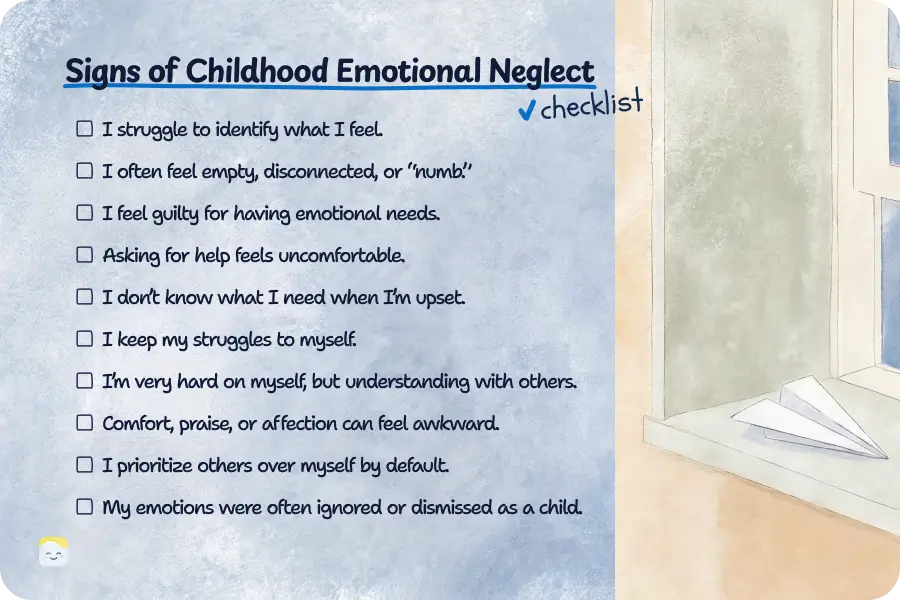
How does the childhood trauma questionnaire work?
This childhood emotional neglect consists of questions that describe typical situations, patterns, and feelings that emotionally neglected kids might experience. If you answer “Yes” or “Sometimes” to most questions, it may signal that your emotional needs weren’t met as a child, which may have shaped how you see the world now.
Tips based on childhood emotional neglect test results
If family members didn’t validate your emotions in childhood, it can now lead to the development of coping mechanisms, which might influence the way you communicate with others and your overall well-being. Yet, healing is possible. Here are some steps that might be helpful.
Tips for people who show some signs of child neglect that influence adult life
- Practice sharing small personal feelings. Kids whose parents were emotionally unavailable one day and supportive the next may learn to keep their feelings to themselves because they never know what reaction they might get for their emotions. To overcome this pattern, instead of discussing only facts or daily tasks, try expressing simple emotions such as “I felt disappointed” or “I was nervous about that.” This can make emotional communication feel more natural over time.
- Make space for enjoyable activities. People with a history of emotional neglect may focus only on responsibilities and duties. Try adding small positive emotional experiences to your life, like going for an evening walk, reading a book in the park, or watching a comedy, even if they don’t feel “useful.” This way, you learn to approach yourself with self-compassion and genuine care.
Rychel Johnson, M.S., LCPC, adds, “If you experienced signs of childhood emotional neglect, practice noticing and validating your emotions instead of immediately dismissing or judging them. Many people who grew up without consistent emotional support learned to ignore their own needs or assume their feelings didn’t matter. A helpful first step is simply to pause throughout the day and ask yourself, “What am I feeling right now, and what might I need?” Building this habit can strengthen self-awareness, self-compassion, and a greater sense of emotional safety over time.”
Tips for someone with a high probability of adverse childhood experiences
If you experienced childhood abuse or were the one whose parents didn’t provide emotional support consistently, now it’s time for you to care about yourself. This is what you can do:
- Notice your automatic responses. Pay attention to situations where you immediately apologize, take responsibility for others’ feelings, or start thinking that everything is your fault. These reactions can point to old coping patterns that are no longer helpful.
- Pause before saying “yes.” If you tend to put other people’s needs first, give yourself time before agreeing to requests. Even a simple “Let me think about it” can help you make decisions that reflect your needs and respect your boundaries
- Practice self-compassion. Notice when you use words like “lazy,” “weak,” or “too sensitive” to describe yourself. Would you speak to someone you care about this way? Probably not. So, try to avoid them when talking about yourself.
- Consider talking to a mental health professional. Therapy may help you learn to set boundaries, take care of your emotional well-being, and gain insight into unhelpful patterns you may not even notice.
Treatment and support for childhood emotional abuse and neglect
Healing from childhood emotional abuse and mental health concerns may require professional intervention. Here are the most common approaches that might be particularly helpful.
- Trauma-Focused Cognitive Behavioral Therapy (TF-CBT). This is the specific type of CBT that concentrates on dealing with painful emotional experiences from childhood that lead to trauma. It can help people who have experienced sexual abuse, emotional neglect, parental drug abuse, or any other kind of substance abuse.
- Attachment-Based Therapy is a form of counseling in which a mental health professional helps you explore how past experiences influence the way you build relationships now. If you often notice patterns like fear of closeness, difficulty trusting others, or repeated relationship struggles, this approach will let you slowly build more secure ways of connecting with people.
- Internal Family Systems (IFS) therapy can be especially helpful for people healing from emotional neglect because it works with the inner “protective” parts that formed when emotional support was missing. It helps you notice these patterns, explore their deeper sense, understand why they developed, and gradually build more secure ways of connecting with others.
- Eye Movement Desensitization and Reprocessing (EMDR) lets people who have experienced emotional neglect work through painful memories that may still feel “stuck.” With a mental health professional, you focus on past experiences while using guided techniques that help the brain reprocess them, making them feel less heavy.
“From your experience or private practice, what approach can be the most effective for those who faced emotional neglect in childhood?” Rychel Johnson, M.S., LCPC, answers, “In my work with therapy clients, I’ve found that the most effective approach combines self-compassion with a safe, supportive therapeutic relationship. Healing from childhood emotional neglect often involves recognizing unmet emotional needs and learning to identify and express feelings. A goal is to gradually develop healthier ways of relating to yourself and others. While the process takes time, many people find that consistent support and small, intentional changes can lead to meaningful and lasting growth.”
Frequently asked questions
How much does a childhood emotional neglect test cost?
Breeze’s child neglect test is completely free. You don’t need to pay for anything to explore themes related to childhood emotional neglect and how it may still affect your emotions, relationships, or entire life today.
Is the childhood emotional neglect quiz scientifically accurate?
This test is based on the most common signs of emotional neglect and is proofread by a licensed mental health professional. However, it isn’t a diagnostic tool and can’t be a substitute for professional evaluation. It’s more of a tool to help you improve self-awareness and serve as a starting point before you seek professional support.
Are the results of the "Was I emotionally neglected as a child?" quiz private?
Yes, the results of Breeze’s emotional neglect questionnaire are completely private. We don’t share your answers or results with other users, and your responses remain confidential. This allows you to explore sensitive experiences honestly and reflect on your childhood, emotions, and relationships in a safe and personal space.
Sources
- de Koning RM, Kuzminskaite E, Vinkers CH, Giltay EJ, Penninx BWJH. “Childhood trauma and LPS-stimulated inflammation in adulthood: Results from the Netherlands Study of Depression and Anxiety.” Brain Behav Immun. 2022
- Kuzminskaite E, Vinkers CH, Milaneschi Y, Giltay EJ, Penninx BWJH. “Childhood trauma and its impact on depressive and anxiety symptomatology in adulthood: A 6-year longitudinal study.” J Affect Disord. 2022
- Shahab MK, Elzinga BM, Spinhoven P, Rosendaal FR, Penninx BWJH, Mook-Kanamori DO. “Footprints from childhood: intra- versus extra-familial childhood maltreatment and attachment to romantic partners in adulthood.” BMC Psychol. 2025
- Raby KL, Labella MH, Martin J, Carlson EA, Roisman GI. “Childhood abuse and neglect and insecure attachment states of mind in adulthood: Prospective, longitudinal evidence from a high-risk sample.” Dev Psychopathol. 2017
Disclaimer
This article is for general informative and self-discovery purposes only. It should not replace expert guidance from professionals.
Any action you take in response to the information in this article, whether directly or indirectly, is solely your responsibility and is done at your own risk. Breeze content team and its mental health experts disclaim any liability, loss, or risk, personal, professional, or otherwise, which may result from the use and/or application of any content.
Always consult your doctor or other certified health practitioner with any medical questions or concerns
Breeze articles exclusively cite trusted sources, such as academic research institutions and medical associations, including research and studies from PubMed, ResearchGate, or similar databases. Examine our subject-matter editors and editorial process to see how we verify facts and maintain the accuracy, reliability, and trustworthiness of our material.
Was this article helpful?