


Podcast name
Fearful avoidant attachment
Fearful avoidant attachment (also called “disorganized attachment”) is an insecure attachment style characterized by craving closeness while fearing and avoiding it at the same time. This creates a push-pull dynamic: a person seeks connection, then withdraws once it feels too real, overwhelming, or unsafe.
The roots of the fearful avoidant style may stem from inconsistent caregiving, childhood trauma, or environments where the same person was both a source of comfort and fear. As a result, closeness becomes confusing: it may be desired, but it is also associated with pain, unpredictability, or rejection.

Attachment theory foundations
According to the attachment theory developed by John Bowlby, people may develop internal working models of relationships based on their early interactions with caregivers. Fearful avoidant attachment patterns typically stem from a disorganized attachment style in children. [1] Beeney JE, Wright AGC, Stepp SD, Hallquist MN, Lazarus SA, Beeney JRS, Scott LN, Pilkonis PA. “Disorganized attachment and personality functioning in adults: A latent class analysis.” Personal Disord. 2017
In childhood, the pattern shows up as contradictory behaviors toward a caregiver, while in adulthood, it evolves into fearful-avoidant attachment, where the same inner conflict is expressed through intimate relationships.
Fearful avoidant attachment causes
According to attachment theory, attachment styles tend to form in childhood, but they can also change over a lifetime. So, let’s explore the main causes a person may develop a fearful avoidant attachment.
Early childhood experiences, including childhood trauma
Studies prove that adverse childhood experiences, particularly emotional abuse, often become the early predictors of the fearful avoidant attachment. [2] Williams B, Ospina JP, Jalilianhasanpour R, Fricchione GL, Perez DL. “Fearful Attachment Linked to Childhood Abuse, Alexithymia, and Depression in Motor Functional Neurological Disorders.” J Neuropsychiatry Clin Neurosci. 2019 These can include:
- Inconsistent and unpredictable caregiving, when a parent was warm one moment and distant the next
- Emotional neglect, when emotional needs weren’t noticed or supported
- Constant criticism
- Growing up around fear or tension
- Unpredictable reactions from caregivers when you were upset or overwhelmed
- Unexpected rejection or punishment for showing specific needs
The key here is parental inconsistency. Sometimes they were caring and supportive, while the next day they might become distant, critical, or emotionally unavailable. This unpredictability makes it difficult for a child to form a stable sense of safety in relationships, leading to mixed expectations about closeness and trust later in life.

Later painful experiences
Sometimes people may develop a fearful avoidant attachment style in adulthood, particularly due to interactions with romantic partners. This can happen after relationships that feel emotionally intense but unstable, where closeness is followed by betrayal, rejection, or sudden withdrawal.
Pretty much like in childhood, the person may start developing difficulty trusting others. You might begin expecting that closeness will eventually lead to hurt while still having a desire to open up to someone.
Fearful avoidant attachment style characteristics
Like any other insecure attachment style, fearful avoidant attachment develops as a way to adapt to relationships that once felt unsafe or unpredictable. This is what distinguishes it from others.
- Internal conflict between wanting closeness and fearing it. “I want to open up, but I’m too scared that you will hurt or reject me.” This feeling follows all adult relationships of people with fearful-avoidant attachment.
- Tendency to experience relationships as unpredictable. In childhood, such people never knew what to expect during interactions with caregivers. As such, now they’re always on edge, and even a delayed reply can feel like something is wrong or about to change.
- Strong emotional sensitivity in relationships. Constant anxiety and overthinking might make emotions feel more intense and harder to regulate. Even small situations can trigger strong reactions (both positive and negative), which may feel confusing both for the person and for their partner.
- Confused or unstable sense of safety in intimacy. Such people may feel a strong desire for emotional or physical closeness, but once intimacy actually happens, they can suddenly feel exposed, uncomfortable, or want to cry.
- Negative self-view. Those with a fearful avoidant attachment style may carry a quiet belief that they are “too much,” “not enough,” or somehow hard to love. This can lead to self-doubt in relationships and questioning why someone would choose you, downplaying your needs, or expecting rejection even when things are going well.
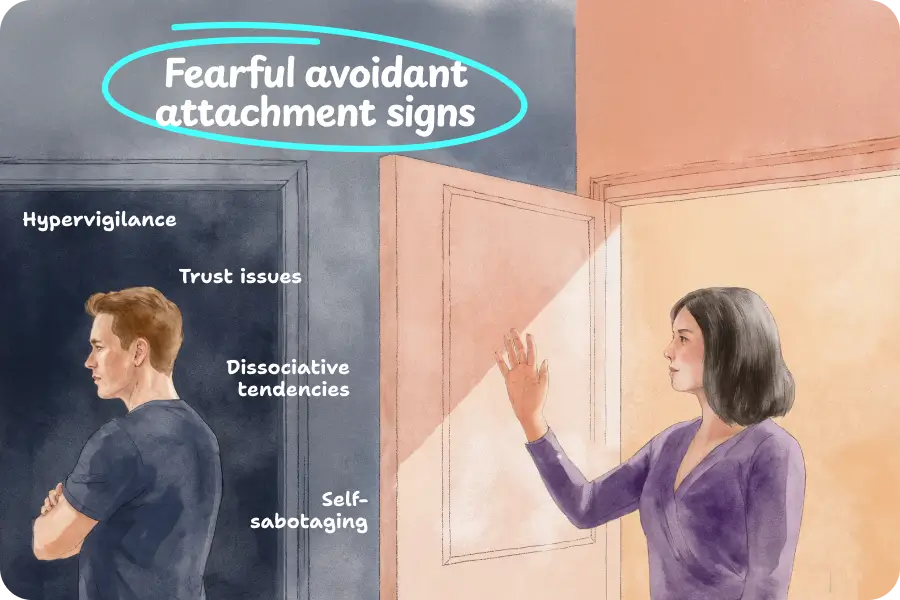
4 key fearful avoidant attachment signs with examples
Now, let’s explore specific behaviors and patterns that often show up in daily life and close relationships. While characteristics describe inner experiences and emotional patterns, these signs are the outward ways those patterns tend to manifest.
1. Hypervigilance
There is often a sense of being restless and anxious throughout daily life. A slight change in tone, the lack of emojis in text messages, or even a pause before answering can feel threatening to people with a fearful avoidant attachment style, even if nothing is said directly.
For example, like Rue Bennett in Euphoria, you might pick up on the smallest emotional shift and spiral internally — replaying conversations, questioning what you did wrong, or assuming the connection is slipping, even when the situation is still unclear.
2. Trust issues
For people with fearful avoidant attachment, it can be difficult to trust even themselves and believe that they are enough to “deserve” genuine love. In romantic relationships, this may show up as doubting your partner’s intentions and expecting disappointment even when things are going well.
Ann, Breeze’s user (the name has been changed), shared her story, “Even when things were actually fine, I still couldn’t relax. My boyfriend was always kind, but I thought it wouldn’t last for long. I was always waiting for something bad to happen, even when there was no real reason for it.”
3. Dissociative tendencies
Studies show a significant link between fearful-avoidant attachment and depersonalization, primarily through psychological dissociation. [3] Daphne Simeon, Margaret Knutelska. “The role of fearful attachment in depersonalization disorder.” European Journal of Trauma & Dissociation. 2022 Simply put, during conflict or stressful situations, people with this attachment style tend to mentally withdraw from negative emotions because they consider it unsafe due to the environment they grew up in.
In daily life, it can manifest as:
- Feeling emotionally “numb” during arguments or stress
- Mentally zoning out in serious conversations
- Feeling detached from your emotions, like you’re observing yourself from the outside
- Needing distance or isolation after emotional situations to feel normal again
This can also include specific dissociative experiences such as:
- Depersonalization — feeling disconnected from yourself, as if you’re watching your thoughts, body, or actions from a distance.
- Derealization — feeling like the world around you isn’t real, is “foggy,” distant, or dreamlike.
- Dissociative amnesia (mild stress-related) — difficulty recalling parts of emotionally intense conversations or events.
4. Self-sabotaging
You might engage in self-sabotage and unconsciously erode emotional connections due to low self-esteem and fear of closeness. For instance, you may start pulling away when things begin to feel stable, pick fights over small issues, or lose interest right when the relationship becomes more serious.
At times, you might also test your partner — creating distance or acting cold — to see if they will stay, even though this can push them away.
Fearful avoidant attachment style vs. other adult attachment styles
There are four attachment styles people typically develop. The secure attachment patterns are considered the most balanced, while the insecure ones reflect different ways people adapt to unmet emotional needs.
| Fearful-avoidant | Dismissive-avoidant | Anxious-preoccupied | Secure | |
| Core belief | “I want closeness, but it does not feel safe.” | “I don’t need others.” | “I may be abandoned.” | “I am worthy; others are reliable.” |
| View of closeness | Both desires and fears closeness | Seeks distance, avoids closeness | Seeks closeness, fears distance | Comfortable with intimacy |
| Behavior in relationships | Push–pull: moves closer, then withdraws | Distant, self-reliant, guarded | Seeks reassurance, may be clingy | Consistent, open, trusting |
| Reaction to conflict | Swings between pursuit and withdrawal | Withdraws, shuts down | Heightened emotions, seeks validation and reassurance | Communicates calmly |
| Emotional pattern | Intense, conflicting (anxious + avoidant) | Suppressed, detached | Intense, anxious | Stable, balanced |
The influence of fearful avoidant attachment in relationships
Dating a person with a fearful avoidant attachment style may sometimes feel like dating a narcissist. One day, they love you to the moon and back, and the next day, they don’t want to answer text messages. However, while for a narcissistic partner this pattern is often driven by a need for control, validation, or lack of empathy, in fearful avoidant attachment, it usually comes from inner conflict and fear of getting hurt.
The idealization and devaluation cycle
For a fearful avoidant person, dating can lead to cycles of avoidance and anxiety. This is how it can feel:
- Strong start and fast emotional closeness. They open up quickly, feel deeply connected, and may idealize the partner.
- Growing anxiety as things get real. The closer the relationship gets, the more tension and doubt appear.
- Pulling away or creating distance. A person with a fearful avoidant attachment style becomes less responsive, colder, or needs more space without a clear explanation.
- Doubting the relationship. They may suddenly focus on flaws or question their feelings, seem numb, overwhelmed, or unsure what they want. Shame can also be very present here, as the person may be somewhat aware that what they are doing may be harmful to them or others.
- Reaching out again. Once distance is created, a fearful avoidant partner may miss the connection and come back.
- Cycle repeats. Closeness feels good again… until it starts to feel unsafe.
3 fearful avoidant attachment triggers
There are several triggers that can intensify fearful avoidant attachment behaviors and make them more noticeable or harder to manage in relationships.
1. Growing emotional closeness
While it’s a normal stage of any relationship, the attachment process can start to feel overwhelming. As emotional intimacy deepens, it may trigger fear, leading to an urge to pull back, create distance, or question the relationship.
2. Conflict or emotional intensity
During calm moments, closeness may feel manageable, but as soon as conflict or strong emotions appear, it can feel unsafe. Even a small argument or emotional conversation may trigger a sudden need to escape the situation to protect yourself emotionally.
3. Inconsistency in behavior
If two people with fearful avoidant attachment styles start dating or if a fearful-avoidant person meets a narcissist, it can bring additional challenges. When someone is warm and close one moment and distant the next, it creates confusion and anxiety. This might make partners pull away and trigger a cycle of mutual withdrawal or extreme conflict.
In a relationship with a narcissist, vulnerability is often exploited, leading to a “trauma bond” where the fearful-attachment person becomes hyper-focused on regaining the narcissist’s approval to soothe their affect regulation issues.
How to heal fearful avoidant attachment: 6 tips
Healing fearful avoidant attachment requires consistent effort to rewire cognitive responses to intimacy and “prove” to your mind and nervous system that closeness isn’t dangerous.
1. Identify personal triggers
Start by noticing what exactly activates your withdrawal or anxiety. It can be silence, conflict, too much closeness, or even feeling ignored. Keep a simple note on your phone after strong emotional reactions:
- What happened?
- What did I feel?
- What was my first impulse (withdraw, shut down, overthink)?
Over time, you’ll see clear patterns, and awareness alone may already reduce reactivity. You can use the Breeze app to track your emotions and more clearly understand what’s going on.
2. Name your emotions when feeling overwhelmed
Research shows that naming an emotion reduces its intensity. [4] Levy-Gigi E, Shamay-Tsoory S. “Affect labeling: The role of timing and intensity.” PLoS One. 2022 Instead of reacting to an impulse to withdraw, state the feeling internally: “I am feeling overwhelmed because of this conversation.” This activates the prefrontal cortex and lessens the fear response in the amygdala.
3. Implement the 24-hour rule
Avoid making relationship decisions, such as breaking up or ghosting, while experiencing intense emotions. Wait at least 24 hours for your nervous system to regulate. This ensures your actions are based on logic rather than a survival-based fear response.
4. Build trust step-by-step
Trust and emotional closeness don’t happen all at once. It’s built on small, repeatable experiences of safety. Here are several practices you can do to stop fearing rejection:
- Share small personal thoughts (one at a time)
- Notice how the other person responds over time
- Allow yourself to stay in contact even after emotional discomfort appears
- Practice staying present during mild vulnerability instead of withdrawing
- Ask for small needs directly (e.g., clarity, reassurance)
- Reflect after interactions: “Was I actually rejected, or did I just feel afraid?”
5. Challenge cognitive distortions
Notice thoughts like “they will leave me” or “I can’t trust anyone,” and gently question them. Ask yourself what actual evidence you have and whether you are reacting to the present situation or to past experiences that your mind is replaying. How to work with it in practice:
- Write down the thought exactly as it appears in your mind
- Label it: “Is this a fact or a fear?”
- Look for evidence for and against it
- Replace it with a more balanced version (e.g., “I feel anxious, but I don’t actually have proof they are leaving”)
- Revisit past situations where your fear did not come true
This practice helps separate emotional reactions from reality. It doesn’t eliminate fear instantly, but it reduces its authority in decision-making and helps create more stable, grounded responses in relationships.
6. Establish clear boundaries
Directly stating your needs, such as “I need an hour of alone time to recharge,” creates a sense of control. When you know you can protect your space through communication and your partner will respect it, you are less likely to feel the need to use withdrawal as a defensive shield.
Nicole Arzt, LMFT, provides more tips to help people shift from a fearful avoidant attachment style to a secure one. “Aim to cultivate more self-compassion in daily life. The more you can “lift” yourself and be kind to yourself, especially during difficult times, the more you communicate that you are safe within your own self. This eventually transcends to your external world.”
Professional interventions: How to fix fearful avoidant attachment
Because fearful avoidant attachment causes are typically rooted in early disorganized attachment, specialized psychological frameworks may be required to shift to secure attachment style more easily. Here are the main approaches that may help you fix an insecure attachment style.
| Approach | Function |
| Eye Movement Desensitization and Reprocessing (EMDR) | Desensitizes specific traumatic memories that trigger current avoidant responses. |
| Internal Family Systems (IFS) | Identifies and integrates parts of the personality that drive withdrawal. |
| Somatic Experiencing | Addresses the physical “trauma loop” stored in the nervous system. |
| Cognitive behavioral therapy / dialectical behavioral therapy (CBT / DBT) | Provides tactical skills for distress tolerance and interpersonal effectiveness. |
Expert Insight
It is important that you both know one and another’s triggers. And with that, you both need strategies for how to return to regulation after bouts of dysregulation occur. One of you, for example, may need physical affection, whereas another may value having more alone time until feeling more stable. As always, open communication is key for attuning to one another’s specific needs.

Nicole Arzt
Mental health professional
Frequently asked questions
Is fearful avoidant attachment the same as the disorganized attachment style?
Yes, fearful avoidant attachment and disorganized attachment style refer to the same clinical phenomenon. “Disorganized” is the term used in developmental psychology and refers to children, while “fearful-avoidant” is used in adult attachment theory to describe the same traits in romantic relationships.
Both are defined by high anxiety and situations where an individual simultaneously craves and fears intimacy. They share identical origins in childhood trauma or inconsistent caregiving that results in nervous system dysregulation.
How common is the fearful avoidant attachment style?
Determining how common fearful avoidant attachment style is can be difficult because researchers use different ways to measure it, often relying on self-report questionnaires instead of clinical evaluations. This means results can vary depending on the method used. [5] Zakreski E, Jahnke S, Androvičová R, Bártová K, Chronos A, Krejčová L, Martinec Nováková L, Klapilová K. “Preoccupied and Fearful-Avoidant Attachment Styles May Mediate the Relationship Between Poor Parental Relationship Quality and Sexual Interests in Violence.” Arch Sex Behav. 2025
In general populations, estimates are lower and less consistent, but in clinical groups or populations with significant childhood trauma, these numbers can increase to over 20%. [6] Bakermans-Kranenburg MJ, van IJzendoorn MH. “The first 10,000 Adult Attachment Interviews: distributions of adult attachment representations in clinical and non-clinical groups.” Attach Hum Dev. 2009
Sources
- Beeney JE, Wright AGC, Stepp SD, Hallquist MN, Lazarus SA, Beeney JRS, Scott LN, Pilkonis PA. “Disorganized attachment and personality functioning in adults: A latent class analysis.” Personal Disord. 2017
- Williams B, Ospina JP, Jalilianhasanpour R, Fricchione GL, Perez DL. “Fearful Attachment Linked to Childhood Abuse, Alexithymia, and Depression in Motor Functional Neurological Disorders.” J Neuropsychiatry Clin Neurosci. 2019
- Daphne Simeon, Margaret Knutelska. “The role of fearful attachment in depersonalization disorder.” European Journal of Trauma & Dissociation. 2022
- Levy-Gigi E, Shamay-Tsoory S. “Affect labeling: The role of timing and intensity.” PLoS One. 2022
- Zakreski E, Jahnke S, Androvičová R, Bártová K, Chronos A, Krejčová L, Martinec Nováková L, Klapilová K. “Preoccupied and Fearful-Avoidant Attachment Styles May Mediate the Relationship Between Poor Parental Relationship Quality and Sexual Interests in Violence.” Arch Sex Behav. 2025
- Bakermans-Kranenburg MJ, van IJzendoorn MH. “The first 10,000 Adult Attachment Interviews: distributions of adult attachment representations in clinical and non-clinical groups.” Attach Hum Dev. 2009
Disclaimer
This article is for general informative and self-discovery purposes only. It should not replace expert guidance from professionals.
Any action you take in response to the information in this article, whether directly or indirectly, is solely your responsibility and is done at your own risk. Breeze content team and its mental health experts disclaim any liability, loss, or risk, personal, professional, or otherwise, which may result from the use and/or application of any content.
Always consult your doctor or other certified health practitioner with any medical questions or concerns
Breeze articles exclusively cite trusted sources, such as academic research institutions and medical associations, including research and studies from PubMed, ResearchGate, or similar databases. Examine our subject-matter editors and editorial process to see how we verify facts and maintain the accuracy, reliability, and trustworthiness of our material.
Was this article helpful?