



You want to be productive, build a career, and communicate effectively with others. All these goals may seem different on the surface, but the common thing is that your success depends on the way you think. Habits of mind shape how you approach challenges and respond to stress.
In this article, we’ll explore how to develop intellectual behavior and disciplined choice-making. Keep reading to learn more about the 16 habits of mind and see examples.

What are habits of mind?
Habits of mind are cognitive patterns described in the book Learning and Leading with Habits of Mind: 16 Essential Characteristics for Success by Dr. Arthur Costa and Bena Kallick, PhD. They help people use their intellectual resources effectively.
When someone doesn’t know the answer to a problem, they use their usual ways of thinking to figure it out. On the other hand, habits of mind help the person think outside the box and effectively deal with challenging situations.
Why do we need intellectual habits of mind?
The 16 habits of mind change the focus from what you know to how you act when you don’t know. It is a way to stay mentally organized in everyday life so that we don’t get overwhelmed by the problems we face. It teaches that real competence is about controlling your emotions and thinking clearly in any case.
As a result, a person can succeed in career, education, relationships, and daily life.
Katherine Scott, M.Ed/Ed.S, LMFT, explains why people may need to develop habits of mind to support their mental well-being. “Perspective is a part of the human condition. However, there are many cognitive distortions that can influence this and make perspectives ‘sticky’ or inflexible. One of these, for example, is swapping feelings for facts about a situation. Habits of mind can greatly benefit our mental and emotional well-being by allowing us to have powerful tools to not get lost or stuck in a perspective that does not serve us due to heightened emotional states dictating or causing increased rumination over things we have no control over.”
The 16 habits of mind list
Successful people can be effective problem solvers who consistently rely on structured thinking. So, further, we’ll explore the most common patterns.
Please note that these 16 habits aren’t the only ways to manage your behavior effectively. Think of these as a starting point rather than rigid rules.
1. Completing what you start
People who practice this habit may succeed in various areas step by step. They can approach tasks strategically, collect information, and analyze each step. If something goes wrong, such people remain comfortable with uncertainty and test different methods until they find the right solution.
For instance, you have decided to run a marathon. While some people might give up once they first feel tired or find it difficult to fit another training into their schedule, you may plan trainings on weekends, make time for rest, or reach out to a coach to develop an effective training program. As a result, you can find the most effective actions that help you prepare for the marathon and make your dream come true. Completing a task involves adherence to milestones set for oneself that are realistic for the person.
2. Managing impulsivity and thinking before acting
The study found that impulsivity is associated with lower satisfaction with the standard of living, health, and personal achievements. [1] Kabara, Auwal & Shahrill, Masitah & Mohd Roslan, Roslinawati & Adnan, Mazlini & Darussalam, Universiti & Brunei, & Artikel, Perkembangan. (2024). “THE INFLUENCE OF IMPULSIVITY AND ANTI-SOCIAL BEHAVIOUR ON ACADEMIC PERFORMANCE OF UNIVERSITY UNDERGRADUATE STUDENTS IN NIGERIA.” This shows that considering consequences beforehand, especially when faced with complex problems, can help a person deal with them better.
To manage impulsivity, use these methods:
- The three-second rule. Before speaking or acting, count to three. This forces the brain to shift from emotional reaction to rational processing.
- Alternative mapping. Quickly identify two different ways to respond to the situation. Choosing a better option prevents “tunnel vision.”
- Goal-checking. Ask, “Does this action help my long-term goal or just my current mood?” and make a decision based on the answer.
3. Listening with understanding and empathy
According to the research, emotionally intelligent leaders improve business results and have an impact on work team performance. [2] Coronado-Maldonado I, Benítez-Márquez MD. “Emotional intelligence, leadership, and work teams: A hybrid literature review.” Heliyon. 2023 So, being empathetic to others is one of the thinking habits that may be extremely helpful in life. It can include:
- Paying full attention when someone is speaking.
- Trying to see situations from another person’s perspective.
- Asking clarifying questions to better understand feelings.
- Validating emotions without judgment.
- Adjusting your communication style to match the listener’s needs.
“Empathy is seeing with the eyes of another, listening with the ears of another, and feeling with the heart of another.” Alfred Adler once said. So, if you want to become more empathetic, you may need to practice active listening, pause before responding, and consciously try to step into others’ shoes. This takes a certain level of humility, which can be uncomfortable for some to access vulnerable parts of themselves.

4. Thinking flexibly and considering alternative points of view
Flexibility is another habit of mind that allows people to adapt to ever-changing situations and improve their problem-solving skills. You may need to approach problems from different angles and look for alternative solutions to avoid repeating the same mistake.
| Flexible Thinking | Rigid Thinking |
| Considers multiple solutions to a problem | Insists on one “right” solution only |
| Open to feedback and alternative viewpoints | Dismisses others’ opinions |
| Adapts strategies when circumstances change | Sticks to routines even when ineffective |
| Embraces uncertainty as an opportunity to learn | Feels threatened by change |
| Learns from mistakes and adjusts accordingly | Repeats the same mistakes without reflection |
In fact, when a person is thinking flexibly, they can turn to different perspectives:
- The big picture is high-level processing. Stepping back allows you to see the entire situation, identify broad trends, connect unrelated ideas, and fill in gaps when you don’t have all the facts.
- The detail-oriented view is high-precision processing. You dive deep into the specific, technical components of a problem to ensure accuracy.
5. Metacognition: Thinking about our thinking
Your past knowledge and current thoughts directly influence the way you live and make decisions. As such, metacognition is about being aware of your intentions and actions, as well as their effects on others and your future life.
Reflecting on your thinking patterns can help you identify biases, recognize when assumptions may be incorrect, and remain open to more effective problem-solving strategies. Metacognition can include:
- Strategy evaluation. Before starting a task, you pause to ask, “What is the best way to approach this?” While working, you check, “Is my current plan actually working, or do I need to pivot?”
- Monitoring your emotions. You need to recognize the physical and emotional cues that signal your brain is shifting. For instance, you might notice your heart rate rise during a debate and realize, “I need to slow down.”
- Impact analysis. This involves reflecting on how your internal narrative dictates your behavior. It involves asking, “If I act on this thought, how will it affect my reputation, my relationships, or my long-term progress?”
- Self-correction. It’s about the ability to admit your mistakes and act differently than you did before.
6. Striving for accuracy
Habits of mind don’t only involve gathering data and continuous learning, but also understanding that anyone can make mistakes. People who strive for success value accuracy and take a moment to check their work for mistakes and imperfections.
For instance, a student may reread an essay before submitting it and look for unclear arguments or small grammatical errors. A manager might double-check financial reports to ensure the numbers are correct before presenting them to the team. This approach will give you more confidence in what you do.
To develop attention to detail:
- Break large tasks into smaller steps and check each one carefully.
- Use checklists.
- Ask for feedback from others.
- Slow down when working on complex tasks.
- Reflect on past mistakes and identify what you can improve next time.
7. Developing a questioning attitude
Critical thinking may help you avoid life challenges and make more informed choices. Instead of accepting information at face value, a questioning attitude prompts you to look for evidence, identify contradictions, and uncover the “why” behind a situation. This habit means moving from a passive receiver to an active investigator.
- Generating hypotheses. Ask “What if?” to explore alternative outcomes.
- Finding gaps. Recognize when information is missing or doesn’t align with the facts.
- Strategic inquiry. Ask a variety of questions to uncover the underlying cause of a complex issue.
For example, you may question why a project at work keeps missing deadlines instead of assuming the team is simply “unmotivated.” You might explore whether the goals are unclear, resources are limited, or communication is ineffective.
| Passive thinking | Questioning attitude |
| “I’m sure they are mad at me.” | “What evidence supports the idea that they are mad?” |
| “I don’t know what to do.” | “What information do I need to make a choice?” |
| “This is just how I am.” | “What would happen if I tried a different reaction?” |
8. Applying past knowledge to new situations and learning from experience
Successful people try not to repeat the same mistakes and learn from prior experiences. They treat life as a series of experiments where even a failure provides valuable data for the next attempt. Here’s how you can apply past knowledge in new situations.
- When faced with a new challenge, start by asking, “What does this remind me of?”
- Analyze your prior knowledge and remember why you might have experienced unsuccessful attempts to do something.
- Try one more time, but with a new approach. Analyze what has changed over time and notice certain patterns.
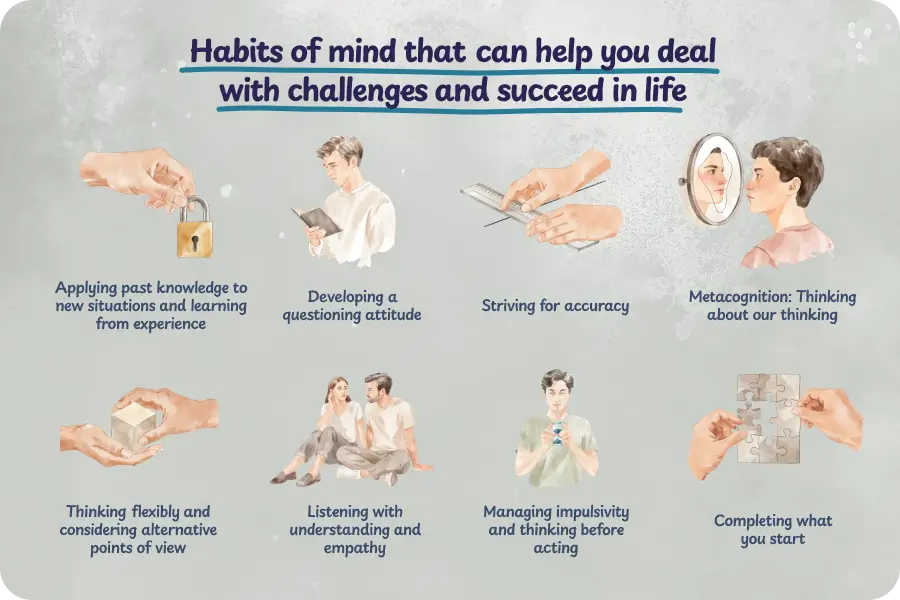
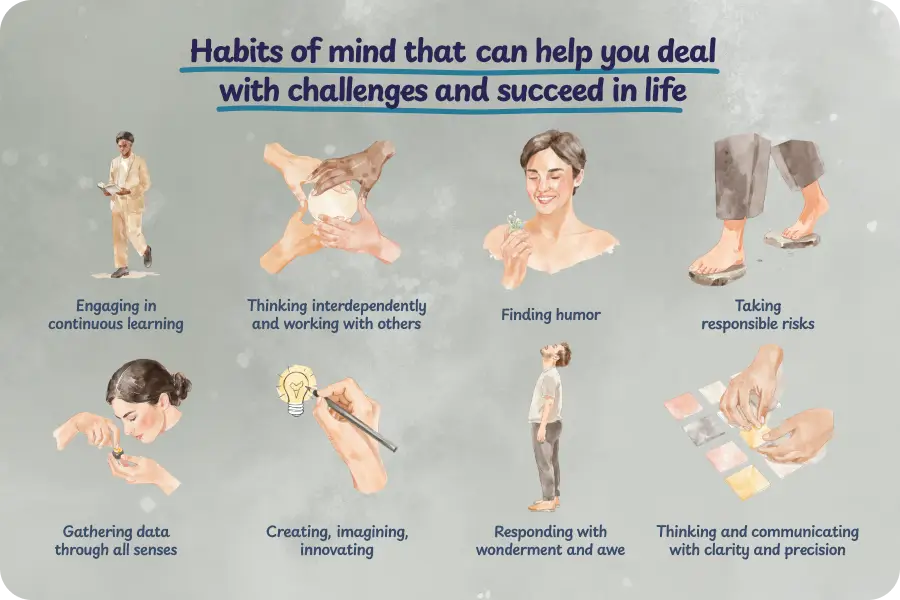
9. Thinking and communicating with clarity and precision
Studies prove that effective communication helps people avoid conflict and minimize its adverse consequences when it does occur. [3] “Developing Effective Communication Skills.” J Oncol Pract. 2007 Even more, high emotional intelligence, the ability to articulate your thoughts correctly, and empathy can help you build trusting relationships with others, succeed in professional settings, and feel more confident.
Imagine that you’re a manager who needs to explain the task to your employees. The level of precision and your attention to detail can directly influence how well the team understands expectations and performs the assignment. If instructions are vague, employees may complete the task incorrectly. However, if you clearly explain goals, deadlines, and responsibilities, people can work more efficiently.
10. Gathering data through all senses
Intelligent people don’t only observe. They hear, smell, feel, and analyze their experiences.
The most common example of a person using this habit of mind is Sherlock Holmes from books written by Arthur Conan Doyle. He knows how many answers a person can find by paying attention to a slight change in tone, a faint smell, or a subtle gesture, and he uses this information to investigate crimes.
In real life, this habit is about being mindful. You can see a far deeper layer of reality when your thoughts remain in the present.
11. Creating, imagining, innovating
To improve these skills, you need to remain focused on how something can be done differently from the “norm” and how you can improve your or others’ lives. This is how almost any development in science, art, or business begins. Creative thinkers imagine possibilities beyond the obvious and experiment with ideas without fear of failure.
In practical terms, you can boost this habit by:
- Brainstorming multiple solutions.
- Asking “What if…?”
- Combining ideas from different fields.
- Taking time for reflection and letting your mind wander.
12. Responding with wonderment and awe
This habit is the antidote to mental stagnation. While some people see a challenge as a problem to be avoided, those who respond with wonderment and awe see it as an opportunity to get better. As a result, you may notice an improved performance in tasks that seemed boring or scary earlier.
Developing a “beginner’s mind” attitude can bring positive effects:
- Ask questions like a child. Approach situations with curiosity, even if you think you already know the answer.
- Practice gratitude and reflect on aspects of life that inspire awe or appreciation.
- Try new experiences.
- Treat difficult tasks as opportunities to discover and grow, rather than obstacles.
13. Taking responsible risks
Risk-taking is a habit of mind that allows the person to develop new skills and create inspiring things. You don’t necessarily need to do something super scary to develop this skill. However, stepping out of a comfort zone is more than possible.
For instance, you can engage in public speaking to share your knowledge with others. Or, maybe, you may want to pitch an idea at work that you’ve been unsure about. While it can sound like a risk, in reality, it’s just an opportunity for growth.
Yet, avoid being impulsive. Taking responsible risks should involve understanding that there may be different consequences. So, it’s important to have a plan B when you face challenging conditions as well.
14. Finding humor
The study has shown the effectiveness of the positive thinking training approach in improving resilience and life satisfaction. [4] Taherkhani Z, Kaveh MH, Mani A, Ghahremani L, Khademi K. “The effect of positive thinking on resilience and life satisfaction of older adults: a randomized controlled trial.” Sci Rep. 2023 Finding humor in daily situations can help you approach challenges with less tension and find common language with people more easily.
Humor can act as a social bridge. A light joke or a warm smile can reduce awkwardness, ease conflict, and make communication feel more natural. To develop this habit of mind, you may need to:
- Don’t take yourself too seriously, and accept that everyone makes mistakes.
- Look for the absurd, as even small daily inconveniences can have a humorous side.
- Spend time with positive people.
- Reframe setbacks. Ask yourself, “Will this matter in a year?”
- Give yourself permission to joke, smile, and relax.
15. Thinking interdependently and working with others
Even the most intelligent people may find it challenging to deal with all problems alone. For instance, you have decided to launch a startup company. You might have a brilliant idea, but without a team, it can be hard to turn it into reality. You may at least need a developer to build the product, a marketer to promote it, and a financial specialist to manage the budget.
The ability to collaborate and work with the team is what defines your success, whether you’re an employee or an entrepreneur. This habit is the realization that collective intelligence outweighs individual effort.
- The “multiplier” effect. When you work with others, you multiply the perspectives available. A developer sees technical constraints that a marketer might miss, leading to a better final product.
- Social intelligence. This requires the ability to justify your ideas while remaining genuinely open to your peers’ expertise.
- Consensus building. It involves the discipline to set aside your ego for the sake of the group’s shared goal.
16. Engaging in continuous learning
Effective thinkers remain open to new information, develop problem-solving skills, and employ habits they have never tried before. In the digital age, it’s essential to cultivate this habit of mind to stay up to date and remain competitive. You can:
- Watch educational videos, lectures, or expert talks on topics that interest you.
- Read books, research articles, and trusted online resources.
- Take online courses or attend workshops to upgrade your skills.
- Set small learning goals each month.
- Surround yourself with people who inspire you.
Real-world habit of mind examples in education and business
Of course, not all famous people knew about the concept of habits of mind. However, they had something in common — they turned to them unconsciously to keep moving forward when others stopped.
Steve Jobs
Jobs was a systems thinker who strived for perfection. He wanted his products to be perfect and constantly insisted on it. He was committed to making every Apple product flawless and to focusing on a higher quality than existed in the market. This aspect led to Apple’s precise brand identity today.
Warren Buffett
This investor believes, “We don’t have to be smarter than the rest. We have to be more disciplined than the rest.”
He always focuses on long-term value over short-term noise. The ability to control impulsive decisions helps him avoid reacting to market volatility and instead wait for the appropriate time. He treats investing like a “20-slot punch card.” It means that if you only had 20 investments you could make in your entire life, you would be incredibly deliberate about each one.
Marie Curie
The first person to win two Nobel Prizes, Curie was extremely persistent. She spent years trying to isolate tiny amounts of radium. Despite health issues and repeated setbacks, she never abandoned her systematic search, and this refusal to quit led to the discovery of radioactivity and two new elements, which fundamentally changed modern medicine.
Habits of thinking vs. growth mindset: What’s the difference?
| Habits of mind | Growth mindset |
| A set of thinking and behavior skills | A belief that you can improve and get better daily |
| Focuses on how you act in difficult situations | Focuses on how you think about challenges and approach complex problems |
| Includes persistence, empathy, flexibility, and self-control | Includes a belief that effort leads to progress and constant attempts to put this effort into |
| Helps you solve problems step by step | Helps you not give up after failure |
| Can be practiced daily in real situations | Can be developed by changing your attitude |
| About building smart habits | About believing you can grow |
How to cultivate habits of the mind
To cultivate the 16 habits of mind, you need to take time and make a conscious effort. Here’s what can be helpful.
1. Develop one habit at a time
Trying to master all 16 habits at once is a recipe for failure. Instead, pick one habit that addresses your current biggest challenge. Maybe you find it difficult to manage impulsivity or work in a team. Focus exclusively on that habit for 7 to 10 days until it feels like a natural response rather than a forced effort. Then, choose another habit and repeat the cycle.
2. Use the “if/then” technique
We are more likely to follow through if we have a preset plan for specific triggers. As such, you can create a simple formula: “If [situation happens], then I will [habit of mind].” For instance, “If I feel overwhelmed by a project, then I will use metacognition to break the task into three small steps.”
3. Reflect on your day
At the end of each day, analyze your behavior. Where did you succeed? Where did you slip back into an old pattern? This evaluation allows you to learn from past experiences and avoid repeating the same pattern over and over again. It also makes you more mindful and intentional in your future actions.
Breeze’s custom routines can help you build a new habit faster. Choose a habit, set up reminders and frequency, and become a better version of yourself daily. You can also reflect on your day through journaling or learn something new about yourself through self-reflection tests.
Common challenges: Why learning mind habits is difficult
When we try to develop habits of mind (pretty much like any other habit), we can unconsciously sabotage this process. It can include:
- Impatience. You may expect quick results and want to give up when progress feels slow.
- Fear of failure and avoiding challenges to protect your ego.
- Comfort zone attachment. People may prefer familiar behaviors, even if they’re ineffective.
- Negative self-talk and imposter syndrome. You might believe that you’re “just not that kind of person” until new habits start working.
- Lack of consistency. Practicing a habit occasionally rather than daily won’t be very helpful.
Expert Insight
“Developing habits of mind is a lifelong pursuit. Living within these frameworks is committing to a lifestyle of curiosity, the power of pause, humility when facing failures or obstacles, and the challenge of knowing all of oneself. Compassion can go a long way as one adapts to this new way of living, while recognizing impatience, fear of failure, and comfort zone attachment are a part of the human condition. These things have implied an element of risk for a long time, and it’s an active choice to rely on oneself to keep oneself intellectually safe from obstacles such as negative self-talk and reacting to a lack of consistency. Each day may not be a perfect execution; however, what really matters is the try.”

Katherine Scott
Mental health professional
Final thoughts: Building a culture of mindful thinking
16 habits of mind aren’t a magic pill that can help you succeed in life instantly. However, they let you develop a completely new approach to challenges that focuses on growth rather than fear. With consistent practice, these habits gradually reshape the way you think and make decisions in everyday life.
Sources
- Kabara, Auwal & Shahrill, Masitah & Mohd Roslan, Roslinawati & Adnan, Mazlini & Darussalam, Universiti & Brunei, & Artikel, Perkembangan. (2024). “THE INFLUENCE OF IMPULSIVITY AND ANTI-SOCIAL BEHAVIOUR ON ACADEMIC PERFORMANCE OF UNIVERSITY UNDERGRADUATE STUDENTS IN NIGERIA.”
- Coronado-Maldonado I, Benítez-Márquez MD. “Emotional intelligence, leadership, and work teams: A hybrid literature review.” Heliyon. 2023
- “Developing Effective Communication Skills.” J Oncol Pract. 2007
- Taherkhani Z, Kaveh MH, Mani A, Ghahremani L, Khademi K. “The effect of positive thinking on resilience and life satisfaction of older adults: a randomized controlled trial.” Sci Rep. 2023
Disclaimer
This article is for general informative and self-discovery purposes only. It should not replace expert guidance from professionals.
Any action you take in response to the information in this article, whether directly or indirectly, is solely your responsibility and is done at your own risk. Breeze content team and its mental health experts disclaim any liability, loss, or risk, personal, professional, or otherwise, which may result from the use and/or application of any content.
Always consult your doctor or other certified health practitioner with any medical questions or concerns
Breeze articles exclusively cite trusted sources, such as academic research institutions and medical associations, including research and studies from PubMed, ResearchGate, or similar databases. Examine our subject-matter editors and editorial process to see how we verify facts and maintain the accuracy, reliability, and trustworthiness of our material.
Was this article helpful?