


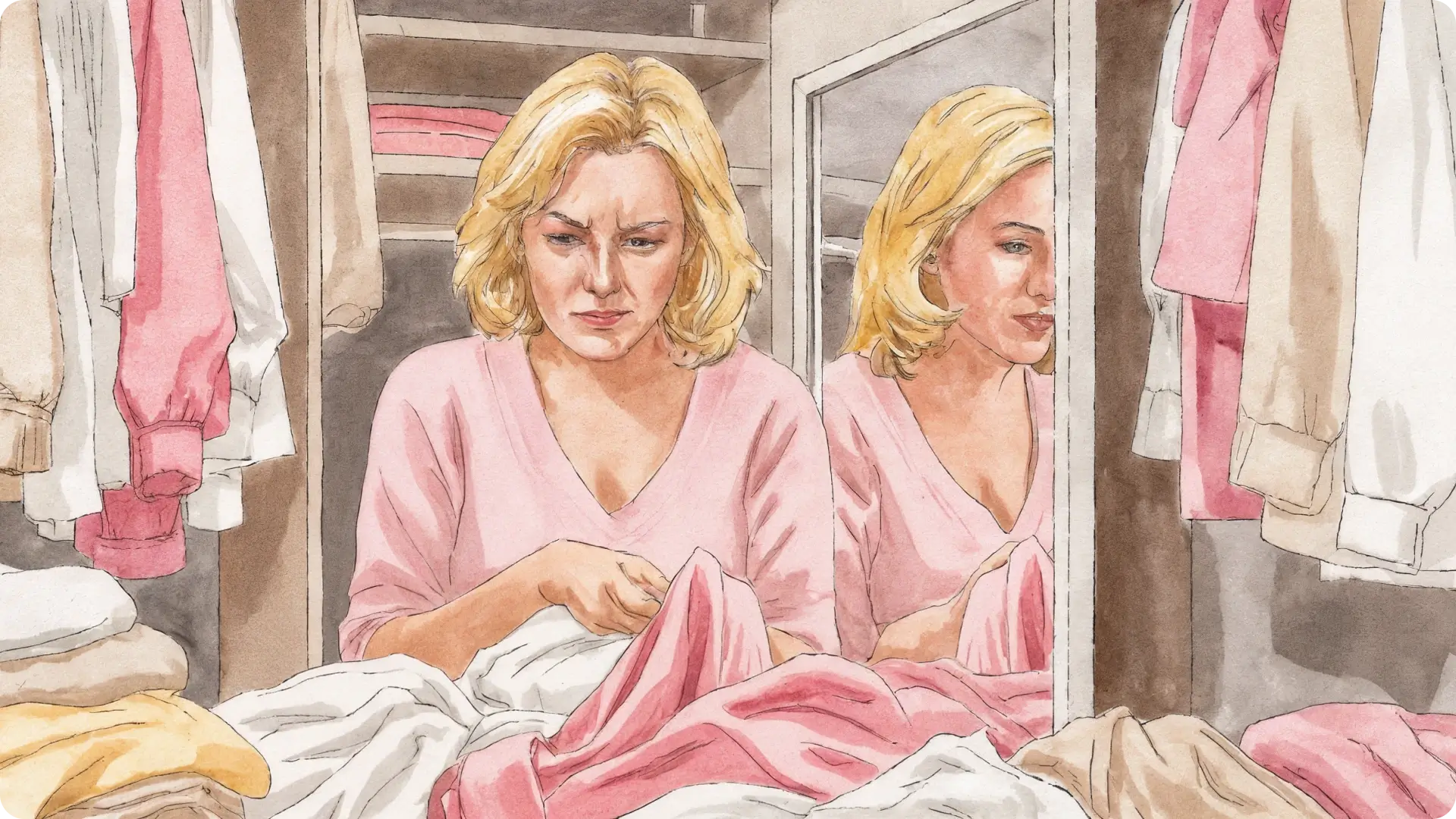
Do you sometimes avoid photos because you think, “I’m so ugly.” Or, maybe you focus on one “flaw” so much that it’s all you can see?
Let’s find out why you may have difficulties with self-acceptance, identify how to overcome body image dissatisfaction, and feel attractive.

Is It Normal to Feel Unattractive?
Yes, it’s completely normal to feel inadequate or dissatisfied with your physical appearance sometimes, especially when you compare yourself to others. When you look in the mirror, you may see a reflection shaped by psychological factors such as your mood, past experiences, self-esteem, and the impossible beauty standards on social media. Feeling unattractive now and then doesn’t mean there’s something wrong with you.
You are certainly not alone in this struggle. The UK Health and Social Care Committee survey found that 80% of respondents agreed or strongly agreed that their body image had a negative impact on their mental health.
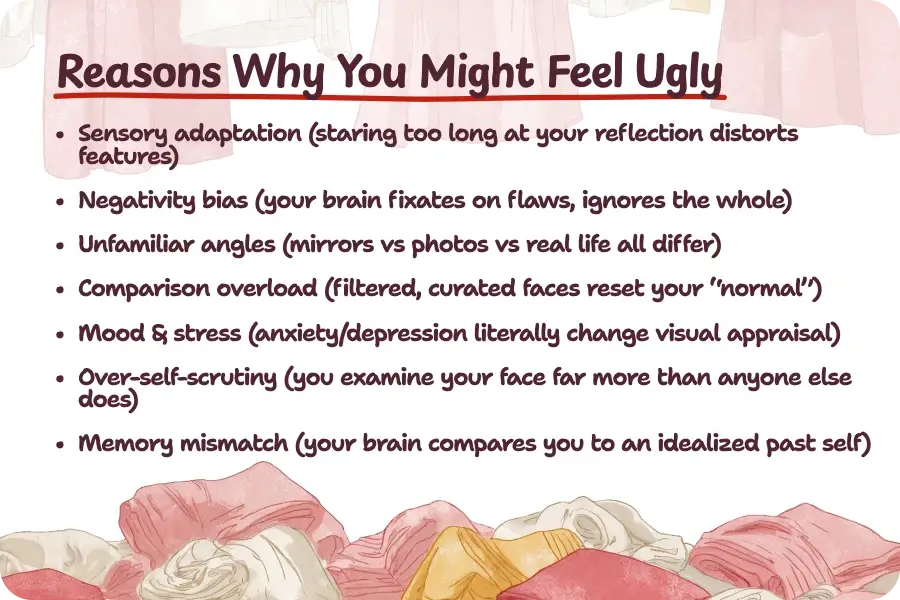
6 Real Reasons Why You Might Feel Ugly
To find the root cause of your self-hatred, we have to look at the intersection of biology, modern culture, unrealistic expectations of society about one’s appearance, and the internal negative self-talk.
1. The beauty standards distortion
We are the first generation in history to compare our “raw footage” to everyone else’s “edited highlights.” Social media promotes the use of AI, Photoshop, or editing tools, and lighting to create faces that don’t exist in nature. As a result, we may see more “beautiful” people in thirty minutes of scrolling than our ancestors saw in their entire lifetimes.
This constant exposure to filtered images and excessive grooming resets our “average” and makes normal physical features feel like flaws. Eventually, when you look in a mirror and see pores, fine lines, asymmetrical features, or natural body shape, your brain flags them as errors or threats. You may even think, “I hate other women or men.”
Moreover, algorithms show you what you engage with. If you look at “glow-up” social media content, you are bombarded with “before and afters.” This, in turn, may only reinforce the idea that your current state is a “before” that needs fixing.
2. The neurobiology behind feeling ugly when you look in the mirror
The reason you feel “uglier” the longer you look in the mirror isn’t because your face is changing. It’s because of how your brain processes information. To understand why, we have to look at how the human brain processes visual data.
1. Featural processing
When you stare in a mirror for a long time, you force your brain to switch from seeing the whole picture to scanning for individual parts. As a result, these features start to look weird, asymmetrical, or alien. You may begin to see your eyes as separate from your nose and your nose as separate from your mouth. This is called the “Troxler Effect” or “Perceptual Fading.”
2. Sensory adaptation
According to research, staring at your reflection for too long triggers a neurological process called sensory adaptation, which can literally change what you see:
- The neurons responsible for perceiving your general “look” get tired and stop responding.
- Because your brain has adapted to seeing your face, it begins to search for deviations or novelty.
3. The amygdala and the “threat” response
If you are already feeling worthless or insecure, your amygdala (the brain’s fear center) is on high alert. In this state, the brain treats perceived flaws as threats to your social standing. This may lead to a negative thought loop: you look in the mirror → your amygdala triggers a stress response → your focus narrows → you see more “flaws” → the amygdala becomes more sensitive, and so on.
3. The psychology of self-perception
Negative self-perception is often an “echo” of a voice from your past. For example, you had narcissistic parents who praised physical attractiveness. Or, you were bullied during the formative years of puberty. Or maybe your first partner criticized you and perceived imperfection as a loss of value as a person. In these cases, your brain may have internalized such experiences and formed them as your own beliefs. You might be a perfectly attractive adult, but you are viewing yourself through the eyes of a 15-year-old who felt like a failure.

4. The “spotlight effect”
This is a psychological phenomenon where you overestimate how much others notice your appearance. According to research, people are generally “socially blind” to the details others hate about themselves.
The reason is that your brain is trained to focus on yourself more than other people. So, it thinks other people notice the small details or flaws we notice about ourselves. In actuality, other people are also more focused on themselves, meaning they are much less likely to notice what you are feeling insecure about.
5. Attachment styles
People with insecure attachment styles may have low self-esteem and look for reasons why they might be unlovable. “Ugliness” in this case is an easy target to blame for deeper fears of abandonment.
People with anxious attachment may ruminate on or hyper-fixate on negative self-talk: “If I can just fix my skin/weight/nose, then I will finally be ‘safe’ from abandonment.” It’s a defense mechanism that creates an illusion of control over social belonging.
For those with an avoidant attachment style in relationships, feeling unattractive can serve as a subconscious barrier that justifies staying isolated.
Do you have an insecure attachment style? Take an avoidant attachment style quiz and other insightful tests about your personality, attachment, childhood trauma, and well-being in the Breeze app.
6. Body dysmorphic disorder, eating disorders, and other mental health conditions
Sometimes, feeling unattractive can be a symptom of depression, eating disorders, or body dysmorphic disorder. For some people with these mental health conditions, the brain’s visual processing center actually functions differently. Instead of seeing a “whole” face (holistic processing), the brain over-focuses on individual parts (detail-oriented processing), which makes any minor feature feel like a massive deformity.
Expert Insight
There is more specific criteria to a diagnosis of body dysmorphic disorder than feeling “unattractive,” including appearance preoccupations, repetitive behaviors in response to the preoccupations, clinical significance, and differentiation from other mental health diagnoses. If you feel that you have BDD, please consult a professional for further evaluation and support.

Hannah Schlueter
Mental health professional
7 Practical Steps to Stop the Thought: “Why Am I So Ugly?”
These approaches can help you practice self-compassion and improve your self-esteem and overall well-being:
1. Pause the negative self-talk
Start with neutral statements like:
- “I look normal today.”
- “This is just my face.”
- “I’m allowed to exist without being perfect.”
Instead of aggressively trying to convince yourself you’re attractive, ask balanced questions:
- What actual evidence supports this thought?
- Am I focusing on one small detail and ignoring the whole picture?
- Would I judge a friend this harshly?
2. Check your physical and emotional state
Your brain becomes more critical when you’re exhausted, stressed, anxious, or overwhelmed. Lack of sleep alone can change how you see yourself in the mirror. Before believing the thought, ask yourself:
- Am I tired?
- Am I stressed?
- Did something upsetting happen today?
3. Identify and limit comparison triggers
Social media feeds are filled with filtered, carefully posed images. Even when you know this logically, your brain still compares. According to research, the frequent use of image-focused platforms may increase the risk of body dysmorphia.
Pay attention to which accounts or platforms make you feel worse about yourself. You may unfollow if an account propagates unrealistic beauty standards or makes you feel like your life or body is a “project” that needs fixing. If you can’t unfollow (e.g., a friend or family member), use the mute button to remove their highlight reel from your daily mental space.
4. Remember how easily images distort reality
Lighting, camera lenses, angles, posture, and even facial expressions can change how you look in photos. When a single picture triggers hours of self-criticism, remind yourself: one image is not a full representation of you.
5. Strengthen parts of your identity that aren’t appearance-based
When your self-esteem depends mostly on your physical appearance, it becomes significantly more fragile. Invest energy in skills, interests, relationships, values, and goals. Learn something new and meaningful, and build connections. The more you focus on different parts of your personality, the less your looks will define your self-worth.
6. Practice self-compassion
You can also try positive affirmations:
- My worth isn’t defined by my appearance.
- I have qualities that matter beyond how I look.
- I deserve kindness, especially from myself.
- My value doesn’t decrease because of a bad photo or angle.
- My appearance is only one small part of who I am.
- I can treat myself with kindness, even on insecure days.
- It’s okay to have flaws — everyone does.
- I deserve respect, including from myself.
- I can choose not to believe every critical thought.
- Confidence grows from how I treat myself, not how I look.
- I am learning to see myself with more balance and less judgment.
This is where the Breeze app can come in handy. It offers guided science-backed tools to help you track your emotions, identify triggers, build healthier emotional responses, and get out of your head when you need it. With the Breeze mood tracker, journaling, daily affirmations, and personalized routines, you can begin to understand the deeper patterns behind your perceived flaws.
7. Reduce mirror checking and photo analysis
It’s tempting to keep checking your reflection, zooming into photos, or comparing different angles to “figure out” what’s wrong. Unfortunately, the more you analyze, the more flaws your brain invents.
Try setting boundaries with mirrors and photos. Give yourself specific times to get ready, then step away. Obsessive checking rarely brings reassurance and only increases doubt.
The mirror convinces you that your only value is aesthetic. Try to remind your brain of your functional and social identity. Before you walk away from the mirror, name three things you did well today that had nothing to do with your face:
- “I finished that report on time.”
- “I was a good listener when my friend called.”
- “I made some really good pancakes this morning.”
The Mirror Protocol Cheat Sheet
| Step | Action | Why it works |
| Distance | Stay 3 feet away. | Prevents “featural” distortion. |
| Neutrality | Use nouns, not adjectives. | Calms the brain’s fear center. |
| Grounding | Touch the sink/counter. | Pulls you out of the visual spiral. |
| Non-appearance-based achievements | Recite 3 non-physical wins. | Restores your sense of self-worth. |
Professional Treatment for Negative Self-Image
If these body image issues are constant and make it hard to live your life, you may seek a professional’s help.
1. Cognitive Behavioral Therapy (CBT)
CBT is the gold standard for body image distress. It helps you identify “cognitive errors,” such as catastrophizing (“If I have this wrinkle, I am unlovable”) and emotional reasoning (“I feel ugly; therefore, I must actually be ugly”).
For example, a therapist might ask you to write down the thought “Everyone is staring at my flaws” and then examine the real evidence for and against it. Eventually, you learn to replace extreme, automatic thoughts with neutral ones, such as “Some people may notice my appearance, but that doesn’t mean they’re judging me.”
2. Mirror Retraining
In a clinical setting, a mental health professional helps you look in a mirror and describe your body using neutral, objective language to see things through a less judgmental lens. Instead of saying, “I have a disgusting, huge nose,” you practice saying, “I have a nose with a bridge and two nostrils.”
3. Exposure and Response Prevention (ERP)
This type of therapy involves facing situations you avoid because of your looks, like going to a grocery store without makeup or wearing a certain outfit, without engaging in “safety behaviors” (like constantly checking your reflection). This way, your brain learns that the feared outcome, like rejection or humiliation, usually does not happen, and the anxiety decreases on its own.
Summary: Prioritize Self-Care To Feel Good in Your Body
Feeling unattractive at times is part of being human, but lasting change doesn’t come from fixing every perceived flaw. Long-term healing happens when you begin to understand your negative thoughts and past experiences that shape how you see yourself. When you build self-confidence, challenge harsh self-criticism, practice self-care, and seek the help of a licensed therapist, you can shift from constantly judging your appearance to self-love and self-acceptance.
Expert Insight
Removing the association between physical appearance and value/worth is the single biggest piece to stabilizing one’s self-esteem. Despite what society tells you, physical appearance has no impact on your inherent worth. This allows people to understand that they may not like how they look every day, but they can still treat their bodies with the respect and care they deserve.
Hannah Schlueter
Mental health professional
Sources
- UK Health and Social Care Committee. The impact of body image on mental and physical health. August 2022
- EBSCO. Spotlight effect. 2025
- Gupta M, Jassi A, Krebs G. The association between social media use and body dysmorphic symptoms in young people. August 2023
- Mehdi Adibi, Davide Zoccolan, Colin W. G. Clifford. Editorial: Sensory Adaptation. December 2021
Disclaimer
This article is for general informative and self-discovery purposes only. It should not replace expert guidance from professionals.
Any action you take in response to the information in this article, whether directly or indirectly, is solely your responsibility and is done at your own risk. Breeze content team and its mental health experts disclaim any liability, loss, or risk, personal, professional, or otherwise, which may result from the use and/or application of any content.
Always consult your doctor or other certified health practitioner with any medical questions or concerns
Breeze articles exclusively cite trusted sources, such as academic research institutions and medical associations, including research and studies from PubMed, ResearchGate, or similar databases. Examine our subject-matter editors and editorial process to see how we verify facts and maintain the accuracy, reliability, and trustworthiness of our material.
Was this article helpful?