

Do you feel as though your mother constantly criticizes you, avoids spending time together, manipulates, and dismisses your feelings? If so, you may start to think, “My mom hates me!”
If it feels relatable, keep reading. In this article, we’ll explore the most common answers to the question, “Why does my mom hate me?” and learn to differentiate real hate from subjective feelings. You’ll find out how this mother-child relationship may affect your well-being and what to do to take care of your mental health.
Please pay attention that the following article explores topics connected to abuse and toxic relationships. If it triggers significant distress, you may take the childhood trauma test to gain a clearer understanding of how your upbringing has shaped your current well-being.
Why does my mom hate me?
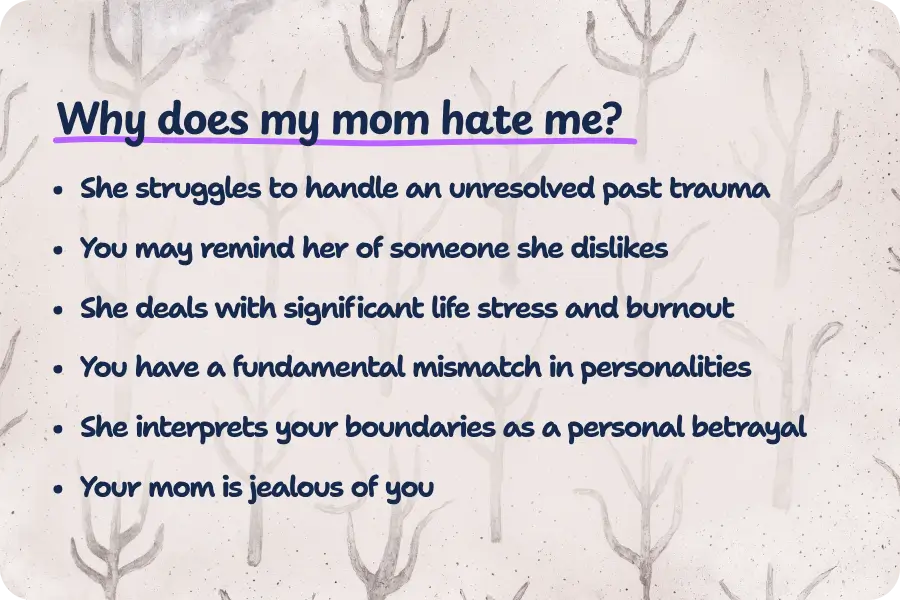
Your mother’s behavior may make it seem like she hates you due to various reasons, including parental burnout, personal issues, jealousy, and unresolved generational trauma that she hasn’t learned to process. Here are some reasons why it might seem that your mom hates you.
1. She struggles to handle an unresolved past trauma
Your mother may have been raised in a household without love or with abuse, so she may lack the “emotional tools” to express affection properly. She simply doesn’t know how to love their children and, as a result, replaces genuine care with criticism, control, or emotional distance.
Perhaps your mom experiences mental health issues related to the past. For instance, she may live with PTSD, depression, anxiety disorder, or another condition. Some symptoms can make it much more challenging to embrace unconditional love and, most importantly, show it to kids. As a result, you might have a strained relationship with your mother.
2. You may remind her of someone she dislikes
Projection and displacement are psychological defense mechanisms that allow a person to redirect their own negative feelings or traits toward someone else to avoid facing them. Parents may subconsciously see parts of themselves or people they dislike in their children, which can lead to constant criticism.
- The mirror effect. If you remind her of a part of herself she dislikes, she may react with hostility toward you instead of dealing with her insecurities.
- The “ex” factor. Maybe you resemble a partner she had a painful breakup with (like your father). Because of this, your mom might unfairly project that resentment onto you.
3. She deals with significant life stress and burnout
If your mom raised you alone or faced chronic financial instability, she may have been forced into ‘survival mode’ for so long that she lost the ability to connect emotionally. Studies prove that workplace stress and a lack of a supportive family background make parents vulnerable to parental burnout.
In any case, high-level stress may:
- Make a person less empathetic.
- Trigger chronic irritability.
- Lead to emotional withdrawal.
- Result in “displaced aggression,” where she vents her frustrations with life onto you.
- Make everything seem uninteresting, as if nothing matters.
Your needs may feel like additional burdens to your mom, which can make her react with impatience. Because of this, a child feels guilty about the mother’s emotional state and may start thinking, “My mom hates me.”
4. You have a fundamental mismatch in personalities
This isn’t the reason to hate another person (no matter if it’s a close one or someone you know just a little bit). However, if you and your mother have fundamentally different temperaments, communication styles, or core values, it can create constant friction. Maybe you’re feeling unloved because she reacts with anger or rejection to your choices, which can lead to you experiencing emotional pain.
5. She interprets your boundaries as a personal betrayal
A toxic mother may feel like she’s losing control over you when you start growing up and becoming more independent. As a result, she may:
- Engage in guilt-tripping
- Play the victim
- Call you selfish or ungrateful
- Engage in silent treatment
- Criticize your life choices
- Triangulate other family members, etc.
Of course, she doesn’t necessarily start hating her own child. Still, such an unhealthy relationship can harm your emotional well-being.
6. Your mom is jealous of you
You may lack a supportive environment in your family because your mom feels jealous of your achievements and overall life. Maybe now you can travel a lot, which wasn’t possible for her while she was taking care of you.
As a result of this jealousy, she can make dismissive comments and undermine your successes to experience a sense of her superiority. This behavior might stem from her feelings of inadequacy or mourning her “unlived life.”
Signs your mother hates you
When questioning, “Why does my mom hate me?” it’s also essential to ask yourself, “Does she really hate me?” While she may be hurtful, hatred and emotional immaturity are not the same thing. Still, certain patterns can highlight that she might really experience strong negative emotions about you as her child.
1. She engages in emotional abuse
Emotional abuse is a pattern that goes beyond occasional conflict or harsh words said under stress. It can include:
- Constant criticism
- Humiliation
- Name-calling
- Gaslighting
- Threats
- Silent treatment
Instead of feeling safe to be themselves, a child feels like their emotions are inconveniences and their whole existence is a burden.
A key sign of an unhealthy relationship is how you feel after interactions. If you consistently leave conversations feeling ashamed, guilty, confused, or “not good enough,” that’s not normal parental conflict — that’s emotional harm.
2. She is physically violent
Another sign that a mother hates her children is physical violence toward them. Earlier on, some parents might have considered physical punishments as a way to discipline children or “teach a lesson.” While it is unacceptable and extremely harmful to kids’ well-being, it might not signal parental hate but rather a lack of knowledge of discipline or child development.
However, there’s an important difference between misguided discipline and domestic violence driven by hostility. When physical force is frequent, excessive, unpredictable, or used to intimidate, control, or release anger, it crosses into abuse.
3. Relationships feel unsafe
It can include emotional abuse, physical violence, verbal aggression, intimidation, and unpredictable reactions that influence your sense of safety and self-worth. You may feel like you don’t know what a mother’s love is, as your mother is the source of your fears and worries.
4. She literally says that she hates you
A healthy relationship with your mother would never involve such phrases as:
- “I hate you.”
- “If I didn’t have you, I would be happier.”
- “I wish you had never been born.”
- “You ruined my life.”
- “I regret having you.”
- “You’re the worst thing that ever happened to me.”
During a severe conflict, she may say something that makes you feel hurt, and it may later require open communication. Yet, when it comes to harsh phrases about regrets, it may no longer signalize healthy dynamics but rather toxic parenting.
5. Her actions indicate that she doesn’t care for you
Neglect may be another root cause of the feeling “my mom hates me.” She might not control you or criticize constantly. Instead, she can simply show a lack of care at all.
Your mom wouldn’t have been surprised if you hadn’t stayed at home for a few days as a 13-year-old teenager. Or, maybe, now she doesn’t want to meet you in person, even when you visit your country once a year while coming from another continent. You don’t feel needed, and this may be the cause of further underlying issues.

Why do I feel like my mom hates me?
Your mom might not hate you but rather be unable to provide enough love because of her own struggles or past trauma. Here are some reasons why you might experience “mommy issues,” even if hatred isn’t the true root.
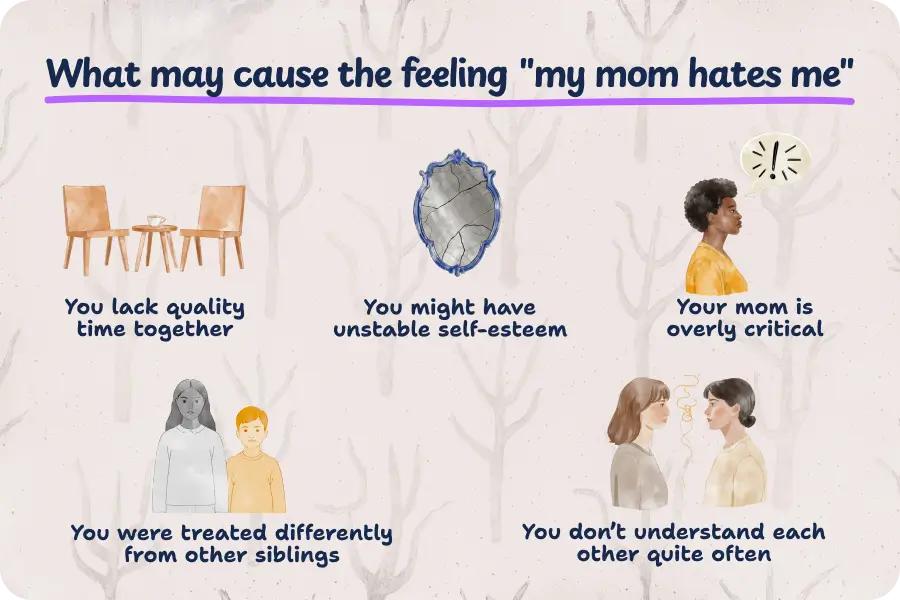
1. You lack quality time together
It isn’t always about a complete lack of care, but rather a lack of meaningful time spent together. If she didn’t attend your school events, rarely asked about your day, or was physically present but emotionally distracted, the relationship may have grown without enough shared moments to build closeness.
You might experience the same now as well. Maybe she always forgets to call you to check how you’re doing, or seems more focused on practical discussions than connection.
2. You might have unstable self-esteem
The root cause may be in your sense of self-worth rather than family relationships. If your mom is quite assertive when it comes to showing emotions, and you have unstable self-esteem, you may suppose that:
- Her neutral mood means she’s disappointed in you
- Her tiredness equals loss of love
- Constructive feedback is personal rejection
- Disagreement means she doesn’t accept you
In this case, an honest conversation can help. You may tell your mom that you lack reassurance and sometimes interpret her tone or reactions as signs of rejection. You can discuss how to improve communication and your relationship with your mother.
3. She is overly critical
If your mom is overly demanding and critical, you may also sometimes feel like your relationship isn’t very healthy. She might:
- Set very high expectations
- Rarely express praise or approval
- Compare you to others
- Turn conversations into lectures
- Give advice that feels like judgment
She may believe that she’s trying to “push you to be better,” but in reality, it can leave you thinking, “My mother hates me.” In many cases, that conclusion may not be true. While this dynamic isn’t healthy or truly motivating, it often says more about her internal patterns than about your worth.
4. You were treated differently from other siblings
Your mom organized big birthday parties for your siblings, but for your celebration, she always said she “didn’t have money.” Or, maybe, she remembered your siblings’ achievements with pride and excitement but barely acknowledged yours.
In any case, it makes sense why you may feel like your mother hates you. And it can really signal her lack of care. But while the effect on your mental health is real, it doesn’t always mean she consciously dislikes you. It can also reflect her unconscious patterns and tendency to favoritism rather than true hatred.
5. You don’t understand each other quite often
Communication in these dynamics may feel like speaking two different languages without a translator. Lack of common ground can be especially typical for teenagers and adults who experienced some of the signs mentioned above.
You may argue about your decisions and feel misunderstood when you share your achievements or see that she doesn’t find anything you talk about interesting. Your mom may not hate you. She can seem “cold” and different. And it can be challenging to build a meaningful bond for both you and your mother.
Is my mom toxic, or am I the problem? Signs of toxic parenting vs. miscommunication
| Toxic parenting | Miscommunication |
| Constant humiliation, shaming, or ridicule | Occasional harsh words during stress, followed by repair |
| Love and warmth depend on obedience or achievements | Love exists, but it’s expressed in ways you don’t easily recognize |
| No apologies, even after clear emotional harm | The parent can admit mistakes after a calm conversation |
| Control replaces support | Worry shows up as too much advice or involvement |
| You feel afraid to be yourself around them | You feel safe, but sometimes emotionally out of sync |
| Conflicts leave you feeling worthless or anxious | Conflicts feel tense, but don’t damage your self-worth |
| Problems are denied or always blamed on you | Both sides can reflect and share responsibility |
Emily Mendez, M.S., Ed.S., explains how a person can quickly tell whether their mom hates them or whether it’s just a case of repeated misunderstandings. “True parental hatred in parent-child relationships is very uncommon. This is not something that is typically assessed quickly. Clinicians usually look at patterns of behavior over time and whether there is evidence of care in the relationship. Clinical assessment is important in this type of situation.”
How a difficult relationship with your mother can affect you
Feeling unloved or misunderstood can negatively influence your well-being and the way you express emotions. Here are the most common outcomes.
The internal impact
- The “inner critic“ with your mother’s voice can constantly doubt your achievements and magnify your flaws.
- If your mother’s love felt conditional or was entirely absent, you might grow up feeling like you are “not enough” or that you have to “earn” the right to exist.
- According to the research, if your mother was overly critical, you may experience intense anxiety or tend to “shut down” during stress.
Challenges in adult relationships
- You may develop a fear of abandonment and behave “clingy” to prevent people from leaving you.
- Conversely, you might push people away to avoid the vulnerability that once led to pain.
- People-pleasing is another possible outcome. You may suppress your own needs just to keep the peace.
Professional and social life
- You may face challenges with establishing boundaries and struggle to say “no.” It can lead to burnout, or you may cause intense guilt when you try to prioritize your well-being.
- Children who experienced a lack of parental involvement in adulthood may show lower academic scores, according to the study.
- Relationships with bosses can feel loaded with tension, as you might project your mother’s critical or unpredictable nature onto them. You may even think that you hate women.
What should I do if my mom hates me? Steps for coping and taking care of your mental health
If your mom really hates you, it can be challenging to fix something through open communication, as she may not be interested in building better relationships. If the dynamic is tense (but she still loves you), here are some tips.
1. Discuss your feelings with your mother
Everyone can have a different picture of an ideal family life. While for you it can be about Sunday breakfasts together in a cozy cafe (even though you live separately), she can perceive it as a burden or unnecessary expectation.
Nonetheless, if you want to build a healthier relationship with your mother, you can always have a serious conversation about it. Discuss:
- Moments when you feel hurt and why
- Specific actions or words that affect your emotions
- Differences in expectations between you and her
- Your need for emotional closeness or spending quality time together
- How past experiences continue to impact your feelings today
Use “I” statements to avoid making your mother feel attacked. If she’s interested in improving your connection, this step may be enough to see the first changes.
2. Set clear boundaries
Maybe your mom keeps being overly controlling or critical. In this case, setting boundaries is necessary.
- At first, state clearly what kind of behavior is unacceptable for you and what might happen if she engages in it (e.g., you’ll stop calling her, will talk only about neutral topics, etc.)
- Be firm but calm, focusing on your needs rather than blaming her. For example, you might say, “I won’t continue this discussion if it turns into criticism.”
- Enforce your boundaries and keep your promises anytime something goes wrong. This way, you’ll show that you approach the situation seriously.

3. Try family therapy
You may see that your mother is trying to improve the way she communicates, but it’s challenging for both of you. If so, professional counseling might be helpful.
A trained family therapist can provide a neutral space where both of you feel heard. They might help you identify harmful patterns and teach strategies for expressing emotions safely. Therapy can also guide you in setting boundaries, resolving conflicts, and rebuilding trust.
4. Distance yourself
If nothing helps and the relationship with your mother keeps feeling toxic and draining for your mental health, it may be reasonable to limit communication. It doesn’t necessarily mean that you need to cut contact completely. However, it might be better to:
- Reduce the frequency of calls, texts, or visits
- Avoid sharing deeply personal information that could be used against you
- Limit in-person meetings
- Use written communication instead of phone or video when it feels safer
- Prioritize your emotional needs before responding to her demands
When improving the parent-child relationships isn’t possible
There can be situations when the only option is to accept that improving relationships isn’t possible at all. Here are some signs this may be the case:
- The parent consistently refuses to acknowledge or change harmful behavior. Even when you tell your mother that her behavior harms your self-esteem, she doesn’t want to change anything and only cares about her own life.
- It’s too painful to communicate with her due to past wounds. A history of experiencing abuse or childhood trauma can make simple interactions feel tough to handle.
- Emotional or physical abuse continues. Maybe your mother keeps giving harsh reviews of your appearance or commenting on your personality. If she is still abusive, it’s better to take care of your mental health.
- Maintaining the relationship harms your well-being. You feel that it’s extremely tough to work on this connection, and the results aren’t rewarding.
Expert Insight
“The decision to try to improve the relationship or distance oneself is usually based on safety, psychological or physical harm, and the parent’s willingness or ability to change. If the relationship is characterized by harm or toxic behaviors, and it appears that the parent will not or cannot change, distance is typically a healthy step.”

Emily Mendez
Mental health professional
Healing your relationship with yourself after a hurtful parent-child dynamic
If you feel that your mom hates you and any attempts to improve the relationship don’t work, it may be time to limit communication and start healing. Experiencing constant neglect can mean that she doesn’t want to change, so it might be better to shift the focus from trying to fix the relationship to taking care of yourself.
1. Reach out for support from friends and other family members
If you have any relatives or friends who are ready to support you, it’s time to talk to them. You may need to explain your decision and state that it won’t influence your relationships with them. Additionally, you can talk about:
- Ways they can support you when you feel overwhelmed
- How to help you after difficult interactions
- Whether it’s okay to ask about your relationship with your mother
- Signs that you might need extra care
- Your need for understanding rather than advice or judgment
2. Find ways to release negative emotions
You might have a busy schedule and plan every second to avoid feeling frustrated. However, difficult emotions may still arise sooner or later. To process them better, do the following:
- Use Breeze’s mood tracker to notice times when you feel angry or sad. Track what triggered these emotions and analyze patterns after some time.
- Give your feelings somewhere to go instead. This might mean journaling, where you don’t try to sound “reasonable,” or creative expression that captures the mood.
- You can also try physical activity to feel better. Doing yoga, going for a walk, or hitting the gym can help you feel much better by releasing endorphins and supporting neurotransmitters involved in mood, like dopamine.
3. Focus on what makes you feel happier
You may need to develop coping skills to deal with frustration. But coping isn’t only about managing pain. It also involves actively bringing more positive experiences into your life. Give yourself permission to enjoy things that have nothing to do with your mother. You might:
- Pick up an old hobby
- Explore a new passion
- Meet with people you love
- Try mindfulness practices to feel more in control of your life
4. Try offline or online therapy
Seeking help from a licensed therapist or a support group can help you feel that you’re not alone with the challenges. You may process negative feelings connected to relationships with your mother and deal with the outcomes, such as low self-esteem or challenges that influence other relationships in your life. Approach the healing process with patience, and you’ll see noticeable changes.
Conclusion
The feeling “My mother hates me” can be extremely painful and frustrating. Nevertheless, your approach to the situation may not always align with reality. Check whether your relationship involves signs of hatred, and if it does, take care of your mental health by prioritizing yourself and your inner balance.
Sources
- Bogdán PM, Varga K, Tóth L, Gróf K, Pakai A. “Parental Burnout: A Progressive Condition Potentially Compromising Family Well-Being-A Narrative Review.” Healthcare (Basel). 2025
- Ahmadzadeh YI, Eley TC, Hannigan L, Creswell C, Lichtenstein P, Spotts E, Ganiban J, Neiderhiser J, Rijsdijk F, McAdams TA. “Parental criticism and adolescent internalising symptoms: using a Children-of-Twins design with power calculations to account for genetic influence.” J Child Psychol Psychiatry. 2022
- Mao M, Zang L, Zhang H. “The Effects of Parental Absence on Children Development: Evidence from Left-Behind Children in China.” Int J Environ Res Public Health. 2020
Disclaimer
This article is for general informative and self-discovery purposes only. It should not replace expert guidance from professionals.
Any action you take in response to the information in this article, whether directly or indirectly, is solely your responsibility and is done at your own risk. Breeze content team and its mental health experts disclaim any liability, loss, or risk, personal, professional, or otherwise, which may result from the use and/or application of any content.
Always consult your doctor or other certified health practitioner with any medical questions or concerns
Breeze articles exclusively cite trusted sources, such as academic research institutions and medical associations, including research and studies from PubMed, ResearchGate, or similar databases. Examine our subject-matter editors and editorial process to see how we verify facts and maintain the accuracy, reliability, and trustworthiness of our material.
Was this article helpful?