

Podcast name
What is an energy vampire?
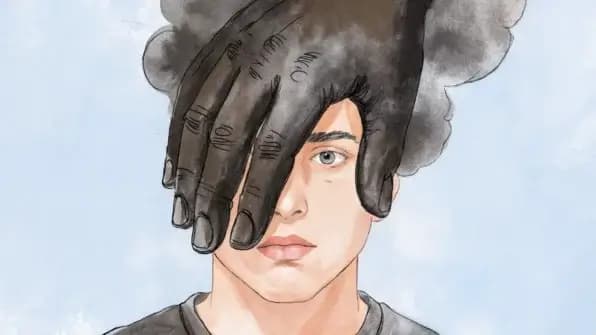
I used to notice that after spending time with certain people, I felt completely drained. It was like someone had quietly turned the brightness down in me. And then I came across the term “energy vampire.”
Hi, I’m Mary, and I’ve been using Breeze for over 2 years now. Today, I want to share my story about how some people close to you can drain your emotional energy and how I started to recognize it for what it really was. I delved into the topic of what an energy vampire is quite deeply, so I’ll try to break it down in a simple, practical way.

Energy vampire meaning
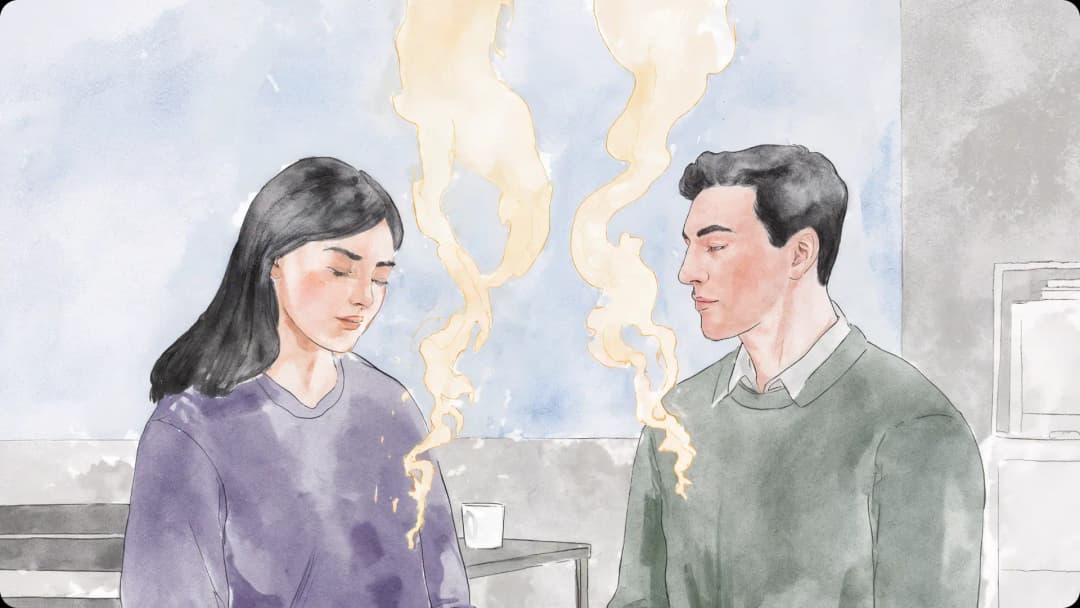
“Energy vampire” is an unofficial term used in pop culture to describe someone who tends to consume your emotional attention, time, and mental energy without offering much in return and leaving you feeling drained after communication.
It doesn’t mean the person is literally “taking energy,” of course. Rather, it’s a metaphor for relationships where interactions feel one-sided — you listen, support, reassure, and adjust, while your needs get ignored.
You might not notice that a person is an energy vampire immediately. Even more, you may feel fine during the conversation but experience the negative influence afterward. I’ve found a study proving that charm is one of the main manipulation tactics people unconsciously trust, which is why emotionally draining individuals are not always openly toxic. [1] Buss DM, Gomes M, Higgins DS, Lauterbach K. “Tactics of manipulation.” J Pers Soc Psychol. 1987
Energy vampire communication vs. trauma dumping
Trauma dumpers may behave quite similarly to energy vampires: they may overshare past pains and seem like they aren’t emotionally intentional when listening to your problems. Nevertheless, the difference often lies in awareness and intention.
A person who is trauma dumping may share overwhelming personal experiences because they are struggling to regulate emotions. They typically are not trying to manipulate or emotionally exhaust others on purpose and simply lack healthy boundaries or safe outlets for processing difficult feelings.
An energy vampire, on the other hand, often turns every interaction back to their life simply due to the need to be the center of attention. Your feelings slowly get pushed aside, and it may seem like they don’t care, which may leave you feeling emotionally drained instead of supported.
| Energy vampire | Trauma dumper |
| Takes energy without giving much back | Shares overwhelming personal struggles |
| May seek attention, validation, and control repeatedly | Usually seeks relief, comfort, or someone to listen |
| Relationship dynamics are often one-sided over a long period of time | One-sided relationship dynamics can happen occasionally during difficult times |
| Your emotions may receive little attention | May still care about your feelings, but become consumed by their own pain |

7 signs you’re communicating with an energy sucker
The most common energy vampire behaviors include constant negativity, guilt-tripping, needing attention, constant drama, lack of emotional support for others, and talking only about their own problems.
1. You feel guilty for nothing and responsible for their emotions
It seems like a typical conversation, and then suddenly you feel like you said or did something wrong. “Why do I feel guilty?” you may think. Energy vampires often use subtle guilt-tripping, passive-aggressive comments, silence, sighs, or emotional pressure to make you feel responsible for their mood, even when you did nothing bad.
It used to happen to me with my friend Kathy. While we were pretty close and spent a lot of time together, she constantly seemed disappointed. When we went to cafes, I suggested, she would complain about the food, the music, or the prices. If I chose a movie, she acted bored halfway through. Slowly, I felt responsible for making sure she enjoyed herself. It felt like I was carrying the emotional weight of both of us.
2. Every conversation becomes about them
Many emotional vampires may exhibit narcissistic traits and concentrate only on what matters to them. They may dwell on the same situations over and over again or tell you about the smallest details of their day, but seem completely uninterested when you start talking about your experiences or problems.
3. They constantly create drama
These people create huge problems out of nowhere. If you’re late for 5 minutes, they may say that you don’t respect their time. If you say that you don’t want to go somewhere, they may act deeply offended or turn it into an argument. Small situations quickly become emotionally exhausting conflicts.
The same happened to me with my boss. When I made a small mistake in a report, it turned into a much bigger issue than it really was. Instead of just correcting it, we had a long conversation where I had to explain myself again and again.
4. They ignore your emotional needs
They can’t become your listening ear even when you really need support. “Oh, you got fired from work and now don’t know what to do with your life. I’m sorry. By the way, I bought a ticket to the Maldives next week.”
This phrase may sound exaggerated, but it can really be like this. You share something important or emotional, and instead of support or even basic attention, the focus quickly shifts back to them.
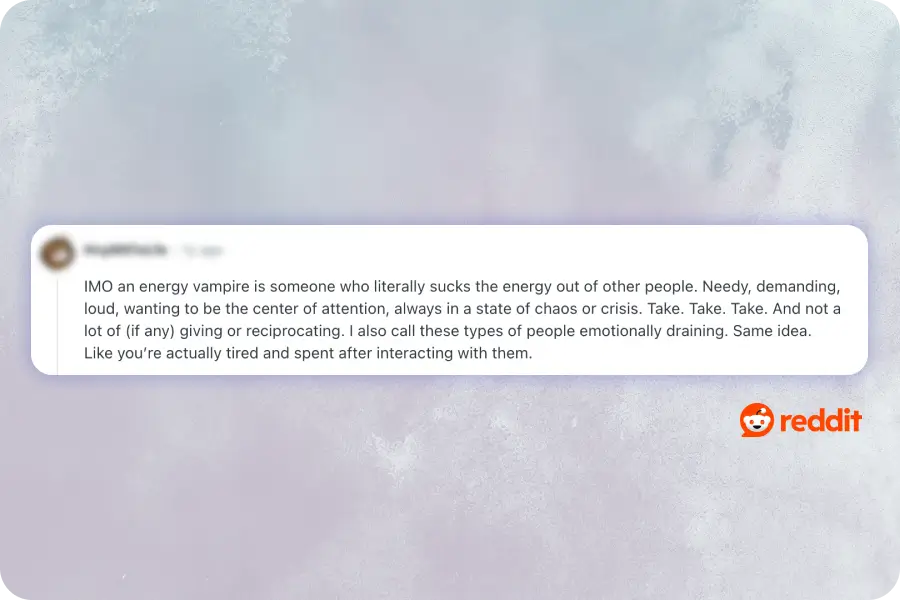
I’ve found this thought on Reddit, and I really like how it describes what I’ve experienced in communication with emotional vampires.
5. They cross boundaries
Do you feel uncomfortable when they send you dozens of voice messages? They don’t care. Do you ask them to say beforehand if they’re late for a friendly gathering? They won’t do it anyway.
It seems like setting boundaries doesn’t work when you’re spending time with an energy vampire. They may always behave in a way that’s comfortable to them, even if you’ve agreed to do something differently.
6. They ruin your good mood
Your energy drains slowly: at first, they complain about everything; then they don’t pay attention to your emotions; and finally, they seem like they don’t care about your life either. As a result, you come back home and feel emotionally exhausted, irritated, or strangely empty.
7. You’re feeling drained after each contact
It can seem like you’ve spent all your physical and emotional energy just to stay around this person. It happened to me with my former situationship. While everything started like a casual rebound, it then became pretty toxic.
I felt constantly tired after seeing them, even if we didn’t do anything intense. My thoughts were messy; I kept replaying conversations in my head, trying to understand what went wrong or what I should have said differently. Finally, I noticed that I feel much happier when they aren’t around. This is why our love story finished pretty quickly.

6 energy vampire personality traits
An energy vampire is someone who can be difficult to spot from the very beginning. That’s why I’ve gathered the key personality traits to watch for early on, so you can stay aware before the relationship or communication becomes too close.
- Zero accountability or responsibility. They rarely admit when they are wrong. Even obvious mistakes are explained away, blamed on circumstances, or shifted onto other people.
- One-upping everything. Whatever you share, they try to top it. If you’re tired, they’re exhausted. If you had a bad day, theirs was worse.
- Constant negativity. They focus heavily on problems, complaints, and what’s wrong in life.
- Passive aggression. They rarely say things directly. Instead, they use sarcasm, subtle digs, or “jokes” that feel slightly uncomfortable or hurtful.
- Victim mentality. They often see themselves as unfairly treated by life or others, even when they play a role in the situation.
- Inconsistency in closeness. They may swing between being overly close and suddenly distant, which creates confusion in relationships.
5 types of energy vampires
As you might have understood, I’ve met a lot of energy vampires. Some of them were easy to notice in social situations, while others seemed like charming people from the very beginning. So, later on, I found out that there are 5 types of emotional vampires, and they can behave differently.
1. The drama seeker
They always get in trouble or attract turmoil. Conflicts, crises, and emotional chaos seem to revolve around them. And they don’t try to deal with it alone. Instead, this type of emotional vampire can ruin the mental and emotional health of everyone around them, pulling others into their problems and turning small situations into constant tension and stress.
2. The victim
They often feel like life is unfair to them. Instead of looking for solutions, they tend to focus on how things always go wrong for them and expect others to comfort or rescue them.
True to say I used to behave the same way a long time ago. I often felt like everything was happening to me, not something I could change. However, when I started to delve deeper into the topic of emotional vampires, I noticed this negative outlook and worked hard to change it.
3. The attention seeker
Energy vampires feed on constant attention and validation from others. If everything you talk about is their problems and desires, this is often a sign you’re dealing with this type.
4. The controller
They try to manage people, situations, or emotions around them. It may be your best friend who always tells you what you should do or what is “right” in every situation.
For example, you say you don’t feel like answering messages today and need some rest, and they respond, “That’s not normal. You’re just avoiding people.” Instead of respecting your boundary, they try to redefine it for you and make you feel like your needs are wrong or unacceptable.
5. The narcissistic-type
This type tends to be highly self-focused and has difficulty seeing situations from other people’s perspectives. Conversations, decisions, and even conflicts often revolve around them. They may lack empathy and find it challenging to support you if you need them. These people don’t necessarily have a narcissistic personality disorder, but can show similar patterns of behavior.
Why do people typically become energy vampires or behave like that? Katherine Scott, M.Ed/Ed.S, LMFT, answers, “Commonly, ‘energy vampires’ come from family systems of energy vampires. Family cultures or unhealthy patterns of communication could create environments that teach people that the only way to feel heard is to do so in emotionally draining methods. More often than not, ‘energy vampires’ are hungry for connection, just as a toddler is when they seek out attention through negative behaviors. With the current pulled back, ‘energy vampires’ are just people with unhealthy methods of seeking connection.”
How to establish boundaries with people who drain your energy
As I’ve already said, setting boundaries in relationships with energy vampires may seem challenging because they often resist limits. However, there are several things that helped me in particular.
1. Pay attention to where you invest your own energy
“Do you really need to talk to this person?” That’s the first thing I started to ask myself when I noticed the first signs of toxic behavior. Energy vampires are people you can meet anywhere. However, not all of them deserve unlimited access to your time, attention, and emotional energy.
Sometimes the healthiest decision is not to “fix” the relationship but simply to step back and protect your mental well-being.
Of course, you may need to communicate with your boss or parents. Nevertheless, if it’s just a friendly acquaintance or someone you don’t feel emotionally safe around, it’s okay to reduce contact.
2. Seek support after emotionally draining communication
When you feel exhausted or emotionally overwhelmed after talking to someone, don’t ignore those feelings. Sometimes, even a short conversation with an energy vampire can leave you anxious, irritated, or mentally drained for the rest of the day.
Talk to a trusted family member or friend to feel that you’re not alone. Sometimes hearing an outside perspective can help you better understand the situation.
3. Focus on self-care and restring your emotional energy
According to the study, people with lower self-esteem may rely more on external approval. [2] Low AAY, Hopper WJT, Angelescu I, Mason L, Will GJ, Moutoussis M. “Self-esteem depends on beliefs about the rate of change of social approval.” Sci Rep. 2022 When I heard it for the first time, I understood that to feel better after communicating with energy vampires, I need to improve my self-esteem in general.
As such, I decided to focus on small self-care acts that will let me feel better daily. Here’s a brief list of things you can do (some of them I’ve tried myself, others helped my friends improve their self-esteem).
- Regular physical activity
- Creating a stable daily routine
- Limiting social media comparison
- Talking to supportive friends or family members
- Spending more time on hobbies you genuinely enjoy
- Practicing positive self-talk instead of constant self-criticism
- Setting small, realistic goals and celebrating progress
- Going to therapy or support groups
“I suspect that I may be an emotional vampire. How can I check it to know for sure?” Here’s an insight from Katherine Scott, M.Ed/Ed.S, LMFT, “Perspective is a very helpful tool in this situation. When in the proper headspace to receive honest feedback, seeking input from someone you trust or a mental health professional can expand your awareness of yourself in relation to others.”
How to stop being an energy vampire?
If you notice toxic behavior patterns in your daily actions, here’s what you can start doing to change them.
- Slow down and observe yourself in conversations. Notice if you tend to dominate the talk, interrupt others, or shift attention back to your problems too quickly. Awareness is the first step to changing any habit.
- Practice listening more intentionally. Let the other person finish their thoughts without rushing to respond or redirect the topic. Ask follow-up questions instead of immediately sharing your story.
- Pay attention to emotional balance. If you often bring heavy emotions into conversations, try processing them elsewhere first — through journaling, reflection, or calming yourself before talking to others.
- Respect boundaries. If someone seems tired, distracted, or less responsive, don’t push for more emotional involvement than they are willing to give.
- Check the “energy exchange” in your relationships. A healthy connection should feel mutual. If you feel like you’re giving less, you always can.
Characters with energy vampire symptoms in movies
Attention-energy vampires are people we meet on the streets and see on the cinema screens. So, here’s a list of such characters I’ve collected from Reddit, so you can see how these patterns can appear in popular stories and shows.
The endless talker
- Colm (Derry Girls) — talks in long, pointless stories that leave everyone exhausted.
- Rose Nylund (The Golden Girls) — constantly shares overly detailed stories that go on and on.
The boundary crosser
- Michael Scott (The Office) — demands attention and creates uncomfortable, awkward situations.
- Gail the Snail (It’s Always Sunny in Philadelphia) — invades personal space and ignores social limits.
The rule enforcer
- Sheldon Cooper (The Big Bang Theory) — enforces strict personal rules and expects everyone to adapt to him.
Frequently asked questions
Are energy vampires real?
“Energy vampire” is not a medical or psychological diagnosis. It’s an informal term people use to describe someone whose behavior consistently leaves others emotionally exhausted. While the label itself is not scientific, the emotional impact of difficult relationships can be very real.
How do you know if you're around an energy vampire?
You will feel it in the moment or afterward. Conversations can feel one-sided, emotionally heavy, or focused only on their needs and problems. After spending time with them, you may feel unusually tired, irritated, anxious, or emotionally drained, even if nothing openly negative happened.
Who attracts energy vampires?
According to the study, interpersonal vulnerability, boundaries, attachment patterns, and prior experiences may increase tolerance for harmful behavior. [3] Forth A, Sezlik S, Lee S, Ritchie M, Logan J, Ellingwood H. “Toxic Relationships: The Experiences and Effects of Psychopathy in Romantic Relationships.” Int J Offender Ther Comp Criminol. 2022 So, people who are empathetic, emotionally supportive, or patient and struggle with boundaries may attract energy vampires more easily.
Sources
- Buss DM, Gomes M, Higgins DS, Lauterbach K. “Tactics of manipulation.” J Pers Soc Psychol. 1987
- Low AAY, Hopper WJT, Angelescu I, Mason L, Will GJ, Moutoussis M. “Self-esteem depends on beliefs about the rate of change of social approval.” Sci Rep. 2022
- Forth A, Sezlik S, Lee S, Ritchie M, Logan J, Ellingwood H. “Toxic Relationships: The Experiences and Effects of Psychopathy in Romantic Relationships.” Int J Offender Ther Comp Criminol. 2022
Disclaimer
This article is for general informative and self-discovery purposes only. It should not replace expert guidance from professionals.
Any action you take in response to the information in this article, whether directly or indirectly, is solely your responsibility and is done at your own risk. Breeze content team and its mental health experts disclaim any liability, loss, or risk, personal, professional, or otherwise, which may result from the use and/or application of any content.
Always consult your doctor or other certified health practitioner with any medical questions or concerns
Breeze articles exclusively cite trusted sources, such as academic research institutions and medical associations, including research and studies from PubMed, ResearchGate, or similar databases. Examine our subject-matter editors and editorial process to see how we verify facts and maintain the accuracy, reliability, and trustworthiness of our material.
Was this article helpful?