


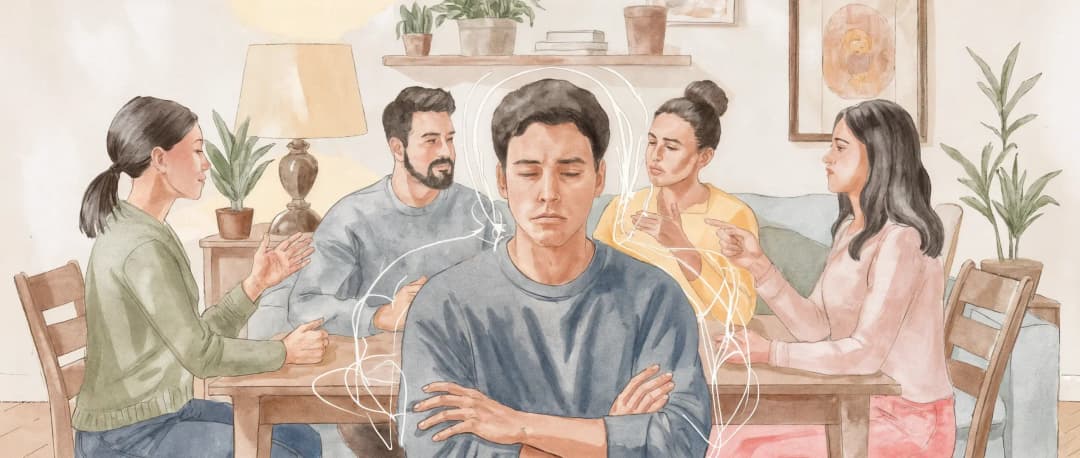
Have you ever noticed that you’re calmer with friends, coworkers, or even strangers than you are with your family members? In many families, people find themselves becoming unusually impatient and defensive around the closest people, research shows [1] South Richardson, D. Everyday Aggression Takes Many Forms. 2014 .
If you find yourself consistently conflicted or irritated within the family, this article can help you understand underlying causes and learn to process painful emotions and respond differently, preventing unhealthy relationships and poor communication.
You can start by taking an insightful Childhood Trauma Test to understand whether past emotional turmoil is affecting your adult life.

7 Causes Why You May Feel Irritated Around Your Family Members
Let’s explore the most common reasons why you may feel irritable within your family system.
1. Your Family Brings Out Old Negative Patterns
The dysfunctional family roles you played as a child can quietly continue into adulthood, contributing to feelings of loneliness, anxiety, isolation, or depression, according to a study [2] Merav Kalik Lerner, Sabina Lissitsa. “Black sheep”—physical, social, and behavioral diversity as a barrier to STEM educational choice. December 2024 .
Even if you’ve grown and changed, being around family can trigger old versions of yourself. A simple comment from a parent or sibling may stir up feelings that are much deeper than the moment itself because it taps into years of history.
For example, being asked a harmless question like, “Have you thought more about your career?” might feel less like curiosity and more like criticism if similar conversations have been stressful in the past.
You may also notice yourself slipping back into familiar roles without meaning to. For instance, the “responsible one” may feel pressure to fix everything, while the “different one” may become defensive more quickly. These reactions often happen automatically, shaped by patterns that were formed long ago.
2. You Feel Too Comfortable to Filter Yourself
While it feels counterintuitive, the people closest to us often receive the emotions we suppress everywhere else. It doesn’t make anyone a bad person. The reason we treat those we care about most worse than strangers is that the close relationship provides safety and intimacy that allows releasing painful emotions without immediate fear of abandonment [1] South Richardson, D. Everyday Aggression Takes Many Forms. 2014 . That’s why feelings may come out more freely, sometimes in messy ways.
Around strangers or coworkers, we intentionally monitor our tone and reactions. We’re more likely to pause before speaking. At home, that filter can disappear. As a result, you may unconsciously assume that family members will “understand” or tolerate your bad mood or passive-aggressive behavior.
If you’re noticing that your reactions feel stronger than you’d like, it might help to get a clearer picture of your emotional patterns. Try this anger test to gain insight into what might be driving such feelings.
3. You Have Unresolved Family Conflict
A sibling’s joke or a parent’s advice may touch on feelings of resentment that have never been fully addressed. In this case, irritability is often a surface emotion. Underneath it may be something deeper:
- feeling misunderstood
- feeling judged
- feeling unappreciated
- carrying old hurt from unresolved conflicts
- difficulty maintaining boundaries
4. Family Can Trigger Stress and Pressure
You may feel pressured to behave a certain way, visit them often, succeed in life, help financially, or have a certain sexual orientation. These high expectations can create a constant stress that turns into irritability.
This is especially common during holidays, family gatherings, or periods of stress in personal life. When you’re already emotionally drained, even small interactions can impact your emotional well-being.
5. You Feel Irritable Because of Emotional Distress From Other Areas of Life
Sometimes your family isn’t the real source of the irritation. Work stress, burnout, relationship problems, lack of sleep, personal insecurity, or anxiety can all lower your emotional tolerance.
Family simply becomes the place where those difficult emotions spill out. Because family interactions are emotionally loaded, they often become the easiest target for emotions that began somewhere else.
6. You Feel Angry Because Your Boundaries Are Violated
If family members often comment on your choices, invade your personal space, expect immediate access to your time, or dismiss your feelings, irritation can become a natural response. Sometimes what looks like anger is actually your mind signaling that something here doesn’t feel respectful or healthy.
7. Mental Health Conditions Can Contribute to Irritability
In some cases, persistent or intense irritability and behavioral problems may be linked to underlying mental health conditions. For example, borderline personality disorder (BPD), bipolar disorder, depression, anxiety disorders, or eating disorders can all affect emotional regulation and increase sensitivity in close relationships.
These conditions can make emotions feel stronger, shift more quickly, or become harder to manage—especially in environments that already carry emotional history, like family settings. As a result, reactions may feel disproportionate or difficult to control, even when you don’t intend them to be.
Expert Insight
The level and impact on your daily life are the biggest indicators of a need for additional support. If your ability to function effectively (at work, with friends, in your personal life, etc.) is suffering, it is time to speak with a professional.

Hannah Schlueter
Mental health professional
7 Tips to Make Positive Change in Communication & Handle Toxic Family Relationships
While you can’t always change your family, you can change how you relate to and interact with them:
1. Recognize your needs
Sometimes irritability points to unmet emotional needs, telling you that something inside you feels neglected. You may need:
- more personal space
- clear boundaries
- more rest
- more understanding
- more independence
- supportive environment
Instead of asking, “Why am I so angry?” it may help to ask, “What am I really feeling right now?“ or “What do I need right now that I’m not getting?” It can be stress, hurt, exhaustion, or feeling controlled or unseen. Once you identify the real emotion, it becomes easier to respond rather than react.
Another option is to journal your thoughts and patterns. Writing things down can help you make sense of what feels overwhelming in the moment. Guided Breeze journaling allows you to step back from emotional reactions and notice what emotions come up most often and what you tend to need but don’t express.
You don’t need to write perfectly or at length. Even a few lines like “I felt ignored during dinner conversation” or “I needed space but didn’t ask for it” can help you connect the dots between your emotions and your needs. Eventually, this practice can increase your self-awareness.

2. Notice the pattern while practicing self-acceptance
Becoming irritable around family does not make you selfish or ungrateful. It means there may be family dynamics worth understanding. Accepting emotions and recognizing triggers helps you respond more intentionally. Pay attention to when the irritation rises:
- Is it around certain family members or during certain conversations?
- When do you feel criticized by other family members?
- When do you feel trapped or obligated?
Try Breeze to monitor your feelings and moods. An in-app mood tracker can help you identify patterns and activities that make you feel bad by using statistics.

3. Practice setting boundaries
Setting boundaries is another step in protecting your own well-being, especially when dealing with toxic family members. This can look different for everyone, from intentionally keeping details of your personal life private to reducing contact or creating physical separation.
In more difficult situations, people may even consider family estrangement or choosing to permanently cut ties when relationships become consistently harmful and unsustainable. In the end, boundaries aren’t meant to punish anyone. They help you feel safer and respected.
Expert Insight
Feelings of guilt that arise from setting boundaries are often a result of past systems, expectations, or the perceived feelings of others. An important part of handling those feelings is to remind yourself that they do not last forever. Setting boundaries gets easier with practice and consistency.
Hannah Schlueter
Mental health professional
4. Schedule regular “me time”
Taking regular time alone in daily life allows people to reflect on their emotions and improve their emotional regulation, making it easier to make rational decisions, according to studies [3] Lisa Prescott Dixon, Brigham Young University. The Impact of Spending Time Alone on Emerging Adults’ Mental Well-Being. 2020. . When you’re constantly surrounded by others, especially in emotionally charged relationships, your nervous system has fewer opportunities to calm down and reset.
“Me time” doesn’t have to be long or complicated. It can be as simple as going for a walk, listening to music, journaling, or doing something that feels grounding and personal. What matters is consistency—creating regular space where you are not performing roles, managing conflict, or meeting expectations but simply reconnecting with yourself.
5. Adjust your expectations
Part of the frustration in poor relationships comes from expecting people to behave differently than they typically do. While it’s natural to hope for change, holding onto unrealistic expectations can lead to repeated disappointment when you spend time with family.
Accepting what you can and cannot change helps you focus on protecting your mental well-being. Not every disagreement will lead to understanding or closure. In some cases, continuing to push for a resolution only increases frustration. Letting go of the need to “win” or be fully understood can reduce emotional exhaustion.
6. Practice stress-resilience exercises
1. Emotional regulation practice
Try this when you feel triggered, overwhelmed, or pressured to respond:
- Take a deep breath.
- Count to 10 slowly, or take a short walk.
- Ask yourself the following questions: What images and thoughts appeared in your head? What sensations did you have in your body? What did you do or want to do? Do you need more time to respond clearly?
2. Give yourself time before reacting to emotional events
Develop the ability to accept difficult situations from a calmer and more reasonable position, not allowing negative emotions to perpetuate additional stress:
- Pause and notice your initial emotional reactions, like tension or irritation.
- Recognize the difficulty without passing judgment: “This is a tough moment, and that’s okay.”
- Ask yourself: “What is one thing I can control right now?”
- Choose a small, reasonable action or thought that helps you stay grounded, such as focusing on your breath or taking a short break.
3. Practice self-compassion
Mindfulness also helps you develop understanding and support for yourself in difficult moments. It may help you avoid strong criticism and not judge yourself for your own emotions or reactions.
You may try the mindfulness apps and the following practice to let go of self-criticism, blame, and harsh judgment. Notice when negative self-talk shows up. It may be a moment when you start feeling worthless or think, “Why do parents hate me?” When you catch it, pause and try to respond with compassion. Gently remind yourself: “I’m okay. I can handle this.” Support yourself as you would a close friend with patience, encouragement, and respect.
4. Create emotional “buffer time” after interactions
After spending time with family, give yourself space to decompress. This could include quiet time, a walk, or an enjoyable analog activity. Buffer time helps you process emotions instead of carrying stress into other parts of your day and affecting your mood, focus, and energy.
7. Try seeking support from a mental health professional
Approaches like family therapy typically address long-standing unmet expectations within relationships. A family therapist can help identify unhealthy patterns, guide more productive conversations, and create a space where each person feels heard and understood.
In some cases, support from a clinical psychologist may be more appropriate, especially when exploring deeper emotional patterns or strengthening your self-identity. Therapy can also support personal growth and help you build healthier coping strategies, improve social skills for handling conflict, and create functional relationships.
Frequently asked questions
1. Is it normal to feel more irritable around family than other people?
Yes, it’s normal. Family relationships are often tied to long-standing patterns, expectations, and past experiences, which can make reactions feel stronger and more immediate.
2. Why do small things my family does annoy me so much?
What seems like a small issue in the moment can trigger deeper, unresolved feelings. Irritation is often less about the current situation and more about accumulated history or repeated patterns.
3. Why am I more patient with strangers than with my family?
With strangers, you intentionally filter your behavior and manage your reactions. Around family, you feel more comfortable expressing unfiltered emotions, which can lead to more visible irritability.
Sources
- South Richardson, D. Everyday Aggression Takes Many Forms. 2014
- Merav Kalik Lerner, Sabina Lissitsa. “Black sheep”—physical, social, and behavioral diversity as a barrier to STEM educational choice. December 2024
- Lisa Prescott Dixon, Brigham Young University. The Impact of Spending Time Alone on Emerging Adults’ Mental Well-Being. 2020.
Disclaimer
This article is for general informative and self-discovery purposes only. It should not replace expert guidance from professionals.
Any action you take in response to the information in this article, whether directly or indirectly, is solely your responsibility and is done at your own risk. Breeze content team and its mental health experts disclaim any liability, loss, or risk, personal, professional, or otherwise, which may result from the use and/or application of any content.
Always consult your doctor or other certified health practitioner with any medical questions or concerns
Breeze articles exclusively cite trusted sources, such as academic research institutions and medical associations, including research and studies from PubMed, ResearchGate, or similar databases. Examine our subject-matter editors and editorial process to see how we verify facts and maintain the accuracy, reliability, and trustworthiness of our material.
Was this article helpful?