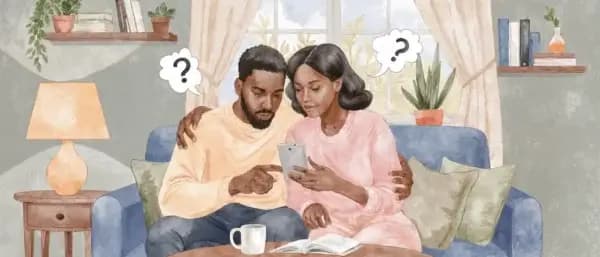


“I feel like I’m too needy. I constantly want to spend time with my partner and can’t do anything without them.” If you’ve ever thought something like this or your partner has ever told you that your attention feels overwhelming, this article is for you.
Keep reading to explore what it means to be clingy in romantic relationships, how to spot the signs of overly dependent behavior, and how to stop being clingy.
Your behavior may stem from an insecure attachment style. Take a quick & free test and get a personalized plan to stop being needy.
Clingy Meaning in Relationship: What Does It Actually Mean to Be Clingy?
Being clingy in a relationship means constantly needing reassurance, validation, and attention from your partner. For instance, you may call them 10 times a day, text them every hour to check where they are, or feel anxious if they don’t reply immediately. You may also cancel your plans so you’re always available and revolve your life around one person.
This behavior might stem from fear of abandonment, low self-esteem, relationship anxiety, or unmet emotional needs. And while initially it may seem like deep affection, over time it can create pressure. As a result, acting clingy can cause:
- Loss of personal space
- Emotional exhaustion for both partners
- Increased conflicts
- Decreased attraction over time
- Imbalance in emotional effort
- Fear of setting boundaries
- A higher risk of breakup
According to this study, clinginess and lack of personal space are among the most common causes of intimate relationship strain. [1] Apostolou M, Wang Y. “What makes It Difficult to keep an Intimate Relationship: Evidence From Greece and China.” Evol Psychol. 2021 So, if you want to build healthy relationships, being able to spot clingy behavior from the very beginning is essential.
Signs of a clingy person: Are you crossing the line?
The most common signs of a clingy partner include a lack of personal boundaries, the need for constant reassurance, being overly jealous, and difficulty spending time alone. While occasional insecurity is normal, these patterns become problematic when they limit freedom and create pressure. So, let’s explore these and other signs in detail.
1. You feel insecure about your partner’s feelings and need constant reassurance
Asking, “Do you still love me?” 20 times a day highlights inner insecurity. You might question their compliments and believe that your partner might leave you once you make even a minor mistake. You may repeatedly ask whether they:
- Still find you attractive.
- Are truly happy with you.
- Believe that their ex may be better at something.
- Would choose you again if they had the chance.
- Are trying to hide something from you, etc.
And even when your loved one assures you that anxiety stems out of nowhere, you might calm down for a few minutes and then feel worried again.
2. You can’t accept that your partner needs alone time
Anytime they want to spend an evening reading a book or playing computer games, you get worried. “Did I do something wrong?” you may think. And even if you stay together almost all the time, their desire to go to the gym alone might negatively influence your self-confidence.
In fact, when you don’t give your partner space to recharge and be themselves, it can make them feel controlled.
3. You call and text your partner too often and expect immediate responses
In healthy relationships, partners may call and text each other throughout the day when they’re busy at work or spend time separately. However, one of the signs of clingy behavior is your desire to constantly blow up their phone with calls and messages. The line between clinginess and care is different for every couple. Still, it may not be fine if you:
- Send multiple consecutive messages if they don’t answer quickly
- Feel anxious when they take longer than usual to reply
- Get upset if they don’t text you first
- Feel ignored if they’re busy for a few hours
- Find it challenging to focus on your day while waiting for their response

4. You check their socials all the time
Relationships’ clinginess may also manifest online. For instance, you might check when they were online on WhatsApp multiple times a day or check every account they start following. If you also compare yourself to people they follow, assume hidden meanings behind simple emojis, or create scenarios in your head without real evidence, it’s a warning sign that may highlight attachment issues.
5. You feel frustrated when your partner wants to spend time with their friends
There should only be one meaningful person in their life, and it’s you. If you believe in this statement, it might also signal that you’re a clingy partner. Of course, loved ones may also be the best friends. However, you can’t replace the whole world for a person. So, if you create guilt trips each time they plan a friendly gathering, remember that it might negatively influence relationship development.
6. You’re overly jealous
You may feel uncomfortable about your partner having colleagues of the opposite sex or start an argument anytime they occasionally look at someone attractive on the street. And while mild jealousy might be the norm, as it can simply reflect that you care about the relationship, uncertainty in your loved one’s loyalty may grow from insecurity rather than real threats.
The research states that pathological jealousy is associated with high impulsivity and anxiety. This, in turn, can negatively influence relationship dynamics. [2] Costa AL, Sophia EC, Sanches C, Tavares H, Zilberman ML. “Pathological jealousy: romantic relationship characteristics, emotional and personality aspects, and social adjustment.” J Affect Disord. 2015
7. You feel bored without your partner
A clingy person may try to be constantly together because they don’t know what to do alone. If your partner is your primary source of joy and you can’t feel happy if they’re not around, it can be a warning sign.
Free time may start to feel empty when you’re on your own. You might scroll through your phone just to distract yourself or wait for them to become available instead of making plans independently.
8. You try to speed up the relationship development
A desire to reach the commitment stage two weeks after the first date may be typical for clingy people. Of course, every relationship can develop at its own pace and in its own way. Nevertheless, when one partner needs some time to get to know each other better, and the other one insists on building a family right away, it can create emotional pressure.
This behavior might also be typical for narcissistic partners. They may want to speed things up and engage in “love bombing” just to stop showing affection on a random Tuesday, leaving you feeling frustrated.
9. You always adapt to their needs and neglect your own
Clinginess in relationships can also manifest in neglecting your wishes to make the partner happy. If they want to go to the cinema and you want to visit a cozy cafe, you may immediately agree with them, even if you feel disappointed. This pattern can show up in everything you do:
- You change your schedule to fit theirs, even when it exhausts you.
- You stop seeing friends because they prefer you to stay home.
- You dress, speak, or behave in ways you think they’ll approve of.
- You say “it’s fine” when something actually hurts you.
- You give up hobbies or goals to spend more time together.
Finding compromises and sometimes adapting to a significant other’s needs is okay. Yet, when it’s a one-sided scenario, the relationship may feel unbalanced and hurtful.
10. You constantly need physical contact
Physical affection is fine until it becomes something a clingy person uses to control the partner’s attention. Hugging, holding hands, cuddling, or having sex are normal ways to connect, but if you feel anxious when they are busy and can’t or don’t want to satisfy your need for physical contact immediately, it may signal dependence rather than intimacy.
11. You need help even with small tasks
We don’t talk about things you literally can’t or don’t know how to do. However, clingy behavior might involve constant attempts to make your partner busy solving your problems just to prove to yourself that you’re still valuable to them. It might include:
- Asking them to make small daily decisions for you.
- Constantly seeking advice.
- Relying on them to fix minor problems.
- Interrupting their time with frequent favors.
12. You engage in “protest” behaviors
Partner’s clingy behavior may also involve so-called “protest” behaviors. These are actions meant to get attention or a reaction when you feel insecure. Instead of openly saying, “I need you,” you might try indirect strategies to test their feelings. This can include:
- Flirting with others to make them jealous.
- Ignoring their messages on purpose.
- Posting vague emotional quotes online to get a reaction.
- Threatening to leave just to see if they’ll chase you.
A person acting clingy may believe that these behaviors can calm their anxiety. Yet, in the long term, it can damage trust within the couple.
Self-audit assessment to understand whether you’re clingy
Check yourself for clinginess in relationships. Answer 10 questions with “Yes” or “No.” Six or more “Yes” answers may signal that your behavior isn’t just overthinking. It may be a consistent pattern that can put pressure on your partner and strain the relationship.
- Do you feel anxious when your partner doesn’t reply quickly?
- Do you often ask for reassurance that they still love or value you?
- Do you cancel your plans to always be available for them?
- Do you feel uncomfortable when they want to spend time alone or with friends?
- Do you overthink their tone, short replies, or minor changes in behavior?
- Do you check their social media activity frequently?
- Do you feel responsible for keeping the relationship “alive” all the time?
- Do you struggle to enjoy your free time without them?
- Do you fear that one mistake could make them leave you?
- Do you feel empty or lost when you’re not in constant contact with them?
Breeze’s mood tracker can also help you understand whether you act clingy in romantic relationships. Notice your moods and their triggers for about a week, and then analyze your reactions. For example, if you feel irritated when your partner doesn’t share every small detail of their day, that pattern is worth paying attention to.
Am I too clingy in relationships, or is my partner emotionally unavailable?
Sometimes, so-called “clinginess” can be a normal reaction to your partner’s certain behaviors. For instance, if your significant other seems to focus only on themselves and rarely shows interest in your feelings, you may naturally try to fill those unmet needs in a relationship by seeking extra attention.
| Behaviors that signal you’re clingy in relationships | Behaviors that highlight your partner’s emotional unavailability |
| You panic when they don’t reply quickly. | They often disappear without explanation. |
| You need constant reassurance of their love. | They rarely express emotions or affection. |
| You overanalyze small changes in tone or behavior. | They avoid deep conversations about feelings. |
| You cancel plans to be available at any time. | They avoid making plans together. |
| You try to fix conflicts immediately out of fear. | They shut down or withdraw during conflicts. |
| You feel anxious even when nothing is wrong. | Their behavior makes you feel anxious because something actually feels off. |
Expert Insight
“When someone can’t tell whether they’re being clingy or their partner is emotionally unavailable, the first step is to shift focus from labels to patterns and needs. Consider asking yourself: “When I reach for connection, do I feel met, dismissed, or inconsistently responded to? And when I don’t reach, does my partner move toward me on their own?” Clinginess often softens when a person feels securely responded to, while emotional unavailability tends to show up as a consistent lack of responsiveness regardless of how calmly needs are expressed.”

Rychel Johnson
Mental health professional
Why am I a clingy one? Understanding the root of needy behavior
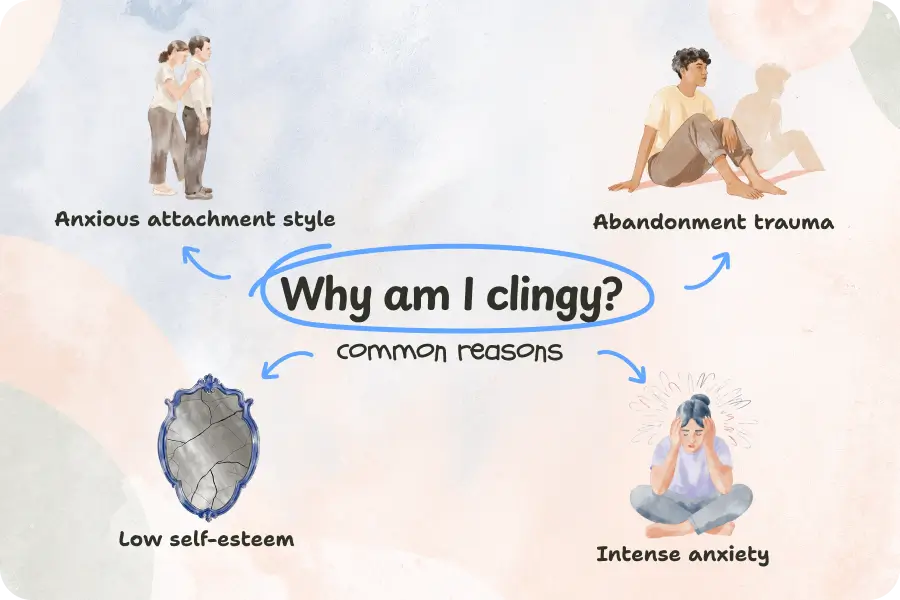
Clingy behavior toward significant others typically doesn’t stem from nowhere. This pattern can be caused by an anxious attachment style, trauma from childhood or past relationships, low self-esteem, and the fear of the unknown. Let’s explore some potential causes in detail.
1. Anxious attachment style
People with an anxious attachment tend to crave closeness but constantly fear losing it, according to the research. [3] Métellus S, Vaillancourt-Morel MP, Brassard A, Daspe MÈ. “Attachment Anxiety and Relationship Satisfaction in the Digital Era: The Contribution of Social Media Jealousy and Electronic Partner Surveillance.” J Marital Fam Ther. 2025 They may find it challenging to set healthy boundaries in relationships and feel calm only when they receive frequent reassurance.
Anxious attachment style may stem from negative childhood experiences, wounds from past relationships, or inconsistent emotional support from caregivers. The good thing is that attachment style can be changed over time. If you feel that acting clingy negatively influences your romantic relationships, professional help may be necessary.
2. Abandonment trauma
Some people may experience severe challenges in childhood that turn into trauma. For instance, if they experienced neglect, betrayal, or abandonment, it can turn into a strong sense of fear that loved ones will leave them.
It is more than just anxious attachment. It’s a deep-seated emotional wound that shapes how you relate to others. Unlike general anxiety, abandonment trauma can make even healthy relationships feel unsafe, triggering clingy or controlling behaviors as a way to “protect” yourself from anticipated loss.
3. Low self-esteem
If you believe you’re not enough and think your significant others can’t love you only for your personality, it can lead to clingy behavior. In particular, self-esteem issues might make you:
- Assume that your partner may always find someone better.
- Compare yourself to others.
- Fear of expressing your needs in case it drives them away.
- Give up your hobbies and friends if your partner doesn’t like something.
4. Intense anxiety
Anxiety may also influence your social life and the way you build relationships. Particularly because of the fear of the unknown, you may cling to what is familiar, and when you live in a constant state of “what if,” your partner becomes your source of safety. Such an attitude creates a cycle where any distance or situation in which a partner spends time alone feels dangerous.
How to stop being a clingy partner: 7 actionable steps to security
To stop being clingy and build relationships that focus on mutual trust and healthy connections, you need to start working on your anxiety daily. Here are some tips that might be rather helpful.
1. Notice clingy behavior
When you realize that you might be the clingy one in relationships, it can be the moment you embrace change. Once it happens, observe your behavior for a few days. Maybe you call too often, are rather jealous, or try to develop relationships quickly, and your loved one feels uncomfortable. You can also use the self-assessment provided above to check what particular actions may feel clingy.
2. Discuss it with your partner
Once you understand that certain behaviors can make your partner uncomfortable, it’s better to talk about it. Maybe, they don’t perceive it as clinginess but rather as genuine care. Or, maybe, they feel frustrated by actions you haven’t noticed and will be happy if you pay attention to them.
Also, an open talk is necessary to highlight your unmet needs and find a healthy way to meet them, which is still comfortable for both of you.
3. Communicate and establish boundaries
Find strategies that are acceptable for both of you. For example, your partner may want to spend every waking moment together with you on weekends but needs time on weekdays in the evenings to attend yoga classes alone. You can discuss everything that matters for both of you and causes frustration now, including:
- How often do you both prefer to text or call during the day?
- How much alone time does each of you need?
- Behaviors that feel supportive and ones that feel overwhelming.
- Boundaries around friends, hobbies, and social life that feel comfortable.
- How quickly do you both want the relationship to progress?

4. Find your passions and hobbies, and give your partner some space
To stop being clingy in a relationship, learn to pay attention to your own life outside it. You can find new analog hobbies or try something you’ve already done before. From dancing classes to knitting in a cozy cafe, it can be anything that makes you happy and distracts you from relationship-related anxiety.
5. Look for other ways to meet your emotional needs
There’s nothing wrong with having emotional needs within a relationship. However, you need to be able to handle your emotions on your own as well. For instance, you may need to seek support from friends and trusted family members, try grounding techniques, or practice journaling when you feel overwhelmed. You can also build small daily habits that strengthen emotional independence, like self-reflection, meditation, or physical activity.
6. Distract yourself when you feel that you’re crossing the line
Once you notice that you focus on the partner too excessively and everything else stops making sense, find a healthy distraction. Try some of the following ideas:
- Go for a walk without your phone.
- Call a friend.
- Start a 20-minute task, like cleaning or cooking.
- Do a short workout or stretch session.
- Read a few pages of a book.
- Write down what you feel instead of texting your partner.
Clingy reactions are strongest in the first emotional wave. If you give yourself time to cool down, you may realize that the urge to call, text, or check their socials has already passed.
7. Seek professional help
If you find it challenging to handle relationship challenges on your own, a licensed psychologist can help you develop an earned secure attachment. Seek help from your mental health provider, and they might suggest you attend a cognitive behavioral therapy specialist, an attachment-focused therapist, or trauma-informed counseling if past experiences influence your current relationships.
Rychel Johnson, M.S., LCPC, explains what a person can do if their partner is clingy. “When a partner is clingy, the goal isn’t to push them away but to create a balance between connection and individuality. Respond to them with warmth and reassurance while also setting gentle, consistent boundaries around their need for space. Clinginess often comes from anxiety or fear of disconnection, and reassurance can help, but over-accommodating at the expense of your own needs can lead to resentment.”
Summary: Turning your clinginess in relationships into a secure connection
Being clingy is a pattern of behavior that you are capable of changing. Notice your reactions and try to understand their causes, learn to handle difficult emotions on your own, and seek professional help if necessary. A loving and caring partner can support you in this way and help you feel valuable without the need for constant reassurance.
Sources
- Apostolou M, Wang Y. “What makes It Difficult to keep an Intimate Relationship: Evidence From Greece and China.” Evol Psychol. 2021
- Costa AL, Sophia EC, Sanches C, Tavares H, Zilberman ML. “Pathological jealousy: romantic relationship characteristics, emotional and personality aspects, and social adjustment.” J Affect Disord. 2015
- Métellus S, Vaillancourt-Morel MP, Brassard A, Daspe MÈ. “Attachment Anxiety and Relationship Satisfaction in the Digital Era: The Contribution of Social Media Jealousy and Electronic Partner Surveillance.” J Marital Fam Ther. 2025
Disclaimer
This article is for general informative and self-discovery purposes only. It should not replace expert guidance from professionals.
Any action you take in response to the information in this article, whether directly or indirectly, is solely your responsibility and is done at your own risk. Breeze content team and its mental health experts disclaim any liability, loss, or risk, personal, professional, or otherwise, which may result from the use and/or application of any content.
Always consult your doctor or other certified health practitioner with any medical questions or concerns
Breeze articles exclusively cite trusted sources, such as academic research institutions and medical associations, including research and studies from PubMed, ResearchGate, or similar databases. Examine our subject-matter editors and editorial process to see how we verify facts and maintain the accuracy, reliability, and trustworthiness of our material.
Was this article helpful?