



You start dating someone and think, “That’s it! Finally, I’m in love.” But what if you aren’t? Limerence, fear of loneliness, attachment issues, or even the excitement of something new can all feel surprisingly similar to love. In this article, we’ll highlight biological reactions and emotional shifts that can help you spot the difference.

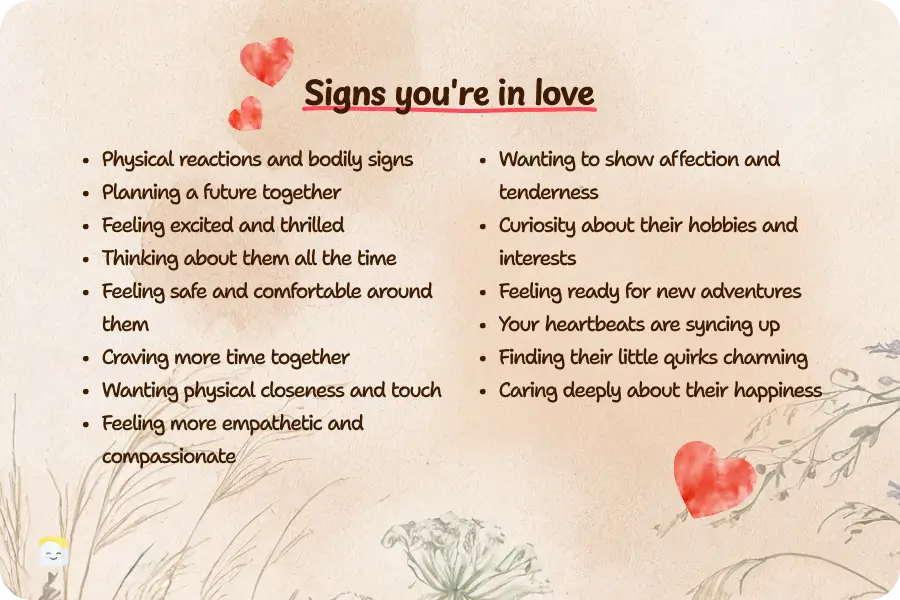
17 signs you love someone
Love usually develops over time and is built on trust, respect, emotional safety, and genuine care for each other’s well-being. So, here are some common signs that your feelings have deepened beyond the initial excitement of a new relationship.
Behavioral signs: How love shows up in real life
1. You unconsciously keep thinking about them
It doesn’t feel like an obsession but rather like thinking about someone you’d be happy to share your life with. When you see a T-shirt they might like at the store, you remember that green is their favorite color. When you hear a song, you wonder if they’d enjoy it.
This is different from constantly worrying about whether they like you or anxiously waiting for their next text. Instead, your thoughts are filled with a desire to share experiences together.
2. You stop noticing other attractive people
“Wow, they’re so cool,” you might have thought before about a stranger. But now you just don’t care. Your loved one has the most beautiful eyes and the warmest smile. While you can still recognize that other people are good-looking, they simply don’t capture your interest.
3. You rearrange your schedule without feeling resentful
You feel happy while spending time with them, so changing your plans doesn’t feel like a sacrifice. You might leave work a little earlier or wake up before sunrise just to have breakfast together. Instead of feeling like you’re giving something up or feeling forced, you’re excited about the opportunity to see them.
Of course, healthy relationships require balance, and constantly putting your needs aside isn’t a sign of love. But if you make space for someone in your life because they bring you joy, it can be a sign your feelings are growing deeper.
4. You experience excitement and euphoria
Your life starts seeming like a rom-com, and you feel like a teenager again. Due to the release of dopamine and noradrenaline, life becomes more colorful.
Traffic jams no longer irritate you, and even the most boring tasks feel easier because you look forward to seeing or hearing from them later. You may catch yourself smiling for no obvious reason, daydreaming about your next date.
5. You reach out to repair after a fight
Even the happiest couples can have arguments. Yet, people who are truly in love usually don’t focus on “winning” the conflict; they focus on repairing the relationship, despite their ego.
6. You instinctively want to share small, mundane moments
You send them a picture of a dog you see near your favorite coffee shop, tell them about a funny conversation you overheard, or text them when something reminds you of them. This is because you never forget about them and want them to be a part of every single moment of your life.
7. You find yourself adopting their interests
Their world seems so interesting and exciting. Soccer? You agree to attend a match together. Gardening? You’ve always dreamed of growing your own herbs anyway. Their favorite TV show? You decide to give it a try.
This doesn’t mean you lose your identity or pretend to like things just to impress them. You’re genuinely curious about what brings them joy.
8. You find their quirks cute
At the beginning of romantic relationships, their little habits and quirks often become some of your favorite things about them. Maybe they always mispronounce a certain word, dance while cooking, or have an oddly specific morning routine. Instead of finding these behaviors annoying, you see them as part of what makes them unique.
10. You remain curious about who they are becoming
As your loved one grows and changes, you want to rediscover them. You ask about their day not just out of habit, but because you want to know what’s on their mind. You notice new interests, changing opinions, and evolving dreams, and you’re excited to learn more about them.
11. You celebrate their wins as if they were your own
Their emotions and desires matter to you. And when they get a promotion at work or finally hit a personal goal, you feel a surge of real pride. Because your sense of self has expanded to include them, their happiness becomes your happiness.
12. You think about the future with them in it
Marriage and kids aren’t the only things you may dream about. Maybe you think about going to a concert in a year, buying an apartment together, or visiting your family members who live in another country. Discussing long-term commitments signals that it’s something more than just physical attraction.
14. You feel like you “crave” your partner
You find yourself wanting to be close to them more often. After a long day, they’re the person you look forward to seeing, texting, or calling. Their presence brings you comfort, so spending time together becomes something you look forward to.
This desire to be near your partner is common in the early stages of love, when the brain’s reward system is especially active. Simply hearing their voice or seeing them can lift your mood.
15. Tedious things feel exciting with them
Even grocery shopping or cooking dinner feels like something exciting when you’re together. You want to be with them and spend time together as much as possible. Over time, the relationship turns into a natural sense of commitment, as you simply enjoy doing life together.
Physical & somatic signs
When you fall in love, your brain becomes much more active, producing dopamine, oxytocin, and adrenaline that strengthen emotional connection and make spending time with your partner feel rewarding. These natural changes help create feelings of happiness, closeness, trust, and long-term attachment. [1] American Psychological Association. “What happens in your brain when you’re in love?” 2023
16. Your nervous system calms in their presence
Being in love can help your body feel calmer over time. While the early stages often bring excitement, butterflies, and higher stress hormones, long-term love usually helps you feel more relaxed and emotionally secure. Simply being with your partner, or even thinking about them, can help lower stress, while hugs, cuddling, and other affectionate touch promote bonding and a sense of calm. [2] Seshadri KG. “The neuroendocrinology of love.” Indian J Endocrinol Metab. 2016
17. Your body feels safe and grounded
“They feel like home.” Have you ever heard someone say that? This feeling often goes beyond words. Around the right person, your body may naturally relax. You don’t feel the need to stay on guard, overthink what you say, or constantly worry about being judged. Instead, you feel comfortable being yourself.
Expert Insight
The body can respond in many different ways; however, it’s normal to feel more rested and relaxed alongside someone you’ve built closeness and vulnerability with. If you are noticing more “fight or flight responses” being present for you as a result of the relationship, it could be worth communicating or seeking further support about.

Hannah Schlueter
Mental health professional
Am I in love? Quiz
Limerence vs. falling in love
Some people mistake the intense feelings of limerence for real love, especially at the beginning of a relationship.
- Limerence is an all-consuming infatuation fueled by uncertainty, idealization, and a strong desire for the other person to return your feelings.
- Falling in love is a deeper process in which attraction gradually grows into trust, emotional closeness, acceptance, and a desire to care for one another.
| Limerence | Love |
| Develops quickly and intensely. | Grows gradually over time. |
| You idealize the other person and overlook their flaws. | You see their strengths and imperfections and care for them anyway. |
| Your mood depends heavily on their attention. | Your feelings don’t rely on constant reassurance. |
| You obsess over texts and what they think of you. | You communicate openly without constantly overanalyzing every interaction. |
| You experience an intense fear of rejection or abandonment. | You feel emotionally safe, even during disagreements. |
| Boundaries may become blurred or ignored. | Both partners respect healthy boundaries. |
| You may neglect your needs, hobbies, or relationships. | You maintain your identity while making room for your partner. |
| The relationship is fueled by emotional highs and lows. | The relationship becomes calmer, more secure, and more consistent over time. |
| You may be more attached to the idea of the person than to who they really are. | You stay curious about who they are and who they’re becoming. |
| The relationship often feels emotionally exhausting. | The relationship brings a sense of peace and stability. |
| The intensity fades once uncertainty disappears. | Love tends to deepen through shared experiences, trust, and commitment. |
Can limerence turn into love, and, if yes, how does it happen? Hannah Schlueter, MA, LAC, answers, “Many factors influence the ability for limerence to become love. Limerence is most often one-sided and not based in reality. It can fade with certainty that is typically built over time in a deeper relationship. If the underlying motivators for the relationship can be adjusted, it would need to change to a relationship built on stability as opposed to dependency.”
Platonic vs. romantic love
Some people may also confuse the deep affection they feel for a close friend with romantic love, especially when the friendship is emotionally intimate.
Physical attraction
People in romantic love usually want to hug, kiss, and be physically close to each other. Platonic relationships don’t involve this kind of romantic or sexual intimacy. Even if physical touch is your love language, you typically don’t experience the same sense of passion or desire toward someone you love platonically.
Jealousy
Yes, we can feel jealous when a close friend spends more time with someone else. However, in romantic love, jealousy is usually connected to the fear of losing your place as their romantic partner or having that role taken by someone else. In platonic relationships, jealousy is more often about spending less time together or feeling left out, not about romantic exclusivity.
Desire for commitment
In platonic love, commitment centers around maintaining a friendship. You talk about weekend plans, wonder when you’ll see each other next, and support each other through life’s challenges. In romantic love, commitment usually goes further: you want to build a shared future, explore each other daily, make long-term plans together, and become each other’s life partner.
Priority
Your new love becomes one of your main life priorities, and you naturally start making time and space for them in your daily life. While close friends remain important, romantic partners often become the person you turn to share major decisions with and get support.
How to know if it’s true love
According to Robert Sternberg’s Triangular Theory of Love, there are 3 components of love:
- Intimacy — you trust each other, share your thoughts and feelings openly, and feel emotionally close.
- Passion — you enjoy physical affection, from holding hands to kissing and sexual intimacy.
- Commitment — you choose each other every day and make plans for a future together, even when the relationship isn’t always easy.
If at least one of these components is missing, the relationship may be something other than complete, lasting love, such as friendship, infatuation, or a relationship based mainly on attraction or commitment.
The 3 stages of romantic relationships
Maybe you aren’t in love yet, but your feelings only develop. Imago Relationship Therapy, developed by Harville Hendrix, PhD, and Helen LaKelly Hunt, PhD, highlights 3 stages of relationships.
1. Romantic love (or infatuation)
This is the exciting honeymoon phase, filled with butterflies, intense attraction, and constant thoughts about the other person. Fueled by dopamine, norepinephrine, and adrenaline, infatuation often feels euphoric and can make you see your partner through rose-colored glasses.
This stage usually lasts up to two to three years before either fading or developing into deeper love.
2. The power struggle
As the initial excitement fades, you start seeing your partner for who they really are. Their flaws become more noticeable, disagreements become more common, and the fantasy gives way to reality. Couples who learn to communicate openly, work through conflicts, and accept each other’s imperfections often grow into a deeper, more lasting love.
3. Conscious (mature) love
At this stage, the butterflies may not be as intense, but the relationship feels deeper and more secure. You know each other well, accept each other’s imperfections, and choose to keep growing together. Love shifts from the thrill of something new to feeling safe, supported, and at home with each other. Research suggests that relationships like these can also have a positive impact on well-being. [3] McIntyre KP, Mattingly BA, Stanton SCE, Xu X, Loving TJ, Lewandowski GW Jr. “Romantic Relationships and Mental Health: Investigating the Role of Self-Expansion on Depression Symptoms.” J Soc Pers Relat. 2023
Conclusion
Love isn’t something that develops overnight. Instead, it’s built through time, commitment, and the small choices two people make every day. If you’re asking yourself, “Am I in love?” you probably have real feelings for someone. And even if the answer is “not yet,” that doesn’t mean your relationship is going nowhere. Love often grows gradually, so give yourself time.
Sources
- American Psychological Association. “What happens in your brain when you’re in love?” 2023
- Seshadri KG. “The neuroendocrinology of love.” Indian J Endocrinol Metab. 2016
- McIntyre KP, Mattingly BA, Stanton SCE, Xu X, Loving TJ, Lewandowski GW Jr. “Romantic Relationships and Mental Health: Investigating the Role of Self-Expansion on Depression Symptoms.” J Soc Pers Relat. 2023
Disclaimer
This article is for general informative and self-discovery purposes only. It should not replace expert guidance from professionals.
Any action you take in response to the information in this article, whether directly or indirectly, is solely your responsibility and is done at your own risk. Breeze content team and its mental health experts disclaim any liability, loss, or risk, personal, professional, or otherwise, which may result from the use and/or application of any content.
Always consult your doctor or other certified health practitioner with any medical questions or concerns
Breeze articles exclusively cite trusted sources, such as academic research institutions and medical associations, including research and studies from PubMed, ResearchGate, or similar databases. Examine our subject-matter editors and editorial process to see how we verify facts and maintain the accuracy, reliability, and trustworthiness of our material.
Was this article helpful?