



At first, it feels like a fairytale. Constant compliments, endless attention, gift giving, and messages that make you feel like the center of someone’s universe. But sometimes, what looks like intense romance is actually emotional manipulation in disguise.
In this article, we’ll break down real-life love bombing examples, the manipulation tactics to watch for, and how to tell the difference between genuine affection and harmful behavior.

10 Love Bombing Signs & Examples
Love bombing is powerful because it mimics deep affection, but it often lacks balance and respect. Here are the most common signs:
1. They shower you with excessive compliments and constant praise
One of the most common signs of love bombing is being flooded with nonstop praise very early in the relationship. The person may constantly tell you that you’re “perfect,” “their soulmate,” or “the best thing that ever happened” to them, even though they barely know you.
While compliments are normal in healthy relationships, love bombing can be emotionally overwhelming.
2. They engage in early and intense talks about the future
Love bombers may try to move the relationship forward at an unusually fast pace. They may pressure you into commitment, exclusivity, making plans, and moving in together, or discussing marriage or having children together very early on.
People with an anxious attachment style are often more vulnerable to love bombing because they crave reassurance and closeness. Take an Attachment Style Test to better understand your relationship patterns and learn how they may influence the partners you choose.

3. They seek constant communication
At first, the nonstop texts and calls may feel romantic. However, a love bomber may demand constant contact and attention throughout the day.
For example, they may seek constant reassurance and text you from morning until night, showering you with messages like “I miss you” after only a few hours apart. They may also want to know where you are all the time and get insecure or upset if you don’t reply quickly.
4. They want all your time and attention
As communication becomes constant, they may quickly become possessive of your time and may even discourage you from spending time with other friends, family, or hobbies. They may say things like “Why do you need to go out with them when you have me?” or “I miss you too much when you’re away.” Eventually, this behavior can become controlling rather than caring.
5. They give you over-the-top gifts and show grand gestures
Love bombers may send flowers frequently, and use expensive gifts or surprise visits to impress you and create emotional dependency. A new partner may also buy highly personal gifts early on, such as custom jewelry, framed photos, or items connected to your deepest emotions, even when it feels disproportionate to how long you’ve known each other.
Or, they can make dramatic public displays of affection or extravagant romantic gestures to impress you and others. They may show up unexpectedly at your house, office, or favorite places and frame it as a “romantic surprise.”
6. Hot-and-cold behavior after intense affection
Once emotional attachment is established, some love bombers suddenly withdraw affection and become distant, critical, or manipulative.
After weeks of intense romance, they may become emotionally unavailable, ignore messages intentionally, start criticizing you, or use affection as a reward when you behave the way they want. This cycle can create confusion and make you wonder, “Why do I attract narcissists?“
7. They ignore your boundaries
According to research, another warning sign is when someone pushes physical, emotional, or personal boundaries very early in the relationship [2] Raashi Beri. A Study on Love Bombing, Narcissism and Emotional Abuse among Young Adults in Relationship and Situationship. June 2024 . A love bomber may pressure you to share deeply personal information quickly, show up unexpectedly, or push for intimacy before you’re ready.
8. They make you feel guilty for setting boundaries
Love bombers may react negatively when you ask for space or slow things down, which makes it harder to maintain healthy boundaries.
9. They say “I love you” extremely early
Declaring deep love almost immediately can sometimes be part of love bombing behavior. After only a few dates, they may say, “I know I love you already.” “I’ve never connected with someone like this,” or “You complete me.”
10. They make you feel responsible for their happiness
Love bombers may place emotional responsibility on you, making you feel guilty if you don’t meet all their emotional needs. They may say things like “You’re the only person who understands me,” “I can’t be happy without you,” or “You’re all I need.”
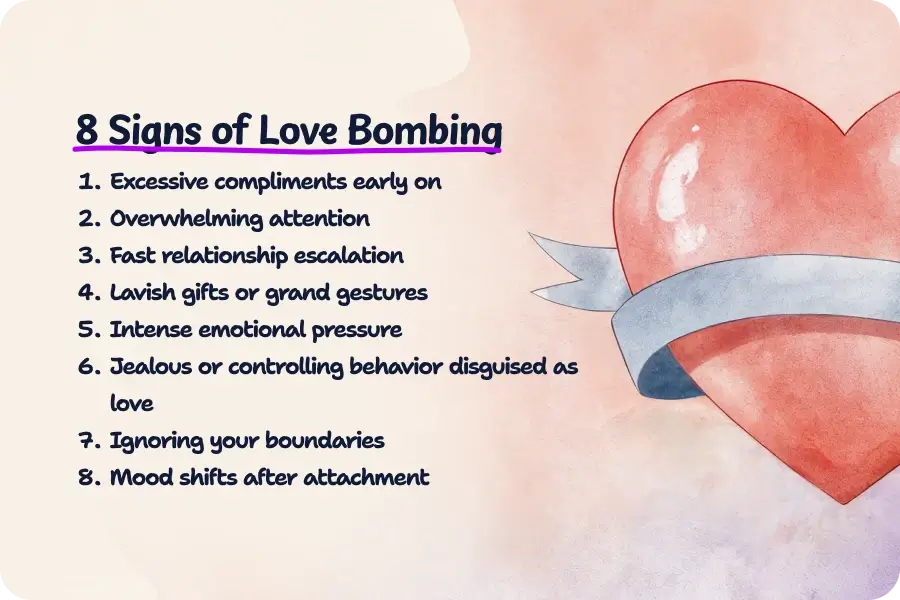
What Is Love Bombing?
Love bombing is a form of emotional manipulation where someone overwhelms another person with excessive affection, attention, compliments, gifts, or grand gestures, especially at the early stages of a relationship. While it may seem flattering or exciting at first, the intense behavior can be used to quickly gain control or emotional dependence, research shows [1] Claire Strutzenberg, Jacquelyn Wiersma-Mosley, Kristen N Jozkowski, Jennifer N Becnel. Love-bombing: A Narcissistic Approach to Relationship Formation. September 2017 .
Moreover, love bombing is not limited to romantic relationships. It can also happen in friendships, familial relationships, or even in workplaces, where someone uses excessive praise, gifts, or attention to gain influence and control.
However, love bombing is not always intentional. Some people may shower others with affection because of insecurity, loneliness, emotional immaturity, or attachment patterns.
5 Stages of Love Bombing
According to research, love bombing is commonly associated with people who display narcissistic tendencies and often follows patterns seen in the narcissistic abuse cycle [2] Raashi Beri. A Study on Love Bombing, Narcissism and Emotional Abuse among Young Adults in Relationship and Situationship. June 2024 . Understanding the stages of love bombing can help you recognize unhealthy relationship patterns early and protect your emotional well-being.
1. Idealization Stage
This is the beginning phase where the person showers you with excessive compliments and validation. They may act as though you are perfect and quickly try to create an intense emotional connection or an “idealized” relationship. At this stage, the relationship can feel exciting and passionate.
2. Dependency Stage
Once emotional attachment forms, the love bomber may try to become the center of your emotional world. They may encourage constant communication and slowly make you rely on them for validation, comfort, and attention.
3. Devaluation Stage
After gaining emotional control or attachment, the intense affection may suddenly change. The person may become distant, critical, manipulative, or emotionally inconsistent. This shift often leaves the other person confused and trying to regain the affection they received at the beginning.
4. Control Stage
In more toxic situations, the relationship may become emotionally controlling or abusive. The love bomber may use manipulation, guilt, or emotional pressure to maintain control. The relationship may start to feel unstable or unhealthy.
5. Repeat or Discard Stage
Some love bombers repeat the cycle by briefly returning to intense affection after conflict or emotional distance. Others may suddenly lose interest and move on once they no longer feel in control.
This stage may involve:
- Sudden apologies and renewed affection
- Promises to change
- Pulling you back in emotionally
- Abrupt emotional withdrawal or breakup
Expert Insight
Love bombing is one characteristic of narcissistic behavior, but it does not mean that anyone who love bombs others can be classified as a narcissist. There are many other traits and patterns to consider before applying this label.

Hannah Schlueter
Mental health professional
7 Tips to Deal with Love Bombing & Protect Your Mental Health
Dealing with love bombing can be confusing because it often starts like a dream relationship with intense attention and a fast emotional connection. The challenge is that what feels exciting at first can slowly turn into pressure and control. That’s why it may help you to learn how to slow things down, set boundaries, and stay grounded in reality.
1. Spot Red Flags
That’s why the first step is awareness. Love bombing may feel overwhelming rather than naturally comfortable. If something feels rushed or emotionally heavy early on, that’s worth paying attention to.
Breeze offers a variety of self-discovery tests on your childhood trauma, attachment patterns, personality, career, friendships, values, relationships, and more. These tools can help you gain deeper insight into who you are and what truly matters to you, and make it easier to manage emotions with greater self-awareness and confidence.

2. Slow the Pace Intentionally
A healthy person will respect the pace. A manipulative one may push back.
You may try the following:
- Take longer to reply to messages
- Avoid making fast commitments (labels, moving in, etc.)
- Limit how often you meet in the beginning
- Keep your daily routine unchanged
- Take time alone for reflection
- Don’t match your partner’s intensity just to “keep up”
3. Set Clear Emotional Boundaries
Boundaries are essential when dealing with love bombing, research shows [3] Raashi Beri. Love Bombing and Emotional Abuse among College Students. 2024 . They help you protect your time, energy, and independence. You may use phrases like:
- “I don’t text constantly during the day.”
- “I need time with my friends and family.”
- “I’m not ready for a serious commitment yet.”
- “I prefer to take things slowly.”
Expert Insight
There is room for a relationship to recover after instances of love bombing. This would require a lot of clear communication about boundaries and each partner’s wants and needs, as well as accountability around engaging in meaningful change.
Hannah Schlueter
Mental health professional
4. Watch Their Response to “No”
One of the clearest indicators of healthy vs unhealthy behavior is how they respond when you set limits. Pay attention to your partner’s reaction. Respect = healthy. Guilt, anger, or pressure = red flag.
5. Don’t Get Hooked on Intensity
Love bombing can feel emotionally addictive because it creates highs of affection followed by tension or uncertainty. However, healthy relationships are not built on emotional extremes. They are based on trust, respect, and communication.
Focus on Consistent Behavior, Not Big Gestures
Surprises and gifts can feel impressive, but a securely attached partner does not need constant dramatic gestures to prove their feelings.
Ask Yourself: “Do Their Actions Match Their Words?”
Love bombers often make huge promises very early in the relationship. They may talk about forever, loyalty, or commitment long before trust has truly formed. Pay attention to whether their behavior actually supports what they say.
For example, someone who claims to respect you should also respect your boundaries. Or, if they say they care about your happiness, they should not pressure or guilt-trip you.
Pay Attention to How You Feel Over Time
Strong chemistry and excitement can sometimes overshadow emotional discomfort. Instead of focusing only on moments of affection or big grand gestures, notice how the relationship affects your overall emotional well-being.
Don’t Excuse Red Flags Because of “Chemistry”
Intense attraction can make it easy to justify unhealthy behavior. You may think that “they’re just passionate,” “they care about me so much,” or “nobody has ever treated me this special before.”
But chemistry alone does not create a healthy relationship. Someone can be exciting, charming, and affectionate while still behaving in manipulative or controlling ways. If you notice behaviors like jealousy, possessiveness, boundary-pushing, or emotional inconsistency, take them seriously instead of dismissing them because the connection feels intense.
6. Seek Outside Perspective
Love bombing can distort your judgment because everything feels personal and emotional. You may experience gaslighting or begin second-guessing yourself. You may start thinking, “Maybe I’m being too sensitive,” or “They only act this way because they love me.”
People who care about you can notice unhealthy patterns that are difficult to see from inside the relationship. You may want to ask close friends or family members for honest feedback about the relationship and pay attention if multiple people express concern about controlling, manipulative, or isolating behavior.
7. Create Emotional Distance if Needed
Your emotional safety comes first. If the behavior continues or escalates, increasing distance and re-evaluating the sustainability of the relationship may be necessary.
Here are steps you can take:
- Reduce contact gradually or directly
- Stop engaging in emotional arguments
- Avoid responding to pressure or guilt
- Consider ending the relationship if your boundaries are not respected
Frequently asked questions
1. What are the signs of love bombing in a new relationship?
A love bomber may constantly text and call, rush the relationship, give you gifts early, talk about a future together very early on, or make you feel like you’re “perfect” after only a short time. Once emotional attachment is established, the behavior can shift into emotional abuse or even physical violence.
2. What’s the difference between genuine affection and love bombing?
Love bombing feels intense and rushed. It can sweep people off their feet fast—only to leave them confused, emotionally dependent, and questioning their reality later. Healthy affection develops gradually and respects boundaries. A healthy romantic partner gives you space and consistency, while a love bomber demands constant attention and emotional validation.
3. Why is love bombing considered a red flag?
Love bombing is a red flag because it can be the first stage of an emotionally abusive relationship. The extreme affection may later turn into jealousy, control, guilt-tripping, manipulation, or emotional withdrawal.
4. How to respond to love bombing?
The best response is to slow the relationship down and maintain healthy boundaries. Pay attention to consistency between words and actions, avoid rushing major commitments, and trust your instincts if something feels too intense too quickly.
Sources
- Claire Strutzenberg, Jacquelyn Wiersma-Mosley, Kristen N Jozkowski, Jennifer N Becnel. Love-bombing: A Narcissistic Approach to Relationship Formation. September 2017
- Raashi Beri. A Study on Love Bombing, Narcissism and Emotional Abuse among Young Adults in Relationship and Situationship. June 2024
- Raashi Beri. Love Bombing and Emotional Abuse among College Students. 2024
Disclaimer
This article is for general informative and self-discovery purposes only. It should not replace expert guidance from professionals.
Any action you take in response to the information in this article, whether directly or indirectly, is solely your responsibility and is done at your own risk. Breeze content team and its mental health experts disclaim any liability, loss, or risk, personal, professional, or otherwise, which may result from the use and/or application of any content.
Always consult your doctor or other certified health practitioner with any medical questions or concerns
Breeze articles exclusively cite trusted sources, such as academic research institutions and medical associations, including research and studies from PubMed, ResearchGate, or similar databases. Examine our subject-matter editors and editorial process to see how we verify facts and maintain the accuracy, reliability, and trustworthiness of our material.
Was this article helpful?