



Podcast name
Sexual Boundaries
Boundaries are limits we set to protect our time and energy. They can be physical, emotional, financial, professional, and, of course, sexual. Sexual boundaries may include what practices, types of touch, approaches, or behaviors you are and are not comfortable with. They may also involve contraception, STI prevention, privacy, or what happens before and after sex.
Talking about these boundaries openly helps create trust, respect, and a safer, more satisfying relationship.

Tips for discussing sexual boundaries with your partner(s)
Discussions about your personal boundaries can feel intimidating, especially if you are only starting to initiate intimacy with someone. However, it can help you ensure your emotional comfort and safety in the long term. Here are some tips on how to make such talks more comfortable and productive.
1. Define the things you love, the things you’re curious about, and your limits
Before initiating talks about sexual boundaries, it’s better to take some time and reflect on your preferences. It may also be a good idea to write your limits down and revise them over time. You can use a color system:
- Green. Things you like and want to try or keep practicing.
- Yellow. Things you’re curious about but need more information or experience before deciding whether you’re comfortable with them.
- Red. Things you know you don’t want to do under any circumstances or that make you feel unsafe or uncomfortable.
You can also distinguish hard and soft limits. “Hard” are the ones you’re absolutely “no” to in any case, and “soft” are things you don’t want to do now but may reconsider in the future if you feel safe and interested.
2. Choose the right time for the discussion
Talking about boundaries right in the middle of sexual experiences may not be the best idea (however, you need to always point out if something feels wrong). But when discussing your sex life in general and ensuring everyone’s in their comfort zone, it may be better to choose a more neutral setting.
You can talk about what makes sex bad or good for you during a calm walk in the park, a car ride, a cozy evening together, etc. Everyone should be fully clothed and relaxed, without feeling rushed, distracted, turned on, or under pressure.
It may be helpful to avoid post-sex conversations if everything was OK because it can make your partner think that something was wrong.
3. Point out that you talk about preferences and want everyone to feel comfortable
To feel connected and take care of your partner’s emotional well-being, use a phrase like “I want us both to feel comfortable, respected, and safe, so I’d like to talk about what we enjoy and what our boundaries are.”
Don’t make it sound formal and avoid “We need to talk” phrases beforehand. Just choose the time when you’re both in a good or neutral mood and focus on the fact that this conversation is about getting to know each other better, not pointing out mistakes or creating rules.

4. Use “I” statements and stay firm and clear
Approach discussing sexual behaviors with curiosity and without judgment. Don’t point out what your partner did or can do wrong. Instead, focus on your likes and desires. For instance:
Let them know what things are out of your limits. You can’t expect your partner to know what you’re thinking.
5. Engage in active listening
The goal of the discussion isn’t only to share your sexual boundaries but also to explore what makes your partner feel comfortable (or not). So, give them your full attention, avoid interrupting, and try to understand their feelings before responding.
Active listening means being curious about your partner’s experience instead of immediately defending yourself or trying to find a solution. You can ask clarifying questions like “Can you tell me more about why this feels important to you?” or “What would help you feel more comfortable?”
6. Respect your partner’s limits
“No” means “no” on both sides. So if your partner doesn’t want to engage in a sexual activity you’re interested in, there shouldn’t be any pressure, guilt, or attempts to convince them. Their boundaries are just as important as yours.
“I want to try a certain sexual activity, but for my partner, it’s completely non-negotiable. I don’t want to force them or even talk to them because I respect their boundaries. But what can I do with my desire to try this activity? (we’re in monogamous relationships).” Hannah Schlueter, MA, LAC, answers, “If your partner is open to it, it might be helpful to elicit feedback as to why it is a non-negotiable for them. Make sure your questions don’t come with pressure or attempts to influence them, but rather act as an attempt to better understand where your partner is coming from. If the activity you’re interested in is something you can engage in safely on an individual level, exploring this option is something to consider.”
7. Don’t agree to what feels wrong to you
The same works for you. If you set boundaries and your partner tries to convince you to do something you don’t want to, remember that you don’t have to compromise your comfort to please someone else. Your feelings, preferences, and limits are valid.
Sometimes people agree to things because they’re afraid of disappointing their partner, creating conflict, or being judged. However, you have the right to say “no,” change your mind, or ask to slow down at any moment. A respectful partner will value your honesty and care about your comfort rather than trying to persuade you to cross your boundaries.
8. Establish a safe word
9. Use tools if talking feels hard
If you find it challenging to talk about sexual boundaries directly because you feel too shy or worried, you can use special techniques.
- Create a “yes / maybe / no” list. Write down activities, preferences, or situations and categorize them based on your comfort level. Then share this list with your partner and discuss your answers together.
- Try conversation cards or guided questions. Special intimacy card decks or online questionnaires can make difficult topics feel more natural and less like an interview.
- Write a message first. If saying things out loud feels overwhelming, you can organize your thoughts in writing and use it as a starting point for a conversation.
- Start with small topics. You don’t have to discuss everything at once. Building a habit of open communication can make more vulnerable conversations easier over time.
10. Don’t hesitate to point out if something goes wrong during sexual intimacy
While all previous tips are focused on discussions aside from sexual situations, it’s important to point out that you can always say when something feels uncomfortable during intimacy. Don’t wait for the right time or expect them to understand your body language.
If something doesn’t feel right, communicate it immediately. You can use simple phrases like:
- “Can we slow down?”
- “I don’t like how this feels.”
- “I’d like to stop for a moment.”
- “Can we try something different?”
Of course, you can discuss it later on. However, some situations are easier to resolve immediately when both partners still remember what happened and can understand what needs to change.
Hannah Schlueter, MA, LAC, provides a tip on how to feel more confident when setting your boundaries. “Practicing assertive communication skills can build confidence in setting boundaries. Another option is to utilize reminders that promote feelings of empowerment, like knowing that boundaries can promote stronger connections in relationships and can also help ensure sex is pleasurable and not stressful.”
A word about consent
What boundaries in terms of consent may need to be discussed
- When you’re ready to start having sex (if you haven’t yet). While some people want to wait until marriage, others simply decide the timing is right for them. Research suggests that adolescents with prior sexual experience were less likely to endorse waiting until marriage and more likely to endorse relationship-based boundaries. [1] Wolf HT, Morrell HE, Halpern-Felsher BL. “Identification and characterization of adolescents’ sexual boundaries.” J Adolesc Health. 2013 This highlights that people’s expectations and values around intimacy can differ significantly, making it important to discuss them openly.
- How you prefer to say “yes” and “no.” Some people are comfortable being direct, while others prefer softer phrases like “Can we slow down?” Discuss what different words and signals mean for both of you. According to the study, females are significantly more likely to use verbal cues to communicate and interpret consent. [2] Richards MJ, Bogart A, Sheeder J. “Communication anad Interpretation of Sexual Consent and Refusal in Adolescents and Young Adults.” J Adolesc Health. 2022 Yet, it still highly depends on the person.
- How to handle hesitation. Decide what happens when one person seems unsure, quiet, or conflicted. For some couples, hesitation means “pause and check in,” while for others, it may mean stopping completely.
- How to check in with each other. Some partners appreciate occasional questions like “Are you still comfortable?” or “Does this feel good?” while others focus mostly on body language.
- Consent when alcohol or substances are involved. Talk about situations where someone’s ability to make clear decisions may be affected and what boundaries you both want to follow.
- Privacy and sharing information. Consent can also include agreements about intimate photos, personal details, and what aspects of your sex life stay private.
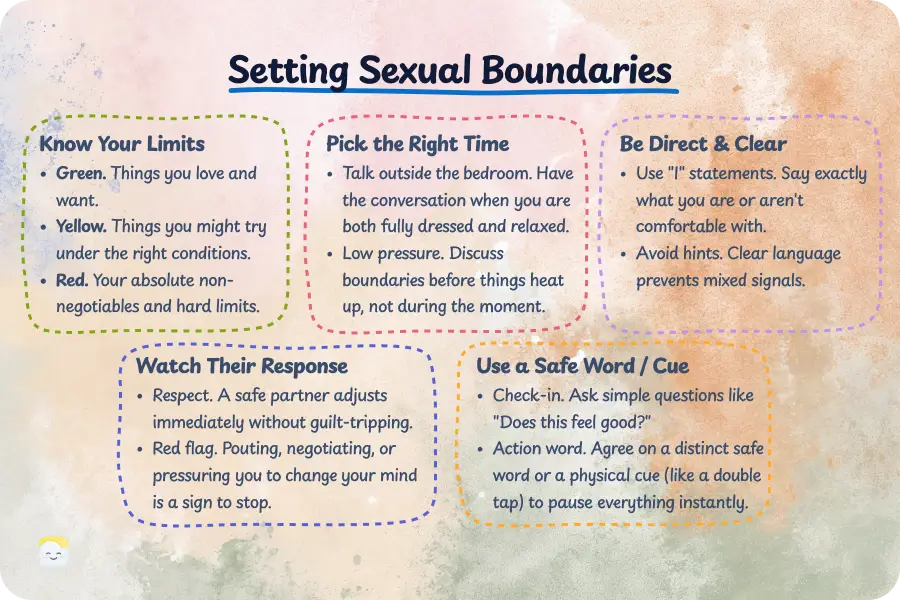
Types of sexual boundaries
Everyone can decide on their own which aspects of sexual intimacy need to be discussed beforehand. Yet, we still create a cheat sheet so you can remember everything and use it as a starting point for an open conversation with your partner(s).
Why it’s important to set sexual boundaries
The fact that you’ve communicated your boundaries makes you feel safe and promotes a better understanding of each other. This, in turn, can positively influence relationship quality.
1. You build trust
When you set boundaries and follow the ones your partner has, it creates a stronger foundation of trust and emotional security. Knowing that your limits will be respected can make it easier to be vulnerable, communicate openly, and develop a deeper emotional and physical connection.
2. It helps reduce misunderstandings
You know that your partner won’t do something that you find physically or emotionally uncomfortable. It creates a sense of predictability, making it less likely that either of you will have to guess what the other person wants or is comfortable with. Clear expectations can also make it easier to navigate new experiences together and address differences before they become conflicts.
3. Following sexual boundaries increases relationship satisfaction
Partners who openly discuss their expectations are often better equipped to resolve differences and adapt as their relationship evolves. This can lead to fewer conflicts around intimacy and a greater sense of compatibility.
4. When you do what your partner desires, it makes intimacy more enjoyable
You don’t have to guess what your partner likes or worry about doing the “right” thing. When you understand each other’s preferences, it’s easier to create experiences that feel satisfying for both of you.
5. Mutual respect and lack of pressure enhance well-being
Feeling like you can be yourself without having to ignore your own comfort or please someone else at all costs can take a lot of stress out of intimacy. When your choices are respected, you’re more likely to feel comfortable expressing your needs. At the same time, when boundaries are unclear or pressured, the risk of harm to your emotional well-being rises. [3] Budde J, Witz C, Böhm M. “Sexual Boundary Violations via Digital Media Among Students. Front Psychol.” 2022
Frequently asked questions
What if I’ve changed my mind and want to reset a certain boundary?
There’s nothing wrong with a desire to set sexual boundaries and rediscuss something that was previously agreed upon. Your preferences, comfort levels, and interests can change over time due to new experiences, personal growth, changes in your relationship, or simply a better understanding of yourself.
A boundary that was once a “no” can become a “maybe” or a “yes,” and something you once enjoyed can become something you no longer want. The important thing is that any change comes from your willingness and curiosity — not from pressure, guilt, or fear of disappointing your partner.
Does my relationship status influence my sexual boundaries?
You can communicate sexual boundaries to your partner(s), no matter whether you’re married, dating, or having a casual hookup. However, there can be certain things that you may find appropriate only in a licensed marriage or long-term committed relations.
Sources
- Wolf HT, Morrell HE, Halpern-Felsher BL. “Identification and characterization of adolescents’ sexual boundaries.” J Adolesc Health. 2013
- Richards MJ, Bogart A, Sheeder J. “Communication anad Interpretation of Sexual Consent and Refusal in Adolescents and Young Adults.” J Adolesc Health. 2022
- Budde J, Witz C, Böhm M. “Sexual Boundary Violations via Digital Media Among Students. Front Psychol.” 2022
Disclaimer
This article is for general informative and self-discovery purposes only. It should not replace expert guidance from professionals.
Any action you take in response to the information in this article, whether directly or indirectly, is solely your responsibility and is done at your own risk. Breeze content team and its mental health experts disclaim any liability, loss, or risk, personal, professional, or otherwise, which may result from the use and/or application of any content.
Always consult your doctor or other certified health practitioner with any medical questions or concerns
Breeze articles exclusively cite trusted sources, such as academic research institutions and medical associations, including research and studies from PubMed, ResearchGate, or similar databases. Examine our subject-matter editors and editorial process to see how we verify facts and maintain the accuracy, reliability, and trustworthiness of our material.
Was this article helpful?