



Podcast name
Permissive Parenting
Can too much freedom in childhood actually make it harder for kids to thrive later in life? What happens when children grow up without clear boundaries? Let’s take a look at parental permissiveness.
You can start by taking an insightful Emotional Intelligence Test to understand how well you recognize and manage your own emotions. It’s a great first step toward awareness of your family dynamics.

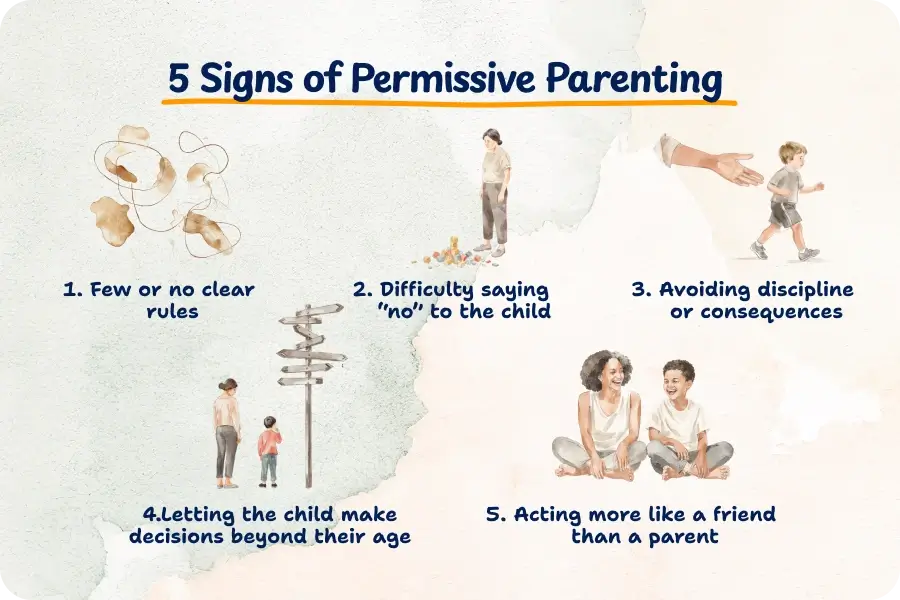
5 Signs of Permissive Parents
Do you have a permissive parenting style? You may find it out by taking the parenting style quiz. Here are some common signs and examples:
1. They lack boundaries and rules
Permissive parents don’t set household rules or impose limits. Even when rules do exist, they may be unclear or not consistently enforced, which can create confusion for the child. Permissive parents may find it difficult to say “no” or enforce consequences when a child misbehaves. Instead of correcting behavior, they may ignore it or excuse it.
For example, kids raised by permissive parents may be allowed to stay up late on school nights without a fixed bedtime, even when it affects their sleep and academic achievement. Or, a child may refuse to do homework, and the parent does not insist or check if it is completed.
Expert Insight
Trust that children thrive with clear limits and guidelines. Even when they protest, they do better when they know the rules and consequences for certain behavior. This establishes a basic homeostasis within the home and lets them feel safe knowing the adults are being the “adults” in the room.

Nicole Arzt
Mental health professional
2. They give a child excessive freedom
Permissive parents may rely too much on children’s choices, even when they are not developmentally ready to make those choices. This can include decisions about routines, behavior, or responsibilities.
A young child can be allowed to decide their own bedtime, screen time, and food choices without guidance or limits.
If you want to know how early patterns can shape how you see yourself in relation to others and how you raise children, take an insightful Childhood Trauma Test!

3. They act more like a friend than a parent
Permissive parents may focus more on being liked by their child than on providing guidance or raising them with a good value system. They may avoid setting authority to maintain a friendly relationship. A permissive parent may let the child skip chores or rules because they want to “stay on good terms” and avoid upsetting them.
Permissive parenting is also characterized by giving in to the child’s tantrums or demands. For instance, when a child throws a tantrum in a store, the parent buys the item just to stop the crying.
4. They’re inconsistent in enforcing rules
Rules and expectations in permissive parenting may change frequently or depend on the parent’s mood. This inconsistency and immaturity can make it hard for the child to understand what is expected. For example, a parent may forbid the child from using rude language, but later ignores it or laughs it off instead of correcting it.
5. They don’t have responsibility expectations
Children are not strongly encouraged to take responsibility for chores, homework, or their behavior, which can affect their independence and discipline. A child may consistently avoid cleaning their room or doing homework, and the parent can do it for them or overlook it.
5 Effects of Permissive Parenting on Child Development And Emotional Well-Being
Permissive parenting is a warm and caring style, but the lack of consistent discipline can have adverse effects on a child’s mental health, especially during early childhood development, when habits and behavior patterns are being formed.
1. Difficulty with self-discipline
Children of permissive parents may struggle to control their behavior or follow rules because they are not used to following clear limits. A child may find it hard to finish homework or stick to routines without constant reminders. They can also make poor food or hygiene choices, which may result in developing unhealthy habits that are harder to change as they grow.
2. Low frustration tolerance
Without boundaries, children may expect quick satisfaction and struggle when they do not get what they want. They may become upset or angry when things do not go their way or when they’re told “no” in school or social situations.
3. Emotional regulation difficulties and poor social skills
Some children may show impulsive or disrespectful behavior because limits are not consistently enforced. They may have frequent emotional outbursts and have difficulty sharing, taking turns, or respecting rules during group activities or play.
4. Low sense of responsibility
Children of permissive parents may not develop strong accountability for their actions. They can blame others for mistakes or for avoiding chores. As adults, they may continue to avoid responsibility or blame external factors for mistakes.
Expert Insight
You may be too permissive with your parenting if you don’t feel comfortable telling your children no or often feel like they are “running the show.” This is a sign that parenting may feel misaligned. Children can and should have input, but it’s essential for children to trust their parents can lead them well. This creates a safe and secure foundation.
Nicole Arzt
Mental health professional
What Is the Permissive Parenting Style?
Permissive parenting (or sometimes deemed ‘indulgent parenting’) is a style in which parents are warm, caring, and emotionally available but set few rules for their children. Permissive parents usually give their children a lot of independence, and they may act more like friends than authority figures. These parents typically avoid strict rules and often allow a high level of the child’s freedom in decision-making, even in early childhood.
While this parenting style creates a loving and accepting environment, it can sometimes result in a lack of guidance and consistency when it comes to discipline and boundaries, research shows [1] Ariana Awiszus, Melissa Koenig, Julie Vaisarova. Parenting Styles and Their Effect on Child Development and Outcome. August 2022. . As a result, children raised in this parenting style may struggle with self-regulation, responsibility, and understanding limits, even though they often feel loved unconditionally.
Permissive vs. Authoritative Parenting
According to a systematic review of parenting styles, the authoritative style is considered the most effective, contributing to greater life satisfaction in young people [2] Lavrič M, Naterer A. The power of authoritative parenting: A cross-national study of effects of exposure to different parenting styles on life satisfaction. September 2020 . Moreover, an authoritative parenting style is most protective against risky behavior [3] Muhammad Luqman Khan. Permissive Parenting, Self-Regulation, and Risk-Taking Behavior among Adolescents. March 2024 .
As a result, permissive parents often avoid setting limits, whereas authoritative parents set boundaries but still provide emotional support. This balance in authoritative parenting helps children develop better self-control, responsibility, and confidence.
6 Tips to Improve Your Parenting Style
Here’s how to develop healthier parenting practices to help a child understand boundaries, take on responsibility, and support emotional development.
1. Set clear rules and expectations
Children can feel more secure when rules are clear and as predictable as possible. Consistent expectations help children understand what behavior is appropriate and what is not:
- Create simple household rules together.
- Explain why rules exist instead of only enforcing them. Include the child’s input when discussing rules to increase cooperation and responsibility.
For example: “Homework is completed before screen time” or “We speak respectfully during disagreements.”
2. Use logical consequences instead of harsh punishment
One of the most effective parenting techniques is using logical consequences, where the consequence is directly connected to the behavior:
- Stay calm when applying consequences.
- Make sure consequences are reasonable and related to the specific action.
- Focus on teaching instead of shaming.
- Clearly explain why the consequence is happening so the child sees the connection between their actions and the outcome.
Temporarily losing privileges can also help children connect actions with consequences. For example, if a child repeatedly ignores screen time rules, they may temporarily lose access to their tablet or video games until they begin following the agreed limits responsibly.
3. Encourage responsibility
- Give age-appropriate chores and responsibilities.
- Teach children to apologize and repair mistakes.
- Praise effort and responsibility instead of only outcomes.
For instance, if a child forgets homework, encourage them to speak with the teacher themselves. Or, if there is school misconduct, discuss what happened calmly and create a plan for improving behavior instead of only punishing.
4. Support emotional regulation
Children often need help learning how to manage anger, disappointment, and stress in healthy ways:
- Validate emotions without removing boundaries. Instead of saying, “Stop crying right now,” try, “I understand you’re upset. Let’s calm down and talk about it.”
- Teach calming strategies like deep breathing or taking a break.
- Model healthy emotional behavior yourself. For example, instead of yelling when frustrated, calmly say, “I’m feeling upset right now, so I need a moment to calm down before we talk.” This shows you taking accountability and communicating how you intend to take care of yourself.
5. Balance warmth with guidance
- Spend Quality Time Together
Positive attention strengthens the parent-child relationship and helps children feel valued and emotionally connected. Even small daily moments of connection can improve trust and communication.
- Encourage Open Communication
Create an environment where children feel safe expressing emotions, opinions, and concerns without fear of ridicule or harsh judgment:
- Listen without interrupting immediately.
- Ask open-ended questions like: “What was the best part of your day?”, “How did that make you feel?”, or “Why do you think that happened?”
- Stay empathetic even when correcting behavior. You may say, “It’s okay to feel angry, but it’s not okay to hit,” or “I care about your feelings, but respectful behavior is still expected.”
6. Encourage healthy decision-making
Giving children opportunities to make decisions helps build confidence, responsibility, and problem-solving skills. However, too much freedom without structure or support can become overwhelming, especially for younger children who are still developing emotional regulation and judgment.
- Offer Limited Choices Instead of Unlimited Freedom
Limited choices allow a child to feel independent and improve cooperation. For example: “Would you like to clean your room before or after dinner?” or “Do you want to wear the blue shirt or the green one?”
- Teach Children to Think Through Consequences
Help children slow down and consider the possible outcomes of their decisions before acting impulsively:
- Ask reflective questions instead of immediately solving problems for them.
- Discuss both positive and negative consequences calmly to help a child develop critical thinking.
- Gradually Increase Independence
Children develop responsibility at different rates. As they demonstrate maturity, parents can slowly give them more independence and trust to test new limits. Start with small responsibilities, like giving them a simple weekly chore, such as setting the table or feeding a pet. Or, let them manage a small amount of pocket money and decide how to spend it.
Frequently asked questions
1. What is permissive parenting?
Permissive parenting is a style where parents are warm and supportive but set few rules or limits. Permissive parents tend to give children a lot of freedom, and discipline is often minimal or inconsistent.
2. How does permissive parenting affect a child’s behavior?
Children raised by permissive parents may struggle with self-discipline, responsibility, and respecting boundaries. They can become impulsive, have difficulty following rules, or expect immediate gratification.
3. Can permissive parenting lead to behavioral problems?
Yes, in some cases, it may contribute to self-regulation difficulties, poor academic performance, and challenges in social situations, especially if limits are not established.
4. Can permissive parenting be changed?
Yes, at any time these styles can change. Parents can gradually introduce set limits, healthy boundaries, and consistent expectations while still maintaining an emotionally supportive and loving relationship.
Sources
- Ariana Awiszus, Melissa Koenig, Julie Vaisarova. Parenting Styles and Their Effect on Child Development and Outcome. August 2022.
- Lavrič M, Naterer A. The power of authoritative parenting: A cross-national study of effects of exposure to different parenting styles on life satisfaction. September 2020
- Muhammad Luqman Khan. Permissive Parenting, Self-Regulation, and Risk-Taking Behavior among Adolescents. March 2024
Disclaimer
This article is for general informative and self-discovery purposes only. It should not replace expert guidance from professionals.
Any action you take in response to the information in this article, whether directly or indirectly, is solely your responsibility and is done at your own risk. Breeze content team and its mental health experts disclaim any liability, loss, or risk, personal, professional, or otherwise, which may result from the use and/or application of any content.
Always consult your doctor or other certified health practitioner with any medical questions or concerns
Breeze articles exclusively cite trusted sources, such as academic research institutions and medical associations, including research and studies from PubMed, ResearchGate, or similar databases. Examine our subject-matter editors and editorial process to see how we verify facts and maintain the accuracy, reliability, and trustworthiness of our material.
Was this article helpful?