



Do you have a strong sense that something about you doesn’t quite fit anymore? You might be questioning your choices, past experiences, or even who you are at your core. It can mean you’re in a period of major transition and self-reflection.
This article will help you better understand what an identity crisis is, why it happens, and how to support your mental well-being during identity shifts.
Start your self-discovery by taking an insightful personality test to reconnect with your sense of identity.

7 Common Signs You Might Be Experiencing a Personal Identity Crisis
You might go through an identity crisis if you’ve noticed the following:
1. Life feels meaningless
You feel lost and disconnected from things that once felt familiar, like your job, relationships, and hobbies. Activities that used to bring you joy now feel empty or routine, and new interests don’t fully stick either.
It can feel like you’re just going through the motions. You show up and do what’s expected, but without a real sense of purpose or fulfillment.
2. You’re constantly overthinking your future
Instead of feeling excited about the future, you may feel anxious, uncertain, or overwhelmed from trying to “figure everything out.” You may experience difficulties making even small decisions and find yourself stuck in spirals like:
- “Is this really me?”
- “Did I choose the wrong path?”
- “What am I even doing with my life?”

3. Your personality changes depending on where you are
You might feel like you don’t have a coherent identity, just different identities for different situations. You act one way with friends, another with family, and completely differently at work or online. Eventually, this can make you question which version is the “real” you, or if there even is one.
4. You feel torn internally
You feel torn between different values or desires. One part of you wants stability, while another needs change. You may feel pressure to meet others’ expectations while sensing that those expectations don’t align with who you truly are. This can create a constant inner tension, like you’re being pulled in opposite directions without clarity on what feels right.
5. Constantly questioning your values and beliefs
Things you once believed in strongly may no longer feel certain. You might start re-evaluating your opinions, values, goals, or even your worldview. This can feel unsettling, especially if your identity was strongly tied to those beliefs.
6. The urge to make sudden or drastic changes
You might feel a strong desire to change something like your career, appearance, environment, or lifestyle, in hopes that it will bring clarity or relief. While change can be healthy, these urges sometimes come from trying to escape the discomfort of not knowing who you are.
7. An increased sensitivity to others’ opinions
When your sense of identity feels unstable, external validation can start to matter more. You may rely on others’ approval to feel secure or second-guess yourself based on how others react. This can make you feel even more uncertain, as your sense of self becomes influenced by outside perspectives.
7 Tips To Overcome Identity Issues And Start the Path To Identity Achievement
Lack of stable identity can feel unsettling, but it’s also a natural phase of human development. Avoid trying to “fix” yourself quickly. Instead, you may build a clearer, more authentic sense of self through an ongoing process of personal growth and experience.
1. Try a guided self-reflection exercise
The first step to identity exploration lies in self-discovery and self-acceptance. To do this, try the following mindful exercise.
2. Define your personal values
Write down 10 things that matter to you, like honesty, freedom, stability, or creativity. Narrow it down to your top 3–5. Ask: “Am I living in alignment with these right now?”
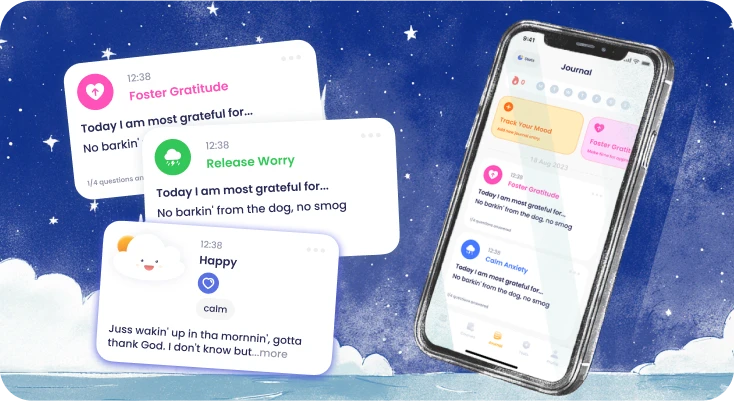
Guided Breeze journaling may help you notice patterns in your emotions and desires and become better equipped to actually feel your feelings and respond rather than react.
3. Practice cognitive reframing
An identity crisis often comes with harsh self-judgments and thoughts like, “I don’t know who I am,” or “I’ve wasted years becoming the wrong person.” Cognitive reframing is a technique that helps you recognize these thoughts and replace them with more balanced, realistic perspectives.
Repeat this exercise whenever self-critical thoughts arise. Eventually, reframing unhelpful thinking patterns can reduce anxiety, improve self-compassion, and make it easier to explore your identity with curiosity instead of fear.
4. Reduce comparison and practice self-compassion
Too many comparisons can distort self-perception. Try limiting social media time and unfollowing accounts that trigger self-doubt. Ask yourself: “Do I want this, or did I just see it online?”
Positive affirmations for personality development may also help you practice gratitude and rewire your inner dialogue with yourself each day, according to research [1] National Library of Medicine. Self-affirmation activates brain systems associated with self-related processing and reward and is reinforced by future orientation. November 2015. :
- “I embrace my uniqueness and recognize my inherent worth.”
- “I deserve support, unconditional love, compassion, and happiness.”
- “I’m moving in the right direction and have self-trust.”
- “I treat myself with the same kindness as I treat other people.”
- “Other people’s opinions do not define my self-worth.”
5. Develop a growth mindset
The idea that your skills and intelligence can be improved with commitment and effort is known as a growth mindset. Carol Dweck, a Stanford professor, developed the idea in her book “Mindset: The New Psychology of Success.” According to Dweck’s research, students who have a growth mindset perform better than those who have a fixed mindset [2] Stanford University. “Growth Mindset and Enhanced Learning”. .
Try adopting a growth mindset in your life if you want to become the best version of yourself.
6. Try “Identity Reset” exercise
You are not required to stay the same person forever.
Avoid forcing instant clarity. Replace “Who am I?” with “What feels right for me right now?” and allow uncertainty without rushing decisions.
7. Seek support
Emotional wounds can contribute to negative self-concept, low self-esteem, self-doubt, feeling unworthy of love, or even depression and anxiety disorders.
By offering yourself compassion for past experiences and getting rid of the emotional baggage, you can restore your energy resource, which will give you the strength to accept and love yourself and move forward more quickly, according to the research on the relationship between negative self-concept and trauma [3] Melamed DM, Botting J, Lofthouse K, Pass L, Meiser-Stedman R. The Relationship Between Negative Self-Concept, Trauma, and Maltreatment in Children and Adolescents: A Meta-Analysis. March 2024. . Understanding how early experiences have shaped you is the first step toward healing and growth.
You can also get social support from:
- Therapy or counseling. A therapist can help you explore your thoughts, emotions, and traumatic experiences in a safe, non-judgmental space. A trained mental health professional can also help you identify patterns that may be influencing your identity.
- Career coaching. If your confusion is tied to work or direction, a coach can help you assess your strengths, interests, and goals, and guide you toward more aligned choices.
- Trusted mentors or support groups. Talking to people who know you well or who have gone through similar experiences can provide emotional support, reassurance, honest feedback, and a sense that you’re not alone in what you’re going through.
Identity Crisis Meaning
An identity crisis is a phase where your sense of self feels unclear or unstable. You may start questioning who you are, what you believe, what you want from life, and whether your current life direction feels authentic.
An identity crisis occurs during major life transitions or even without a clear trigger. While it can create significant distress, it isn’t always a destructive crisis, indicating that something is “wrong” with you. It can be a period where you’re shedding old labels, expectations, and identities that no longer fit.
How Identity Develops
Psychologist Erik Erikson proposed that identity formation is a central developmental task, particularly during the teenage years. As we grow, our sense of self is shaped by our experiences, relationships, values, culture, and life roles.
Identity Crisis vs Identity Diffusion
Identity diffusion is a psychological phenomenon that describes a state where a person hasn’t finished the identity formation process. People experiencing identity diffusion often feel confused, inconsistent, or directionless, especially when making decisions about career, relationships, personal values, or even sexual identity.
| Feature | Identity Diffusion | Identity Crisis |
| Definition | Lack of a clear identity and low exploration | Questioning identity during change |
| Main state | Confusion + no direction | Internal conflict + active exploration |
| Commitment | No strong commitments to values, goals, or beliefs | Temporary uncertainty before forming new commitments |
| Typical question | “I don’t know who I am.” | “Who am I really?” |
| Cause | Lack of identity development or avoidance | Life transitions, stress, or self-reflection |
| Outcome | May persist without change or guidance | Often leads to identity formation or clarity |
| Example | Not sure about career, values, or direction, and not actively exploring | Questioning life choices after a breakup, graduation, or major change |
5 Identity Crisis Stages
An identity crisis doesn’t always follow a predictable pattern, but many people experience similar stages:
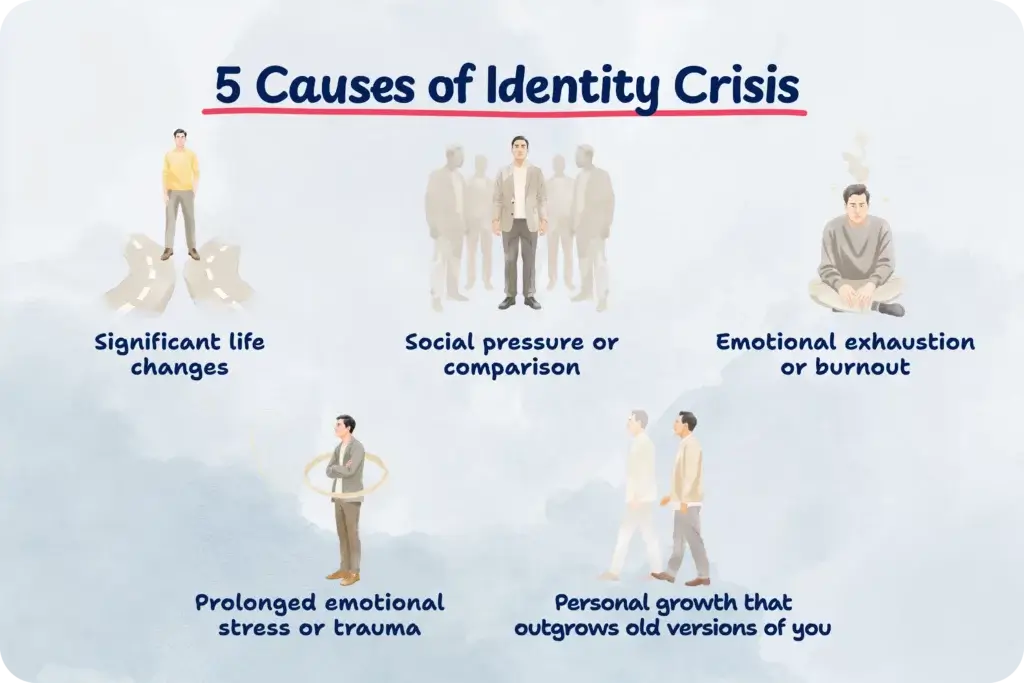
5 Causes of Identity Crisis
Identity confusion can come from many places, including:
- Significant life changes like graduation, career changes, breakups or divorces, and moving countries
- Social pressure or comparison
- Emotional exhaustion or burnout
- Personal growth that outgrows old versions of you
- Prolonged emotional stress or trauma, like loss, betrayal, or situations where you felt unsafe, unheard, or unsupported
What Are 4 Identity Statuses?
Identity statuses describe where you are in the process of figuring out who you are. They are based on two simple questions:
- Have you explored different options? (beliefs, goals, lifestyle)
- Have you made clear choices or commitments?
Depending on your answers, you fall into one of four identity states:
1. Identity diffusion. You haven’t explored much, and you haven’t decided either. You may feel unmotivated or unsure where to start, thinking, “I’m not sure who I am, and I’m not really trying to figure it out.”
2. Identity foreclosure. You’ve made decisions, but without questioning them. As a result, your identity can be shaped more by outside influence than personal choice. You may think, “I know who I am because it was expected of me.”
3. Identity crisis or identity moratorium. You’re actively questioning and exploring different paths, thinking, “I’m searching and trying to figure myself out.”
4. Identity achievement. You’ve explored your options and made choices that feel right for you. Your identity feels more stable and self-defined. A motto that characterizes you may sound like this: “I’ve thought it through, and I know who I am.”
Diagnosing Identity Issues
An identity crisis is not a mental health diagnosis. Instead, it’s a period of uncertainty about your sense of self that many people experience throughout life.
However, persistent identity-related difficulties can occur alongside mental health conditions such as anxiety disorders, depression, post-traumatic stress disorder (PTSD), personality disorders, or eating disorders.
A licensed mental health professional can evaluate whether identity concerns are part of a broader psychological condition.
Treatment for an Identity Crisis
Treatment focuses on helping you understand yourself rather than “fixing” your identity. Common approaches include:
- Psychotherapy. Cognitive behavioral therapy (CBT), acceptance and commitment therapy (ACT), and psychodynamic therapy can help you explore beliefs, values, and unhelpful thinking patterns.
- Mindfulness. Practicing mindfulness and grounding techniques helps you become more aware of your emotions without judging them.
- Values-based goal setting. Making decisions based on your personal values rather than external expectations can strengthen your sense of self.
Why Is Gen Z Having an Identity Crisis?
Several modern factors may contribute to increased self-questioning in Gen Z, according to research [4] Anastya Basyith, Yohamintin Yohamintin, Gianluigi Maulana Dhielfitri. Educational Challenges: Factors Causing Identity Crisis Among Generation Z. January 2024 :
- Social media. Constant exposure to curated lifestyles can encourage comparison and make it harder to develop an authentic sense of self.
- More life choices. Career paths, relationships, and lifestyles are more diverse than ever, which can be empowering but also overwhelming.
- Economic uncertainty. Rising living costs, student debt, and job instability can delay traditional milestones associated with adulthood.
- Changing social norms. Expectations around gender, careers, and relationships have become more flexible, leading many people to explore different aspects of their identity.
- Greater mental health awareness. Younger generations are more open to discussing emotions and personal development, making identity exploration more visible than in the past.
Frequently asked questions
1. How do I know if I’m having an identity crisis?
Common signs include feeling lost, disconnected from yourself, overthinking your life choices, losing interest in things you once enjoyed, and questioning your values or purpose.
2. How long does an identity crisis last?
There’s no fixed timeline. It can last weeks, months, or longer, depending on your situation. It usually resolves as you gain clarity through reflection and experience.
3. Is an identity crisis a bad thing?
Not necessarily. While it can feel uncomfortable, it often leads to self-discovery and personal growth. Many people come out of it with a stronger, more authentic sense of self.
4. Can an identity crisis happen more than once?
Yes. Identity evolves over time, so it’s possible to experience multiple periods of questioning, especially during major life transitions.
Sources
- National Library of Medicine. Self-affirmation activates brain systems associated with self-related processing and reward and is reinforced by future orientation. November 2015.
- Stanford University. “Growth Mindset and Enhanced Learning”.
- Melamed DM, Botting J, Lofthouse K, Pass L, Meiser-Stedman R. The Relationship Between Negative Self-Concept, Trauma, and Maltreatment in Children and Adolescents: A Meta-Analysis. March 2024.
- Anastya Basyith, Yohamintin Yohamintin, Gianluigi Maulana Dhielfitri. Educational Challenges: Factors Causing Identity Crisis Among Generation Z. January 2024
Disclaimer
This article is for general informative and self-discovery purposes only. It should not replace expert guidance from professionals.
Any action you take in response to the information in this article, whether directly or indirectly, is solely your responsibility and is done at your own risk. Breeze content team and its mental health experts disclaim any liability, loss, or risk, personal, professional, or otherwise, which may result from the use and/or application of any content.
Always consult your doctor or other certified health practitioner with any medical questions or concerns
Breeze articles exclusively cite trusted sources, such as academic research institutions and medical associations, including research and studies from PubMed, ResearchGate, or similar databases. Examine our subject-matter editors and editorial process to see how we verify facts and maintain the accuracy, reliability, and trustworthiness of our material.
Was this article helpful?