


Divorce isn’t just about the parents’ marriage ending. Children involved can struggle with anger, sadness, guilt, and confusion. Knowing what to watch for and how to support kids can make a big difference in helping them feel safe and loved during a divorce.
Have you experienced early childhood divorce and wondered if it’s still shaping your life in adulthood? Take a childhood trauma test to find out.

How Does Parental Divorce Affect Children?
According to research, divorce often impacts children emotionally, psychologically, socially, and in their religious sphere. Generally, it can change children’s lives in ways parents might not expect. The consequences can show up in school, friendships, and at home.
Here are the most common child outcomes:
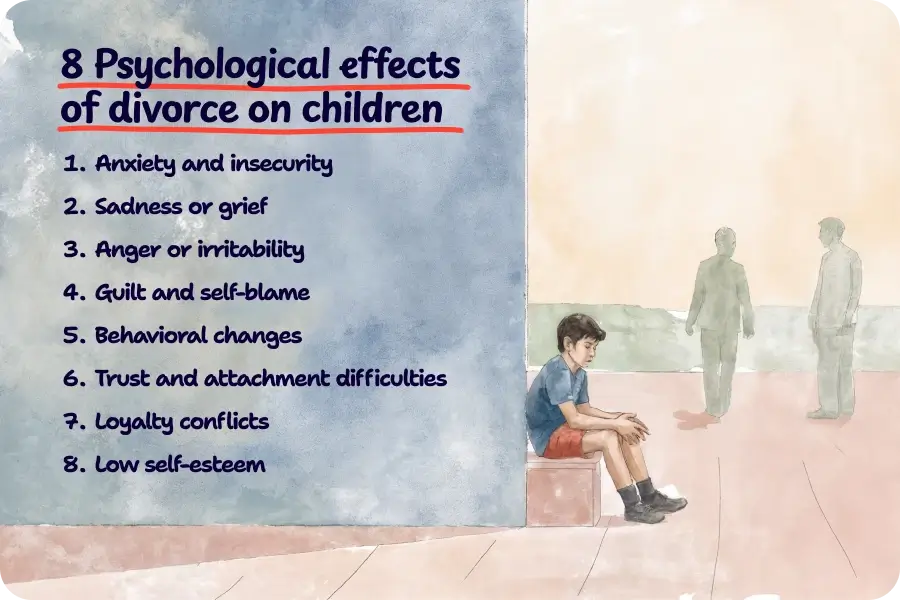
1. Guilt and low self-esteem
One of the most common effects of divorce on children is low self-esteem. Imagine a 12-year-old who starts thinking, “Maybe this is my fault,” or a teen who suddenly feels like they don’t matter as much anymore. According to research, children and teens from divorced families face an increased risk of challenges like lower grades, behavior problems, substance use, and depression. These challenges may be tied to feelings of insecurity and uncertainty during and after the divorce process.
2. Social isolation
Another common outcome is social isolation. Stress, changes in living arrangements, or stigma associated with divorce can make forming friendships more difficult. For instance, a child may stop calling friends or going to parties because they’re moving between two homes and adjusting to new routines, and their life feels unpredictable.
3. Lower academic performance
School can take a hit, too. Children from divorced households might see their grades slip or lose focus in class. Think of a 9-year-old trying to concentrate on homework while witnessing her parents arguing every night.
4. Problems with behavior and discipline
Then there’s the behavior side. Some kids act out their pain externally; they take risks, break rules, or test boundaries. Maybe a 15-year-old starts skipping curfew or experimenting with alcohol, partly because of stress or inconsistent rules at home. Teens are especially sensitive to tension and loss of control.
5. Adult child syndrome
Some children become “little adults” too soon and develop adult child syndrome. They might present as emotionally mature. When this is the case, they take on emotional responsibilities such as comforting a parent, worrying about money or the house, or trying to “fix” things, which can be overwhelming for their age.
6. Insecure attachment style
Long-term, some kids carry worries about relationships into adulthood. They may struggle with trust, fear intimacy, and have difficulties building stable relationships. As a result, they may also develop insecure attachment styles.
For example, a young adult might find it hard to commit because deep down they’re scared of repeating what they saw as a kid. A study confirms that children of divorced or separated parents are more likely to have unstable relationships later in life.

The Immediate vs. Long-Term Impact of Divorce
So, how does divorce affect children short-term and long-term? Here’s a table with examples and protective factors:
| Impact Type | Description | Protective Factors |
| Immediate (Short-Term) | Stress and adjustment difficulties soon after divorce | Warm, responsive parenting; honest communication; stable routines |
| Emotional | Shock, sadness, anger, fear of abandonment | Reassurance from both parents; age-appropriate explanations |
| Behavioral | Tantrums, withdrawal, regression (bedwetting, clinginess), school difficulties | Consistent parenting, structured routines, and monitoring of school progress |
| Cognitive | Confusion about family changes, self-blame (“Did I cause this?”) | Clear explanations, involvement in decision-making where appropriate |
| Social | Loyalty conflicts, feeling “caught in the middle,” withdrawal from peers | Encouragement of interaction with friends and mediation of parental conflicts |
| Long-Term | Outcomes that persist into adolescence or adulthood | High-quality parenting, low interparental conflict, stable environments |
| Emotional / Mental Health | Risk of depression, anxiety, and low self-esteem | Continued emotional support, therapy if needed |
| Relationship Patterns | Fear of vulnerability and commitment, challenges in trust, or desire for strong relationships | Positive modeling of conflict resolution, supportive relationships with parents |
| Academic / Social | Possible lower academic performance, social difficulties | Stable routines, involvement in school, and extracurriculars |
| Behavioral / Risk-Taking | Higher likelihood of substance use, early sexual activity, rebellion (especially if high conflict persists) | Consistent monitoring, guidance, and mentorship |
| Positive Adaptation | Increased independence, resilience, emotional maturity, and closer bonds with parents | Warm, consistent parenting; cooperative co-parenting; stability |
Effects on Children by Developmental Stage
Children may experience divorce differently depending on their developmental stage. Age influences how they understand the situation and process emotions.
1. Infants and toddlers (0-3 years)
- Limited understanding of divorce. They react most strongly to changes in routine and emotional climate.
- May experience separation anxiety from their primary caregivers.
- Regression in behaviors, such as sleep disturbances or toilet training setbacks.
2. Preschoolers (3-6 years)
- Egocentric thinking: may believe they caused the divorce.
- Express emotions through tantrums, crying, or play that reflects sadness or anger.
- Difficulty understanding that separation can be permanent; may hope for reunification and make comments about it.
3. School-age children (6-12 years)
- Better cognitive understanding of divorce, but still tend to fall into a shame spiral.
- May experience academic and behavioral problems or a high level of social anxiety.
- Heightened awareness of parental conflict, which can increase stress.
4. Adolescents (13-18 years)
- More cognitively mature and understanding of causes and consequences.
- May experience anger or loyalty conflicts toward one parent.
- May engage in risk-taking behaviors, including substance use, early sexual activity, or rebellion.
- Can develop coping skills if supported properly.
5. Emerging adults (18-25 years)
- Divorce may influence views on relationships and commitment.
- Some may carry unresolved emotional issues from childhood.
- Others develop resilience and independence, especially if they had supportive parenting.
The Conflict Variable: Why “How“ Parents Divorce Matters More Than “If”
Divorce itself is not the biggest predictor of harm, but these factors are:
- Level of parental conflict. Witnessing ongoing hostility and toxic family dynamics are more damaging than separation. Children often do better in low-conflict divorced homes than in high-conflict non-divorced families, research shows.
- Quality of parenting. Warm, consistent, and responsive parenting protects children. When a parent shows care and listens to a child’s concerns, it makes a kid feel safe.
- Communication. Honest, age-appropriate explanations help reduce confusion and self-blame. Recent research shows that children whose parents asked for their opinions had fewer signs of depression, a better quality of life, and stronger, more secure relationships with their parents than those who were not asked.
8 Strategies To Help Children Cope with the Impact of Divorce
There are practical evidence-based ways parents can make it easier for children to adjust and feel secure:
1. “No-messenger rule” (all ages)
One of the most important rules after a divorce is this: kids should never be put in the middle. That means no carrying messages, no passing money or documents, and no handling emotional burdens between parents.
It might seem small, like saying, “Tell your dad to call me,” but for a child, this can feel like pressure or responsibility they’re not ready for. As a result, it can create anxiety and loyalty conflicts, where they feel like they have to choose sides or keep one parent happy.
Instead, divorced parents should communicate directly with each other through text, calls, or co-parenting apps, so the child stays out of it.
Also, avoid asking kids what the other parent is doing (“Who was there?” “What did they say?”) and complaining about the other parent in front of them.
By avoiding putting kids in the middle, they:
- Feel less pressure and guilt
- Can love both parents without conflict
- Feel safer and more emotionally secure
- Get a powerful message: “Your job is to be a kid. We’ll handle the rest.”
2. Draw your feelings (ages ~4-10)
Kids often can’t verbalize complex emotions. Ask them to draw their family, their feelings, or “what divorce feels like.” Then gently ask: “Tell me about your picture.” This opens conversations without pressure.
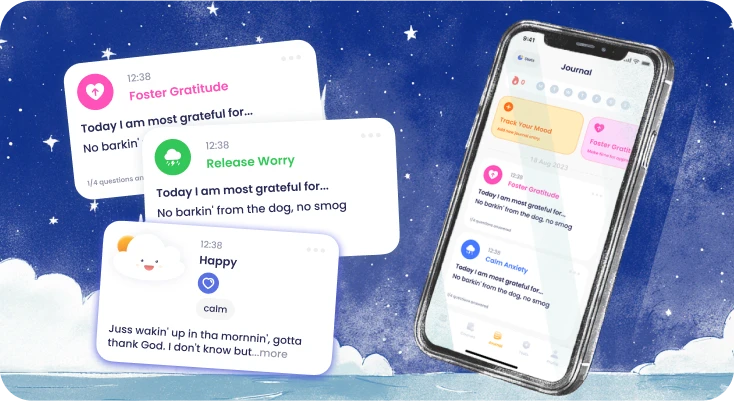
Older kids may try reflective writing. Encourage them to keep a journal or use digital tools like Breeze journaling apps to record daily thoughts and feelings and track patterns in moods or worries.
3. Try “Worry rocks” or “Worry box” (ages ~5-10)
Have kids paint small stones or decorate a box. A child can put their worries into the box (draw them, write them, or just say them out loud). The idea: “Your worries have a place to go, you don’t have to carry them all the time.”
For example, a 7-year-old paints a rock and says, “This is my worry about Mom leaving again,” and puts it in the box before bed.
4. Create a visual schedule (all younger kids)
Predictable routine reduces anxiety because children can see what’s coming instead of guessing. Use a calendar with colors, stickers, or drawings to show:
- “Mom days” and “Dad days”
- School, activities, weekends
Visual schedules make activities and changes explicit. This can be grounding.
5. Practice feelings check-in ritual (all ages)
Build a simple daily habit: at dinner, bedtime, or during a car ride, gently check in with your child’s emotions. You may ask, “What was the best part of your day? What was the hardest?”
For younger children, you can make it more visual and playful:
- Use an emoji chart and let them point to how they feel
- Try color zones (e.g., red = angry, blue = sad, green = calm, yellow = worried)
- Ask them to draw their day instead of explaining it
The key is to listen without jumping in to fix things right away. Sometimes a simple response like “That sounds really hard” or “I’m glad you told me” is enough to help them feel understood.
This small ritual teaches kids that:
- Their feelings are safe to share
- You’re available and listening
- Emotions come and go and can be managed
6. Get a comfort object between homes (all younger kids)
Transitions between homes can be one of the hardest parts of divorce for kids. To give them a sense of continuity, let them carry something meaningful between homes. It can be a toy, stuffed animal, bracelet, or matching items at both houses. The idea is that this object becomes a bridge between two worlds. Even though the physical space changes, something constant goes with them.
For example, a child might sleep with the same teddy bear at both their mother’s and father’s houses or wear a bracelet one parent gave them when they start to feel anxious. You can also give it meaning: “This stays with you wherever you go,” or “It’s a reminder that both homes love you.”
7. Transition rituals (all ages)
Create small routines when switching homes. It can be a goodbye hug and a phrase like “See you soon, I love you,” or some fun ritual like getting a snack or listening to a favorite song in the car. Such predictability makes transitions less stressful.
8. Set regular, intentional one-on-one time (all ages)
Even 10-15 minutes of focused attention with no phones and no distractions lets them feel seen and valued. Let the child choose the analog activity. It could be:
- Drawing or coloring together
- Building with blocks or Legos
- Playing a board game or card game
- Going for a walk or tossing a ball in the yard
- Baking cookies or preparing a snack
For older kids and teens, one-on-one time can be adapted:
- Let them pick a coffee shop visit or a shared hobby
- Use this time to listen without lecturing
- Encourage them to share frustrations or joys
Conclusion
Divorce can be tough for children, but it doesn’t have to define their future. Low parental conflict, warm and consistent parenting, and stable routines matter far more than the divorce itself. By protecting children from adult stress, encouraging open communication, and supporting their emotional needs, parents can help their kids adapt and build resilience. With love and attention, children can cope with transition and grow into confident, emotionally healthy adults.
FAQ
Frequently asked questions
1. How does divorce affect children emotionally?
Children may experience a mix of emotions, including sadness, anger, guilt, confusion, and anxiety. Younger children may feel abandoned or worry that the divorce is their fault. Older children and teens may struggle with loyalty conflicts or fear of future relationships. These emotional reactions often ebb and flow based on circumstances.
2. Do children always experience long-term harm after divorce?
No, not inherently. Divorce itself is not a guarantee of long-term harm. Children are more likely to thrive if parents maintain warm, consistent parenting, low conflict, and stable routines. Many children develop resilience, independence, and emotional maturity through the experience.
3. How can I make transitions between homes easier for my child?
- Use rituals or routines for moving between homes
- Allow a comfort object to travel with them
- Keep communication positive and predictable
- Avoid making them a messenger or putting them in loyalty conflicts
Sources
- Olav Tveit, Espen Røysamb, Kristin Gustavson. Consulting Children When Parents Divorce: Longitudinal Associations with Mental Health and Parent–Child Relationship Outcomes. July 2025
- Rianne van Dijk, Maja Deković, Inge E. van der Valk, Susan Branje. A meta-analysis on interparental conflict, parenting, and child adjustment in divorced families: Examining mediation using meta-analytic structural equation models. May 2020
- Panchal Maulik Krushnalal, Amarjeet Kumar. Effects of Divorce on Children: A Study. April 2024
- D’Onofrio B, Emery R. Parental divorce or separation and children’s mental health. World Psychiatry. February 2019
Disclaimer
This article is for general informative and self-discovery purposes only. It should not replace expert guidance from professionals.
Any action you take in response to the information in this article, whether directly or indirectly, is solely your responsibility and is done at your own risk. Breeze content team and its mental health experts disclaim any liability, loss, or risk, personal, professional, or otherwise, which may result from the use and/or application of any content.
Always consult your doctor or other certified health practitioner with any medical questions or concerns
Breeze articles exclusively cite trusted sources, such as academic research institutions and medical associations, including research and studies from PubMed, ResearchGate, or similar databases. Examine our subject-matter editors and editorial process to see how we verify facts and maintain the accuracy, reliability, and trustworthiness of our material.
Was this article helpful?