

Podcast name
What are soul ties and how to break them?
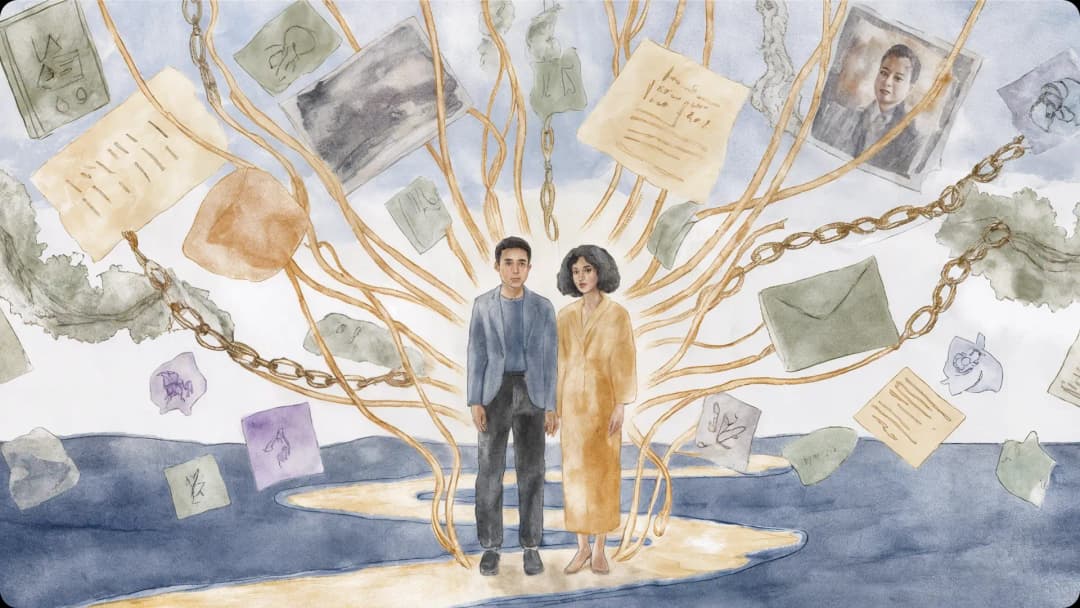
Soul ties mean strong emotional and spiritual connections established between people in relationships, friendships, or intense encounters. This bond is thought to be deeply connected to one’s soul, heart, and mind and is believed to be stronger than any other kind of connection.
What does a soul tie feel like? It is an intuitive feeling that influences your sense of deep connection to another person. You can’t imagine your life without them, as your two souls seem to be interconnected. You feel their emotions as if they were your own, and their presence or absence deeply affects your well-being.
Depending on whether this is a healthy or unhealthy soul tie, the connection can bring immense joy and a sense of completeness or create emotional dependence and discomfort. These effects may linger even when the relationship has ended.

Are soul ties real? The scientific basis of soul ties’ meaning: trauma bonds and attachment
The concept of soul-tie connection came from religious and occult communities and expanded from spiritual soul ties to any kind of unhealthy bond. And this is where psychological terms and ideas come into play. Modern psychology explains many aspects of soul ties through concepts like:
- attachment theory
- trauma bonds
- emotional dependency
For example, strong emotional attachments in close relationships can be linked to attachment styles. A person might feel deeply connected due to past experiences, unmet emotional needs, or fear of loneliness. Similarly, trauma bonds occur in unhealthy relationships where cycles of emotional highs and lows create an addictive attachment.
While soul ties lack scientific proof, the intense emotional and psychological effects they describe are very real. They can deeply influence one’s life and well-being.
We asked Nicole Arzt, LMFT, how mental health professionals approach the concept of soul ties. “A mental health professional typically wouldn’t use this term in therapy unless it was part of a client’s language. That’s because it isn’t clinically recognized, and it may not adequately fit a specific relationship. However, therapists absolutely strive to respect and adopt their client’s verbiage, so this may be used within that context.”
Examples of soul-tie relationships
What does a soul tie feel like?
Various people can define deeply emotional connections in any way possible. Still, there’s something that unites intense attachment and soul-tie relationships.
- Your relationship feels unique and ‘meant to be.’
- You experience a deep emotional connection.
- It feels like you’ve known this person forever.
- It seems the person entered your life at the “perfect time.”
- You feel like they complete you.
- You compare all other relationships to the one shared with this person.

Main types of soul ties
There’s no single classification for this kind of deep connection. Thus, we’ll explore various kinds of soul ties based on different backgrounds.
1. Physical soul ties
This kind of soul ties in a relationship means that two souls become connected after sexual intimacy. Some spiritual perspectives believe that an energetic bond forms during physical engagement, making it difficult to detach from a past partner.
2. Mental soul ties
This bond forms when two people connect on an intellectual level. For instance, they might share perspectives that shape each other’s thinking. Such ties can exist between close friends, teachers, students, or even colleagues who inspire each other.
While mental soul ties refer to enriching and motivating connections, they can also become overwhelming. If one person overly influences the other’s thoughts and makes it difficult to form independent opinions, it can be a sign of an unhealthy soul tie.
3. Emotional soul ties
This bond forms when people connect deeply through shared experiences, support, or deep conversations. Emotional soul ties might happen in romantic relationships, friendships, or even during communication with strangers, as long as strong emotions are involved.
4. Spiritual soul ties
Getting back to spiritual beliefs, spiritual soul ties can come from common practices, meditations, and rituals. Some people might think that their souls are connected from previous lives or bound together by a higher power.
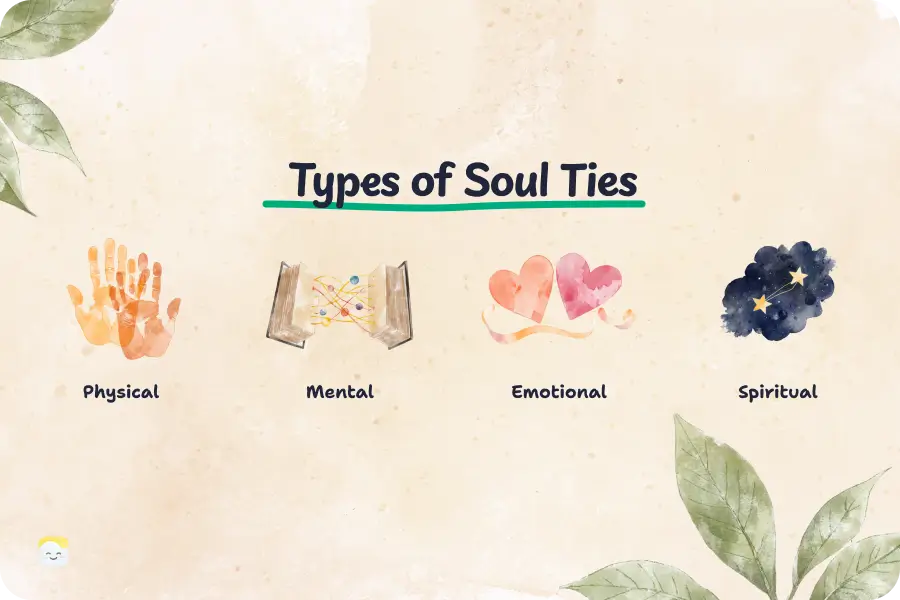
What are the 4 types of soul ties according to another classification?
There’s also another classification described in the article reviewed by Jennifer Jacobsen Schulz, LCSW. [1] Marriage.com. “What Are Soul Ties? 17 Signs of a Soul Tie”
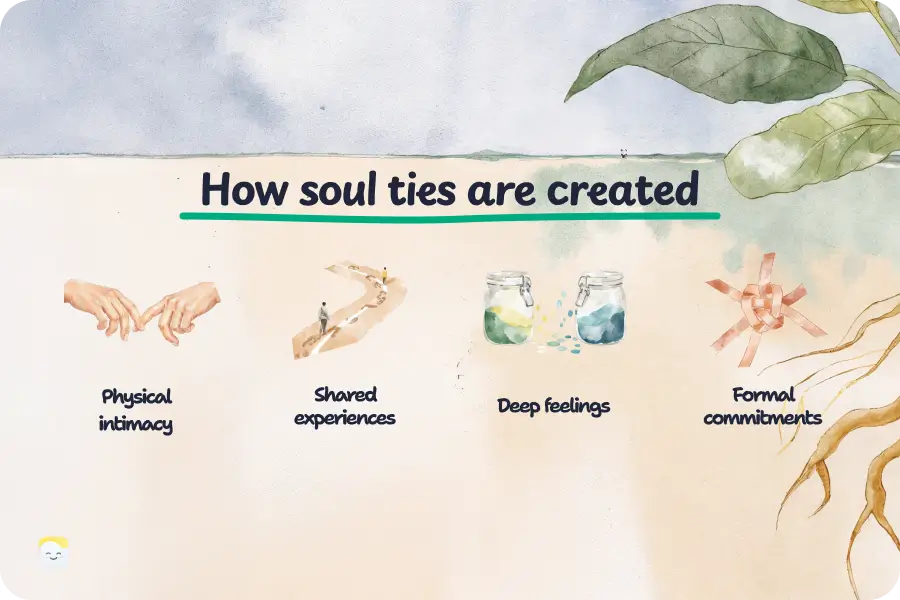
How are soul ties created?
While a soul tie connection seems to be surrounded by plenty of spiritual beliefs, there’s also a psychological perspective on how deep emotional bonds form.
1. Physical intimacy
According to the research, physical intimacy might strengthen emotional bonds in relationships. [2] ResearchGate. “Evolved to Be Connected: The Dynamics of Attachment and Sex over the Course of Romantic Relationships” While sexual activity has been found to stimulate the release of oxytocin [3] MedicalNewsToday. “What is the link between love and oxytocin?” , it has also been shown to play a critical role in the regulation of pair-bond formation. [4] National Library of Medicine. “Oxytocin during the initial stages of romantic attachment: Relations to couples’ interactive reciprocity” As such, this may explain why some people feel emotionally tied to past partners even after the relationship has ended.
2. Shared experiences
Sometimes, soul ties form when two people experience something life-changing together. This can be overcoming challenges, traveling, working on a meaningful project, or facing emotional challenges side by side. This way, a strong bond can be created with family members, friends, or even colleagues. It is often based on mutual respect, trust, and a deep understanding of each other.
3. Deep feelings
When you fall in love with someone, this might have a lasting mark even when communication is over. This is because the vulnerability that you’ve shown in past relationships can create very strong interpersonal relationships and result in stronger connections. [5] Psychologs. “Importance of Emotional Vulnerability in Relationship”
Importantly, a caring approach might turn into a nurturing soul-tie connection. At the same time, abusive relationships can turn into an unhealthy soul tie.
4. Formal commitments
Promises, vows, official marriages, and even business partnerships can create soul ties. Such commitments show a deeper level of trust and connection, often tying people together in meaningful ways.
Soul ties vs. twin flames: What are the key differences?
The Cleveland Clinic proves that there’s no scientific evidence supporting the existence of twin flames. [6] Cleveland Clinic. “What Are Twin Flame Relationships and Are They Healthy?” In contrast, both soul ties and twin flames are often considered spiritual connections marked by deep emotional bonds.
7 warning signs of an unhealthy soul tie
Not all soul ties are good and nurturing. Sometimes, as a result of challenging or unbalanced relationships, an unhealthy soul tie can form. Here’s how to recognize it.
- You experience obsessive thoughts about a person.
- Communication with this person leaves you drained and exhausted.
- Anxiety magnifies when you are apart.
- You feel incomplete without them, as if an important part of your personality is missing.
- You continuously find yourself in a cycle of emotional highs and lows.
- A person’s presence makes you feel nervous and stressed.
- It feels difficult to move on and forget about someone, even if you no longer communicate.
How to break an unhealthy soul tie: A step-by-step guide
Breaking a heavy, draining connection may be tough, but you can absolutely do it. It just takes a bit of time and a clear plan. Here is a simple, honest guide to helping you get your energy back.
1. Stop making excuses for them
The first step is to be completely honest with yourself. Just because a connection feels deep or intense doesn’t mean it’s good for you. Admit out loud or write down on paper that this relationship is draining you and that it’s time to let it go.
2. Go completely “no-contact”
You can’t heal from a wound if you keep touching it. To break the loop, you need a clean break:
- Block and unfollow. Don’t just mute them — block them everywhere. You need to stop yourself from scrolling through their social media.
- Hide the reminders. Pack up their old gifts, hoodies, or photos and put them in a box out of sight (or throw them away).
- Clear your phone. Delete old text threads and photos so you aren’t tempted to look at them when you feel lonely at night.
3. Beat the urge to text with the “10-minute rule”
4. Use the “grey rock” method if you can’t fully walk away
If this person is a coworker, a family member, or someone you have to see, you can’t just cut them off. Instead, become as boring as a grey rock and set clear boundaries:
- Keep conversations short, polite, and strictly about business or daily logistics.
- Never share personal stories, secrets, or how you’re feeling.
- Stick to texts or emails rather than talking face-to-face whenever you can.
5. Reconnect with the real world
When you cut off a heavy attachment, it leaves a big empty space in your life, and that can feel lonely. Fill that time with things that keep your hands and mind busy. Go to a challenging workout, try a new hobby, practice self-care, or spend time with friends who make you feel safe and happy. Remind yourself what life feels like when it’s peaceful.
Summary: Can you truly get rid of soul ties?
You can get rid of soul ties if there’s a need to do it. Limiting your contact with the person, setting boundaries, and engaging in self-care practices may help. There are also some more tips from the expert on what to do.
Expert Insight
“The first step is truly honoring your awareness of your unhealthy attachment. Be compassionate with yourself — it can be hard to change certain relational patterns. From there, start thinking about which boundaries you need to implement. You have a right to reassess what you need in this relationship and establish these limits.”

Nicole Arzt
Mental health professional
Frequently asked questions
What is a soul tie in spiritual and religious origins?
The idea of this concept originates in religious and spiritual communities. Soul ties were first mentioned in the New Age ideology — a movement that spread through the occult and metaphysical religious communities in the 1970s and ’80s. [7] Britannica. “New Age movement” Its members believed that soul ties extend beyond physical boundaries and connect two souls across dozens of lifetimes.
Then, some Christian communities adopted this idea and expanded it. They introduced the idea of the need to break ungodly soul ties — unhealthy emotional and/or sexual relationships or attachments. [8] Restoring the Foundations. “Ungodly Soul Ties” Some also found proof of the existence of soul ties in the Bible, for instance, “What therefore God has joined together, let no man separate.” (Mark 10:9 (NASB)). [9] YouVersion. “Breaking Soul Ties”
How long do soul ties last?
Soul tie connection can last for a certain time or continue over the whole lifetime. It all depends on the depth of the connection and how it impacts you.
Some of the deep connections can fade naturally as people grow apart, while others linger, especially if emotions were intense. Healthy soul ties can evolve into lasting bonds, while unhealthy ones may need conscious effort to break.
How do you know you have soul ties?
There’s no empirical evidence to prove soul ties, but there are certain emotional and psychological signs that might suggest you have formed one. You may feel an intense, deep connection with someone. It could feel like you’ve known the person forever or that they play a crucial, irreplaceable role in your emotional growth.
You may also experience a strong pull or attachment, even after time or distance, and have difficulty moving on from the connection. These feelings, while not scientifically measurable, are often described as the common signs of a soul tie.
Sources
- Marriage.com. “What Are Soul Ties? 17 Signs of a Soul Tie”
- ResearchGate. “Evolved to Be Connected: The Dynamics of Attachment and Sex over the Course of Romantic Relationships”
- MedicalNewsToday. “What is the link between love and oxytocin?”
- National Library of Medicine. “Oxytocin during the initial stages of romantic attachment: Relations to couples’ interactive reciprocity”
- Psychologs. “Importance of Emotional Vulnerability in Relationship”
- Cleveland Clinic. “What Are Twin Flame Relationships and Are They Healthy?”
- Britannica. “New Age movement”
- Restoring the Foundations. “Ungodly Soul Ties”
- YouVersion. “Breaking Soul Ties”
Disclaimer
This article is for general informative and self-discovery purposes only. It should not replace expert guidance from professionals.
Any action you take in response to the information in this article, whether directly or indirectly, is solely your responsibility and is done at your own risk. Breeze content team and its mental health experts disclaim any liability, loss, or risk, personal, professional, or otherwise, which may result from the use and/or application of any content.
Always consult your doctor or other certified health practitioner with any medical questions or concerns
Breeze articles exclusively cite trusted sources, such as academic research institutions and medical associations, including research and studies from PubMed, ResearchGate, or similar databases. Examine our subject-matter editors and editorial process to see how we verify facts and maintain the accuracy, reliability, and trustworthiness of our material.
Was this article helpful?