



You have recently entered a new romantic relationship, but something is going wrong. Maybe your partner frequently talks about their ex, compares you to them, or rushes the relationship forward too quickly, as if they are trying to prove something to someone. This is how a typical rebound relationship looks.
Keep reading to explore the main signs of a rebound relationship, why people start dating another person after a breakup, and what to do if you suspect that you’ve become a rebound partner.

What is a rebound relationship?
“Rebound relationship” is a term used in pop culture to describe a romantic involvement when someone starts dating another person just after a recent breakup. Conscious or not, the goal tends to be to let go of emotional pain rather than to build a genuine connection. A new partner may take on the role of emotional support and become someone who helps them cope with heartbreak.
In a rebound relationship, one partner may still harbor feelings for their ex. They might still love them and try to make them feel jealous, or they might be angry at them and want to show that their life is better than ever. Anyway, rebound relationships don’t generally arise from a desire to develop long-term commitment and emotional security. Instead, they are driven by someone’s need to heal.
While rebound relationships may seem like a great way out of a breakup, they may bring additional challenges in the long run. A person may enter such a relationship without being emotionally ready, which can delay processing emotional pain from the previous breakup and make current relationships confusing and draining.
Why do people enter a rebound after a breakup?
The main reason why people enter new relationships without fully processing a recent breakup is the fact that they can’t handle overwhelming emotions on their own. Some of them may fear loneliness, while others want to boost their self-esteem and prove that they can move on. In any case, a rebound relationship serves as a coping mechanism that allows people:
1. To form another emotional connection and avoid loneliness
Some people may jump from one relationship to another without taking time for reflection because they can’t tolerate the notion of being alone. Deep-rooted fear of loneliness or abandonment can push them to seek closeness as quickly as possible. A new relationship allows them to fill an emotional and physical space left after a breakup and feel needed, even if they haven’t yet processed their previous relationship.
It may be common for people who have experienced childhood trauma, emotional neglect, or unstable attachment patterns. For them, staying alone reactivates old wounds and makes them feel unsafe, so these people rely on romantic relationships to satisfy their emotional needs.
2. To distract themselves from post-breakup grief
The healing process after ending a serious relationship may be a lengthy and painful experience. A new person can distract you from grief, which is why some people choose to enter new relationships quite soon.
A Reddit user describes rebound relationships as “a way to fill the silence that suddenly got too loud. They state, “Some people would rather be with anyone than be alone with their own thoughts.”
Nevertheless, this distraction may be temporary because unprocessed emotions don’t disappear. After some time, grief, anger, or sadness from the previous relationship can resurface.
3. To boost self-esteem
“I’m still hot, interesting, and attractive.” A desire to prove it to themselves is another reason people enter rebound relationships. They don’t approach the other person as someone to build something serious with. Instead, these people may want to prove that they’re still desirable on the dating scene, building relationships to improve their self-esteem after a recent breakup.
Breeze can help you understand the real reason why you may want to enter a new relationship soon after the breakup. Try self-discovery tests and learn what you really feel in the moment. The app will also help you explore your attachment style and unmet needs so you can make more conscious relationship choices.
4. To make another partner feel jealous
Entering a new relationship can also be the way to hurt a previous partner. “Look at me, I can be happy without you. I can replace you easily.” This is what some people may try to state when starting to date a rebound partner.
5. To regain a sense of normalcy
Going on dates, cooking dinner together, or meeting a partner in the evening and discussing the day are typical routines for some people. But after a breakup, life can change quickly and significantly. Some people might enter new relationships simply to return to their habitual routines and feel that their life hasn’t changed much.
6. To prove they’ve moved on
A person may believe that they’ve already processed a breakup after a previous relationship. So, they might start dating a new person to prove to themselves that they’re ready to move forward.
However, this can be more about showing happiness than being truly ready for a new relationship. The focus is on appearing independent or successful, rather than truly connecting with their new partner. As a result, old emotions may still interfere.

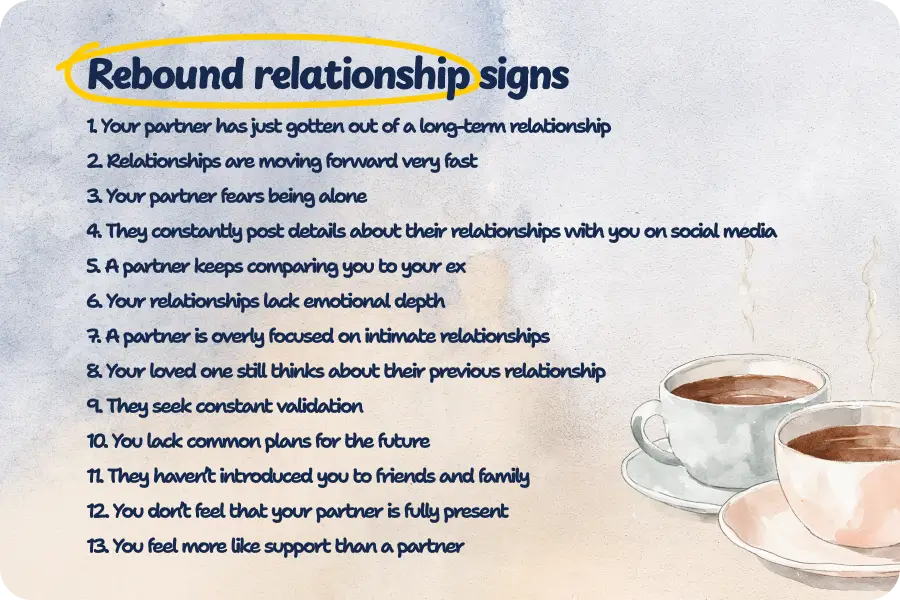
13 rebound relationship signs
The most common signs that you’re in a rebound relationship include a fast pace, lack of emotional depth, and regular comparison between you and a person’s ex-partner. Let’s break down these and other common patterns in more detail.
1. Your partner has just gotten out of a long-term relationship
If their past relationship ended not so long ago, it can signal that they’re trying to fill the empty place and avoid the pain of being alone. However, it isn’t the only factor to consider. While a recent breakup can be a warning sign, it doesn’t automatically mean they are in a rebound.
A person may genuinely fall for you. Still, observing the overall behavior is crucial to determining whether the relationship is healthy or primarily a means of coping with heartbreak.
2. Relationships are moving forward very fast
Love-bombing and rushing to reach the commitment stage can also signal a rebound. It might mean that it’s less about building a connection and more about filling the emotional gap. People in rebound relationships may push for labels or living together sooner than usual, trying to convince themselves that they are ready to move on.
3. Your partner fears being alone
If your partner openly states that they can’t imagine staying on their own, it can indicate that their motivation for building a new relationship is something other than a desire to be with you.
4. They constantly post details about their relationships with you on social media
Happiness doesn’t always thrive in silence. However, if your new partner keeps posting your presents, pictures together, common weekends, and other stuff on social media, it can signal that they’re trying to prove to their ex how “happy” they are now. This excessive activity turns from sharing into a performance where you’re more of a showcase than a partner.
5. A partner keeps comparing you to your ex
Discussing a former loved one and constantly comparing your actions (even from a positive perspective) means that your partner approaches relationships from a very specific lens. They may expect you to act like their ex or be completely different, and, in any case, it prevents the relationship from developing on its own terms.
6. Your relationships lack emotional depth
Even though your loved one tries to develop relationships quickly, you may still feel that they avoid a serious connection. Another person may seem emotionally unavailable, lack empathy, avoid sharing details about their past, or not care about your worries. It feels like you’re playing a game rather than really building something that involves long-term commitment.
7. A partner is overly focused on intimate relationships
Sex can serve as a way to shift focus from past relationships and substitute real bonding. Research suggests that at the beginning of romantic relationships, people experience elevated sexual desire linked to hormonal shifts. Nevertheless, if your partner lacks interest in what happens outside of the bedroom, it can signal that they use physical intimacy only to distract themselves.
8. Your loved one thinks about their previous relationship too often
Stalking a former partner on social media or bringing them up in conversations regularly means that a person is still interested in their ex’s life. It can highlight that emotional investment in past relationships hasn’t fully faded, and they use current ones as a rebound.
9. They seek constant validation
If the last breakup has negatively influenced a person’s self-esteem and sense of self-worth, they may unconsciously try to prove that they’re still desirable. Questions like “Do you still love me?” ten times a day don’t necessarily mean that you’re a rebound. Yet, they may highlight hidden insecurities that stem from unprocessed past wounds.
10. You lack common plans for the future
Although staying in the present matters, it may be a red flag if the here and now is the only thing that matters. In a healthy relationship, people discuss shared plans and opportunities to grow together, but your close one can be more interested in keeping things casual.
11. They haven’t introduced you to friends and family
Even if you’ve already been dating for a few months, it seems that your partner doesn’t want you to become a part of their social circle. This may indicate they aren’t serious about integrating you into their life. They may also not want friends or family to know about you, which can be a cause for concern.
12. You don’t feel that your partner is fully present
Your intuition is strong, and it’s important to trust gut feelings telling you something may be off. It could indicate your relationship isn’t working, even if you can’t fully pinpoint why. It seems that on dates or evenings together, their thoughts are always somewhere else. Or, maybe, they are with someone else.
13. You feel more like support than a partner
At the beginning of relationships, people tend to experience a positive hormonal boost involving surges in oxytocin and dopamine, which is why those in love seem so happy. But when a person hasn’t processed past negative feelings, they may rely on their new partner for comfort and reassurance and feel regularly down with no clear reason.
The 5 stages of a rebound relationship
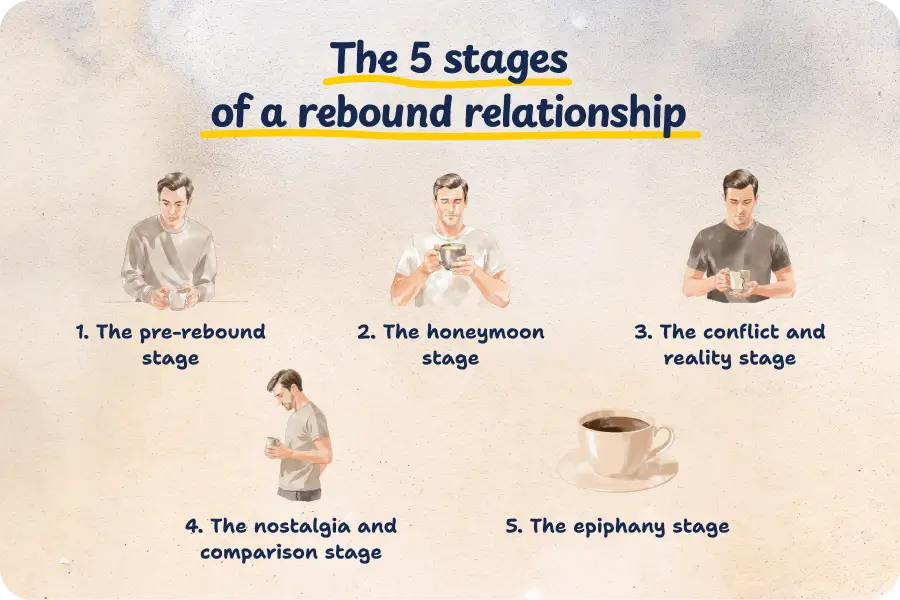
The stages of rebound differ from the development of non-rebound relationships because a previous breakup may influence the emotional state of the partner. These include pre-rebound, honeymoon, conflict and resolution, nostalgia, and epiphany stages. The stages may overlap or repeat rather than follow a clear linear order, but the typical sequence is the following.
1. The pre-rebound stage
Shortly after an old relationship has ended, you may feel the need to flirt, talk to other people, or maybe get intimate with someone. This is what the pre-rebound stage looks like. It is about reclaiming freedom, despite the risks.
Because of this, some people may spend every night partying to avoid feeling lonely. Others might start dating someone out of excitement to try something with someone new or out of a need for distraction after a breakup. Whatever the reason is, this is how a rebound relationship may begin.
Expert Insight
“It isn’t always clear when you’re ready for a relationship. There are no specific predetermined timelines. However, it’s important to consider your motives. Are you genuinely interested in exploring a new relationship and building something with someone? Or, are you trying to avoid the pain and anguish that comes with the grief of a breakup?”

Nicole Arzt
Mental health professional
2. The infatuation / honeymoon stage
The first few months with a new partner may seem perfect, and you might feel super happy. The relationship can be fun and, most importantly, rather different from what you’ve experienced before. “This is finally the one I was looking for!” you might think.
During the honeymoon stage, the initial excitement can temporarily mask past wounds and unresolved issues. However, when the intensity fades, unprocessed feelings may begin to resurface.
3. The conflict and reality stage
After the honeymoon phase, a rebound relationship stops feeling like a new beginning and turns into a more realistic connection. Differences arise, and you might even question yourself, “What was I even thinking when I started dating them?” You may also:
- Start comparing a new loved one and your ex.
- Feel old emotions resurface.
- Experience frequent arguments and misunderstandings.
- Question the future of relationships.
Not all connections survive this stage. Many relationships may come to an end because of constant conflicts. Still, those partners who discuss challenges and work through them together may grow their bond into something more stable.
4. The nostalgia and comparison stage
At some point in relationship development, you may start comparing the new partner with your former one, which sometimes may result in the feeling that your current relationship doesn’t quite measure up to the past. For instance, if your ex was romantic and your current loved one is reserved, you may misinterpret this difference as a lack of care.
Idealized memories can make nostalgia even stronger. Due to the fading affect bias, positive memories often fade more slowly than negative ones, which is why you may remember the past relationship as better than it actually was. Some signs of a nostalgia stage may include:
- Listening to songs that remind you of your ex.
- Revisiting old photos or messages.
- Wondering “what if” about the previous relationship.
- Thinking about getting back together with your ex, especially if you didn’t cut contact completely.
- Looking up your ex on social media and missing them.
5. The epiphany stage
Finally, everything falls into place. You may decide you started dating for the wrong reasons and need to break up. In this case, the relationship has served its purpose of helping you gain clarity on your emotional state rather than building a long-term connection.
On the other hand, you may choose to keep dating and overcome all the challenges together. If this happens, it’s essential to communicate openly about expectations and further relationship development.
How long do rebound relationships last?
The research has found that the average duration of rebound relationships among the studied couples is approximately 4-6 months. Still, this duration can significantly differ depending on emotional readiness, attachment style, and how unresolved feelings from the previous relationship remain.
People with an insecure attachment style are likely to enter a new partnership quite soon, as they use closeness to cope with unresolved distress from the previous relationship. However, their rebound relationships might be less stable because the underlying emotional wounds remain unprocessed.
Nevertheless, some new partnerships may last long. If you’re ready to discuss difficult feelings and consciously process unresolved patterns from the last relationship, a rebound can gradually develop into a healthy connection that lasts indefinitely.
Do rebound relationships work?
There are many factors that may influence whether rebound relationships will turn into a strong bond or remain a temporary emotional refuge. These include:
- Emotional awareness can help you understand whether you’re dissatisfied with your partner’s flaws or projecting past pains on the current partner.
- The ability to reflect on past relationship patterns. Taking the time to understand why the previous relationship ended may let you avoid repeating the same mistakes with a new person.
- Honest communication and mutual respect are necessary in any kind of healthy relationship. If a partner feels that they’re unintentionally used as a source of comfort rather than an equal participant, a couple should be able to discuss it to keep things working.
- The willingness to build intimacy gradually. If you find a new relationship shortly after finishing the previous one, slowing things down allows closeness to grow naturally.
Nicole Arzt, LMFT, highlights more aspects that may influence the fact that relationships that started as a rebound will work. “Both partners need to be honest with one another. If you have residual feelings toward your ex, that’s normal, but you have to be mindful of avoiding projection onto the new relationship. Aim to take things slowly and pause when you find yourself comparing or contrasting. No two relationships are the same, and if you want it to work, you need to treat this as a whole new person in a whole new relationship.”
What to do if you think you’re in a rebound relationship
If you suspect that you’re in a rebound relationship, open communication is the key. Whether you believe that you’ve found a new partner to forget your ex, or you suspect that your loved one may still experience unprocessed wounds from the past, we’ve got you covered. Here’s what to do in both situations.
Tips for those who have experienced a recent breakup
1. Stop rushing closeness
If you’ve entered a new relationship and then found out that you have some void left for your ex, give yourself time to process your feelings. Don’t rush intimacy, whether physical or emotional. It doesn’t mean that you need to limit communication with your partner. Just avoid trying to replace the real emotional connection with intensity or speed.
2. Decide whether you want to continue the relationship
Be honest with yourself and answer several questions:
- Do I still miss my ex and think about getting back to them?
- Have I entered this relationship to avoid loneliness?
- Am I ready to invest emotionally in a new relationship?
3. Stay honest with yourself and your partner
You may decide to keep dating the person and try to turn your connection into a healthy relationship. In this case, it’s essential to communicate your needs and expectations. You may also need the help of a licensed therapist to process past wounds.
Alternatively, you may decide to break up and heal on your own. In this case, let yourself engage in self-care and analyze what you’re really looking for.

Tips if you’re dating someone after their breakup
1. Focus on your feelings and trust your gut
If you feel that something goes wrong and it seems like a rebound, ask yourself several questions:
- Do you get close too quickly?
- When did your partner break up with their ex? (if you can find it out)
- How often do they talk about their previous relationship?
- Do you feel like they aren’t fully emotionally invested in you?
Sometimes your gut feeling may offer more insight than logical analysis. So, if you feel that something goes wrong, don’t ignore it. Maybe it’s time for an open discussion.
2. Have a calm conversation
Explain why you may feel like a rebound and what you state your relationship to look like. Don’t overexplain, but be clear and honest about your feelings. Your partner may agree on improving your relationship together or may decide to leave, and it’s very important for you to be able to accept both options.
3. Set boundaries
If you decide to keep dating, decide what’s right and wrong for your couple. Some examples of boundaries might include:
- Limit talking about ex-partners.
- Keep a balance between time together and personal space.
- Be clear about emotional and physical closeness that feels comfortable for you.
- Respect each other’s pace in moving on from past relationships.
4. If you find it hard to handle, think about leaving your partner
Your relationship may improve over time or might remain unclear. And if you find it challenging to handle controversial feelings, maybe it’s time to choose yourself. Seek support from close friends and family, or consider reaching out for online therapy to make an informed decision.
Final thoughts
Rebound relationships can help you overcome overwhelming feelings from a recent breakup, but they might also delay you from processing past wounds. They might also be traumatizing for your next partner, as comparisons with an ex can create unrealistic expectations.
If you have recently experienced a breakup, try self-awareness practices. Engage in self-discovery with Breeze’s tests to see whether you’re really in love with someone new or simply trying to replace your ex-partner. Track gratitude with journal prompts to learn to support yourself without romantic affairs.
Frequently asked questions
What percentage of rebound relationships last?
Statistics indicate that 65-90% of rebound relationships end within 3-12 months, with averages around 4-6 months. [3] ZIPDO EDUCATION REPORT 2025. “Rebound Relationship Statistics.” 2025 However, this doesn’t mean that all rebound relationships end prematurely. Some of them may survive and turn into long-term connections. The duration of the relationship depends on many variables, including the partners’ ability to communicate their needs openly, process unresolved emotions from past relationships, and set healthy boundaries.
Are rebound relationships healthy or harmful for mental health?
Rebound relationships can affect the mental health of both partners in different ways.
- One study has reported that for those in rebound relationships, the speed with which they began them was associated with greater psychological and relational health.
- On the other hand, according to Rebound Relationship Statistics, those who engage in rebound relationships are more prone to experiencing emotional exhaustion, and 60% of individuals report fatigue and stress.
The data is quite controversial because rebound relationships can influence people both positively and negatively. Their impact largely depends on emotional readiness, attachment style, the reasons for entering the relationship, and the level of honesty between partners.
Can someone fall in love with a rebound?
Yes, sometimes a new partner can become a true love. While rebound relationships typically start as a way to cope with a breakup, real feelings can develop if both partners are ready to work on their relationship.
What happens if rebound relationships end?
If a rebound relationship ends, the breakup can still be quite painful, particularly if you’re holding onto other grief. However, a breakup can also become a source of difficult emotions and personal growth. You’ll be able to process unresolved feelings from past relationships and decide what kind of partner you’re looking for (and whether you truly need a partner right now). Such an ending can make you feel lonely or overwhelmed in the short term, but in the long term, it can promote better self-awareness.
Sources
- Bianca P. Acevedo, Michael J. Poulin, Nancy L. Collins, Lucy L. Brown. “After the Honeymoon: Neural and Genetic Correlates of Romantic Love in Newlywed Marriages.” Frontiers in Psychology. 2020
- Schneiderman I, Zagoory-Sharon O, Leckman JF, Feldman R. “Oxytocin during the initial stages of romantic attachment: relations to couples’ interactive reciprocity.” Psychoneuroendocrinology. 2012
- ZIPDO EDUCATION REPORT 2025. “Rebound Relationship Statistics.” 2025
- Spielmann SS, Macdonald G, Wilson AE. “On the rebound: focusing on someone new helps anxiously attached individuals let go of ex-partners.” Pers Soc Psychol Bull. 2009
- Brumbaugh, Claudia & Fraley, R. (2015). “Too fast, too soon? An empirical investigation into rebound relationships.” Journal of Social and Personal Relationships.
Disclaimer
This article is for general informative and self-discovery purposes only. It should not replace expert guidance from professionals.
Any action you take in response to the information in this article, whether directly or indirectly, is solely your responsibility and is done at your own risk. Breeze content team and its mental health experts disclaim any liability, loss, or risk, personal, professional, or otherwise, which may result from the use and/or application of any content.
Always consult your doctor or other certified health practitioner with any medical questions or concerns
Breeze articles exclusively cite trusted sources, such as academic research institutions and medical associations, including research and studies from PubMed, ResearchGate, or similar databases. Examine our subject-matter editors and editorial process to see how we verify facts and maintain the accuracy, reliability, and trustworthiness of our material.
Was this article helpful?