


Podcast name
Why am I not interested in anything?
You come home from work just to scroll on your phone. You’re not interested in seeing friends or even leaving the house. Life starts to feel like Groundhog Day. You wonder, “Why am I not interested in anything all of a sudden?”
This article explains the reasons behind losing interest in everything. You will learn five concrete exercises to address a lack of interest and regain motivation starting today.
Losing interest can produce a lot of anxiety, whether you’re a good partner, parent, or person in general. Don’t let these worries overshadow your capabilities.
What Does It Mean to Lack Interest?
The feeling of “nothing interests me anymore” is most often a consequence of anhedonia.
According to Alessandro Serretti, Associate Professor of Psychiatry at Bologna University, anhedonia describes a reduced ability to experience pleasure, especially from things that used to feel rewarding. It can feel like:
- Inability to imagine pleasure.
- Everything seems pointless.
- Life is hard, or life is not for you.
- Inability to initiate tasks.
- Seeing pleasure and fun as redundant.
Lack of motivation appears when the dopamine production in the body is disrupted. When people with anhedonia complete tasks, their brains either don’t produce dopamine or do so too late/in small amounts. So, their brains learn, “These activities aren’t worth the effort. I won’t look forward to them,” which makes everything feel pointless.
Reasons Why You’re Not Interested in Anything
Although a feeling that nothing interests you anymore can feel sudden, it’s actually an accumulation of experiences. Most frequently, anhedonia appears when burnout, stress, mental health symptoms, and insecurity are ignored for the sake of productivity.
Below are the most likely reasons nothing interests you anymore. They don’t exclude each other and are likely to overlap and increase the probability of anhedonia.
Mental Health Conditions
82% of people with depression experience loss of interest. Moreover, anhedonia is the main diagnostic criterion for depression, according to the Diagnostic and Statistical Manual (DSM-5). In order for lost interest to be considered anhedonia, it should last over 2 weeks and disrupt a person’s daily routine.
Disclaimer: If you have suicidal thoughts or there is an immediate danger to your health, please consult your healthcare provider or a crisis lifeline (988 in the US). A mental health professional can help alleviate depressive symptoms and regain interest. Read more on how to find a therapist here.
People who lost interest in everything might also experience other symptoms of:
- Generalized Anxiety Disorder (GAD)
- Bipolar Disorder
- Substance Use Disorder
- PTSD
- Schizophrenia and other psychotic disorders
A general mental health assessment with a qualified professional determines whether the underlying reason for your anhedonia is mental health issues.
Loss of pleasure can also be a symptom of neurodevelopmental conditions, like ADHD, Autism Spectrum Disorders (ASD), Tourette’s syndrome, etc. Statistics say that 67% of people who have both ADHD and feel depressed experience chronic anhedonia.
Among neurodivergents, it’s also common not to experience joy from social encounters. This type of lost interest is called social anhedonia.
Stress and Exhaustion
If you constantly have to deal with deadlines, emotional abuse, high expectations, and juggling home and work, it’s not surprising that you might have lost interest in everything. Stress, exhaustion, and burnout are significant contributors to physical anhedonia.
Absence of self-care and rest can also contribute to loss of interest. A study of 260 undergraduate students with poor sleep quality showed that they were more susceptible to anhedonia, depression, and other mental health conditions.
Trauma in the Past
Trauma in the past is a big predictor of loss of interest, especially if it happened in early formative years. Childhood or narcissistic partner trauma makes you lose interest in everything in three ways:
- Trauma changes the way the brain works. The part of the brain responsible for fear, self-protection, and emotional intelligence either enlarges in size or becomes overactive. Vice versa, brain parts responsible for memory and decision-making weaken.
- Dysfunctional relationships can reinforce negative beliefs in oneself. Some people experience loss of interest when they ruminate on negative beliefs like “This world is cold and cruel,” “I am a bad husband/daughter/employee,” “I am such a failure,” etc. The way we perceive the world and ourselves most often comes from our early surroundings. So if your parents let you believe you aren’t enough, you may find yourself wondering, “What is wrong with me?” These thoughts nourish anhedonia.
- Loss of interest decreases life quality. A person who doesn’t see sense in anything is more likely to procrastinate. This procrastination can result in unhealthy eating habits, lack of physical activity, social withdrawal, etc. The worst part about this is that decreased life quality also worsens anhedonia, making it a vicious cycle.
People-Pleasing
When you try to satisfy others’ needs before meeting your own, it can leave you feeling numb. This will eventually confuse people-pleasers about what they actually enjoy doing. The end stop here is a loss of interest: you don’t know what brings you enjoyment and start relying on quick dopamine hits, such as social media, fast food, substances, etc.
Major Life Events
Loss of interest in everything often occurs at the onset of puberty. It happens because dopamine systems in the adolescent brain undergo significant changes. These processes can last up to 25 years of age.
Similarly, major life events like moving, divorce, loss of a loved one, changing workplaces, etc., can also trigger anhedonia. When you mature, previous values or activities that brought joy can feel distant.
With stressful current events in the US and the rise of AI, more and more people reevaluate their attitudes toward life. “Doomscrolling” on personalized content polarizes people, so the loss of interest has become more common than ever.
Signs You Experience Anhedonia
- The daily activities and hobbies that used to bring pleasure seem uninteresting.
- You are more irritable than usual and may even think, “I hate people.”
- Although you can laugh and go on about your days, the low mood persists, especially when you’re alone.
- You wake up already tired.
- You don’t have the energy to do routine tasks, such as brushing your teeth, texting, or getting out of bed.
- When you make plans, you don’t look forward to them.
- Thoughts about the future now feel overwhelming, like “it’s too much work.”
- Your screen time increased significantly.
- All other emotions, such as anger, fear, joy, or calmness, now feel dull.
- You feel empty, as if there is a hollowness inside you.
- You stopped enjoying social situations; hence, you ignore them altogether.
- You can’t focus or are easily distracted.
- You experience these mental well-being symptoms for more than two weeks.
You’re not sure whether it’s anhedonia or procrastination? Our mental health expert Rychel Johnson, M.S., LCPC, clarifies their distinction:“The difference between anhedonia and procrastination often comes down to desire versus capacity. With procrastination, the person usually still wants to do the activity and can imagine it feeling satisfying once they start, but something gets in the way—avoidance, fear, perfectionism, or low motivation. With anhedonia, the person’s nervous system doesn’t register the same sense of interest, anticipation, or reward.”
Notable Facts About Losing Interest in Everything
- Mornings are the worst. This study has found that loss of interest is the most intense in the mornings. Such symptoms may be connected to morning reflections about work, plans for the day, and high expectations for “starting from scratch.”
- Sweets don’t hit as much. Multiple experiments on reward sensitivity have shown that adults with anhedonia have poorer taste and smell, especially for sweets. It confirms that loss of interest also affects physical abilities, like getting satisfaction from eating tasty meals.
- Gut bacteria can lower your mood. Patients with anhedonia often have an imbalance of bacteria in their guts. It’s still unknown whether gut problems cause anhedonia or vice versa.
- Anhedonia is expensive. As a primary symptom of depression, anhedonia can cost the world up to $1 trillion, according to the World Health Organization (WHO).
- People with anhedonia are stealthy. Loss of interest is a mental health symptom that isn’t taken seriously enough. Individualistic countries, like the US, states in Western Europe, the UK, etc., might value productivity and being an “interesting” person over the people’s mental well-being. Hence, many individuals can hide the fact that they feel numb or enjoy life less now.
5 Exercises to Fix Loss of Interest Today
To regain interest, your mental health journey should be comprehensive. General mental health advice works here like a charm. Aim for a healthy lifestyle: balanced nutrition, physical activity, receiving support from loved ones, quality sleep, seeking professional help, etc.
However, if you’d like to break free from anhedonia quickly, you might want to try these 5 exercises. They are perfect for rediscovering yourself and regulating dopamine production.
1. Set Achievable Goals
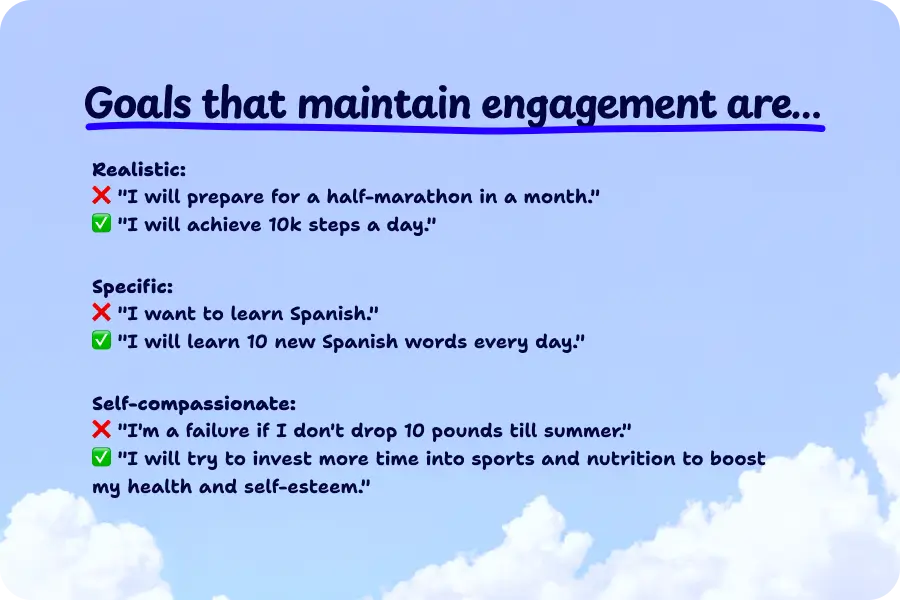
People tend to lose motivation when they don’t feel like their efforts are worth it. We tend to set big, undefined goals: “I will self-improve,” “I will eat healthier,” “I will run a half-marathon.”
Although these goals are worthy and achievable, we could go on about this much more efficiently and with self-compassion. The only adjustment that needs to be made is breaking down these goals into small steps.
Create a to-do list for every day. This should be a realistic and specific list of activities with at least one thing that gets you one step closer to your dream. Said half-marathon can be completed if you run at least a couple of miles every 2-3 days, which seems more doable than running 13 miles without training.
2. Create the “No Limits” List
The main goal of this exercise is to answer one question: “What would you do if you didn’t have to worry about money, work, or kids?” You can either reflect internally, but journaling with a pen and paper or in the Breeze app is better because you essentially create a list of your interests.
But what if I wrote down mundane everyday things? Let’s look into some examples. If you answered:
- “I would spend time with my friends/family.” → Plan different types of activities with your loved ones. For example, go on picnics, visit museums, discuss different ideas every week, or take pub quizzes.
- “I’d sleep.” → That’s great! Get your rest. If you really love sleeping, try to learn about it as much as possible. Some topics for inspiration: lucid dreams, sleepwalking, the meaning of dreams, and so on.
- “I would help other people.” → Start volunteering. Although most of us would love to support others, we rarely have time for this. If it’s your case, start with something really simple, such as talking to a stranger on the street or reducing stress for your significant other when they are in a rush.
3. Think about Interests of Little You
- Find a photo or a videotape of you in childhood.
- Recall some memories from your childhood. How did you behave? What were school days like? How did you spend time with your parents?
- Try to remember what you liked to do when you were a kid. What did you do in your free time? What toys have you dreamt about? What did you write in your letter to Santa?
- Write the interests, special moments, and preferences down.
- Revisit your childhood hobbies one by one.
Expert Insight
“Revisiting childhood hobbies is a powerful way to reconnect with parts of yourself that existed before the pressure of adulthood took over. These activities carry memories of curiosity and play, which can help “reawaken” interest gently rather than forcing yourself to invent something new from scratch. The main pitfall is expecting it to feel the same as it did before—if it doesn’t, people sometimes interpret that as something being wrong with them, rather than recognizing that interests evolve.”

Rychel Johnson
Mental health professional
4. Plan Self-Care Activity to Look Forward To
A significant part of anhedonia is that a person cannot feel excitement before planned events. Birthdays, holidays, weddings, and plans with friends feel overwhelming and not encouraging.
When you’re in such a “slump,” the best activity you can do is take care of yourself. Here are some ideas for low-energy self-care that will make you feel better in the moment:
- Take a 20-minute nap on your lunch break.
- Try self-led yoga (practicing yoga movements that correspond to your mood).
- Get a coloring book and color.
- Practice doing your makeup.
- Declutter one shelf of the closet, kitchen cabinet, desktop cabinet, etc.
- Do anything screen-free that you want to do for yourself.
The main thing: Put the chosen activity in your calendar and make it non-negotiable. Treat it as seriously as a doctor’s appointment you’ve been waiting for for three months.
5. Notice Small Steps to Be Grateful for
Australian lifestyle blogger Michelle B says, “Being stuck in a slump isn’t a skill issue, it’s a forgetting issue.” She means that as soon as people lose interest, they tend to neglect their previous and current achievements.
People indeed tend to overlook the good things in life because “the bad” just requires their immediate attention. Because of social media, we have less and less time for reflection to realize how far we’ve come. Therefore, gratitude journaling exists.
The effectiveness of gratitude journaling is confirmed by numerous mental health professionals and neurobiologists. It’s one of the most effective ways to build self-confidence and start noticing your capabilities.

Lack of Interest Isn’t Always Pathological
Before you diagnose yourself with something serious, pause. Lack of motivation can indeed be a symptom of depression, but it can also be totally normal.
We live in a culture that pressures us to be constantly “interesting,” productive, evolving, and passionate. On social media, we see everybody having a side hustle, a personality brand, or a perfectly curated hobby. This pressure may even make you think, “I hate other women or men.”
You are still a worthy human being if you don’t have any particular hobbies or if you’re “ordinary.” It’s also okay to have low-motivation days when you just have to deal with work and household chores. Be self-compassionate, especially if you deal with internal invisible battles.
If you seem fine without extra interests, don’t chase them just for the sake of “being interesting.” Of course, if your lost motivation troubles you, it’s worth taking action. Try seeking professional help and treatment, and make sure you recharge your batteries enough.
Frequently asked questions
Why did I suddenly lose interest in everything?
A sudden lack of interest in things that used to bring pleasure is usually a sign of exhaustion, overwork, or stress due to current events worldwide. Anhedonia (the clinical term for lack of interest) can also be a symptom of depression, anxiety, or ADHD. However, if there are no other symptoms, your lack of motivation might suggest that you need extra rest.
Can anhedonia go away?
Yes, anhedonia is a treatable symptom. Some people require professional treatment, like Cognitive Behavioral Therapy (CBT), but others can address it with small behavioral adjustments. The most effective things you can do are improve sleep hygiene, walk 10-30 minutes daily, or talk to a trusted friend.
Do people with ADHD lose interest in hobbies?
Yes, it’s a common sign of ADHD to experience cycles of hyperfocus and have little to no motivation even for the things they enjoy. If feelings of little interest persist for more than two weeks, it may be time to seek professional treatment for ADHD and potentially depression.
Is it normal to not desire anything?
Lack of interest is a normal response to burnout and stress, indicating you might need extra rest. If it doesn’t bother you, focus on relaxing and treating yourself. However, if you are concerned about lost interest, refer to your GP. They might refer you to a mental health practitioner, who will assess you for depression and create a special treatment plan for you to feel better.
Sources (Accessed February 2026):
- Anhedonia and Depressive Disorders by Serretti Alessandro. Clinical Psychopharmacology and Neuroscience. August 2023.
- Anhedonia in Major Depressive Disorder: Prevalence and Treatment Expectations and Satisfaction with Treatment Goals Among Patients and Physicians in Asia-Pacific by Herr, K., Berk, M., Huang, W., Kato, T., Lee, J. G., Ng, C. G., Wang, Z., Webb, T., Kasahara-Kiritani, M., & Vandervoort, L. Neuropsychiatric Disease and Treatment. November 2024.
- Low hedonic tone and attention-deficit hyperactivity disorder: risk factors for treatment resistance in depressed adults by Sternat, T., Fotinos, K., Fine, A., Epstein, I., & Katzman, M. Neuropsychiatric Disease and Treatment. September 2018.
- Relationships Among Sleep Disturbance, Reward System Functioning, Anhedonia, and Depressive Symptoms by Wieman, S. T., Hall, K. a. A., MacDonald, H. Z., Gallagher, M. W., Suvak, M. K., Rando, A. A., & Liverant, G. I. Journal of Behavior Therapy. January 2022.
- Neurobiological development in the context of childhood trauma by Cross, D., Fani, N., Powers, A., & Bradley, B. Clinical Psychology Science and Practice. March 2019.
- Implications of the DSM’s emphasis on sadness and anhedonia in major depressive disorder by Buckner, J. D., Joiner, T. E., Pettit, J. W., Lewinsohn, P. M., & Schmidt, N. B. Psychiatry Research. May 2008.
- Reward Processing and Anhedonia by Slaney Chloe. Bristol Medical School (PHS). June 2021.
Disclaimer
This article is for general informative and self-discovery purposes only. It should not replace expert guidance from professionals.
Any action you take in response to the information in this article, whether directly or indirectly, is solely your responsibility and is done at your own risk. Breeze content team and its mental health experts disclaim any liability, loss, or risk, personal, professional, or otherwise, which may result from the use and/or application of any content.
Always consult your doctor or other certified health practitioner with any medical questions or concerns
Breeze articles exclusively cite trusted sources, such as academic research institutions and medical associations, including research and studies from PubMed, ResearchGate, or similar databases. Examine our subject-matter editors and editorial process to see how we verify facts and maintain the accuracy, reliability, and trustworthiness of our material.
Was this article helpful?