

You may meet a great person and start dating. Everything goes smoothly, and you finally feel, “This is the one I want to spend my life with.” And then, one day, you find yourself staring at your phone, rereading old messages, and trying to heal your broken heart.
In this article, we’ll explore why you may experience relationship heartbreak over and over again. We’ll talk about broken heart syndrome and share tips for handling that emotional pain.
If you notice the same pattern in all your relationships, it may stem from your attachment style. Take a quick test to find out whether you lean anxious, avoidant, or secure, and how it shapes how you fall in love.

What is heartbreak in a relationship?
Heartbreak in a relationship refers to a strong sense of pain and stress that stems from a breakup or feelings of neglect and betrayal from your partner. You may experience it on both emotional and physical levels, as it might involve grief and despair, as well as chest tightness, fatigue, and even physical aches.
This can happen because breakups trigger the same neural pathways and hormone releases similar to trauma or bereavement responses. When people face such significant emotional stress, it leads to the release of stress hormones, particularly cortisol and adrenaline. In moments of danger, your body prepares to fight or run.
Сortisol levels may bring additional challenges rather than accumulate your strength. This is why:
- Your heart may race.
- You might experience appetite changes.
- Your thoughts may become restless.
- You may find it challenging to fall asleep.
- Your muscles may feel tense, which can lead to pain.
Also, when experiencing heartbreak, dopamine levels may drop significantly, according to the study. This is why a person may experience low mood, lack of motivation, depression, or anxiety.
What is broken heart syndrome?
Broken heart syndrome (also called Takotsubo syndrome or stress cardiomyopathy) is a very real but temporary disease that causes weakening of the heart’s left ventricle. It might mimic a heart attack and involve such symptoms as:
- Shortness of breath
- Rapid or irregular heartbeat
- Fainting
- Sudden chest pain
- Low blood pressure
- Nausea
- Sweating
- Extreme fatigue
Although symptoms resemble a heart attack, broken heart syndrome can stem from any intense stress and improve with proper medical care.
Risk factors
According to the study, the most common risk factors for broken heart syndrome include:
- Emotional and physical stressors
- Cannabis use (including nondependent use)
- Age over 55 years
- Female sex
- Smoking
- Alcohol abuse
- Anxiety disorders
- Hyperlipidemia
- Hypertension
- Type 2 diabetes mellitus
- Family history of coronary artery disease
Broken heart syndrome vs. heart attack
| Feature | Broken heart syndrome | Heart attack (myocardial infarction) |
| Main cause | Intense emotional or physical stress | Blocked coronary artery due to plaque rupture or clot |
| Trigger | Sudden grief, shock, fear | Atherosclerosis, blood clot formation |
| Coronary arteries | Usually normal or mildly narrowed | One or more arteries are significantly blocked |
| Heart muscle damage | Temporary weakening of the left ventricle | Permanent damage to heart muscle tissue |
| Recovery | Heart function often improves within days or weeks | Recovery depends on severity. Damage may be permanent |
| Common in | Women over 55, mostly after stress | More common in men, the risk increases with age |
| Mortality risk | Generally lower, but complications are possible | Higher risk of long-term complications and death |
The science of the cycle: Why do I keep getting my heart broken in the same way?
You may be struggling to build long-term, stable connections with potential partners because you subconsciously choose what feels familiar, even if it’s not necessarily healthy. The mind may follow old emotional maps, even when they lead to the same painful destination.
1. Attachment theory
Our early relationships with caregivers create an internal working model for how love works. This is known as attachment theory.
- Anxious attachment style might develop when children lack consistent or attuned care from parents, so they become “clingy” and later try to “deserve” this care from meaningful people in their lives. If it feels relatable, you may crave deep intimacy and, at the same time, be subconsciously drawn to avoidant partners.
- Your attachment system is triggered by the avoidant’s inconsistent behavior, which your brain misinterprets as “intense chemistry” or “passion.”
- You get your heart broken when they inevitably withdraw to protect their independence. As a result, you may feel hurt and abandoned in the exact same way as before.
2. Repetition compulsion
Freud coined the term “repetition compulsion,” and some frameworks in modern psychology still back the core concept. It means that a person with a broken heart may subconsciously try to recreate familiar emotional pain in new relationships because they hope to finally resolve it.
Imagine sitting in a cafe and ordering a chocolate brownie, even though you dislike chocolate and have already tried a brownie here several times, and it wasn’t tasty. “But maybe this time it will be different?”
This metaphor captures how some people might behave when seeking a partner. If your first experience of “love” involved someone who was emotionally unavailable, your brain might seek out unavailable people as an adult. The goal isn’t to suffer. It’s the subconscious belief that “If I can finally make this person love me, I will finally heal the original wound.”
3. Neurobiological reactions
Do you remember us talking about stress hormones and dopamine? In fact, they also play a role in forming an emotional bond. What we call “chemistry” may be just familiarity. Your nervous system recognizes a specific pattern of relating to another person and experiences a sense of bonding.
But when a partner is inconsistent, your brain becomes addicted to the hormonal “highs” of the positive moments. As a result, healthy, stable people might feel “boring” because they don’t trigger that familiar spike in stress hormones (cortisol) and reward chemicals (dopamine). You might mistake peace for a lack of connection.
4. Self-concept changes
Another main reason a breakup may be so painful is that you subconsciously “form a new identity” with your partner. Most couples develop common habits, hobbies, routines, goals, and even shared social circles, and that’s fine.
But if “me” slowly becomes “we” and you lose the sense of who you are without another person around, the breakup may feel like losing a part of yourself.
Scientifically, this is called self-expansion. In a relationship, you “expand” to include your partner’s traits and experiences. When it ends abruptly, you suddenly don’t know what to do on a Tuesday night or what music you actually like. Because your “self” was so tied to them, your brain processes the breakup like a physical injury. You’re mourning the version of you that existed only with them.
Nicole Arzt, LMFT, highlights other reasons why a person may repeat the same pattern that leads to painful heartbreak. “Repeated heartbreak can also be a result of low self-worth, particularly if you continue to date people who do not value you as a person. You may not genuinely believe you deserve more. This can lead to attracting and connecting with people who cannot commit to you or do not treat you with adequate respect.”
Navigating the aftermath: When your heart is broken again
To overcome heartbreak and accept your new reality, it can be helpful to focus on self-care. Here’s what you can do to process breakup stress responses.
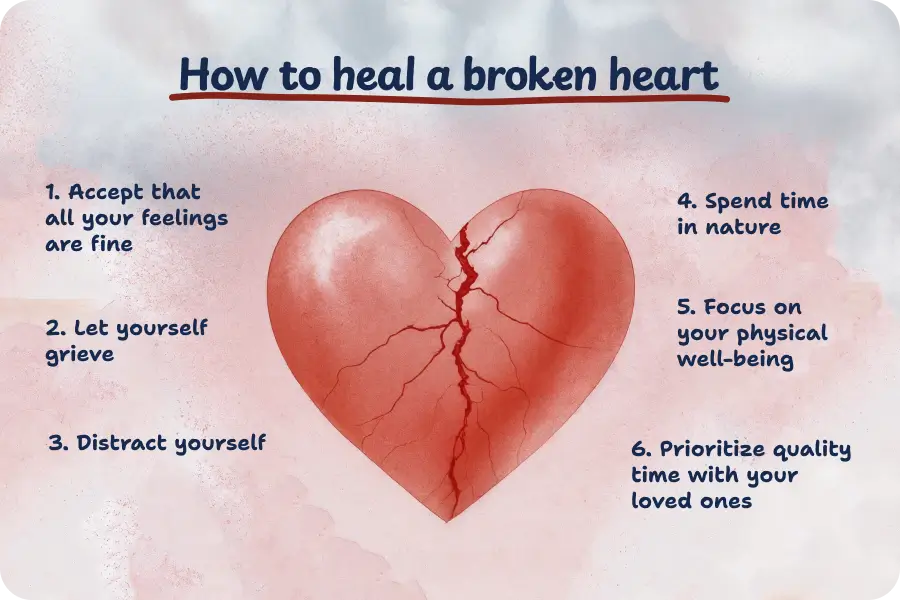
1. Accept that all your feelings are fine
Living with a broken heart may trigger different emotions. Sadness, anxiety, fear of the future, shame, and even some symptoms of depression are common. Don’t judge yourself for feeling what you feel. If you try to pretend that everything is fine, some emotions may remain unprocessed and make you feel much worse later on.
Grief can come and go in waves. One day you’re completely fine, and the next day you’re crying on your pillow all evening. But every time you start to believe that your life has lost meaning, remind yourself that it helps you prevent emotions from “bottling up” and allows you to heal faster.
You can track your feelings and what triggers them in the Breeze app. For instance, you may notice that evenings feel heavier than mornings or that certain songs, places, or social media updates intensify your sadness. It can help you avoid certain triggers and soften the pain.
2. Let yourself grieve
It is okay and healthy to cry over romantic films, discuss your ex-partner with your best friends, and process this sadness through expressive writing. Take your time and resist the urge to “analyze the why.” Also, give yourself small rituals of release.
- Delete photos when you’re ready.
- Pack away shared items if they reopen the wound.
- Mute or unfollow them on social media.
3. Distract yourself
While you need to face your feelings, it doesn’t mean that you need to handle them alone 24/7. Instead, you may find new hobbies, focus on work tasks, or simply watch movies you like rather than focus on something you did together.
Some people may also find rebound relationships to forget their ex-partner. While it can seem like a perfect way out of a heartbreak, sometimes rebounds can become an additional source of pain. So, make sure that you start dating someone out of a real connection rather than from a desire to stop being alone.
4. Spend time in nature
According to studies, spending time outdoors and being exposed to natural environments can reduce stress. You may decide to:
- Take a “tech-free” walk. Leave your phone at home or put it on Do Not Disturb. The constant ping of notifications or the compulsion to “check” the apps keeps your nervous system in a state of “high alert,” while nature allows your brain to rest.
- Practice grounding. If the broken heart syndrome hits, try the 5-4-3-2-1 technique while sitting on a park bench. Identify 5 things you see, 4 you can touch, 3 you hear, 2 you smell, and 1 you can taste. This pulls you out of the “loop” in your head and back into your body.
- Change your surroundings. Looking at a wide-open space, like a field or the ocean, reminds your subconscious that the world is vast and that your current pain, while intense, is not the boundary of your entire existence.
5. Focus on your physical well-being
Taking care of your body can also help you take care of your mental health and distract you from negative feelings. You may need to start hitting the gym, taking dance classes, or going for long walks to trigger dopamine release.
Even though it may seem challenging, ensure you get enough sleep, eat regularly, and stay hydrated, even if your appetite feels low. When your body is under emotional stress, these small routines create a sense of consistency and help you lower cortisol levels.
6. Prioritize quality time with your loved ones
People you trust can also help you overcome difficult times. You may decide to:
- Take a short trip with your friends to change the scenery.
- Cry on your friend’s shoulder when you need to.
- Plan a movie night with comfort films and familiar faces.
- Start a small tradition to create something to look forward to.
Breaking the pattern of relationship heartbreak
Analyze your previous relationships to see what they have in common and avoid moments of pain in the future.
The “type” audit
- Do you consistently date people who are “hard to read” or “mysterious” (which usually just means emotionally unavailable)?
- Are you drawn to people who are “broken,” struggling, or “unpolished” and believe your love will be the thing that finally saves them?
- Do you only feel “in love” when there is drama, uncertainty, or a constant threat of losing them?
The early warning signs
- If they tell you their deepest traumas or want to move quickly right away, this often signals a lack of boundaries.
- If they make you feel like the center of the universe instantly, they might go cold a month later, as it is typical narcissistic behavior.
- If all their exes are “villains,” it may mean you’ll never be good enough either.

Your role in the relationship
In relationships, there can be a role you tend to play. Which one feels most like you?
- The caretaker. “If I do enough for them, they’ll never want to leave me.”
- The performer. “I have to be perfect so they don’t get overwhelmed by me.”
- The investigator. “I’m constantly looking for signs they’re pulling away because I’m afraid that the relationship will come to an end.”
The breaking point
How do your relationships usually end?
- Your partner gradually stops texting, and you spend weeks “chasing” them to get an answer.
- It’s a cycle of fights and makeup sessions until you finally break up completely.
- Everything seems perfect until one day they suddenly decide they “can’t do this anymore” with no explanation.
Relationship green flags
Breaking the cycle doesn’t mean becoming guarded. It means choosing differently. Look for:
- Consistency
- Clear communication
- Accountability
- Emotional availability
- Feeling of calm safety
Healthy love may feel quieter at first. But over time, it builds stability, trust, and a sense that your heart is safe.
Expert Insight
“You may want to consider spending some time alone to really work on yourself. Reflect on what it is you’re authentically seeking in a partner. If you struggle with your self-esteem or self-worth, focus on cultivating more of a deeper relationship with yourself. The higher regard you hold yourself, the more you will attract this level of respect in others.”

Nicole Arzt
Mental health professional
When to seek professional help for repetitive heartbreak
You may need to reach out to a therapist if it’s too tough to deal with everything.
- Being single feels like an emergency. If you feel empty or invisible without a partner, it’s hard to live your life on your own.
- Your body is stuck in “alarm mode.” Being unable to eat, sleep, or focus for weeks at a time means that your nervous system needs a professional reset.
- You keep losing yourself. When you look in the mirror and realize you’ve changed your hobbies, your opinions, and your personality just to keep someone else happy.
- You still date people with the same patterns. You don’t know how to find a different kind of person or feel that “green flags” aren’t for you at all.
Frequently asked questions
What to do when you're heartbroken?
When you feel heartbroken and frustrated, focus on things you can control. You may need to:
- Take care of your physical health.
- Reach out to people you trust.
- Spend time in nature.
- Let yourself grieve and accept that all your feelings are normal.
- Take things moment by moment.
How long does heartbreak last for a man?
There’s no set answer for how long heartbreak lasts for a man. Just like women, men process emotional pain differently depending on personality, attachment style, depth of the relationship, and the circumstances of the breakup.
But if you let yourself process difficult feelings instead of trying to keep everything inside, negative emotions related to the breakup may weaken much faster.
What happens to your body when you're heartbroken?
When you feel heartbroken, your body releases stress hormones, including cortisol and adrenaline. They can increase your heart rate, raise blood pressure, cause chest tightness, disrupt your sleep patterns, and lead to low energy.
How to get over a broken heart when you still love him?
Acceptance and constant self-work can help you move forward. It’s possible to care deeply about someone and still recognize that the relationship isn’t right for you. Create distance to protect your healing, focus on rebuilding your routines and identity outside the relationship. Gently remind yourself why it ended and choose yourself every day instead of dwelling on painful memories.
Sources
- Field, T. (2011). “Romantic Breakups, Heartbreak and Bereavement—Romantic Breakups.” Psychology, 2, 382-387.
- Arnab Roy*, Mahesh Kumar Yadav, Ankita Singh, Indrajeet Kumar Mahto, Abhinav Kumar, Shruti Kumari, Manvi Kumari, Khusboo Kumari, Abhijit Kumar, Aliya Neshab, Niraj Kumar, Sandeep Kumar, Avishek Raj, Balram Mahto, Rajnish Raj, Mina Patel, “The Neurochemistry of Heartbreak: Unravelling the Complex Interplay of Brain Regions, Emotions and Neurotransmitters in Relationship Breakups,” Int. J. Sci. R. Tech., 2025, 2 (7), 216-227.
- Golabchi A, Sarrafzadegan N. “Takotsubo cardiomyopathy or broken heart syndrome: A review article.” J Res Med Sci. 2011
- Khalid S, Khalid A, Maroo P. “Risk Factors and Management of Takotsubo Cardiomyopathy.” Cureus. 2018
- Ewert A, Chang Y. “Levels of Nature and Stress Response. Behav Sci (Basel).” 2018
Disclaimer
This article is for general informative and self-discovery purposes only. It should not replace expert guidance from professionals.
Any action you take in response to the information in this article, whether directly or indirectly, is solely your responsibility and is done at your own risk. Breeze content team and its mental health experts disclaim any liability, loss, or risk, personal, professional, or otherwise, which may result from the use and/or application of any content.
Always consult your doctor or other certified health practitioner with any medical questions or concerns
Breeze articles exclusively cite trusted sources, such as academic research institutions and medical associations, including research and studies from PubMed, ResearchGate, or similar databases. Examine our subject-matter editors and editorial process to see how we verify facts and maintain the accuracy, reliability, and trustworthiness of our material.
Was this article helpful?