


ADHD is a neurodevelopmental condition that both men and women can experience. But even though the condition isn’t gendered, it can manifest differently across genders. Even more, women with ADHD tend to be underdiagnosed or diagnosed much later than men. [1] Holden E, Kobayashi-Wood H. “Adverse experiences of women with undiagnosed ADHD and the invaluable role of diagnosis.” Sci Rep. 2025 Keep reading to explore why it happens, how attention-deficit/hyperactivity disorder manifests, and how it can be treated.

What are ADHD presentations, and why does gender matter?
Attention-deficit/hyperactivity disorder (ADHD) is a neurodevelopmental disorder characterized by inattention, hyperactivity, and impulsivity. It has three main presentations:
Why gender matters in a condition that isn’t gendered
- Females with ADHD may show fewer hyperactive-impulsive symptoms and are less often diagnosed with hyperactive-impulsive/combined presentations, especially in childhood. [2] Loyer Carbonneau M, Demers M, Bigras M, Guay MC. “Meta-Analysis of Sex Differences in ADHD Symptoms and Associated Cognitive Deficits.” J Atten Disord. 2021 , [3] Ferrés FM, Grau CF, Guadall SA, Fernández VR, De La Cruz MC, Quiroga JAR. “Sex differences in adults with ADHD: A population based study.” Eur Psychiatry. 2025
- Some adult clinical samples show no significant sex difference, while some reviews and child samples still describe more inattentive females and more combined/hyperactive males. [3] Ferrés FM, Grau CF, Guadall SA, Fernández VR, De La Cruz MC, Quiroga JAR. “Sex differences in adults with ADHD: A population based study.” Eur Psychiatry. 2025
Simply put, ADHD itself has no gender bias, but its symptoms can vary. Girls and women may be more likely to exhibit inattentive-type symptoms, while boys and men are more likely to exhibit hyperactivity or impulsivity. These differences can affect how quickly someone is recognized, referred for assessment, and diagnosed, especially in childhood.

Differences in ADHD symptoms in women vs. men
There’s no one-size-fits-all rule of how gender differences in ADHD manifest. Nevertheless, there are general patterns rather than diagnostic rules, and anyone can experience any ADHD symptom.
Lesser-known female ADHD symptoms
There are also symptoms that aren’t included as core criteria for an ADHD clinical diagnosis but can be common among women living with the disorder (and may also signal comorbidities). These can include:
- Body-focused repetitive behaviors. Skin picking, hair pulling, or nail biting to calm down and deal with inner restlessness.
- Verbal hyperactivity can be more common than physical activity in women (compared to men). As such, ADHD in females may appear less outwardly disruptive. A woman may talk excessively, interrupt others, speak rapidly, or jump between topics while still seeming physically calm.
- Hypersexuality and a more difficult-to-control sex drive might manifest among people with ADHD.
ADHD in girls vs. boys: How presentation differs in childhood
A boy with ADHD who gets up from his seat or interrupts a lesson immediately attracts the teacher’s attention, while a girl’s inattention rarely disrupts the lesson. Therefore, teachers and parents are much more likely to initiate evaluations of boys. It is not because girls’ symptoms are less pronounced, but because they are easier to miss in a group setting.
In the classroom, females’ ADHD expression manifests as:
Teachers might describe such girls as “scatterbrained” or “unmotivated,” rather than considering them to have ADHD, since their behavior doesn’t align with what they’ve been taught to pay attention to.
The long-term cost of missed childhood symptoms in girls
Left unaddressed, these girls often perceive their problems as character flaws (“I’m lazy,” “I just don’t try hard enough”) rather than as a treatable condition. It can lead to self-esteem challenges, a strong inner critic, and a higher probability of burnout.
Nicole Arzt, LMFT, highlights other potential challenges that people diagnosed with ADHD only in adulthood may face. “People with undiagnosed ADHD symptoms may internalize their struggles as a signal that something is wrong or ‘broken’ with them. This can drive shame and reinforce low self-esteem, which may exacerbate other mental health symptoms, including anxiety, depression, substance use, disordered eating, and more. In all cases, it can leave people feeling frustrated with themselves and others.”
ADHD differences in gender across the lifespan
ADHD behaviors may also vary in men and women over the lifetime. Hormonal changes, age-related challenges, and different levels of responsibility may exacerbate ADHD symptoms.
Adolescence
During puberty, both men and women experience intense hormonal fluctuations, which may influence symptom severity. At the same time, academic demands, social pressures, and the growing need for independence can make ADHD symptoms more difficult to compensate for.
Adulthood
Some women reach adulthood without realizing that their difficulties stem from ADHD. Coping strategies that worked well in childhood may become less effective as responsibilities increase.
This is why the mean age at ADHD diagnosis ranged from 16.3 to 28.6 years for females versus 11.2 to 22.7 for males. [4] Siddiqui, U., Conover, M. M., Voss, E. A., Kern, D. M., Litvak, M., & Antunes, J. (2024). “Sex Differences in Diagnosis and Treatment Timing of Comorbid Depression/Anxiety and Disease Subtypes in Patients With ADHD: A Database Study. Journal of Attention Disorders,” 28(10), 1347-1356.
For women who primarily experience symptoms of inattention, this may be the point at which ADHD symptoms manifest more clearly and become noticeable enough to require further attention.
Perimenopause and menopause
Hormonal changes associated with perimenopause and menopause can make ADHD symptoms more noticeable. Decreased estrogen levels can impact attention, working memory, sleep, and emotional regulation, which can result in chronic overwhelm and anxiety.
Symptoms such as forgetfulness, mental fogginess, irritability, and difficulty concentrating may become more pronounced. Because some of these symptoms can also occur during menopause itself, distinguishing hormonal changes from ADHD can be challenging.
In what gender is the ADHD diagnosis more common?
Masking unveiled: Why the gender gap narrows in adulthood
It happens partly because women tend to get diagnosed later than men, especially when their symptoms are less disruptive. Due to social expectations, girls may learn to suppress hyperactive behaviors, engage in masking, and try much harder than their peers to appear calm, organized, and attentive.
As responsibilities increase in adulthood, these coping strategies may become harder to maintain. Work, relationships, finances, and household responsibilities place greater demands on attention and executive functioning, which is why many women receive a diagnosis much later.
Other causes of the diagnostic delay of adult ADHD
Diagnostic criteria are built mostly on studies of hyperactive boys
DSM-IV studies mostly included boys who were referred to clinics because of hyperactive or disruptive behavior. Compared with DSM-III-R, DSM-IV identified more girls with significant difficulties, suggesting that the earlier criteria were even more focused on the way ADHD typically appeared in boys. [7] Lahey BB, Applegate B, McBurnett K, Biederman J, Greenhill L, Hynd GW, Barkley RA, Newcorn J, Jensen P, Richters J, et al. “DSM-IV field trials for attention deficit hyperactivity disorder in children and adolescents.” Am J Psychiatry. 1994
Sex and gender bias
ADHD research has found that teachers are more likely to refer boys than girls with similar symptoms. [8] Coles EK, Slavec J, Bernstein M, Baroni E. “Exploring the gender gap in referrals for children with ADHD and other disruptive behavior disorders.” J Atten Disord. 2012 Even more, clinicians diagnose ADHD more often for boys than girls with the same vignette symptoms. [9] Bruchmüller K, Margraf J, Schneider S. “Is ADHD diagnosed in accord with diagnostic criteria? Overdiagnosis and influence of client gender on diagnosis.” J Consult Clin Psychol. 2012
The DSM field trials underrepresented girls and women
Diagnostic and statistical manual, fifth edition (DSM‑5) field trials did not include adults, so women presenting in adulthood were not directly represented in field testing. [10] Matte B, Anselmi L, Salum GA, et al. “ADHD in DSM-5: a field trial in a large, representative sample of 18- to 19-year-old adults.” Psychological Medicine. 2015;45(2):361-373. Also, in the field trials used to set DSM‑5 and ICD‑11 criteria for ADHD, only 21% of participants were girls. [11] Platania NM, Starreveld DEJ, Wynchank D, Beekman ATF and Kooij S (2025) “Bias by gender: exploring gender-based differences in the endorsement of ADHD symptoms and impairment among adult patients.” Front. Glob. Women’s Health 6:1549028. doi: 10.3389/fgwh.2025.1549028
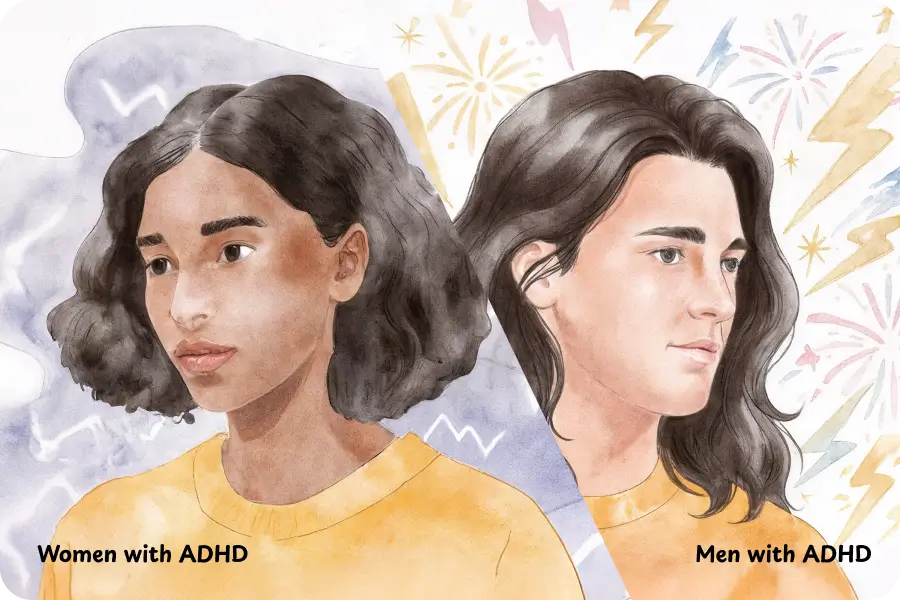
Comorbidities and long-term outcomes by gender
ADHD symptom severity can increase if a person experiences comorbid disorders. There’s no unified pattern of how these co-occurring conditions affect men and women, but some differences may occur.
Conditions that are more common in women with ADHD
Conditions that are more common in men with ADHD
Adult ADHD in women vs. men: What changes after diagnosis
Receiving an ADHD diagnosis in adulthood can change how women and men understand their symptoms and what kind of support they need.
Treatment, medication, and clinical implications — Are women prescribed differently?
Studies prove that girls diagnosed with ADHD are prescribed stimulants less frequently and at a slightly older age than their male counterparts, and they discontinue treatment earlier than boys do. [13] Iris L. Rapoport, Annabeth P. Groenman. “A Review of Sex and Gender Factors in Stimulant Treatment for ADHD: Knowledge Gaps and Future Directions.” Journal of Attention Disorders. 2025
This may partly reflect differences in stigma, diagnosis, and treatment availability, rather than differences in who might benefit from treatment.
Why ADHD medication may need hormone-informed timing
Women may respond differently to ADHD medications due to hormonal fluctuations, body composition, and other individual characteristics. Therefore, medical treatment should be tailored to the individual.
Hormonal fluctuations can be particularly relevant when symptoms change during different periods of the menstrual cycle. Fluctuations in estrogen levels can temporarily impair attention, motivation, emotional regulation, and other ADHD-related difficulties in some women.
Tracking symptom changes throughout the cycle can help identify patterns and provide useful information for a healthcare provider. If ADHD symptoms or medication effects change significantly during certain periods, the treatment plan may require adjustment, rather than simply assuming that the medication is becoming less effective.
Expert Insight
Treatment can support an individual’s efforts to work through themes of masking. It can help people decide if and when masking may, at times, be appropriate versus when it’s more important to engage authentically. Therapy can also address the shame and fears that often coincide with masking behaviors.

Nicole Arzt
Mental health professional
Frequently asked questions
Is ADHD more common in men or women?
It is scientifically unclear. Men get diagnosed with ADHD more often, especially during childhood. However, women may be underdiagnosed because they are more likely to have inattentive symptoms, which can be less noticeable than hyperactive or impulsive ones.
The gender gap becomes smaller in adulthood.
Can women have hyperactive-type ADHD?
Yes, women can have hyperactive-impulsive or combined ADHD. However, hyperactivity in women may sometimes appear as restlessness, excessive talking, difficulty relaxing, or a constant need to stay busy.
Why wasn't I diagnosed with ADHD as a child?
Maybe you turned to masking strategies, or your symptoms were mild or primarily inattentive. Also, you may have been seen as quiet, dreamy, or simply disorganized rather than having ADHD. Furthermore, some cultures or families do not inherently know how to contextualize ADHD, so they may not even be aware of how symptoms can present.
Does ADHD get worse with age in women?
Women may experience more severe symptoms due to perimenopause and menopause because of hormonal fluctuations. Also, symptoms can become harder to manage as responsibilities increase.
Are ADHD symptoms in men and women really that different?
The core ADHD symptoms are the same, but they may be expressed differently. Women might be more inattentive, while men are more likely to show hyperactive or impulsive behaviors.
Sources
- Holden E, Kobayashi-Wood H. “Adverse experiences of women with undiagnosed ADHD and the invaluable role of diagnosis.” Sci Rep. 2025
- Loyer Carbonneau M, Demers M, Bigras M, Guay MC. “Meta-Analysis of Sex Differences in ADHD Symptoms and Associated Cognitive Deficits.” J Atten Disord. 2021
- Ferrés FM, Grau CF, Guadall SA, Fernández VR, De La Cruz MC, Quiroga JAR. “Sex differences in adults with ADHD: A population based study.” Eur Psychiatry. 2025
- Siddiqui, U., Conover, M. M., Voss, E. A., Kern, D. M., Litvak, M., & Antunes, J. (2024). “Sex Differences in Diagnosis and Treatment Timing of Comorbid Depression/Anxiety and Disease Subtypes in Patients With ADHD: A Database Study. Journal of Attention Disorders,” 28(10), 1347-1356.
- Ayano G, Demelash S, Gizachew Y, Tsegay L, Alati R. “The global prevalence of attention deficit hyperactivity disorder in children and adolescents: An umbrella review of meta-analyses.” J Affect Disord. 2023
- Johnson, S., Lim, E., Jacoby, P. et al. “Prevalence of attention deficit hyperactivity disorder/hyperkinetic disorder of pediatric and adult populations in clinical settings: a systematic review, meta-analysis and meta-regression.” Mol Psychiatry 31, 576–586 (2026).
- Lahey BB, Applegate B, McBurnett K, Biederman J, Greenhill L, Hynd GW, Barkley RA, Newcorn J, Jensen P, Richters J, et al. “DSM-IV field trials for attention deficit hyperactivity disorder in children and adolescents.” Am J Psychiatry. 1994
- Coles EK, Slavec J, Bernstein M, Baroni E. “Exploring the gender gap in referrals for children with ADHD and other disruptive behavior disorders.” J Atten Disord. 2012
- Bruchmüller K, Margraf J, Schneider S. “Is ADHD diagnosed in accord with diagnostic criteria? Overdiagnosis and influence of client gender on diagnosis.” J Consult Clin Psychol. 2012
- Matte B, Anselmi L, Salum GA, et al. “ADHD in DSM-5: a field trial in a large, representative sample of 18- to 19-year-old adults.” Psychological Medicine. 2015;45(2):361-373.
- Platania NM, Starreveld DEJ, Wynchank D, Beekman ATF and Kooij S (2025) “Bias by gender: exploring gender-based differences in the endorsement of ADHD symptoms and impairment among adult patients.” Front. Glob. Women’s Health 6:1549028. doi: 10.3389/fgwh.2025.1549028
- Tung I, Li JJ, Meza JI, Jezior KL, Kianmahd JS, Hentschel PG, O’Neil PM, Lee SS. “Patterns of Comorbidity Among Girls With ADHD: A Meta-analysis.” Pediatrics. 2016
- Iris L. Rapoport, Annabeth P. Groenman. “A Review of Sex and Gender Factors in Stimulant Treatment for ADHD: Knowledge Gaps and Future Directions.” Journal of Attention Disorders. 2025
Disclaimer
This article is for general informative and self-discovery purposes only. It should not replace expert guidance from professionals.
Any action you take in response to the information in this article, whether directly or indirectly, is solely your responsibility and is done at your own risk. Breeze content team and its mental health experts disclaim any liability, loss, or risk, personal, professional, or otherwise, which may result from the use and/or application of any content.
Always consult your doctor or other certified health practitioner with any medical questions or concerns
Breeze articles exclusively cite trusted sources, such as academic research institutions and medical associations, including research and studies from PubMed, ResearchGate, or similar databases. Examine our subject-matter editors and editorial process to see how we verify facts and maintain the accuracy, reliability, and trustworthiness of our material.
Was this article helpful?