

Do you find yourself forgetting appointments, misplacing important items, or struggling to finish tasks? What if these challenges aren’t simply signs of stress or anxiety, but symptoms of ADHD?
Research shows that boys (15%) are more likely to be diagnosed with ADHD than young girls (8%) [1] Danielson ML, Claussen AH, Bitsko RH, Katz SM, Newsome K, Blumberg SJ, Kogan MD, Ghandour R. ADHD Prevalence Among U.S. “Children and Adolescents in 2022: Diagnosis, Severity, Co-Occurring Disorders, and Treatment.” May-June 2024 . Due to these gender differences and the stereotypes we commonly hear about, women can be diagnosed with ADHD after years of living without a proper diagnosis and effective treatment. Let’s explore how ADHD symptoms in women manifest and focus on coping strategies and treatment options.

What Is an ADHD Diagnosis & Why Is It Often Missed in Women?
Attention-deficit/hyperactivity disorder (ADHD) is a neurodevelopmental condition that involves impulsivity, hyperactivity, difficulty concentrating, and emotional dysregulation. While ADHD is often associated with only hyperactive behavior, its symptoms can look different in women, making the mental health condition easier to overlook. They can sometimes be mistaken for chronic stress, anxiety, hormonal fluctuations, or just being forgetful.
3 ADHD types
The Diagnostic and Statistical Manual of Mental Disorders (DSM-5) identifies 3 main types of ADHD:
- Inattentive type means that a person experiences a lack of attention and difficulty staying concentrated. Adult women with ADHD may have challenges organizing tasks and executive functioning, and regularly forget important things.
- The hyperactive-impulsive type has difficulty controlling impulses, fidgets, and is consistently restless. Such people may talk a lot, struggle with interjecting, engage in risky behaviors, and act without properly considering consequences.
- Combined type involves significant symptoms of both inattention and hyperactivity-impulsivity. Such women with ADHD meet the full diagnostic criteria and might present the most complex profile for support.
To be diagnosed with a certain type, a person must exhibit at least six of its symptoms for at least six months. At the same time, to have a combined type, you need to meet at least 12 symptoms (6 for the inattentive and 6 for the hyperactive-impulsive type).
ADHD in women compared to ADHD in men
Attention-deficit/hyperactivity disorder symptoms might seem universal for both sexes. However, studies have found that while women with ADHD experience the same symptoms as men, there are some subtle differences in how those symptoms appear and affect them [2] Noemi M. Platania, Daniëlle E. J. Starreveld, Dora Wynchank, Aartjan T. F. Beekman, Sandra Kooij. “Bias by gender: exploring gender-based differences in the endorsement of ADHD symptoms and impairment among adult patients.” March 2025 .
Even more, symptoms of attention-deficit/hyperactivity disorder in women can be less overt, and young girls can develop coping strategies to handle them.
Expert Insight
We live in a culture that encourages suppression in women and girls from an early age. “Boys will be boys” in regard to impulsivity and louder behavior, however girls are taught to focus on quieting their bodies and behaviors. Women are still playing catch-up in regard to proper diagnosis within the mental health sector. This being said, it is important to choose a well-informed and trained clinician when deciphering symptoms. It is up to the clinician to ask the proper questions and complete the necessary assessments to make the correct diagnosis.

Katherine Scott
Mental health professional
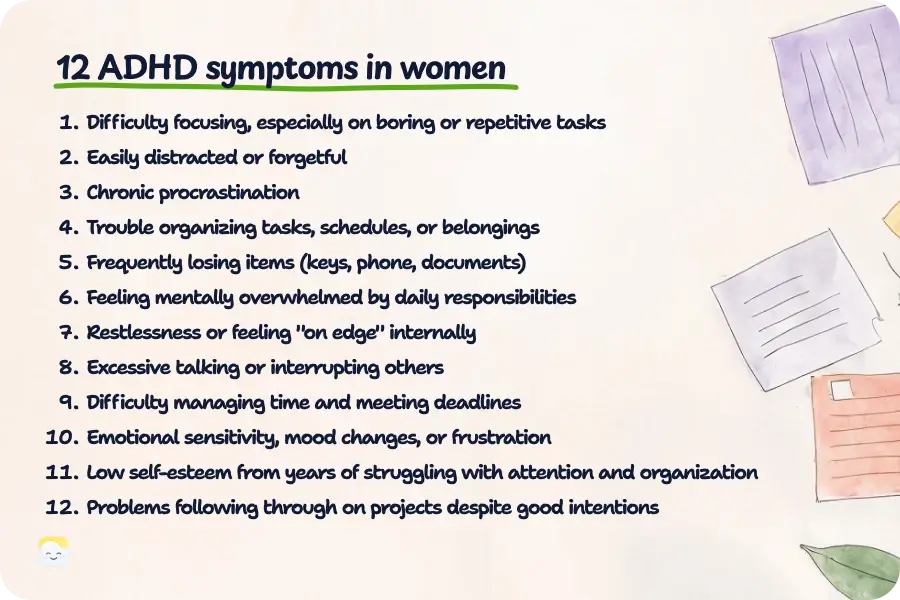
12 Most Common Signs of ADHD in Women
Manifestations and severity of ADHD symptoms in women may vary during their lifetime and even over the menstrual cycle, pregnancy, and menopause, according to the study published in BMC Psychiatry [4] Young S, Adamo N, Ásgeirsdóttir BB, Branney P, Beckett M, Colley W, Cubbin S, Deeley Q, Farrag E, Gudjonsson G, Hill P, Hollingdale J, Kilic O, Lloyd T, Mason P, Paliokosta E, Perecherla S, Sedgwick J, Skirrow C, Tierney K, van Rensburg K, Woodhouse E. “Females with ADHD: An expert consensus statement taking a lifespan approach providing guidance for the identification and treatment of attention-deficit/ hyperactivity disorder in girls and women.” August 2020 . They typically fall under 3 main types: inattentive, hyperactive-impulsive, and emotional regulation symptoms, with inattentiveness being noticed the most often.
Inattentive symptoms
In women, inattention may be more pronounced than in men. Forgetfulness, disorganization, and hyperfixation can stand out.
- Losing focus easily because of background noise or racing thoughts. You can sit down to pay your bills, but get distracted by a buzzing notification. Ten minutes later, you’re deep into scrolling, the bills untouched.
- Difficulties with planning & poor time management. You might avoid tasks that require long-term effort. A big project can feel so overwhelming that you put it off until the last moment.
- Losing things quite often. For instance, sometimes you may lose your keys in odd places, like the fridge.
- Hyperfixation. When feeling inspired, you might spend hours organizing your bookshelf and forget about everything else.
Hyperactivity and impulsivity in women
- Restlessness and constant fidgeting. You can’t sit still during a meeting, so you keep tapping your foot or playing with your pen.
- Excessive talking & interrupting others. You get excited telling a story and end up talking way longer than you meant to.
- Impulsive actions without thinking. You can agree to any crazy idea possible, from purchasing odd clothes to moving to another country right away.
- Difficulty waiting for a turn. Standing in line makes you experience internal restlessness, like you just can’t wait another minute.

Emotional dysregulation and executive dysfunction
Women with ADHD might be sensitive to criticism and quick to react emotionally rather than aggressively, while men might seem impatient, irritable, withdrawn, or unmotivated.
- Difficulty managing stress and multitasking. One extra task makes you feel completely overwhelmed.
- Rapid mood changes and big feelings. You’re happy one minute and upset the next.
- Disorganization in daily routines. A situation where you start cooking but realize you forgot something important from the store is super-typical for you.
- Heightened emotional sensitivity. A small joke feels hurtful and stays in your head for weeks. Women and men with ADHD are more prone to experience rejection sensitivity dysphoria.
4 Ways ADHD Impacts Everyday Life for Women & Practical Tips That May Help
The everyday life of women with ADHD might be influenced by gender bias. For example, others may regard them as overly emotional or unreliable. Yet, difficulties with organization, focus, and emotional regulation are actually symptoms of the disorder.
1. Impact on relationships
Building relationships as a woman with ADHD can bring some arguments and misunderstandings to the couple. Partners may consider difficulty paying attention and being easily distracted as a lack of interest or commitment.
For example, if you forget the date and stay home instead of meeting your partner at a restaurant, it can be perceived as neglect. Also, emotional sensitivity can cause interpersonal conflicts. A small comment like “you never listen” might feel very painful and lead to arguments.
2. Workplace and career struggles
At work, women with ADHD can have challenges concentrating on one process, prioritizing tasks and meeting deadlines, sitting in one place for too long, or remembering meetings and agreements.
3. Parenting with ADHD
This inconsistent parenting can lead to a child’s unstable self-esteem or even result in childhood trauma. The problem can be even more noticeable if a child also has ADHD. Impulsivity of the mother and the child can lead to conflicts, while difficulties with remembering important things might result in low educational performance.
Take a parenting style quiz to become more self-aware and discover your strengths. In the app, you can find more tests on your personality, attachment style, childhood trauma, narcissistic traits, and many more.

4. ADHD in older women
Research suggests that women with ADHD may experience more symptoms during perimenopause and menopause [5] Page CE, Soreth B, Metcalf CA, Johnson RL, Duffy KA, Sammel MD. “Natural vs. surgical postmenopause and psychological symptoms confound the effect of menopause on executive functioning domains of cognitive experience.” April 2023 . Sleep problems, anxiety, and depression can also make it harder for postmenopausal women to plan, organize, and stay focused. As a result, some ADHD symptoms may become more severe with age and have a greater impact on daily life.
Expert Insight
Hormonal imbalances contribute to symptom severity amongst women with ADHD. It is important to have a collaborative relationship with a medical provider who helps manage hormone levels, especially during transitional times such as puberty, perimenopause, or menopause. It is also important to stay up-to-date on bloodwork due to those levels having an influence on the severity of ADHD symptoms and brain fog. Working with a mental health therapist can aid in knowing oneself and developing proper coping tools, so when times occur that symptoms grow louder or more prominent, you are better equipped to respond rather than react or panic.
Katherine Scott
Mental health professional
Diagnosing ADHD in Women
There are currently no medical or laboratory tests that can definitively diagnose ADHD, such as a blood test or brain scan. To get an accurate diagnosis, you may need to visit a licensed mental health professional. They can assess your symptoms using criteria from the Diagnostic and Statistical Manual of Mental Disorders (DSM-5) and may use structured interviews, special questionnaires, rating scales, and input from people close to you.
8 Questions to ask a doctor about adult ADHD symptoms
Before you get diagnosed with ADHD:
- I have some difficulties with memory and attention. Can they be the signs of ADHD?
- Are there other conditions that can mimic ADHD in adults?
- I’ve experienced or still live with an eating disorder. Can it be somehow linked to ADHD?
- Should we discuss my childhood behavior or school performance to identify the diagnosis?
Also, always remember to say if you live with borderline personality disorder, bipolar disorder, substance abuse disorder, or any other conditions.
Once you find out that you live with high-functioning ADHD:
- How can hormonal changes influence my executive function?
- Can I distinguish ADHD manifestations and stress-related cognitive challenges? How can it help me?
- What treatment would you recommend to me?
- Are there signs that I may need changes in treatment?
ADHD Treatment for Women: Medications, Psychotherapy & Lifestyle Tips
Women’s ADHD can’t be cured completely. However, appropriate treatment and healthy daily habits work well for many women.
ADHD medication options
To help women manage the symptoms of ADHD, doctors may prescribe a treatment plan to balance brain chemicals. If you also have hormone imbalances, those can be taken into account, too.
Therapy and coaching
- Cognitive-behavioral therapy (CBT) helps women handle negative thoughts, overcome low self-esteem and self-blame, and develop more consistent habits.
- Dialectical-behavioral therapy (DBT) allows patients to improve distress tolerance and regulate their emotions better.
- Family therapy can make life at home easier. It helps your close ones understand ADHD better and supports healthier ways to deal with impulsive behavior.
- ADHD coaching helps you set goals, plan your day, and manage tasks without feeling constantly behind.
- Support groups provide a safe space to share experiences, learn coping strategies, and connect with others who understand the challenges of living with ADHD.
Lifestyle strategies
ADHD research has found that improved lifestyle choices may improve symptoms of the disorder [6] Lange, Klaus. “Lifestyle and attention deficit/hyperactivity disorder.” May 2018 :
Healthy diet
Some people with ADHD may feel frustrated when they need to cook something or decide what they need to eat. Also, forgetting to eat at all can be a typical symptom of ADHD in women.
Adequate sleep schedule
Your body can set its own internal clock if you go to bed and wake up at the same time every day. This could help you feel better and have more control over your emotions and mood.
Having a regular schedule can help with it even more because ADHD in women can make it hard to fall asleep, stay asleep all night, or wake up in the morning. This will “teach” your brain that it needs to rest at a certain time and tell it when it’s time to be active.
Working out regularly
Women with ADHD may be able to control their mood and reduce their impulsiveness and hyperactivity by being active [6] Lange, Klaus. “Lifestyle and attention deficit/hyperactivity disorder.” May 2018 . Dopamine and norepinephrine, which are responsible for overall mental clarity, go up when you exercise regularly.
If you have trouble going to the gym on a regular basis, you could try going for long walks, doing yoga at home, or dancing. You can also work out with your friends and help each other. It will make things more fun and keep you going.
Self-Care Tips for Women Living with Attention-Deficit/Hyperactivity Disorder
To handle inattentiveness and impulsivity and implement structure into daily life, you can do the following:
1. Approach time management seriously
Women with ADHD can lose track of time or get hyperfocused on something for too long. It might also be tough for some of them to estimate the time needed for a certain task.
2. Use checklists for routines
People with inattentive-type symptoms can forget small but important tasks (like taking vitamins or packing their bag). To reduce forgetfulness, it can be helpful to create morning, evening, or work routines.
Write down key things you need to do, and concentrate on them instead of trying to manage everything at once.
3. Prioritize your mental health
Studies prove high comorbidity of ADHD in women with other disorders, including autism spectrum disorder, depressive disorder, bipolar disorder, anxiety disorders, and disruptive mood dysregulation disorder [7] Gnanavel S, Sharma P, Kaushal P, Hussain S. “Attention deficit hyperactivity disorder and comorbidity: A review of literature.” September 2019 . So if you notice frequent mood changes, permanent anxiety with no reason, or any other unusual states, it’s better to talk about it with your provider.
Here’s where Breeze Wellbeing may come in handy. This app allows you to develop coping mechanisms to stay productive and improve your organizational skills.
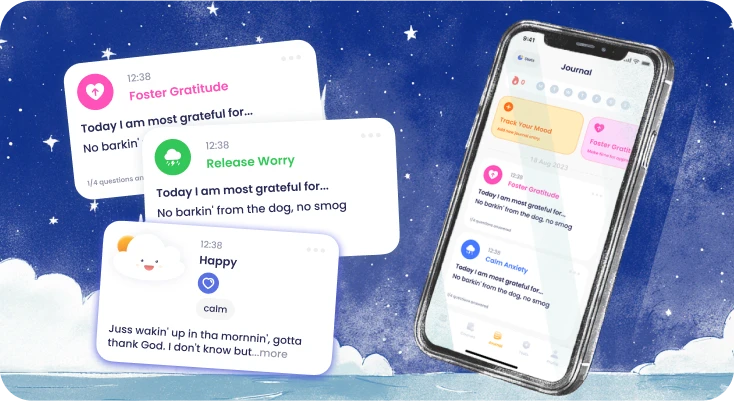
For example, if you want to meditate every day in the morning, simply use Breeze to schedule your sessions. Also, the app lets you journal your thoughts in the moments you feel worried, notice ADHD struggles with the mood tracker, and use relaxation games to feel much calmer and concentrated.
Frequently asked questions
1. Are women more likely to have the inattentive type?
Yes, women are more likely to have the diagnosis of the inattentive or combined types of ADHD and experience forgetfulness, difficulty focusing, or disorganization.
2. What is high-functioning ADHD in adult women?
High-functioning ADHD refers to a form of ADHD that may not be immediately noticeable because a person can manage ADHD symptoms effectively in daily life. Although they may still experience challenges with focus, impulsivity, organization, or emotional regulation, they often develop strategies that help them stay on track and meet their responsibilities. Many people with high-functioning ADHD also use their creativity, energy, and unique thinking skills to thrive in different areas of life.
3. Is ADHD in women genetic or hormonal?
ADHD is about 74% genetic [8] Faraone SV, Larsson H. “Genetics of attention deficit hyperactivity disorder.” April 2019 . While there’s no clear explanation of how it’s inherited, this disorder can stem from a combination of genetic factors, brain chemistry, and environmental factors. Hormonal changes can worsen the symptoms of ADHD or affect how they manifest. Yet, female hormones can’t cause the disorder itself or make it develop from scratch.
Sources
- Danielson ML, Claussen AH, Bitsko RH, Katz SM, Newsome K, Blumberg SJ, Kogan MD, Ghandour R. ADHD Prevalence Among U.S. “Children and Adolescents in 2022: Diagnosis, Severity, Co-Occurring Disorders, and Treatment.” May-June 2024
- Noemi M. Platania, Daniëlle E. J. Starreveld, Dora Wynchank, Aartjan T. F. Beekman, Sandra Kooij. “Bias by gender: exploring gender-based differences in the endorsement of ADHD symptoms and impairment among adult patients.” March 2025
- Tamara Williams, Louise Horstmann, Laiba Kayani, Annabelle Xiao Hui Lim, Abigail Russell, Tamsin Ford, Ann John, Kapil Sayal, Anita Thapar, Kate Langley, Joanna Martin. “An item-level systematic review of the presentation of ADHD in females.” April 2025
- Young S, Adamo N, Ásgeirsdóttir BB, Branney P, Beckett M, Colley W, Cubbin S, Deeley Q, Farrag E, Gudjonsson G, Hill P, Hollingdale J, Kilic O, Lloyd T, Mason P, Paliokosta E, Perecherla S, Sedgwick J, Skirrow C, Tierney K, van Rensburg K, Woodhouse E. “Females with ADHD: An expert consensus statement taking a lifespan approach providing guidance for the identification and treatment of attention-deficit/ hyperactivity disorder in girls and women.” August 2020
- Page CE, Soreth B, Metcalf CA, Johnson RL, Duffy KA, Sammel MD. “Natural vs. surgical postmenopause and psychological symptoms confound the effect of menopause on executive functioning domains of cognitive experience.” April 2023
- Lange, Klaus. “Lifestyle and attention deficit/hyperactivity disorder.” May 2018
- Gnanavel S, Sharma P, Kaushal P, Hussain S. “Attention deficit hyperactivity disorder and comorbidity: A review of literature.” September 2019
- Faraone SV, Larsson H. “Genetics of attention deficit hyperactivity disorder.” April 2019
Disclaimer
This article is for general informative and self-discovery purposes only. It should not replace expert guidance from professionals.
Any action you take in response to the information in this article, whether directly or indirectly, is solely your responsibility and is done at your own risk. Breeze content team and its mental health experts disclaim any liability, loss, or risk, personal, professional, or otherwise, which may result from the use and/or application of any content.
Always consult your doctor or other certified health practitioner with any medical questions or concerns
Breeze articles exclusively cite trusted sources, such as academic research institutions and medical associations, including research and studies from PubMed, ResearchGate, or similar databases. Examine our subject-matter editors and editorial process to see how we verify facts and maintain the accuracy, reliability, and trustworthiness of our material.
Was this article helpful?