



If your relationships with primary caregivers were inconsistent or emotionally unsafe or lacked emotional closeness, you may have developed an insecure attachment style, according to attachment theory. It can be anxious, avoidant, or disorganized attachment.
However, attachment patterns are not fixed. Let’s find out how you can develop what psychologists call earned secure attachment and build healthy relationships.

What Is Earned Secure Attachment?
Earned secure attachment describes a state in which a person who once had an insecure attachment style later develops the emotional skills associated with secure attachment. Instead of reacting to intimacy with fear or anxiety, people with earned security have the ability to:
- Trust their partners more easily
- Communicate emotions openly
- Maintain independence while staying emotionally connected
- Regulate conflict without panic or avoidance
Expert Insight
You can earn a secure attachment through any safe relationship. However, it does tend to take time and patience because secure attachment requires receiving many safe emotional corrective experiences. It is important to remember that there’s no ‘fixed’ destination; instead, secure attachment is about increasing overall safety within yourself and among others.

Nicole Arzt
Mental health professional
The 4 S’s of Secure Attachment: Dan Siegel’s Framework
Psychiatrist Dan Siegel describes secure attachment through four emotional experiences, often called the “4 S’s,” that form the foundation of healthy emotional bonding:
- Safe. You feel physically and emotionally secure in relationships. You trust that disagreements or emotional vulnerability will not lead to rejection or harm.
- Seen. Your partner acknowledges and validates your emotions and past experiences. You feel safe and “seen,” and your partner recognizes who you truly are.
- Soothed. When you’re stressed or upset, your partner responds with comfort and support rather than criticism or distance.
- Secure. Repeated experiences of support and connection create a deep sense of stability, mutual respect, and trust in a relationship.
How Does Earned Security Develop in Adults?
This transformation often happens through self-reflection, therapy, relationships with securely attached people, and corrective emotional experiences that reshape how a person understands intimacy and trust.
1. Therapy and self-awareness
Therapy can help you understand how early attachment experiences shaped your emotional reactions and patterns. A therapist can help challenge negative beliefs about intimacy and teach practical skills for emotional regulation and communication. They also ideally model a secure attachment that you can internalize for yourself.
2. Healthy romantic relationships
When a partner consistently responds with empathy and reliability, it gradually changes old beliefs about relationships. For example, someone with an avoidant attachment style might initially feel uncomfortable sharing vulnerable emotions. However, if their partner listens without judgment and responds with understanding, it creates a new experience of emotional safety. Eventually, this can make vulnerability feel less threatening.
Similarly, a person with anxious attachment may fear abandonment during conflict and constantly seek reassurance. When their partner stays calm and supportive in difficult conversations, it helps build trust and emotional stability.
3. Emotional regulation skills
Another important part of earned secure attachment is learning how to regulate your nervous system and manage strong emotions. For example, instead of sending multiple worried messages when a partner doesn’t respond quickly, you might take a few deep breaths, stay grounded, go for a short walk, or remind yourself that there could be many neutral reasons for the delay.
4. Supportive friendships and community
Secure relationships outside romantic partnerships also reinforce feelings of trust and belonging. Positive experiences like supportive friendships, family connections, or community environments can help you build secure attachment.
As a result, even if someone grew up with distant or emotionally immature parents, they can change their attachment style in adulthood. Are you wondering whether you had negative early experiences that may still affect your life? Take a childhood trauma test to find out more.

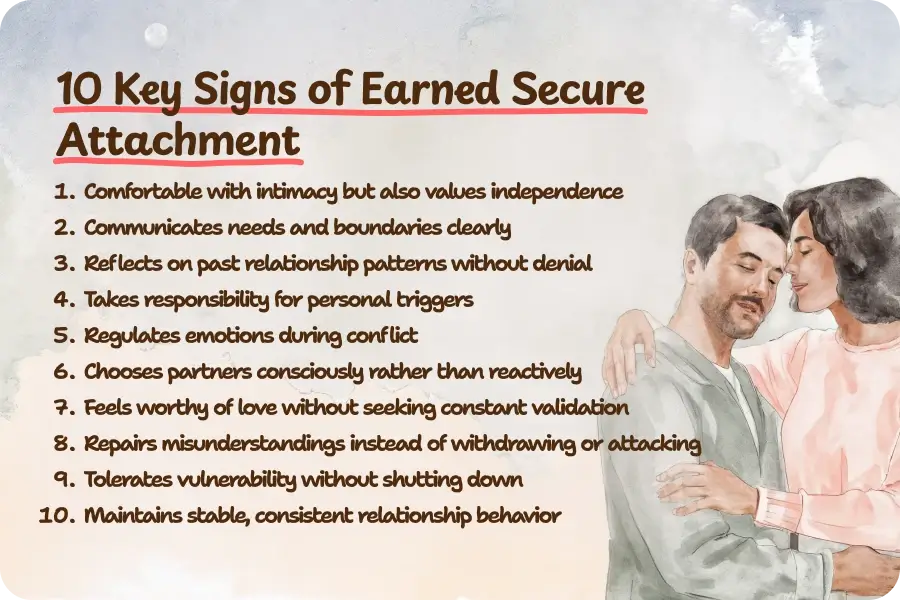
6 Signs of Earned Secure Attachment
People with earned secure attachment may have started with avoidant, fearful, or anxious attachment patterns, but over time, they develop healthier ways of maintaining consistent relationships. Here are some common signs:
1. Comfort with both intimacy and independence. Someone with earned secure attachment can be emotionally close to their partner while still maintaining their own identity, friendships, and healthy boundaries.
2. Open and honest communication. They are able to talk about their feelings, needs, desires, and concerns without fear of rejection. Instead of avoiding difficult conversations or reacting defensively, they try to communicate calmly and openly.
3. Emotional self-awareness & ability to self-regulate. People with a secure attachment style tend to recognize their emotional triggers and understand how early caregiving or other past experiences may influence their reactions. Even when they feel anxious or angry, they can generally pause, reflect, and process their emotions.
4. Trust and stability in relationships. They don’t constantly fear abandonment or assume the worst about their partner’s intentions. Instead, they build trust gradually and feel relatively secure in the relationship.
5. Healthy conflict resolution. Arguments or disagreements don’t automatically feel like a threat to the relationship. They are more likely to approach conflict as a problem to solve together, rather than something to win or escape from.
6. Healthy boundaries. They respect both their own needs and their partner’s boundaries. They are comfortable saying “no” and supporting their partner’s autonomy.
8 Tips to Overcome Insecure Attachment Style in Adult Relationships
Here are several important steps to develop secure attachment:
1. Recognize your adult attachment triggers
The first step toward change is understanding what situations activate your attachment responses. For example, anxiously attached adults may feel rejected when their partner takes time alone. At the same time, people with avoidant attachment can become emotionally unavailable during conflicts.
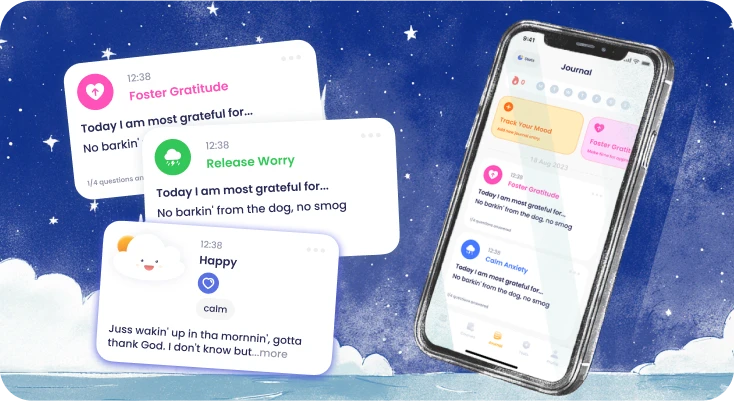
Daily check-ins and mood tracking in the Breeze app may help you see patterns in your emotions and understand your triggers.

2. Practice strengthening emotional awareness
People with insecure attachment react quickly to emotions without fully understanding them. Developing emotional awareness means learning to recognize and name what you feel before reacting.
For example, instead of immediately accusing a partner of not caring, try to pause and notice: “I’m feeling anxious and afraid of being ignored.” Naming the emotion can create space between the feeling and the reaction.
Practices like journaling or simply asking yourself, “What am I feeling right now?” can strengthen emotional awareness and reduce impulsive responses during stressful moments.
Whether you’re just starting or have been journaling for a while, using the proper Breeze journal prompts can make your practice even more powerful.
3. Schedule “me time”
Make sure to dedicate time just to yourself each week. Taking regular “me time” in daily life allows people to reflect on their emotions and improve their emotional regulation, which makes it easier to make rational decisions, according to studies by Brigham Young University.
This practice can be helpful for both anxious and avoidant attachment styles, but for different reasons:
- People with anxious attachment often feel a strong need for closeness and reassurance. When stressed, they may become overly focused on their partner’s behavior or mood. “Me time” helps them reduce overthinking and emotional dependency and build a stronger sense of identity outside the relationship. For example, instead of repeatedly checking your phone, you might spend that time walking or engaging in your analog hobby to regulate your emotions independently.
- On the contrary, people with avoidant attachment tend to withdraw from emotional closeness and rely on independence. They may already spend time alone, but it’s often used to avoid emotions. Intentional “me time” helps them practice reflection instead of emotional suppression and acknowledge their feelings without pressure. In this case, instead of distracting yourself with work or screens, you might use that time to check in with your feelings or write about your experiences.
4. Avoid negative self-talk
It is difficult to develop a secure attachment style when your attention is focused on negative thoughts and beliefs like “I’m never enough” or “People always leave.” Avoid blaming yourself and using harsh or absolute terms like “always,” “never,” or “worthless.”
As an exercise for your self-esteem and self-compassion, take a notebook and write down all your good traits to recognize your worth as a partner. It is okay if you don’t write them all down right away. Try to make this list within a week.
You can also try positive affirmations:
- “It’s safe for me to be close to others.”
- “Other people’s opinions do not define my self-worth.”
- “I can express my needs without fear.”
- “I am worthy of consistent and healthy love.”
- “Not every distance means rejection.”
This may help you rewire your inner dialogue with yourself each day, according to research on self-affirmation. Some people benefit from speaking them out loud in front of a mirror each morning. Even when they feel unfamiliar or uncomfortable at first, they begin to reshape how you see yourself.
5. Develop healthier communication
For example, instead of saying, “You never make time for me,” a more constructive approach might be, “I’ve been feeling lost and disconnected lately, and I’d really appreciate spending some quality time together.” This type of communication focuses on you sharing your emotions and needs, which makes it easier for partners to understand each other and work toward solutions.
Here are more tips for communication shifts:
- Be specific about your needs. “I need more from you.” → “It would mean a lot to me if we could have one evening a week just for us.”
- Slow down during conflict to prevent escalation. “I’m starting to feel overwhelmed right now. Can we take a short break and come back to this?”
- Validate before responding. Even if you disagree, acknowledge your partner’s feelings first. “I can see that this situation was really stressful for you.”
6. Build tolerance for vulnerability
Insecure attachment style often makes vulnerability feel risky. People may avoid sharing fears or needs because they worry about rejection or criticism. However, vulnerability doesn’t mean revealing everything all at once. It can start with small, gradual steps, such as expressing gratitude or asking for support.
For example, someone who usually avoids emotional conversations might begin by saying, “I sometimes find it hard to talk about my feelings, but I’m trying to be more open.” These small acts of vulnerability help build trust and emotional safety in relationships.
7. Choose emotionally healthy partners
Healing attachment style is much easier in relationships with people who are consistent, respectful, and emotionally responsive. A supportive partner can help create new experiences that challenge old beliefs about relationships.
For instance, someone who expects rejection may be surprised when their partner listens patiently during a difficult conversation instead of becoming defensive or dismissive.
8. Talk to a mental health professional
Emotional wounds, like those from adverse childhood experiences or narcissistic abuse, can contribute to negative self-concept, low self-esteem, self-doubt, feeling unworthy of love, or even depression and anxiety disorders.
Understanding how early experiences have shaped you is the first step toward healing and growth. According to research on the relationship between negative self-concept and trauma, when you practice self-compassion for past experiences and process your emotional trauma, you may accept yourself and move forward more quickly. Through psychotherapy, you can avoid reacting to past wounds and respond more thoughtfully to emotional triggers.
Conclusion
Earned secure attachment shows that early experiences don’t permanently determine how we connect with others. Through self-awareness, supportive relationships, working with mental health professionals, and intentional emotional growth, people can learn to trust, communicate, and build stable romantic connections. Earned security represents not just healing from past experiences but the ability to create relationships based on mutual respect, safety, and emotional connection.
Frequently asked questions
1. How long does it take to develop an earned secure attachment?
There is no fixed timeline. For some people, it may take months, while for others it may take years of personal growth and relationship experience. Your pace is the right pace.
2. Is therapy necessary to achieve an earned secure attachment?
Therapy can be very helpful, especially for people with deep relational trauma. However, supportive relationships, personal reflection, and emotional skill-building can also contribute to change.
3. Is an earned secure attachment permanent?
It is generally stable once developed, but, like any psychological state, it requires maintenance and conscious choice during periods of extreme stress. Therapy, healthy communication, emotional awareness, and supportive relationships help reinforce a secure style over time.
Sources
- National Library of Medicine. Self-affirmation activates brain systems associated with self-related processing and reward and is reinforced by future orientation. November 2015
- Melamed DM, Botting J, Lofthouse K, Pass L, Meiser-Stedman R. The Relationship Between Negative Self-Concept, Trauma, and Maltreatment in Children and Adolescents: A Meta-Analysis. February 2024
- Lisa Prescott Dixon, Brigham Young University. The Impact of Spending Time Alone on Emerging Adults’ Mental Well-Being. Summer 2020
Disclaimer
This article is for general informative and self-discovery purposes only. It should not replace expert guidance from professionals.
Any action you take in response to the information in this article, whether directly or indirectly, is solely your responsibility and is done at your own risk. Breeze content team and its mental health experts disclaim any liability, loss, or risk, personal, professional, or otherwise, which may result from the use and/or application of any content.
Always consult your doctor or other certified health practitioner with any medical questions or concerns
Breeze articles exclusively cite trusted sources, such as academic research institutions and medical associations, including research and studies from PubMed, ResearchGate, or similar databases. Examine our subject-matter editors and editorial process to see how we verify facts and maintain the accuracy, reliability, and trustworthiness of our material.
Was this article helpful?