


Podcast name
How to deal with social media addiction
According to data from the California State University, 5-10% of Americans could meet the criteria for being at risk for social media addiction. Are you feeling like you’re one of them? Then this article is for you.
While it may be challenging to stop scrolling from day one, small changes in how you use social media can help you overcome addiction and improve your emotional well-being.

How to stop social media addiction: A 4-step practical blueprint
Rewiring your digital habits to see social media as a choice, not an automatic impulse, is easier than you think. Try these practical tips to change your digital environment and start spending time in the real world rather than engaging in dopamine-driven compulsive scrolling.
1. Exterminate the instant triggers
How much time a day do you spend on your phone? As one Reddit user states, “I have 10-12 hr screentime usually, and I can’t stop.” Often, the problem is not a lack of willpower but the constant cues that push you to open social media without thinking.
Notifications from TikTok, Instagram, email messages, and even SMS: every time your phone makes a sound, you feel that urge to take it immediately. To focus more on real-time:
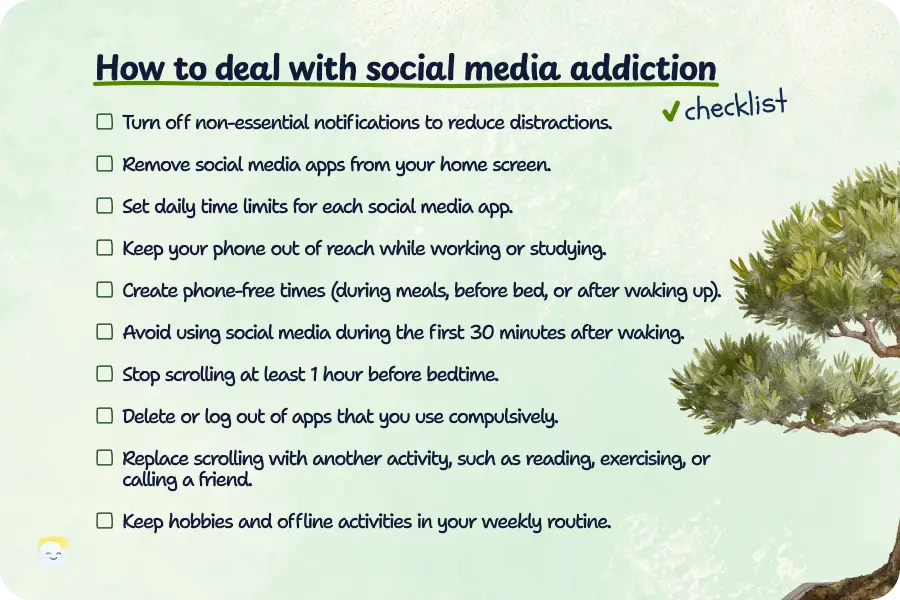
- Turn off non-essential social media notifications.
- Remove social apps from your home screen so you don’t open them automatically.
- Log out of all social media accounts after each session.
Have you ever promised yourself that you'll use your phone less and then found yourself scrolling again just minutes later?
2. Introduce technical friction to prevent excessive use
Prevent yourself from excessive social media usage by going further. Making social media less convenient to access can give you enough time to pause before opening an app automatically. Here’s what you can do:
- Put your phone in another room, so you need to stand up and go to reach it.
- Set grayscale in your phone settings to reduce the release of dopamine associated with scrolling.
- Use built-in trackers and screen time management tools to limit social media usage and track the time you spend on social apps.
3. Establish rigid environmental boundaries
Now it’s time to make your social media interactions more structured. To do it, set certain times and places where you can use your phone. For instance, “I can scroll for 10 minutes on the way to work and 20 minutes when I get back home after a busy day.”
But here’s to the trick. It may not work from the very beginning because the desire to open the app is too strong. In this case:
- Establish phone-free zones, e.g., the bed, dining table, or workplace. It means that you aren’t allowed to use social media apps there.
- Buy an alarm clock and use it to wake up. Don’t reach for your phone in the first hour in the morning.
- Charge your phone in another room at night to avoid late-night scrolling.
- Create screen-free routines, such as reading before bed, taking a walk after work, or eating meals without your phone nearby.
- Leave your phone at home when you go for a walk and want to spend time in real life.

4. Explore what hides behind an excessive or compulsive use of social media apps
Many people engage in excessive social media use not because “It’s simply fun” but rather due to their inner worries and struggles. When you start to see the first results of a digital detox, it may be worth looking a little deeper.
Anxiety
“The thought of sitting idle with my own thoughts scares me; that’s why I look elsewhere to kill time,” says a user on Reddit. It might be your case as well. If you find it challenging to handle negative emotions or worrying thoughts, social media often becomes a quick escape from internal discomfort.
Boredom
“When my life is full of adventures, I don’t want to open social media platforms. But when I need to handle routine tasks, I can spend hours on TikTok.” If it’s about you, maybe you lack excitement and quality time in your day. It becomes a quick source of stimulation when real-life activities feel too slow, predictable, or unstimulating.
However, it’s always possible to change it. Engage in sports, spend more time with friends and family, and try cooking, reading, or other new hobbies. When you add life to your days, social media starts to lose its grip because it’s no longer your main source of stimulation.
Stress
“When everything feels overwhelming, I just scroll to switch my brain off for a bit.” Many people turn to social media as a quick way to escape pressure from school, work, or personal life. It offers instant distraction, but it doesn’t solve the underlying stress. Social media only pauses the stress for a moment, sometimes contributing to the increase of stress due to the postponement of facing it.
Loneliness
Some people may lack communication in real life, while social media gives a sense of connection through messages, likes, and updates. Others can deal with social anxiety and check Facebook 20 times a day to feel connected to others without the need to experience face-to-face contact.
Nevertheless, studies prove that more time spent on social media was associated with higher levels of loneliness. [1] Bonsaksen T, Ruffolo M, Price D, Leung J, Thygesen H, Lamph G, Kabelenga I, Geirdal AØ. “Associations between social media use and loneliness in a cross-national population: do motives for social media use matter?” Health Psychol Behav Med. 2023 So, next time you decide to engage in TikTok scrolling, try inviting your friend for coffee instead.
What causes social media addiction?
There’s a clear reason why reducing social media usage time can be difficult. Social platforms are deeply rooted in neurobiological reward systems.
The dopamine feedback loop
Your social media addiction is largely driven by the brain’s dopamine system, which reinforces behaviors that feel rewarding. According to the study, every like, comment, or new piece of content gives a small dopamine release, teaching your brain to repeat the action. [2] De D, El Jamal M, Aydemir E, Khera A. “Social Media Algorithms and Teen Addiction: Neurophysiological Impact and Ethical Considerations.” Cureus. 2025
But we never know how many likes we’ll get and what funny Instagram reel we’ll see next. And because these rewards are unpredictable, the loop becomes even stronger and makes scrolling feel automatic and hard to stop.
On top of that, social media platforms are deliberately built to maximize attention. Features like endless feeds, auto-play videos, and constant notifications are designed in a way that keeps you engaged for as long as possible.
The psychology of social comparison
What you see on social media is only a carefully selected highlight, not the full picture of real life. Still, many platforms are designed in a way that makes these polished versions feel like reality.
As a result, social media encourages comparison with others, especially with idealized posts that show only successes, appearances, or “perfect” moments. This can quietly distort self-perception.
Over time, you might start relying on likes, comments, and reactions as a source of validation. When approval becomes tied to self-worth, it can deepen the urge to stay online, even when it doesn’t feel good.
Fear of missing out (FOMO)
The fear of missing out pushes people to check apps again and again, worrying that they might miss something important or entertaining. FOMO happens through a simple psychological loop: you see constant updates (stories, posts, notifications), and your brain learns that something new could appear at any moment.
This creates a learned behavior: uncertainty (“maybe something is happening right now”) + easy access (phone in your pocket) = repeated checking. Even when nothing important is there, the brain remembers that sometimes there is, so it keeps pushing you to look again.
Social media addiction solutions and treatment options
When the question is “What should I do if I see the negative consequences of my social media addiction, but nothing helps?” professional help may be a way out.
Professional support for social media addiction
If you use social media platforms as a way to handle loneliness, stress, or worrying thoughts, cognitive behavioral therapy (CBT) can be a highly effective option to change unhealthy thoughts and replace them with more balanced ones.
Expert Insight
“Cognitive Behavioral Therapy (CBT) is a therapeutic approach that targets one’s awareness of unhelpful thought patterns that perpetuate negative feelings and actions. CBT can help someone gain more insight to the automatic thought patterns and core beliefs that perpetuate social media addiction. Furthermore, CBT can aid in the replacement of negative automatic thoughts with more helpful and neautral thought patterns that lend to more long-term success at battling addictive tendencies such as social media addictions.”

Katherine Scott
Mental health professional
Digital detox bootcamps and support networks to improve well-being
There are also digital detox camps and special programs that may be helpful when you’re dealing with social media addiction. They typically work by removing social media apps from your life and handling workshops that change your approach to the digital world completely.
As a result, you feel more present, less mentally overloaded, and more in control of your attention, as your brain gradually adjusts to life without constant digital stimulation.
Social media addiction symptoms and warning signs
But how can I understand that I live with social media addiction? If you start thinking like this, it may be the first warning sign. Yet, there are still specific signs and symptoms you can check yourself for.
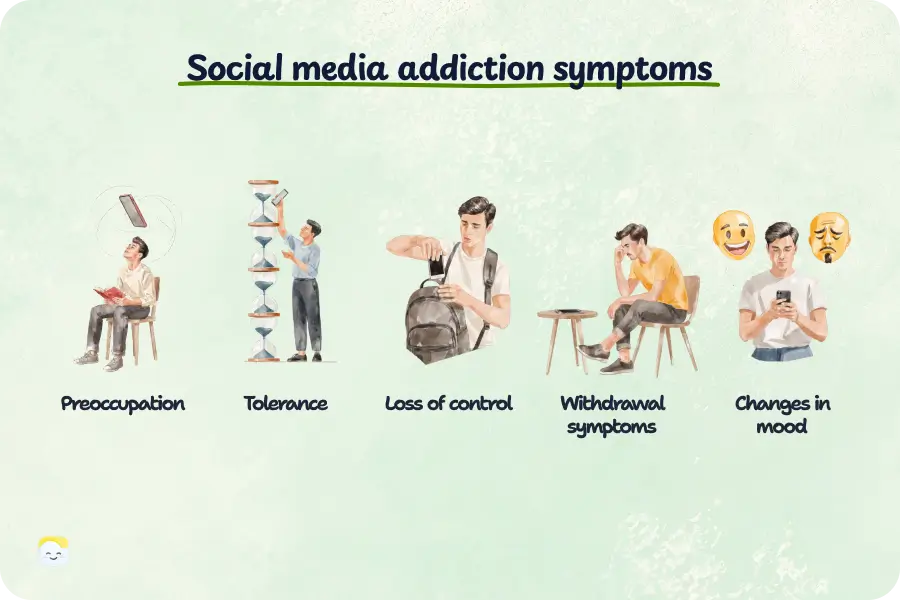
Core symptoms
- Preoccupation. Scrolling through social media becomes the first thing you do in the morning and the last thing you do before falling asleep. You start constantly thinking about the likes you get and keep planning your next posts.
- Tolerance. You need more and more time to feel like “It’s enough” for social media. Maybe you even feel like it’s never enough and stop scrolling your phone only when urgent tasks arise.
- Loss of control. You can procrastinate on important things and repeatedly try to cut down your screen time while still opening TikTok 10 minutes after you promised not to do it for the whole day.
- Withdrawal symptoms. When you can’t access social media due to the lack of an Internet connection, it can trigger feelings of anxiety, frustration, irritability, or restlessness.
- Changes in mood. Similarly, if your post doesn’t get “enough” likes and comments, you may feel like the whole day is ruined.
Subtle signs
- Compulsive checking. You may compulsively check social media without even thinking about it. In a line or when you’re bored, you just open Instagram and notice it 2 minutes later.
- Phubbing. Your real-world relationships may also struggle because of social media addiction. You might routinely ignore people right in front of you to check or scroll through notifications during face-to-face conversations.
- Toxic comparison. If you think everyone around you is happier, more successful, or richer than you, it can be a warning sign.
Physical indicators
- Sleep deprivation. Even after a busy day, you may be scrolling for hours. This bedtime procrastination disrupts circadian rhythms due to blue light exposure and emotional stimulation, which is why you don’t get fully recharged.
- Decreased attention span. Excessive technology use, especially scrolling through short videos on social media, can negatively influence your ability to concentrate. [3] Chiencharoenthanakij R, Yothamart K, Chantathamma N, Sukhumdecha W, Charoensri S, Thanyakulsajja B, Anuroj K. “Short-Form Video Media Use Is Associated With Greater Inattentive Symptoms in Thai School-Age Children: Insights From a Cross-Sectional Survey.” Brain Behav. 2025
- Phantom vibrations. Some people may even anticipate a new message or notification so strongly that they “hear” or “feel” that their phone vibrates when it doesn’t.
Katherine Scott, M.Ed/Ed.S, LMFT, highlights the earliest signs that a person becomes addicted to social media. “The early signs of social media addiction can be subtle. For example, if one goes out for a meal with others and finds themselves checking their phones to a point where connection with the others is interrupted, this could be a sign they are trending toward addiction. Furthermore, if someone asks you to put your phone away and your first reaction is to get defensive, that could be another red flag that your attachment to social media may be teetering on the unhealthy side.”
Social media addiction statistics 2026
- 1 in 4 school-aged adolescents (25%) show signs of social media addiction or problematic social media use. The findings were based on 20 studies involving more than 486,000 adolescents. [4] Ahmer Z, Arshad N, Shafique K. “Likes, shares, and addiction: Pooled prevalence of social networking sites addiction among school-going adolescents-A systematic review and meta-analysis.” Arch Psychiatr Nurs. 2026
- A meta-analysis across 32 nations found pooled prevalence estimates of 5%, 13%, or 25%, depending on how strictly addiction was defined. [5] Cheng C, Lau YC, Chan L, Luk JW. “Prevalence of social media addiction across 32 nations: Meta-analysis with subgroup analysis of classification schemes and cultural values.” Addict Behav. 2021
- The total number of global internet users has increased by 5.1 percent over the past 12 months, thanks to the addition of 294 million new users, according to 2025 data. [6] DATAREPORTAL. “Digital 2026 Global Overview Report.” 2025
- Adolescents who spend more than 3 hours per day using social media may be at heightened risk for mental health problems. [7] Riehm KE, Feder KA, Tormohlen KN, Crum RM, Young AS, Green KM, Pacek LR, La Flair LN, Mojtabai R. “Associations Between Time Spent Using Social Media and Internalizing and Externalizing Problems Among US Youth.” JAMA Psychiatry. 2019
- 92% of teachers report that social media distractions reduce student focus. [8] Worldmetrics. “Social Media Addiction Statistics.” 2026
Social media addiction and mental health
According to a study conducted by the University of Pennsylvania, students who limited their social media usage to 10 minutes per platform (Facebook, Instagram, and Snapchat) per day noticed significant reductions in loneliness and depression over three weeks.
In turn, excessive usage of social media increases worrying thoughts and can lead to:
- Emotional isolation. Spending more and more time online can quietly replace real, in-person connections. Over time, it can feel like you’re surrounded by people, but still emotionally alone.
- Low self-esteem. When social media turns into a space where everyone is trying to gain likes and approval, it becomes easy to start measuring your worth the same way. That often leaves people feeling less confident without even realizing why.
- Poor body image. An endless amount of filtered photos and “perfect” posts can slowly shift what we think is normal. The brain starts comparing real life to edited highlights.
- Greater feelings of inadequacy. Scrolling through highlight reels can create a constant sense that others are doing better, achieving more, or living fuller lives. This comparison loop can gradually undermine self-worth.
- Higher levels of envy and jealousy. The brain receives constant signals of success, beauty, and achievement from others while rarely seeing the struggles behind them. This imbalance can easily trigger envy and emotional discomfort.
- Greater risk of cyberbullying-related distress. Rumor spreading and harsh comments online can spread quickly and feel inescapable. Even reading negativity about someone else can increase anxiety.
- Information overload and mental fatigue. The brain receives an endless stream of posts, videos, and notifications, with almost no time to rest and process. This can lead to mental fatigue, scattered attention, and feeling “overstimulated but empty.”
Frequently asked questions
How to help someone addicted to social media?
Start with a supportive conversation rather than criticism. Encourage them to set digital boundaries, spend more time on offline activities, and try limiting social media gradually instead of quitting all at once.
If excessive use is seriously affecting their relationships, work, or mental health, professional support may be necessary.
How many hours of social media are considered addictive?
There isn’t a specific number of hours that defines addiction. Someone who spends two hours a day constantly thinking about social media and is unable to control their use may have a bigger problem than someone who spends four hours online for work or meaningful social interaction.
The key signs are loss of control, compulsive use, and continuing to use social media despite negative consequences.
Why is Gen Z so obsessed with social media?
Gen Z grew up with smartphones and social media present for the entire duration of their lives, so these platforms have become a central part of communication, entertainment, and self-expression for them. Features like endless scrolling, personalized content, and instant feedback through likes and comments keep users engaged, while social media accounts often become an important part of identity and staying connected with friends.
How to stop social media addiction in teens?
- Talk openly about peer pressure, comparison, and unrealistic content online.
- Set consistent family rules around phone use.
- Delay checking social media until after schoolwork or other responsibilities are finished.
- Plan regular family activities that don’t involve screens.
- Be a positive role model by practicing healthy digital habits yourself.
How does social media addiction affect the brain?
Social media activates the brain’s reward pathways by releasing dopamine, a chemical linked to pleasure and motivation. In the long term, the brain begins to crave the constant stream of notifications, likes, and new content, making it harder to resist checking social media. Excessive use may also reduce attention span, increase impulsive behavior, and make it more difficult to focus on tasks that don’t provide immediate rewards.
Sources
- Bonsaksen T, Ruffolo M, Price D, Leung J, Thygesen H, Lamph G, Kabelenga I, Geirdal AØ. “Associations between social media use and loneliness in a cross-national population: do motives for social media use matter?” Health Psychol Behav Med. 2023
- De D, El Jamal M, Aydemir E, Khera A. “Social Media Algorithms and Teen Addiction: Neurophysiological Impact and Ethical Considerations.” Cureus. 2025
- Chiencharoenthanakij R, Yothamart K, Chantathamma N, Sukhumdecha W, Charoensri S, Thanyakulsajja B, Anuroj K. “Short-Form Video Media Use Is Associated With Greater Inattentive Symptoms in Thai School-Age Children: Insights From a Cross-Sectional Survey.” Brain Behav. 2025
- Ahmer Z, Arshad N, Shafique K. “Likes, shares, and addiction: Pooled prevalence of social networking sites addiction among school-going adolescents-A systematic review and meta-analysis.” Arch Psychiatr Nurs. 2026
- Cheng C, Lau YC, Chan L, Luk JW. “Prevalence of social media addiction across 32 nations: Meta-analysis with subgroup analysis of classification schemes and cultural values.” Addict Behav. 2021
- DATAREPORTAL. “Digital 2026 Global Overview Report.” 2025
- Riehm KE, Feder KA, Tormohlen KN, Crum RM, Young AS, Green KM, Pacek LR, La Flair LN, Mojtabai R. “Associations Between Time Spent Using Social Media and Internalizing and Externalizing Problems Among US Youth.” JAMA Psychiatry. 2019
- Worldmetrics. “Social Media Addiction Statistics.” 2026
Disclaimer
This article is for general informative and self-discovery purposes only. It should not replace expert guidance from professionals.
Any action you take in response to the information in this article, whether directly or indirectly, is solely your responsibility and is done at your own risk. Breeze content team and its mental health experts disclaim any liability, loss, or risk, personal, professional, or otherwise, which may result from the use and/or application of any content.
Always consult your doctor or other certified health practitioner with any medical questions or concerns
Breeze articles exclusively cite trusted sources, such as academic research institutions and medical associations, including research and studies from PubMed, ResearchGate, or similar databases. Examine our subject-matter editors and editorial process to see how we verify facts and maintain the accuracy, reliability, and trustworthiness of our material.
Was this article helpful?