



Do you experience your boss having an inflated sense of self-importance, constantly manipulating and blaming others, and creating drama and a toxic work environment? Do they, at the same time, maintain a polished public image? In this case, you might be dealing with a narcissistic boss.
Here’s how to recognize narcissistic behavior, set boundaries, and prioritize your own needs and well-being in communication with a boss with narcissistic qualities.
And if you want to understand how you handle conflicts and discover how you can improve your emotional awareness, take an Emotional Intelligence Test!

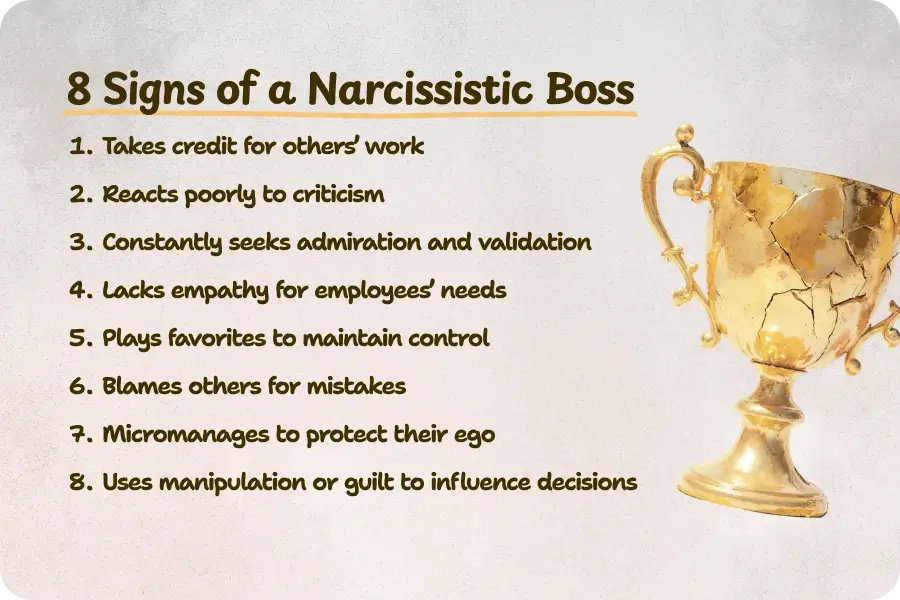
6 Signs Your Boss Could Be A Narcissist
Not every demanding boss is a narcissist. However, consistent patterns of toxic behaviors and manipulation are strong indicators.
1. They take credit for your work
A possible narcissistic boss may present team achievements as their own. Success becomes a tool for boosting their reputation. However, failure becomes someone else’s responsibility. This pattern allows narcissistic people to build a strong image with senior leadership to get promotions, bonuses, or praise. Those with narcissistic qualities are focused on their own gain at the cost of others.
For example, imagine a team spends weeks developing a new marketing strategy. During internal meetings, an overt grandiose narcissistic boss provides little input and rarely participates in the detailed work. But when the project is presented to executives, the manager introduces it as “a strategy I developed with my team.” They highlight their vision and position themselves as the driving force behind the success. Other employees who did the research, analysis, and creative work may receive little or no recognition.
However, if the campaign later underperforms, the narrative quickly changes. A narcissistic boss may say something like, “I trusted the team to execute the plan, but unfortunately, the results didn’t meet expectations.”
If your workplace stress is affecting your mental health, it may help to check in with yourself. Take an Anxiety Test to see whether workplace stress might be impacting your well-being.

2. They cannot tolerate criticism
When you point out a flaw in their plan or offer a better way to do things, you may trigger anger or subtle punishment. Instead of analyzing your data, a narcissist may view it as a perceived slight against their authority and immediately project their shame back onto you:
- A narcissistic boss may use the silent treatment and social exclusion to make you feel unsafe. They may stop CC’ing you on important emails or “forget” to invite you to a meeting.
- They may start micromanaging your work, waiting for a minor mistake to use it as evidence that you were the problematic one all along.
- Finally, a narcissistic boss may snap at you in a meeting and question your competence simply because you raised a concern. You may feel targeted or even gaslighted out of your own experiences.
3. They demand admiration and loyalty
To a narcissistic boss, loyalty isn’t defined by your commitment to the company’s mission or your professional reliability. They expect you to validate their intelligence, leadership, or vision and show uncritical devotion to them personally on a consistent basis.
For instance, they may want you to play the audience to their personal stories or past successes, laugh at their jokes, and tolerate their inappropriate behavior. If you fail, they may label you as uninterested or not a team player.
4. They lack empathy
If an employee has a family emergency, burnout, a health crisis, or a personal loss, a narcissistic boss may respond with annoyance: “We all have problems, but the deadline doesn’t care.” Instead of offering support, they may increase the pressure, believing that it will somehow motivate the exhausted person.
Another common narcissistic trait and a sign of a lack of emotional intelligence in the workplace is the one-up. If you mention you are tired, they will tell you why they are more tired. If you say you are stressed, they will recount a story of a time they handled ten times the stress without complaining. This way, they minimize your pain and create the illusion of effortless perfection.
5. They create chaos and unpredictability
A narcissistic boss may change rules, expectations, and priorities without explanation to keep you anxious and dependent on their approval. If you follow the rules, they may say you’re uninitiative and unambitious. If you break the rules to be innovative, they’ll punish you for being insubordinate.
For example, on Monday, the narcissistic boss tells you, “Focus 100% on project A. It’s the only thing that matters this week.” So, you start deep work, ignore distractions, and skip breaks and long lunches to get it done. On Friday at 4:00 PM, your boss texts you and asks, “Where is the progress on Project B? Why haven’t you been prioritizing that? It’s like you aren’t even paying attention to our goals.”
When you point out that Goal A was the priority, they may gaslight you, claiming they never said that or that any competent person would have known the priorities shifted.
Moreover, a narcissistic boss may treat every task as urgent and ignore the actual importance or impact of the work. When everything is an emergency, you are constantly trying to finish a crisis that never ends. Because you are always reacting to pings and urgent emails, you lose the ability to focus on complex, high-value tasks that actually move your career forward.
6. They violate your boundaries and personal time
Expect emails at 11:00 PM, texts on Sunday morning, and an unspoken rule that you must always be available. Even if you don’t reply, your brain stays in a high-alert state and waits for the next ping. As a result, you can be physically present with your family or friends but mentally occupied by a toxic workplace.
The Covert Narcissist Boss: The Victim Who Seems So Nice
One of the most confusing forms of narcissistic behavior in the workplace is the covert or victim-playing narcissist. Unlike the loud, arrogant stereotype, covert narcissistic bosses may appear:
- humble
- sensitive
- misunderstood
- supportive to upper management
They may say, “I’m just trying my best, but my team keeps letting me down,” or “I care deeply about my employees, but they’re very difficult to manage.” To people from other departments, they look kind and professional. Internally, however, they make their team feel isolated and doubt themselves, especially when others say, “Your boss seems so nice though.”
Manipulation Tactics Used by a Manager with Narcissistic Traits
Narcissistic bosses rarely use direct aggression alone. Instead, they rely on subtle psychological strategies.
1. Gaslighting
You may find yourself thinking, “Did that conversation really happen the way I remember it?” This can be the result of gaslighting. It’s a manipulation tactic used to make others doubt their perception. A narcissistic boss may deny previous conversations or decisions, assuring you that “they never said that.”
Or, they may give you vague instructions and then criticize you for not understanding the task. This forces you into a state of cognitive distortion called mind-reading, where you spend more energy trying to predict their mood than doing your actual job.
2. Triangulation
This is one of the most common tactics of the narcissistic boss. They share different information with different employees to create competition or distrust. They may say, “The team thinks you aren’t doing enough” or “I wish you were more committed like Sarah.” As a result, coworkers begin competing or mistrusting each other instead of questioning the manager. This takes away focus from the boss’s behavior and distracts with the perceived involvement of another coworker, inadvertently taking the blame.
3. Public shaming vs. private praise
Typically, a narcissistic boss criticizes you in front of the group to feel superior. However, if they praise you, they do it only when they need a favor for personal gain and only in private so that no one else can witness your success. According to research, this creates a psychological trap called intermittent reinforcement, where the rarity of the “reward” makes you work ten times harder to get it again. It’s the same logic that keeps people addicted to slot machines.
4. Strategic favoritism
A narcissistic boss may divide the team, which pressures members to compete for approval. One employee becomes the temporary favorite, and another is blamed for everything that goes wrong. This creates a culture of comparison and anxiety, where everyone is terrified of being the next target.
The Mental Health Impact of an Employer with Narcissistic Personality Disorder
Workplace narcissism can be confusing because these leaders may appear charming, confident, and successful, especially to senior management. Meanwhile, their team experiences criticism, unrealistic expectations, emotional exhaustion, and decreased self-esteem, research shows. Moreover, working with a boss who lacks self-awareness can reduce a team’s success by half and, according to another study, cause stress and lower motivation.
Employees often experience:
- chronic stress
- anxiety before meetings
- self-doubt and loss of confidence
- burnout
- sleep problems
Expert Insight
Work can be a place that we spend the majority of our time involved with. Work serves as a community, a part of our identity, and a source of social connections. So, when the workplace includes a person of power with inconsistent, toxic traits, this can leave us in perpetual fight or flight mode. We can all survive someone having a bad week, but when it becomes a constant ‘bad time’ or gaslit narrative, we often are overloaded by stress hormones, which leaves its mark on our central nervous system. It can also be jarring to experience both sides of someone with narcissistic qualities, such as witnessing them praise a colleague but passively abuse you. Having a higher-up with these qualities can generate an abusive dynamic, leaving employees to suffer the mental, emotional, and physical health consequences.

Katherine Scott
Mental health professional
Dealing with A Narcissistic Boss: 5 Daily Survival Tactics
If you wonder how to deal with a narcissist, try the following tips to prevent manipulation:
1. Document everything. Keep detailed records of emails, task instructions, meeting notes, and deadlines. Documentation becomes crucial if conflict escalates.
2. Confirm decisions in writing. After meetings, send follow-up emails summarizing agreements. For example, “Just confirming our discussion: I will complete X by Friday using the approach outlined today.”
3. Avoid emotional reactions. A narcissistic boss may provoke emotional responses because it gives them control. Your neutral language reduces their influence. Do not argue about perception. Instead, redirect to facts: “Let’s refer to the email summary from yesterday to confirm the details.”
4. Set clear boundaries. Do not share vulnerabilities, frustrations, or private details that can later be used against you.
5. Build a support system quietly. Develop professional relationships with trusted colleagues who can confirm events or support accurate information.
When to Approach HR & How to Do It Strategically
Step 1: Collect evidence
Build a record of:
- contradictory instructions
- inappropriate behavior, like comments, jokes, or signs of misogyny
- retaliation
- unreasonable expectations
Step 2: Identify patterns
HR can respond more effectively to documented, repeated behavior than to isolated complaints.
Step 3: Present facts, not emotions
When approaching HR, focus on:
- operational impact
- workplace policy violations
- team productivity problems
For example, you may summarize, “Over the past three months, several deadlines were changed after project completion without written communication, which created conflict within the team.”
When to Quit the Job?
If the environment continues harming your mental health or career growth, leaving may be the healthiest option for your well-being. Here are warning signs that it’s time to move on:
- chronic anxiety about work
- repeated public humiliation
- retaliation after raising concerns
- no support from leadership or HR
Expert Insight
People of authority within toxic work environments can make someone feel powerless and, therefore, stuck in their situation. However, just as I would encourage someone in a domestic violence system, their boss’s perception of them does not deem it the ‘right’ one. Documentation of interactions is key, as well as seeking support in and out of the workplace. Generating relationships within the workplace can create additional points of reference if job relocation is appropriate, and proper observational documentation is the key to reporting behaviors to HR departments and other employers. The best thing we can do within these sorts of toxic environments is to remain as emotionally disciplined in front of the toxic perpetrator, as this feeds their manipulation. Seeking outside support from others can aid in resting in your peace and not allowing the toxic individual to sway your perception of the inappropriate treatment and behaviors.
Katherine Scott
Mental health professional
6 Tips to Spot Narcissistic Bosses in Future Interviews
One of the most frustrating parts of working for a narcissistic boss is realizing the problem only after you’ve accepted the job. Narcissistic managers can present themselves as charismatic and confident during interviews. However, if you know what to look for, there are subtle red flags to watch:
1. The interview is mostly about them
Healthy leaders are curious about candidates. They ask questions, listen carefully, and try to understand your ideas and working style. A narcissistic boss, however, may spend most of the interview talking about their achievements and how difficult it is to find good employees.
For example, they say, “When I joined this company, everything was a mess. I basically rebuilt the whole team myself.”
2. They blame former employees
Narcissistic bosses may see themselves as the only competent person. Pay attention to how the manager talks about past team members and statements like “My last team just couldn’t handle the pressure” or “Employees today don’t have the work ethic they used to.”
3. Vague or defensive answers about team culture
If you ask about the work environment, pay attention to the response. Healthy leaders describe collaboration, team strengths, and communication practices. A narcissistic boss may respond, “The culture reflects my leadership style. I expect people to keep up with my standards.”
4. They interrupt or talk over you
Another subtle signal of an interviewer’s narcissistic traits is how much space you’re allowed in the conversation. If they interrupt you frequently or finish your sentences, it may indicate a lack of empathy and poor listening skills.
7. Employees seem uncomfortable
If possible, observe the team environment during the interview process. Watch for signs that may reflect a culture shaped by fear or strict control:
- employees avoiding eye contact
- tense or formal interactions
- unusually quiet workplaces
8. High turnover in the role
If you discover that multiple people have left the position in a short time, it may indicate leadership issues. You can politely ask: “Could you share what led to the opening of this position?” A transparent employer should be comfortable explaining the situation.
9. They don’t like thoughtful questions
Narcissistic leaders may dislike questions that challenge their authority. If you ask about decision-making processes, feedback culture, or work-life balance, and the interviewer becomes annoyed or defensive, this could be a warning sign.
Conclusion
A narcissistic boss can create a confusing and exhausting workplace dynamic. Their behavior often leaves employees questioning their competence and judgment, and harms their self-esteem and overall well-being. But once you increase your self-awareness and learn to recognize the patterns like gaslighting, triangulation, credit stealing, or favoritism, you can begin to protect yourself.
Documentation, calm communication, self-care, and setting clear boundaries can help you maintain control of your work environment while deciding your next career step. A healthy workplace should support growth, not constant psychological survival.
Moreover, trust your instincts during the hiring process. Interviews are not only about proving you’re a good candidate. They are also your opportunity to evaluate whether the workplace is healthy. If something feels off or you see arrogance, defensiveness, or excessive self-promotion, it may be worth paying attention to that instinct. A good boss should make you feel respected, valued, curious, and motivated, not anxious or intimidated.
Frequently asked questions
1. Should I confront a narcissistic boss directly?
Direct confrontation with a narcissistic boss may lead to defensiveness. It is usually safer to rely on documentation and neutral communication.
2. Why does my boss seem nice to everyone except our team?
Narcissistic leaders often manage their reputation carefully with senior leadership while mistreating employees privately.
3. Is quitting the only solution?
Not always. Some employees successfully manage the situation with boundaries and documentation. However, if the environment damages your health or career growth, leaving can be a healthy decision.
Sources
- Nevicka B, De Hoogh AHB, Den Hartog DN, Belschak FD. Narcissistic Leaders and Their Victims: Followers Low on Self-Esteem and Low on Core Self-Evaluations Suffer Most. March 2018
- Tasha Eurich. Working with People Who Aren’t Self-Aware. October 2018.
- Jauk E, Kanske P. Can neuroscience help to understand narcissism? A systematic review of an emerging field. May 2021
Disclaimer
This article is for general informative and self-discovery purposes only. It should not replace expert guidance from professionals.
Any action you take in response to the information in this article, whether directly or indirectly, is solely your responsibility and is done at your own risk. Breeze content team and its mental health experts disclaim any liability, loss, or risk, personal, professional, or otherwise, which may result from the use and/or application of any content.
Always consult your doctor or other certified health practitioner with any medical questions or concerns
Breeze articles exclusively cite trusted sources, such as academic research institutions and medical associations, including research and studies from PubMed, ResearchGate, or similar databases. Examine our subject-matter editors and editorial process to see how we verify facts and maintain the accuracy, reliability, and trustworthiness of our material.
Was this article helpful?