



Podcast name
Malignant narcissist
Ever felt drained after spending time with someone who seems obsessed with control and the misery of others? You may be facing a malignant narcissist. Unlike other types of narcissism, these people combine an inflated sense of self with cruelty and manipulation, turning relationships into power games.
Let’s find out how to recognize the warning signs of manipulation and spot malignant narcissistic behaviors before they harm your self-esteem and overall mental health.

What Is a Malignant Narcissist?
Malignant narcissism, also called pathological narcissism, refers to people who display extreme narcissistic traits such as ruthlessness and a grandiose sense of self-importance, often combined with characteristics of antisocial personality disorder or psychopathy, including manipulativeness, lack of empathy, and aggressive behavior.
According to research, malignant narcissism differs from other types of narcissism as it involves the presence of sadistic and antisocial traits. It’s considered the most dangerous and traumatic of all the types of narcissistic personality disorder spectrum to those close to the narcissistic person. The reason is that a combination of extreme entitlement, aggression, and manipulation may cause severe emotional, psychological, or even physical harm to people in a relationship with a malignant narcissist.
However, mental health professionals don’t recognize malignant narcissistic personality disorder as a separate mental health condition. Malignant narcissism is also not an official diagnosis and is not listed as a distinct category in the Diagnostic and Statistical Manual of Mental Disorders (DSM).
11 Traits & Behavior Examples of a Malignant Narcissist in Daily Life
Here’s how you can spot a malignant narcissist’s behavior, according to research on pathological narcissism:
1. Enjoy others’ distress
Unlike most people with narcissistic traits who mainly seek admiration, malignant narcissists may experience satisfaction seeing others uncomfortable, anxious, or hurt. In daily life, this can appear as provoking emotional reactions, escalating conflicts for entertainment, or calmly watching someone struggle after being set up to fail.
For example, during a disagreement, they intentionally say something deeply personal and cruel, then calmly watch as the other person becomes upset. Instead of apologizing, they might change the subject or say, “You’re too sensitive,” clearly satisfied by the reaction.
2. Cruelty is calculated
Their harmful behavior is rarely impulsive. Malignant narcissists tend to plan how and when to hurt others for maximum impact. They may spread damaging rumors, knowing it will harm someone’s reputation while making it difficult to trace back to them.
For example, rather than confronting a coworker directly, people with malignant narcissism quietly suggest to management that the coworker is “unreliable”. When the coworker later faces consequences, the narcissist acts innocent and even offers fake sympathy.
3. Constantly expect betrayal
Similar to people with vulnerable narcissistic traits, malignants often believe others are plotting against them, even when there’s no evidence. At the same time, they feel deeply entitled to special treatment. This combination can lead to constant accusations, loyalty tests, and an expectation that others must “prove” themselves repeatedly.
As an illustration, a malignant narcissist may accuse a partner of secretly turning friends against them after a harmless conversation or a delayed reply to a message. They might demand passwords only to say later that those efforts were fake or insufficient. But no matter what you do, they act like it’s never enough because they are always expecting betrayal.
4. They are morally flexible
Rules, ethics, and values apply only when convenient. They criticize others for lying but justify their own lies as “necessary,” “strategic,” “protecting themselves,” or “what anyone smart would do.” If caught, they claim the truth would have caused more harm. This way, they reframe dishonesty as a form of intelligence.
5. They need total psychological control
They don’t just want influence. People with malignant narcissism tend to control how others think, feel, and react. This can show up as gaslighting, rewriting past events, or insisting their version of reality is the only correct one. Eventually, people around them may feel confused, anxious, or unable to trust their own judgment.
6. Use fear to achieve their goals
In personal relationships, malignant narcissists often maintain control by keeping others afraid and alert to their moods. This may involve unpredictable mood changes, sudden punishments, or threats. For example, a malignant narcissistic boss may randomly single out employees for harsh criticism during meetings. No one knows who will be targeted next, creating constant tension through fear rather than respect.
7. See people as tools for personal gain
They are attentive and generous toward someone who can help them advance socially or professionally. Once that person is no longer useful, communication becomes cold, dismissive, hostile, or disappears entirely without explanation. Anyone from their circle can be replaced by another person who offers more advantages.
8. They are vindictive
A person with malignant narcissism rarely forgets or forgives. Even minor disagreements can be stored and later repaid through sabotage, humiliation, or exclusion. The response is often disproportionate to the original “offense.”
9. Use an apology as another opportunity to blame others
Their apologies, when they come, lack substance and genuine remorse. “I’m sorry you feel that way” becomes their signature phrase. They might apologize for a specific action if cornered, but within the same conversation, they’ll list five things you did wrong first. Due to their lack of empathy, the apology becomes another opportunity to dominate.
Even after causing serious harm, such as ruining a relationship or career, they show no real concern for the damage done and may repeat the behavior without hesitation.
10. Use strategic lies to isolate their victim
Perhaps most damaging is their ability to isolate. Unlike the grandiose narcissist, who typically acts more openly, malignant narcissists poison relationships between their target and others through strategic lies and misrepresentations. Your sister stops calling as much. Your best friend seems distant. Only later might you discover that they were told you said hurtful things you never said. By the time you realize what’s happened, your relationships with family members or friends feel broken.
11. They’re jealous of the happiness of others
People with malignant narcissism may experience intense envy toward anyone who appears content, successful, or fulfilled. Seeing someone happy can trigger feelings of shame, inadequacy, or even rage, because it highlights what they believe they lack.
This envy can be directed at material values such as cars, apartments, clothes, luxury items, and appearance, or spiritual values. For example, they may be jealous that others have kindness and the ability to talk to anyone or to make new friends as an adult without manipulation.
Even casual happiness, like a friend sharing good news about a vacation or work milestone, can provoke passive-aggressive remarks or cold indifference, as they are unable to tolerate others’ contentment. This way, the malignant narcissist doesn’t just envy happiness but actively diminishes it in others to protect their fragile self-image.
Covert Malignant Narcissist: How They Differ From Overt Ones
Overt narcissists are often openly aggressive, arrogant, or humiliating. They may criticize or attack others, demonstrating their power. People with covert malignant narcissism are the hidden threat. According to research on the difference between the two types, they can be quiet, subtle, and even charming on the surface, yet manipulative, controlling, and vindictive underneath.
Covert narcissists prefer spreading rumors, manipulating situations, or gaslighting. Unlike the overt ones, they mask their cruelty, making it harder to recognize their true intentions until the damage is done.
Expert Insight
A person with malignant narcissistic traits can theoretically change, but in practice, it is rare and slow. Meaningful change requires sustained accountability and a genuine willingness to examine harm done to others—qualities that are often limited in malignant narcissism. Therapy can sometimes help reduce the most destructive behaviors if the person is consistently engaged and consequences are clear, but treatment is typically long-term, and outcomes are modest. Treatment is more often focused on helping those impacted by the narcissist heal and set boundaries.

Rychel Johnson
Mental health professional
Malignant Narcissist vs. Other Personality Types
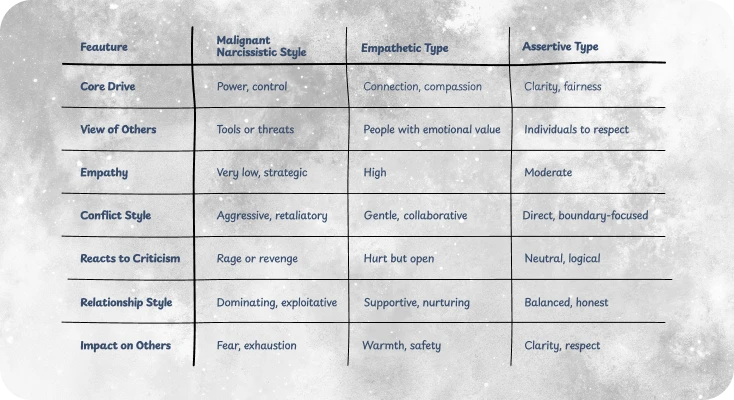
Malignant narcissism includes traits such as suspiciousness bordering on paranoia, ruthlessness, a sense of one’s own grandiosity, accompanied by a complete lack of guilt and remorse. This makes them particularly dangerous compared to other personality types.
1. Malignant Narcissist vs. Sociopath (Antisocial Personality)
Sociopaths and malignant narcissists both show a disregard for others, but their motivations differ. Sociopaths act out of impulsive self-interest and thrill-seeking, while malignant narcissists are driven by ego, control, and a need to dominate others.
2. Malignant Narcissist vs. Borderline Personality
People with borderline personality disorder (BPD) struggle with emotional instability and fear of abandonment. Malignant narcissists exploit these vulnerabilities to manipulate others. Unlike BPD, malignant narcissists maintain a calculated sense of control, rather than reacting out of intense emotions.

3. Malignant Narcissist vs. Assertive Personality
Assertive people communicate clearly, respect boundaries, and resolve conflicts calmly. Malignant narcissists, in contrast, exploit assertive people’s fairness and may try to manipulate or undermine them for personal gain.
4. Malignant Narcissist vs. Empathetic Personality
Empathetic people prioritize understanding and cooperation. Malignant narcissists may exploit empathy, like dark empaths, taking advantage of a caring person’s trust or compassion for their own benefit.
What Causes Malignant Narcissism?
A study on the origins of narcissism in children shows that being the child of narcissistic parents is the main factor causing malignant narcissism. A highly narcissistic parent may treat the child as an object, either through overvaluation, such as excessive praise and entitlement, or emotional neglect and conditional love. As a result, it makes a child develop a fragile self‑worth masked by aggression and manipulation later in life for their own needs.
Another common reason is emotional or physical parental abuse. Children who grow up with parents who are controlling, sadistic, or abusive often learn to defend themselves through hypervigilance, manipulation, and aggression. The constant exposure to fear, shame, or humiliation teaches the child that the world is hostile and that power and control are necessary for survival.
Eventually, these children may internalize a belief that their worth depends on dominating others. This coping mechanism, while protective in childhood, can crystallize into exploitative and cruel behavior in adulthood.
Malignant Narcissism in Relationships
In intimate relationships, the malignant narcissism becomes more insidious. They may remember every vulnerability you’ve shared and store it like ammunition. During an argument about something trivial, they may suddenly bring up your childhood trauma or your insecurity about your weight. The original topic disappears. Now you’re defending your worth as a person.
What distinguishes malignant narcissism from ordinary self-absorption is the presence of sadism. A malignant narcissist might “accidentally” reveal a friend’s secret in a group setting to watch their embarrassment. Or they may give their partner the silent treatment for days, not just out of anger, but because they enjoy watching them anxiously try to fix something they didn’t break.
They also create hierarchies within families and friend groups. One child becomes the golden favorite, while another “can do nothing right”. This behavior is rooted in both insecurity and manipulation. When they choose a “golden child,” they pick someone who makes them look good and boosts their self-esteem. The “black sheep“, on the other hand, becomes someone to blame, criticize, or manipulate. This type of categorizing allows the narcissist to feel superior.
5 Tips to Deal With a Malignant Narcissist Safely And Avoid Narcissistic Abuse
Here’s how to strengthen your own boundaries and self-love, and deal with a narcissist to avoid narcissistic abuse:
1. Document everything, but keep it private
Start keeping records: save emails, text messages, and voicemails. Write down conversations with dates and times, including who else was present. Such caution is necessary because malignant narcissists may distort events to make themselves look justified.
Your documentation protects your sanity and provides evidence if you need legal protection later. Store these records somewhere they can’t access: a separate email account, a trusted friend’s house, or a password-protected cloud service. Also, avoid sharing anything they could twist against you, whether at work or in personal relationships.
2. Try the Gray Rock technique
When you must interact, try to become profoundly boring. Give minimal responses with no emotional content. “Yes.” “No.” “I’ll think about that.” Their fuel is your reaction, such as anger, tears, justification, or even joy. Deprive them of it. If they provoke you, offer “I see” rather than defending yourself.
Try to avoid explaining, justifying, or defending yourself. Practice responses that close doors: “That doesn’t work for me.” “I’ve made my decision.” “This topic isn’t up for discussion.”
However, “gray rock” has limits. It works for coworkers or distant relatives you see occasionally. It’s harder to maintain with a spouse or parent you live with, and attempting it can sometimes escalate their behavior as they work harder to get a response from you.
3. Build your exit strategy in stages
Whether you’re planning to leave a relationship, a job, or simply establish more distance, do it quietly. Announcing your plans gives them time to sabotage you. Instead, take concrete steps: open your own bank account, consult with a lawyer, secure your own housing, talk to HR at work about transfer possibilities, reconnect with friends you’ve pushed away. Each action should happen below their radar.
If you’re leaving a romantic relationship, be especially careful during this phase. The period when a malignant narcissist realizes they’re losing control can be dangerous. Create a safety plan that includes where you’ll go, who will help you, and how you’ll stay financially stable.
4. Take care of your mental health with Breeze
Firstly, you may take self-discovery tests to help you better understand your feelings and get insights about your personality. Find out if you have childhood trauma, a narcissistic partner, and understand the reason for your anxiety.
Then, use Breeze journaling to process your thoughts and learn how to feel your feelings. Writing things down can help you spot manipulation patterns and release emotions you’ve been carrying alone.
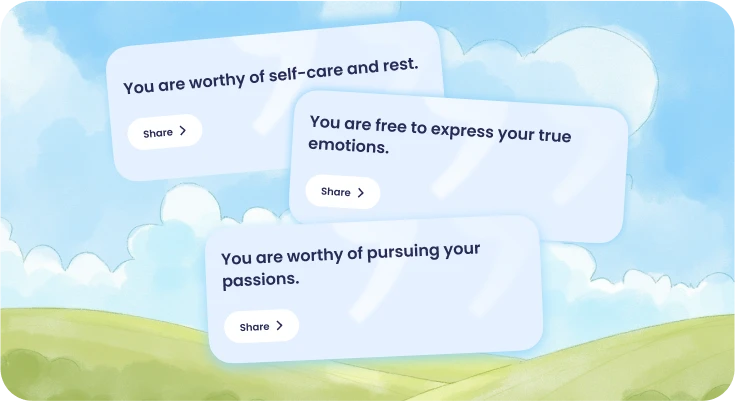
Finally, try Breeze affirmations to stop the shame spiral and replace old patterns of self-blame or doubt with positive statements. For example, you might remind yourself daily:
- My feelings are valid, even if someone tried to dismiss them.
- I do not need anyone’s approval to know my worth.
- I am allowed to set boundaries without explaining myself.
- I trust my memory, my judgment, and my lived experience.
- I am not responsible for managing someone else’s emotions.
- Choosing peace does not make me weak; it makes me wise.
- I am allowed to step back from people who harm me.
- I deserve relationships built on respect, honesty, and safety.
- I can let go of guilt that was never mine to carry.
5. Use professional guidance
Mental health professionals, support groups, or legal advisors can help you plan responses, protect your rights, and recover from narcissistic abuse.
Expert Insight
Someone should strongly consider ending a relationship with a malignant narcissist when there is a consistent pattern of emotional, psychological, or physical harm and little to no accountability despite clear and consistent boundaries. A relationship that creates chronic anxiety or fear and isolates you from support is potentially dangerous. When safety, mental health, and self-respect are repeatedly compromised—and the other person shows manipulation rather than genuine repair—ending the relationship is often a protective and healthy choice.
Rychel Johnson
Mental health professional
Sources
- Paroma Mitra; Tyler J. Torrico; Dimy Fluyau. Narcissistic Personality Disorder. March 1, 2024.
- Day NJS, Townsend ML, Grenyer BFS. Living with pathological narcissism: a qualitative study. August 2020.
- Emanuel Jauk, Elena Weigle, Konrad Lehmann, Mathias Benedek, Aljoscha C. Neubauer. The Relationship between Grandiose and Vulnerable (Hypersensitive) Narcissism. September 2017.
- Charles Zeiders, Peter Devlin. Malignant Narcissism & Power. August 2021
- Brummelman E, Thomaes S, Nelemans SA, Orobio de Castro B, Overbeek G, Bushman BJ. Origins of narcissism in children. 2015.
Disclaimer
This article is for general informative and self-discovery purposes only. It should not replace expert guidance from professionals.
Any action you take in response to the information in this article, whether directly or indirectly, is solely your responsibility and is done at your own risk. Breeze content team and its mental health experts disclaim any liability, loss, or risk, personal, professional, or otherwise, which may result from the use and/or application of any content.
Always consult your doctor or other certified health practitioner with any medical questions or concerns
Breeze articles exclusively cite trusted sources, such as academic research institutions and medical associations, including research and studies from PubMed, ResearchGate, or similar databases. Examine our subject-matter editors and editorial process to see how we verify facts and maintain the accuracy, reliability, and trustworthiness of our material.
Was this article helpful?