



“Monkey branching” means cultivating emotional connections with another person while staying in a committed relationship. This way, a person “secures” a new relationship before breaking up with a current partner. According to the study, 67.58% of 515 participants reported at least one backburner relationship. [1] Journal of Social Psychology Research. “Identifying Motivations for Relationship Alternatives: Analyzing College Students’ Backburner Relationships.” 2023 Can it be your case? Let’s explore.

What is monkey branching in dating?
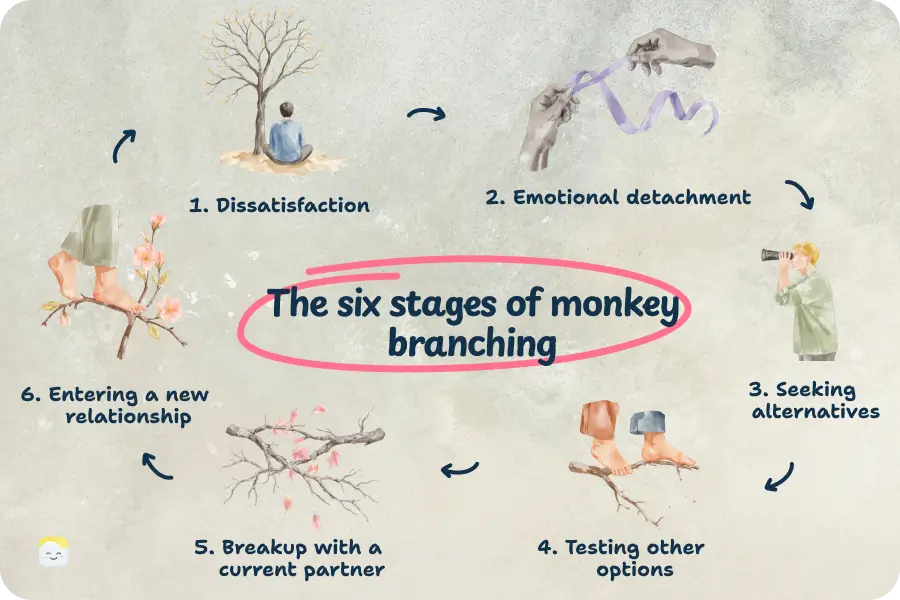
The term “monkey branching” comes from the image of a monkey swinging from one branch to another without letting go of the first until it has a firm grip on the next. In dating, it describes someone who starts building a romantic connection with a new person while remaining in their current relationship.
Is monkey branching considered cheating?
Whether monkey branching is cheating or not depends on your relationship boundaries and how each person defines “cheating.” A partner may not have intimate relationships with someone else but engage in flirting, texting, building emotional connections, talking about feelings, etc.
If you’re in a monogamous relationship, it can be quite painful to discover. And if you’ve already discussed what kinds of interactions you consider unacceptable, but your partner continues them in secret, it can feel like a betrayal of trust.
For many people, monkey branching falls under emotional cheating because it involves investing romantic energy, intimacy, or commitment in another person.

Monkey branching vs. rebounding
While people may confuse monkey branching and rebounding, these two terms have different meanings.
- Monkey branching is about lining up the next partner while you’re still in a relationship.
- Rebounding is about starting a new relationship soon after the breakup, while you haven’t fully processed it and still have feelings for your ex-partner.
Monkey branching vs. cushioning vs. benching
Signs your partner is a monkey-brancher
Are you thinking that your current partner may be a monkey-brancher? Check them using these signs.
- They suddenly detached from you emotionally and physically and don’t want to discuss their feelings or have sex with you anymore.
- They became overly critical, and things that have never been the problem turn into a catastrophe now.
- You notice that your support isn’t enough, and they seek emotional validation from other people around them.
- They become unusually secretive with their phone. They set a new password, keep their screen turned away, take calls in private, or seem anxious whenever you are nearby while they’re texting.
- They spend a lot of time with someone else (which they didn’t do before).
- They stop making long-term plans that include you.
- They seem emotionally checked and don’t want to address issues in relationships, but avoid breaking up.
- They become defensive when you ask about a specific friend or coworker.
- They suddenly care much more about their appearance or social life without involving you.
- They avoid introducing you to certain people or keep parts of their social life separate from you.
The psychology of monkey branching
According to the mate switching hypothesis (which is the science-backed term), leaving a poor current partner for a better one can be adaptive in evolutionary terms. [2] Personality and Individual Differences. “The mate switching hypothesis.” 2017 But while the hypothesis may explain why some people are motivated to seek alternative partners, it doesn’t justify such behavior or suggest that it is healthy or ethical.
Why do people monkey-branch?
In modern society, where a partner is no longer someone you depend on for survival, monkey branching is usually driven by psychological rather than evolutionary factors.
- Fear of being alone. Some people look for a new relationship because they simply can’t handle being alone. They may experience loneliness, anxiety, or a loss of identity when they’re single.
- Low self-esteem. “What if no one chooses me anymore?” Those with low self-esteem can have another relationship lined up because they’re afraid they won’t find a new partner after a breakup. Attention and romantic interest from someone else can temporarily boost their confidence and make leaving a relationship feel less risky.
- Relationship dissatisfaction. Instead of addressing unresolved conflicts or ending an unhappy relationship, some people emotionally invest in someone else as an escape or a way to test whether a “better” relationship is possible.
- Novelty seeking and FOMO. Some people find long-term relationships less exciting over time, so they continue looking for new romantic possibilities. Dating apps and social media can reinforce the feeling that there’s always someone more attractive or compatible just a swipe away, making it harder to fully commit to one partner.
Expert Insight
Other reasons of monkey branching can include passive or passive-aggressive communication patterns, attachment wounds, reliance on external validation, or identity exploration. Such behavior can be for a multitude of reasons and may not be fully understood by others.

Hannah Schlueter
Mental health professional
Attachment style and monkey branching
According to the study, insecure attachment, especially anxious and avoidant attachment, is associated with more relationship instability and lower relationship satisfaction. [3] Conradi HJ, Noordhof A, Kamphuis JH. “Satisfying and stable couple relationships: Attachment similarity across partners can partially buffer the negative effects of attachment insecurity.” J Marital Fam Ther. 2021 This is how it happens:
Anxious attachment
People with anxious attachment may fear being alone. So when a relationship feels shaky, they may start lining up someone new as a safety net, even before the current relationship ends. It’s less about hurting their partner and more about avoiding the pain of being left alone.
Avoidant attachment
People with avoidant attachment tend to pull away when a relationship gets too close, too vulnerable, or too serious/long-term. Monkey branching can seem like a way to avoid dealing with an uncomfortable conversation or breakup by focusing on a new person instead.
Anxious-avoidant attachment
This style mixes both fears — fear of being abandoned and fear of getting too close. That combination can make monkey branching more likely, since a new partner can ease the fear of being alone while also giving them a reason to pull back from a relationship that feels too intense.
The six stages of monkey branching
What is monkey branching in narcissism and BPD?
People with narcissism and borderline personality disorder may engage in monkey-branching behavior more often than others. Here’s why it happens.
Monkey branching and narcissism
Narcissism sits on a spectrum and is linked to a strong focus on self-image and a tendency to see relationships in terms of what they offer. Many people may fall somewhere on it.
- This can make someone more likely to keep an eye out for “better” partners even while they’re already in a relationship, since they may hold high standards and struggle to feel fully satisfied with what they have.
- Some also fear looking undesirable or unwanted, so having a new partner ready to go can protect their self-image if the current relationship ends.
It’s worth noting that Narcissistic Personality Disorder (NPD) is a distinct clinical diagnosis, and having narcissistic traits doesn’t automatically mean someone will monkey branch, but the traits can make the pattern more likely.
Monkey branching and BPD
Monkey swinging in people with BPD can stem from difficulties with emotional regulation. When emotions become overwhelming, some people may seek immediate comfort, validation, or a sense of stability from someone new rather than coping with the distress or addressing problems in the current relationship.
Relationships affected by BPD can also swing quickly between idealizing a partner and feeling deeply disappointed in them, which can make jumping to someone new feel like relief.
Do monkey branch relationships last? The real success rate
There’s no direct evidence on how long monkey-branch relationships last. However, studies have found that the average duration of rebound relationships is about 4 to 6 months. [4] ZIPDO EDUCATION REPORT 2025. “Rebound Relationship Statistics.” 2025 While this isn’t the same phenomenon, the underlying mechanism can be similar: both often involve starting a new relationship before fully processing the end of the previous one.
Why do these relationships often struggle?
When they can work
Monkey-branching relationships may work if both people are ready for open discussions and consistent effort to build trust. They need to:
- Acknowledge how the relationship began instead of hiding or minimizing the transition from the previous relationship.
- Build trust through transparency, honesty, and consistent actions.
- Process unresolved feelings for former partners.
- Address the reasons behind the monkey branching, such as fear of being alone, insecure attachment, or conflict avoidance.
- Communicate openly about expectations, boundaries, and concerns instead of avoiding difficult conversations.
- Invest in personal growth and work on the patterns that contributed to unhealthy relationship behaviors.
Hannah Schlueter, MA, LAC, explains how people in monkey-branching relationships can overcome trust issues. “Addressing the root cause of the behavior is going to have the best outcome, but on an individual level, solidifying a stable sense of self-esteem and building assertive communication skills can help when navigating trust issues.”
How to take care of your mental health after being monkey-branched
- Accept what happened. It wasn’t your fault, but another person’s decision. It isn’t about you but about their attachment style, behavioral patterns, lack of self-awareness, etc.
- Allow yourself to grieve. It can be painful at first, and it’s completely normal. You can cry, experience betrayal, or feel self-doubt. Remember that it’s just a phase that will end.
- Set a period of no contact. Every time you talk to your ex can be triggering. Instead, focus on yourself to create emotional distance and avoid reopening old wounds.
- Don’t compare yourself to the new partner. Remember that they didn’t leave the relationship because someone is better or worse. The reasons are completely different.
- Lean on trusted friends and family for support. You may feel vulnerable and need someone to talk to. Sharing your feelings with people you trust can help you process the breakup, feel less alone, and gain perspective during a difficult time.
- Reflect on the relationship to identify lessons and red flags. Try to understand what worked, what didn’t, and what warning signs you may have overlooked.
- Avoid checking your ex’s social media, as it can make healing more difficult. You can block them or simply hide their profile and posts. Just make sure that you don’t check their socials regularly.
- Rebuild your confidence by investing time in hobbies, goals, and activities that bring you joy. It will help you shift focus from the breakup and feel better in the long term.
- Consider talking to a therapist if the breakup leaves you struggling with trust. A mental health professional can help you process feelings of betrayal, rebuild your self-esteem, and develop healthy coping strategies so the experience doesn’t define your future relationships.
Frequently asked questions
What is monkey branching?
Monkey branching involves looking for a potential partner and future relationship while still staying in your current one.
Why do women monkey-branch?
There are no significant gender-related differences in why men and women monkey-branch. However, the reasons can vary from person to person depending on their relationship experiences, attachment style, and personal circumstances, rather than their gender.
For example, some women may begin emotionally investing in someone else after feeling chronically neglected, unsupported, or disconnected in their current relationship. Others may monkey-branch because they fear being alone, seek emotional validation, or want reassurance that they have another relationship to move to before ending the current one.
What's the difference between monkey branching and monkey barring?
“Monkey branching” and “monkey barring” are the two terms that mean the same pattern in dating behavior.
Sources
- Journal of Social Psychology Research. “Identifying Motivations for Relationship Alternatives: Analyzing College Students’ Backburner Relationships.” 2023
- Personality and Individual Differences. “The mate switching hypothesis.” 2017
- Conradi HJ, Noordhof A, Kamphuis JH. “Satisfying and stable couple relationships: Attachment similarity across partners can partially buffer the negative effects of attachment insecurity.” J Marital Fam Ther. 2021
- ZIPDO EDUCATION REPORT 2025. “Rebound Relationship Statistics.” 2025
Disclaimer
This article is for general informative and self-discovery purposes only. It should not replace expert guidance from professionals.
Any action you take in response to the information in this article, whether directly or indirectly, is solely your responsibility and is done at your own risk. Breeze content team and its mental health experts disclaim any liability, loss, or risk, personal, professional, or otherwise, which may result from the use and/or application of any content.
Always consult your doctor or other certified health practitioner with any medical questions or concerns
Breeze articles exclusively cite trusted sources, such as academic research institutions and medical associations, including research and studies from PubMed, ResearchGate, or similar databases. Examine our subject-matter editors and editorial process to see how we verify facts and maintain the accuracy, reliability, and trustworthiness of our material.
Was this article helpful?