


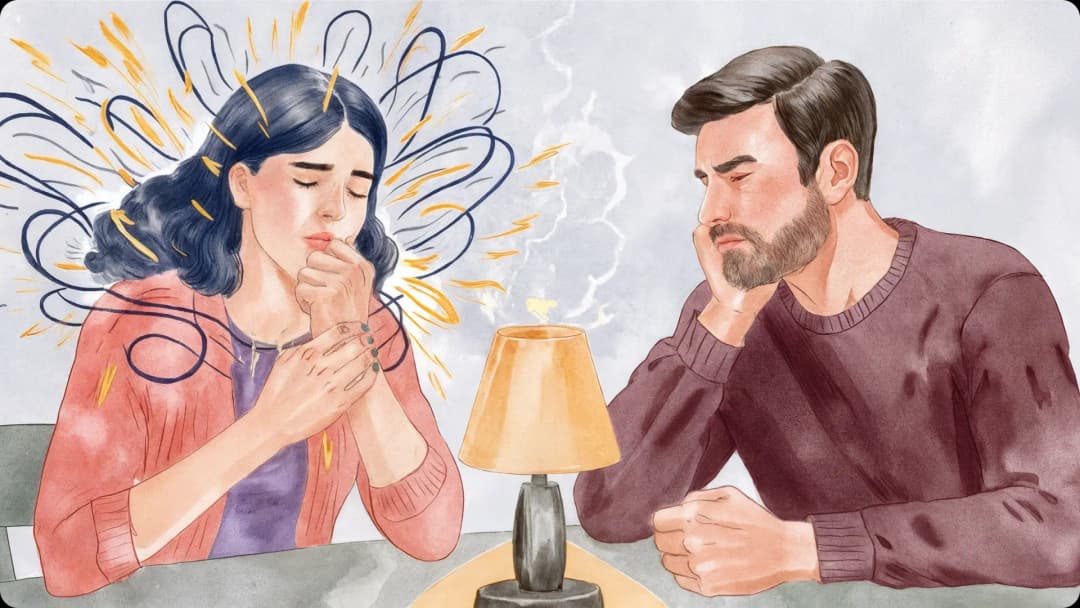
Emotional dysregulation is one of the less consistently recognized dimensions of ADHD, and it can be especially damaging to intimate relationships. It is not part of the core DSM-5 diagnostic criteria for ADHD, though emotional symptoms are increasingly recognized in adult ADHD research and clinical practice. A research study suggests that emotional dysregulation often contributes to the relational struggles that people with ADHD and their partners describe. [1] Bodalski, E.A., Knouse, L.E., & Kovalev, D. “Adult ADHD, Emotion Dysregulation, and Functional Outcomes: Examining the Role of Emotion Regulation Strategies.” J Psychopathol Behav Assess 41, 81–92 (2019).
The good news is that these patterns are not permanent. They can improve with targeted support, and that support is now more accessible than it has ever been.

What Emotional Dysregulation Actually Means in ADHD
Emotional dysregulation occurs when someone is unable to control their emotions as effectively as they should. This includes how quickly emotions are triggered, how intense they are, and how long it takes for them to return to normal once activated.
People with ADHD often describe this as feeling emotions “louder” than others. A moment of criticism that a neurotypical person might process and move past within minutes can, for someone with ADHD, produce an intense shame or anger response that takes hours to subside.
It’s not a character flaw. It shows variations in networks that control emotion and executive function, such as prefrontal circuitry and catecholamine systems. However, the biology is more complex than any one brain region or neurotransmitter.
The Rejection Sensitivity Connection
Rejection Sensitive Dysphoria (RSD) describes extreme emotional sensitivity to perceived rejection, criticism, or failure, whether real or imagined. A partner’s neutral tone, a slightly short text response, or a missed expression of appreciation can trigger disproportionate emotional pain for some people with ADHD.
This pattern creates predictable relationship cycles.
This concept is often discussed in ADHD communities and clinical writing, although it is not a formal DSM diagnosis, and the research literature more commonly uses the broader term “rejection sensitivity.”

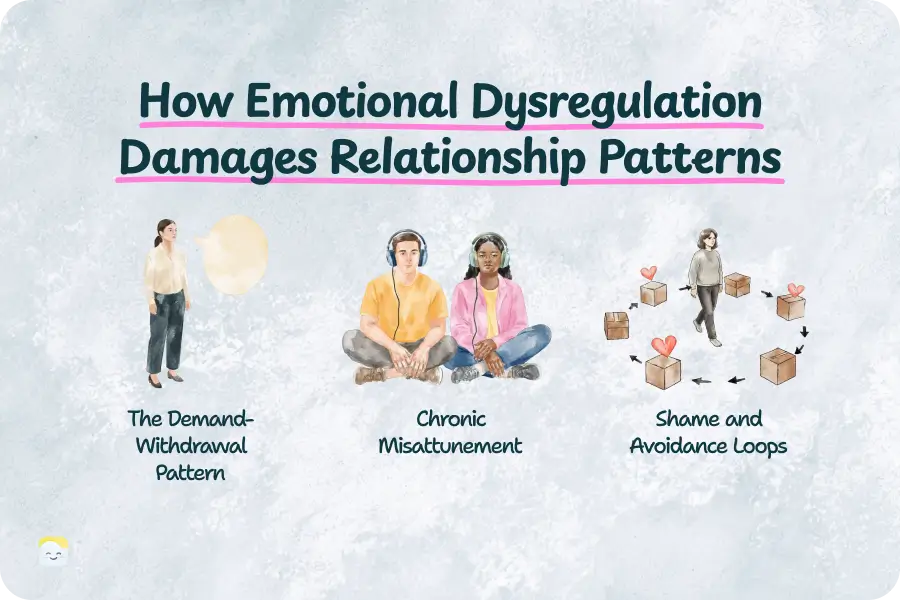
How Emotional Dysregulation Damages Relationship Patterns
When one or both partners in a relationship have ADHD, the relationship may become dysfunctional in ways that seem like communication issues but are really caused by something else.
1. The Demand-Withdrawal Pattern
Demand-withdrawal conflict patterns occur when one partner emotionally escalates while the other shuts down and withdraws from the situation. In ADHD-affected couples, depending on the situation, either partner can play either role.
Each person’s response makes the other’s behavior worse. The escalating partner interprets withdrawal as abandonment. The withdrawing partner interprets escalation as aggression. Neither is wrong about what they’re experiencing. Both are stuck.
2. Chronic Misattunement
People with ADHD may have difficulty reading emotional cues accurately, particularly when they’re already overwhelmed. This means that when there is a fight, the ADHD partner might miss signs that the other person is reaching their limit. This can cause the fight to keep getting worse, which the non-ADHD partner might think is a complete lack of care for their feelings.
Over time, chronic misattunement erodes trust. The non-ADHD partner stops expecting to feel understood. The ADHD partner senses the growing distance but often can’t identify why it’s happening or what to do about it.
3. Shame and Avoidance Loops
Many adults with ADHD carry significant shame about their emotional reactivity. After an intense conflict, they may apologize profusely, over-explain, or withdraw entirely. These responses, while understandable, can frustrate partners who want acknowledgment and repair without the emotional drama of either extreme.
Research Insight: ADHD, Emotional Regulation, and Relationship Outcomes
A study found that emotional dysregulation, more than inattention or hyperactivity symptoms, predicted relationship dissatisfaction in adults with ADHD. [2] Huynh-Hohnbaum, A.L. and Benowitz, S.M., 2026. “Relationship difficulties: compounding effects of Adult Attention-Deficit/Hyperactivity Disorder (ADHD).” Medical Research Archives, [online] 14(2). Partners of adults with ADHD reported significantly higher rates of emotional exhaustion and lower relationship quality when emotional dysregulation was present, regardless of how well other ADHD symptoms were managed.
This finding is useful in real life. This means that managing ADHD with medication and behavioral strategies that focus on attention problems might not fully address the social aspect of ADHD. Targeted help with controlling your emotions, like in therapy, skill building, or structured couples work, is not extra for many couples. It could be a key part of treatment.
Why Online Counseling Is Particularly Well-Suited for ADHD
It has historically been hard for people with ADHD to get counseling for problems that are related to their condition. Scheduling appointments, commuting to offices, managing waitlists, and maintaining consistent attendance are all executive-function tasks that people with ADHD may find difficult.
Online therapy removes some of these barriers. Clients can have sessions from anywhere, at times that work for them, like when they are working or taking care of someone. This way, they don’t have to deal with the stress and time it takes to get to an in-person appointment. For people with adult ADHD, this simplification of logistics is not insignificant. It’s often the difference between ongoing involvement and care that isn’t given or is abandoned.
There is also a clinical case for online delivery in the treatment of people who have trouble controlling their emotions. Some clients may feel less anxious at home, which can make it easier for them to engage with emotionally charged content. Some clients can stay calm during tough sessions better when they’re in a place that makes them feel safe.
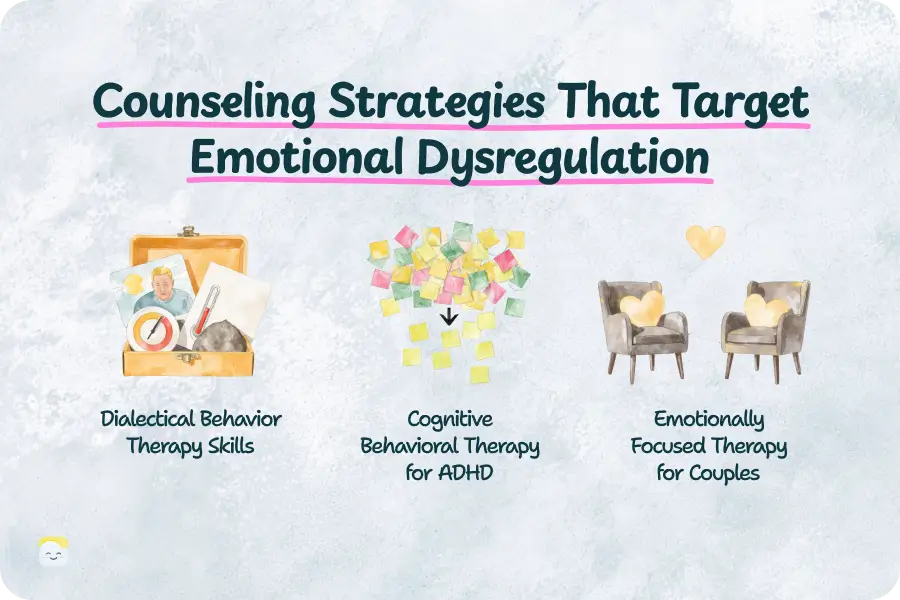
Counseling Strategies That Target Emotional Dysregulation
Not all therapy approaches are equally effective for ADHD-related emotional dysregulation. Generic talk therapy can be helpful for insight, but it rarely produces the skill-level change that regulatory difficulties require.
The approaches below have relevant evidence or strong clinical rationale, though the evidence base varies by approach and by whether ADHD-specific outcomes have been studied directly.
Dialectical Behavior Therapy Skills
DBT was originally developed for borderline personality disorder and is now used for emotional dysregulation across several clinical presentations. Its direct evidence base for ADHD is smaller than its evidence base for borderline personality disorder, but DBT skills are clinically relevant for emotion regulation, distress tolerance, and interpersonal effectiveness. The skills most directly applicable to people with partners who have ADHD include:
- TIPP skills, like changing body temperature, doing intense exercise, breathing at a steady pace, and paired/progressive muscle relaxation, help the body quickly calm down when emotions get strong. This gives you time to choose a response instead of automatically reacting.
- Opposite Action trains the client to identify the emotion-driven urge and deliberately do the opposite, particularly useful for ADHD-related avoidance and shutdown behaviors.
- Interpersonal Effectiveness skills help people who have trouble controlling their emotions communicate more clearly by giving them structured ways to say what they need and set limits without making things worse.
Cognitive Behavioral Therapy for ADHD
CBT adapted for ADHD targets the thought patterns that fuel emotional dysregulation, particularly catastrophizing, all-or-nothing thinking, and the shame-based interpretations that often follow reactive episodes. In a relationship context, CBT helps both partners identify how cognitive distortions shape their interpretation of each other’s behavior.
The most effective ADHD-specific CBT protocols include behavioral components, not just cognitive work. Creating routines for handling conflict, setting up environments that support emotional control, and practicing structured conversations to repair relationships are practical ways to apply therapy insights to everyday life.
Emotionally Focused Therapy for Couples
EFT is a structured couples therapy approach grounded in attachment theory. It targets the underlying attachment fears driving demand-withdrawal cycles, rather than focusing exclusively on communication behaviors. For couples affected by ADHD-related emotional dysregulation, EFT may help address the shame, fear of abandonment, and relational exhaustion that accumulate over years of unresolved conflict.
EFT has a strong evidence base for relationship distress and is increasingly available through online platforms with therapists trained in the approach. The structured nature of the model may suit some ADHD clients well, because sessions have a consistent format and clear objectives rather than open-ended exploration.
Practical Strategies for Couples Navigating Emotional Dysregulation in Relationships Together
Therapy provides the framework, but change happens between sessions. These strategies support the work on a day-to-day basis.
For the Partner With ADHD
- Identify your personal early warning signs of emotional escalation before they become visible to your partner. Physical sensations like jaw tightening, increased heart rate, or heat in the chest often precede the verbal expression of dysregulation, and catching them early gives you more options for self-regulation.
- Create a pre-agreed exit phrase with your partner that signals you need a brief pause without implying abandonment or dismissal. “I need ten minutes to regulate, and then I want to come back to this” is more reassuring than going silent or leaving abruptly.
- Track patterns in your dysregulation episodes using a simple log. Note the time of day, hunger and sleep status, recent stressors, and what the conversation topic was. Patterns often reveal that dysregulation is most likely to occur under specific conditions, making it more predictable and therefore more manageable.
For the Non-ADHD Partner
- Distinguish between the behavior and the person. The emotional reactivity may reflect a difficulty with regulation rather than an expression of how your partner feels about you. Holding that distinction during difficult moments is genuinely hard, but it changes how you interpret what’s happening.
- Resist the impulse to interpret withdrawal as abandonment when your partner calls for a pause. For partners with ADHD, a requested break is often a regulatory strategy, not a rejection. Understanding this reframes what the pause means.
- Seek individual counseling support for yourself, particularly if you’ve been in a caretaking or managing role in the relationship. The emotional labor of loving someone with dysregulation is real, and your own regulation and well-being matter independently of your partner’s progress.
For Both Partners Together
- Establish a shared vocabulary for emotional states before conflicts arise. Many couples find that a simple 1-to-10 intensity scale helps communicate emotional state without triggering further escalation. “I’m at a seven right now” is more informative and less activating than trying to explain a complex emotional state in the middle of a conflict.
- Schedule regular low-stakes check-ins separate from conflict resolution. Brief weekly conversations about what’s working and what’s feeling hard build the relational foundation that makes harder conversations possible.
- Work with a therapist trained in both ADHD and couples dynamics, where possible. General couples therapists who aren’t familiar with ADHD can inadvertently misattribute ADHD-related patterns as resistance or unwillingness to change, which can make things worse rather than better.
Finding the Right Online Counseling Support
The quality of mental health support for ADHD and relationship concerns varies considerably depending on the platform and the individual therapist’s training. When searching for online therapy for this specific combination, it’s worth asking directly whether a therapist has experience with adult ADHD, emotional dysregulation, and couples work.
Online therapy access has expanded the realistic options for people in areas without local ADHD specialists and for people whose schedules make weekly in-person appointments impractical. Both of these were significant barriers before telehealth became standard, and removing them has meaningfully improved who can access specialized mental health support.
Key Insights
Frequently asked questions
Can emotional dysregulation in ADHD be treated without medication?
Yes, though medication may help create the neurological conditions that make therapeutic skill-building more effective. Many people make significant progress through DBT skills training, CBT, and couples therapy without medication or alongside medication management. The most effective approach depends on individual factors and is best assessed with a qualified clinician.
Is online couples therapy as effective as in-person therapy for ADHD-related relationship issues?
Based on clinical research, online couples therapy is shown to be just as effective as in-person therapy, offering comparable outcomes in relationship satisfaction and therapeutic alliance. [4] Jongok Hong, Dasom Choi, Hwajung Hong. “Seeking Harmony in a Beautiful Mess: Designing for Romantic Relationship Navigation of ADHD-Neurotypical Couples.” 2025
For neurodiverse couples, virtual sessions from a familiar home environment can significantly support emotional regulation by reducing the sensory and cognitive fatigue of traveling and “masking.” However, for couples experiencing highly escalated conflict or safety concerns, the physical presence and containment of an in-person setting remains the recommended approach.
How do I know if my partner's emotional reactions are ADHD-related or something else?
Formal assessment by a psychologist, psychiatrist, or other qualified clinician with ADHD expertise is the most reliable route. Emotional dysregulation appears across several conditions, including anxiety, trauma, mood disorders, autism, and personality disorders, some of which co-occur with ADHD. A thorough evaluation distinguishes between them and informs the most appropriate treatment approach.
Can trauma cause ADHD?
Trauma does not typically cause developmental ADHD, but trauma can create symptoms that resemble ADHD, including concentration problems, impulsivity, sleep disruption, irritability, and emotional reactivity. ADHD and trauma can also co-occur, which is why professional assessment matters.
What should I look for in an online therapist for ADHD and relationship issues?
Look for documented experience with adult ADHD, familiarity with emotional dysregulation as distinct from general mood concerns, and training in either EFT, CBT for ADHD, DBT skills, or another structured couples approach. Asking directly about a therapist’s experience with this specific combination before committing to sessions is reasonable and often welcomed.
Sources
- Bodalski, E.A., Knouse, L.E., & Kovalev, D. “Adult ADHD, Emotion Dysregulation, and Functional Outcomes: Examining the Role of Emotion Regulation Strategies.” J Psychopathol Behav Assess 41, 81–92 (2019).
- Huynh-Hohnbaum, A.L. and Benowitz, S.M., 2026. “Relationship difficulties: compounding effects of Adult Attention-Deficit/Hyperactivity Disorder (ADHD).” Medical Research Archives, [online] 14(2).
- Lakeman R, King P, Hurley J, Tranter R, Leggett A, Campbell K, Herrera C. Towards online delivery of Dialectical Behaviour Therapy: A scoping review. Int J Ment Health Nurs. 2022
- Jongok Hong, Dasom Choi, Hwajung Hong. “Seeking Harmony in a Beautiful Mess: Designing for Romantic Relationship Navigation of ADHD-Neurotypical Couples.” 2025
Disclaimer
This article is for general informative and self-discovery purposes only. It should not replace expert guidance from professionals.
Any action you take in response to the information in this article, whether directly or indirectly, is solely your responsibility and is done at your own risk. Breeze content team and its mental health experts disclaim any liability, loss, or risk, personal, professional, or otherwise, which may result from the use and/or application of any content.
Always consult your doctor or other certified health practitioner with any medical questions or concerns
Breeze articles exclusively cite trusted sources, such as academic research institutions and medical associations, including research and studies from PubMed, ResearchGate, or similar databases. Examine our subject-matter editors and editorial process to see how we verify facts and maintain the accuracy, reliability, and trustworthiness of our material.
Was this article helpful?