



Procrastination generally refers to the conscious avoidance of a task due to negative task-related emotions. While all people can engage in procrastination, for those with ADHD, it may be especially common. Time blindness, emotional dysfunction, and inattention can make task initiation and further planning more challenging. It isn’t about laziness but rather about differences in how the ADHD brain regulates motivation.
In this guide, you’ll explore how it works and learn ADHD procrastination techniques to feel better.

Is ADHD procrastination paralysis the same as typical procrastination?
While ADHD procrastination also means an involuntary avoidance triggered by emotional distress, the underlying mechanisms are different. Typical procrastination often involves delaying a task despite knowing it should be done, usually because it’s unpleasant. ADHD procrastination paralysis, however, is closely tied to executive dysfunction.
Note: Although many people use the term “ADHD paralysis” online, it is not a formal diagnostic term.
Adult ADHD procrastination & executive dysfunction
Executive dysfunction refers to difficulties with the brain’s self-management skills, known as executive functions. These skills help you plan, organize, prioritize, start tasks, manage time, stay focused, regulate emotions, and complete goals. When executive functioning is impaired, everyday activities can feel much harder, even if you genuinely want to do them.
The most common challenges with executive function among people with ADHD may include:
- Difficulty starting tasks, even important ones
- Trouble prioritizing what to do first
- Time blindness (misjudging how much time the task takes)
- Difficulty breaking large tasks into smaller steps
- Frequently forgetting deadlines, appointments, or instructions
- Struggling to switch between tasks
- Trouble sustaining attention on boring or repetitive work
- Feeling mentally overwhelmed by simple responsibilities
- Relying on urgency to take action
- Frequently leaving tasks unfinished
- Trouble keeping track of multiple responsibilities at once
These challenges are thought to be related to differences in brain functioning: ADHD is associated with altered activity and connectivity in the brain reward system and systems that manage attention, inhibition, motivation, timing, and goal-directed control. [1] Cubillo A, Halari R, Smith A, Taylor E, Rubia K. “A review of fronto-striatal and fronto-cortical brain abnormalities in children and adults with Attention Deficit Hyperactivity Disorder (ADHD) and new evidence for dysfunction in adults with ADHD during motivation and attention.” Cortex. 2012 Studies also prove that adults or students with more ADHD symptoms tend to show higher procrastination scores. [2] Niermann HC, Scheres A. “The relation between procrastination and symptoms of attention-deficit hyperactivity disorder (ADHD) in undergraduate students.” Int J Methods Psychiatr Res. 2014

Procrastination in ADHD: 5 symptoms
To distinguish ADHD-related procrastination from a typical tendency to delay tasks, check yourself for these symptoms.
1. Constant distraction
It’s pretty common for people to get distracted when the task is difficult or takes a long time to handle. Nevertheless, for people with ADHD, inattention is much more severe and persistent. It isn’t just about losing focus on hard tasks; it is a constant struggle to filter out the background noise of everyday life.
Impulsivity also contributes to everyday procrastination. When a more engaging activity arises (like your friend calling you and inviting you to go to the cinema instead of finishing a work assignment), the ADHD brain may prioritize the immediate reward over the less exciting but important task.
2. Planning too much to handle
ADHD often involves difficulties with time management. It’s not from a lack of effort. People with this condition actually experience time differently. They often live in two zones: “now” and “not now.”
Because the future feels blurry, it is hard to tell how long tasks actually take. Out of fear of forgetting things, everything gets crammed into today’s schedule all at once. This leads to packing the day with an impossible number of tasks, leaving zero breathing room.
3. Low dopamine and challenges with motivation
ADHD brains have altered dopamine function compared to that of neurotypical people. Dopamine is a neurotransmitter involved in motivation, reward, attention, and the ability to feel satisfaction from completing tasks. When dopamine levels or regulation change, everyday tasks that provide little immediate reward can feel less engaging or harder to start.
This is why people with ADHD may struggle with tasks that are important but repetitive, predictable, or far from a deadline. The brain may not receive enough “reward signals” to create the motivation needed to begin, even when the person understands the task’s importance.
4. ADHD task paralysis
When an ADHD brain tries to organize tasks, it perceives every single step, micro-decision, and potential hurdle all at once. This leads to a phenomenon known as “ADHD paralysis,” where the sheer volume of details feels so massive that starting anything becomes impossible.
5. Perfectionism and fear of failure
While there are no specific studies proving that perfectionism is more noticeable among people with ADHD, some research suggests that perfectionistic thoughts, self-criticism, and avoidance are common in adults with ADHD. [3] Strohmeier CW, Rosenfield B, DiTomasso RA, Ramsay JR. “Assessment of the relationship between self-reported cognitive distortions and adult ADHD, anxiety, depression, and hopelessness.” Psychiatry Res. 2016 In this context, perfectionism may function less as a healthy drive for high standards and more as a coping strategy driven by fear of mistakes, rejection, or failure.
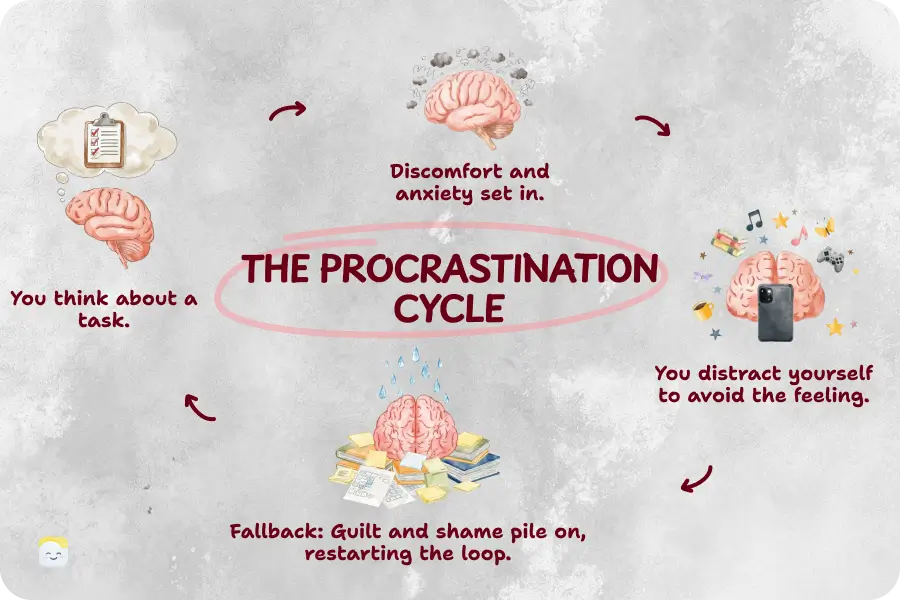
What is the ADHD-related procrastination cycle?
Those with attention-deficit/hyperactivity disorder typically experience the same cycle of procrastination.
- The task feels overwhelming. When you need to do something boring, challenging, or time-consuming, the brain starts perceiving the task as emotionally uncomfortable.
- Avoidance begins. As you experience negative feelings, instead of starting, you may switch to something easier or more rewarding. You may start scrolling through social media, watching videos, or focusing on another activity that provides immediate satisfaction.
- Temporary relief reinforces procrastination. More rewarding tasks provide greater reward signals, which reinforce avoidance. This makes you want to delay a challenging task more and more.
- Deadlines and pressure increase. You understand that work still needs to be done, and this makes negative emotions around the task even stronger. You’re feeling overwhelmed, but nothing helps to get the tasks started.
- A sense of urgency creates motivation. Deadlines sneak up, and you feel that work needs to be done. Despite enduring so much anxiety, you finally focus on the task.
- The cycle repeats. Work is done; you experience a dopamine boost and remember that you have plenty of other things to do. But maybe not today… Are they so urgent?
This urgency cycle in adults with ADHD means that they start doing something only when adrenaline kicks in. It leads to so-called panic-induced productivity. But before that happens, they may spend hours or even days avoiding the task while feeling increasingly overwhelmed. Although this last-minute burst of focus can sometimes produce good results, relying on it repeatedly is mentally and physically exhausting.
Attention-deficit/hyperactivity disorder (ADHD) procrastination types
There can be various types of ADHD procrastination depending on the underlying reason for delaying a task.
- Task initiation procrastination. You feel that you don’t want to even start the task because it feels too boring or overwhelming.
- Decisional procrastination. You find it too difficult to decide or choose between options because every choice seems “imperfect” or carries the risk of making the wrong decision. As a result, you continue gathering information or avoid deciding altogether.
- Distraction-based procrastination. You may start working on the task but get distracted easily, literally by anything. As you find it challenging to maintain focus, even a task that takes 30 minutes can take you the whole day.
- Hyperfocus procrastination. You find certain information or activity intrinsically interesting, and nothing can stop you from searching through it or doing it. At the same time, more important and urgent tasks can be pushed aside, distorting your priorities.
- Planning procrastination. You spend too much time planning, writing to-do lists, and thinking beforehand instead of actually completing tasks.
- Overwhelm procrastination. When something feels too overwhelming and complex, adults with ADHD can experience severe procrastination. You may think, “I’m not ready to do it,” and continue focusing on something simpler.
- Perfectionistic procrastination. Specific tasks feel like they need to be done perfectly. You may be so afraid of making careless mistakes that it feels easier not to start anything at all.
- Boredom-driven procrastination. Maybe the task is so repetitive or unstimulating that you struggle to stay engaged or find enough motivation to begin. The ADHD brain often seeks novelty, challenge, and immediate rewards, so routine activities may feel unusually difficult to complete.
Emily Mendez, M.S., Ed.S., shares insights on what to do to stop delaying tasks till the last minute. “Procrastination is often emotional rather than logical, especially for those with ADHD. Tasks that feel overwhelming may be delayed. One of the easiest ways to beat this is to break tasks into microtasks. This can help reduce avoidance. You can also try building checkpoints into your week rather than waiting until the last minute to complete something.”
Chronic procrastination
Adults with ADHD may experience more than one type of procrastination at once. Even more, different types can manifest in different settings and situations, leading to chronic procrastination.
Such repetitive delays in tasks may lead to significant challenges in professional life and personal relationships. This behavior may cause even more stress when thinking about delayed tasks and create a vicious cycle, as you feel guilty for not doing something and become even more frustrated about getting started.
ADHD procrastination triggers
There are specific things that can make procrastination among people with ADHD much stronger. Among the following are:
- Lack of novelty. When the task is boring or monotonous, a person with ADHD may easily get distracted and shift focus to something more stimulating.
- Lack of clear instructions or priorities. When a task feels undefined, it can be difficult to know where to start. Also, difficulty deciding what matters most can lead to jumping between tasks or avoiding them altogether.
- Emotional discomfort. If you feel worried or anxious about doing something, it’s more likely that you start engaging in ADHD procrastination.
- Too many distractions. One of the most noticeable ADHD symptoms is inattention. So, when your phone rings, people around you are talking about something interesting, and new thoughts keep popping up, it can be difficult to stay focused on the original task. These constant interruptions can break momentum and make it easier to postpone work.
- Past negative experiences. If you have already faced criticism about a similar task or noticed that it was pretty difficult, you may now avoid it due to the emotional toll.
- Lack of external structure. Without deadlines, accountability, or routines, it may be harder to feel the urgency to take action.
How procrastination in ADHD contributes to mental health
1. Self-esteem challenges
When you constantly find it challenging to handle tasks, it may lead to negative internal thoughts and the belief that something is wrong with you (even though it isn’t).
2. The shame spiral
You experience shame for a lack of self-control, which makes managing procrastination even more difficult due to continuous stress.
3. Anticipatory anxiety
Staying in a constant fight-or-flight mode due to worries about endless tasks creates a paralyzing dread of actually starting them, turning even simple to-do lists into a constant source of mental exhaustion.
4. Burnout
Many adults with ADHD may feel burned out due to the endless cycle of worrying about the task and doing nothing, and then overworking before the deadline.
5. Depressive feelings
According to studies, there’s a strong link between burnout and later depression. [4] Meier ST, Kim S. “Meta-regression analyses of relationships between burnout and depression with sampling and measurement methodological moderators.” J Occup Health Psychol. 2022 The symptoms may overlap, or ADHD and procrastination can lead to significant stress that later contributes to feelings of hopelessness, low motivation, and emotional exhaustion.
6. Sleep problems due to last-minute work
Due to severe ADHD symptoms, a person may delay tasks till the last minute and then work overnight to meet deadlines, which can lead to chronic sleep deprivation and daytime fatigue.
7. Avoiding new opportunities
“I won’t be able to deal with this as well.” A person may understand that procrastination limits their ability to take on new tasks and try something new.
8. Relationship stress
ADHD adults may not meet promises or complete responsibilities on time, which can create conflicts with close ones.
How to stop ADHD procrastination. 8 tips
To reduce ADHD-related procrastination, you may need to stop relying on your executive functioning skills and create external systems that make it easier to start and complete tasks. Since ADHD can affect planning, time management, and self-regulation, the goal is not simply to “try harder” but to build strategies that align with how your brain processes motivation and attention.
1. Try body doubling
Working alongside someone can increase your sense of accountability and help you stay focused. Even if the person isn’t actively working or doing something similar, just the fact that someone is present nearby can make you feel more motivated.
2. Find an accountability partner
Sharing your goals and deadlines can create external motivation and improve self-control. You can also agree on some milestones and celebrate them to feel more encouraged.
3. Use visual timers
Visual timers give people with ADHD a better feeling of time and may help them overcome time blindness. Seeing time pass can make deadlines feel more real and reduce the uncertainty that often makes starting tasks difficult.
4. Break big tasks into smaller steps and create a plan
Making the task feel less overwhelming can help you reduce procrastination. You may need to break it down into smaller steps so each one feels manageable and easy to check off your checklist.
Then, list everything you need to do and create a step-by-step plan on how to handle it. Don’t try to fit everything into one day. Just make sure you always know what to do next.
5. Find your peak times of energy
The same task may take you either 20 minutes or 3 hours. And sometimes it isn’t about poor planning. It’s about how much energy you have and what your dopamine level is.
Through experimentation, you may find your peak mental energy times in the morning, during the day, or even late at night. Then, plan the most challenging and demanding tasks accordingly. This will let you save lower-energy periods for routine or less demanding work.
6. Use gamification strategies
This approach works for both neurotypical and neurodivergent people. You may need to apply gamification strategies to turn boring tasks into challenges and feel more motivated. Here’s what can help:
- Race against the clock. Set a timer and see how much you can finish before it goes off.
- Create a reward system. Pair difficult tasks with something you enjoy afterward, like a favorite snack, coffee, or an episode of a TV show.
- Try the “don’t break the chain” method. Mark every day you complete your target habit on a calendar and aim to keep the streak going.
- Use a habit-tracking app. Many apps include streaks, badges, achievements, and progress bars that make tasks feel more engaging.
- Randomize your to-do list. Put tasks into a jar or use a random picker to make choosing the next task more novel.
7. Try the Pomodoro technique
You work for 25 minutes and then take a 5-minute break. After 3–4 work sessions, take a longer break of 15–30 minutes. Breaking tasks into short, timed intervals can make them feel less overwhelming and help maintain focus.
Yet, it may be challenging for people with inattention symptoms and short attention spans to stick to the exact same routine. You can adjust it in a way that is comfortable for you and gradually increase your working time. It could be 15 minutes of focused work followed by a 3-minute break, or even 10-minute work sessions at first. The best version of the Pomodoro technique is the one you can consistently maintain.
8. Establish a consistent daily routine
Research supports the idea that external structure and routines may reduce work and academic procrastination in ADHD by lowering planning demands and supporting task initiation. [5] Oguchi M, Takahashi T, Nitta Y, Kumano H. “The Moderating Effect of Attention-Deficit Hyperactivity Disorder Symptoms on the Relationship Between Procrastination and Internalizing Symptoms in the General Adult Population.” Front Psychol. 2021
Instead of deciding what to do from scratch each day, create predictable time blocks for work, meals, exercise, and rest. The fewer decisions you have to make in the moment, the less mental energy you spend getting started, making it easier to follow through on important tasks.
Emily Mendez, M.S., Ed.S, provides more tips on how people with ADHD can overcome procrastination. “Don’t try to force through to finish something. A myth is that people with ADHD just need more willpower. But executive functioning challenges are what often keep people with ADHD from completing tasks. If you feel overwhelmed, it’s important to take a break. Trying to force yourself to finish a task will just make it that much harder. Also, external support can be very helpful. That could be supportive individuals, planners, timers, and other tools.”
Frequently asked questions
Is procrastination a sign of ADHD?
Procrastination isn’t a sign of ADHD, as it can be quite common among neurotypical people as well. However, people with ADHD may experience it more often and more intensely because of differences in executive functioning, attention regulation, and motivation.
Why do people with ADHD procrastinate so badly?
It happens due to challenges with executive functions that help the brain organize, plan, and start tasks. A person with ADHD may struggle to estimate how long something will take, break a big project into smaller steps, or find enough stimulation to begin a boring or overwhelming task. Emotional factors can also play a role: fear of failure, perfectionism, frustration, or stress may make avoidance feel like the easiest option.
What is the 30% rule for adults with ADHD?
The 30% rule for ADHD was introduced by Dr. Russell Barkley. According to Barkley, some adults with ADHD may have executive functioning skills that are approximately 30% behind their chronological age. For example, a 30-year-old with ADHD may struggle with self-regulation, planning, or impulse control in ways that resemble those of someone who is around 21 years old.
What is the 24-hour rule for ADHD?
The 24-hour rule for ADHD is a popular self‑regulation strategy. It states that you may need to wait for 24 hours before making an impulsive decision or acting on an urge.
What type of ADHD causes procrastination?
Procrastination can happen with any type of ADHD because it is often connected to challenges with executive functioning. However, it is especially common in people with inattentive ADHD, who may find it more difficult to organize tasks, stay focused, or know how to get started.
What is the 1/3/5 rule for ADHD and procrastination?
The 1/3/5 rule is a way to plan your day without feeling overwhelmed. It means choosing 1 big task, 3 medium tasks, and 5 small tasks to focus on. Having a clear and limited list can make it easier for people with ADHD to prioritize and get started.
What is the 5-4-3-2-1 rule for procrastination?
The 5-4-3-2-1 rule from Mel Robbins is a quick trick to stop overthinking and take action. You count backward from five and start the task when you reach one. It helps break the cycle of hesitation and makes the first step feel easier.
What is the 2-minute rule for ADHD?
The 2-minute rule means starting a task for just two minutes instead of thinking about finishing everything at once. For example, you can write one sentence, wash a few dishes, or open your work file. Starting small can help you build momentum and continue.
What are the 4 F's of ADHD?
The 4 F’s of ADHD describe common challenges that may affect daily life:
- Focus. Difficulty staying focused or directing attention.
- Fuel. Trouble finding motivation to start tasks.
- Follow-through. Difficulty finishing what you started.
- Forgetfulness. Forgetting plans, deadlines, or important details.
These are not official ADHD symptoms but a simple way to understand some common struggles.
Sources
- Cubillo A, Halari R, Smith A, Taylor E, Rubia K. “A review of fronto-striatal and fronto-cortical brain abnormalities in children and adults with Attention Deficit Hyperactivity Disorder (ADHD) and new evidence for dysfunction in adults with ADHD during motivation and attention.” Cortex. 2012
- Niermann HC, Scheres A. “The relation between procrastination and symptoms of attention-deficit hyperactivity disorder (ADHD) in undergraduate students.” Int J Methods Psychiatr Res. 2014
- Strohmeier CW, Rosenfield B, DiTomasso RA, Ramsay JR. “Assessment of the relationship between self-reported cognitive distortions and adult ADHD, anxiety, depression, and hopelessness.” Psychiatry Res. 2016
- Meier ST, Kim S. “Meta-regression analyses of relationships between burnout and depression with sampling and measurement methodological moderators.” J Occup Health Psychol. 2022
- Oguchi M, Takahashi T, Nitta Y, Kumano H. “The Moderating Effect of Attention-Deficit Hyperactivity Disorder Symptoms on the Relationship Between Procrastination and Internalizing Symptoms in the General Adult Population.” Front Psychol. 2021
Disclaimer
This article is for general informative and self-discovery purposes only. It should not replace expert guidance from professionals.
Any action you take in response to the information in this article, whether directly or indirectly, is solely your responsibility and is done at your own risk. Breeze content team and its mental health experts disclaim any liability, loss, or risk, personal, professional, or otherwise, which may result from the use and/or application of any content.
Always consult your doctor or other certified health practitioner with any medical questions or concerns
Breeze articles exclusively cite trusted sources, such as academic research institutions and medical associations, including research and studies from PubMed, ResearchGate, or similar databases. Examine our subject-matter editors and editorial process to see how we verify facts and maintain the accuracy, reliability, and trustworthiness of our material.
Was this article helpful?