


Podcast name
How to be more charismatic
Charisma isn’t something innate. While some people may seem more charismatic naturally, others can develop it over time. Here are some tips to become more charismatic and leave a positive impression on those around you.

20 insights on how to be charismatic
A charismatic person is someone who feels confident in social settings, connects with those around on a deeper level, and makes others feel valued and understood.
Internal mindset
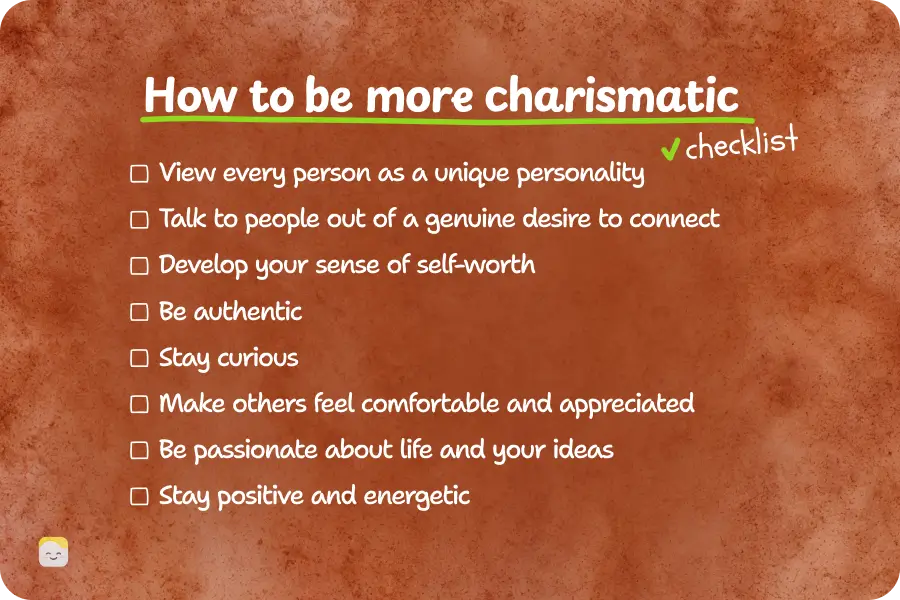
1. View every person as a unique personality
Charismatic people are approachable. They show genuine interest in people they talk to and, instead of focusing on themselves, approach every interaction as a way to explore something new about the person. To become a good listener, you should understand that everyone has unique experiences, perspectives, and stories worth hearing.
2. Talk to people out of a genuine desire to connect
Remember that people generally enjoy talking about themselves more than listening to others. Instead of approaching conversations with the goal of being liked or making an impression, focus on building a real connection. Be curious and ask open-ended questions to deepen connections rather than to speak about yourself.
3. Develop your sense of self-worth
People perceive others both consciously and subconsciously. So, no matter how confident you try to seem, if you constantly doubt yourself or seek approval from others, those insecurities can come through in your behavior.
Don’t seek external validation purposefully. Learn who you are, set clear goals, and reach them. People trust those who appear calm and confident, sometimes even more than those with an impressive track record.
4. Be authentic
Charismatic people know who they are. While they have strong social skills, they don’t compromise their values or pretend to be someone they’re not just to gain approval. Rather than trying to fit every situation or please everyone, express your opinions respectfully, admit when you don’t know something, and let your personality show.

5. Stay curious
Don’t try to appear interesting. Be an interesting person. Expand your knowledge, explore new hobbies, and stay open to different ideas and experiences so you’ll always have something meaningful to discuss.
6. Make others feel comfortable and appreciated
Naturally charismatic people show genuine warmth and make those around feel valued and special. Before or during a conversation, ask yourself, “How do I want this person to feel after talking with me?” Small gestures like offering a sincere compliment, remembering personal details, or giving someone your full attention can have a lasting positive impact.
7. Be passionate about life and your ideas
Conversations with charismatic people rarely feel dull because their enthusiasm is contagious. They speak with excitement about the things they care about, whether it’s a personal goal, a hobby, or a meaningful cause.
You don’t have to be loud or dramatic to be passionate. But having interests that you talk about with spark and sincerity can make you more attractive to others.
8. Stay positive and energetic
People always want to interact with others who make them feel good and recharged. Of course, it doesn’t mean that you should always pretend that everything is OK even if it isn’t. Instead, try to bring a positive attitude into your interactions whenever possible. Focus on the positive aspects of situations and acknowledge other people’s successes.
Conversational dynamics
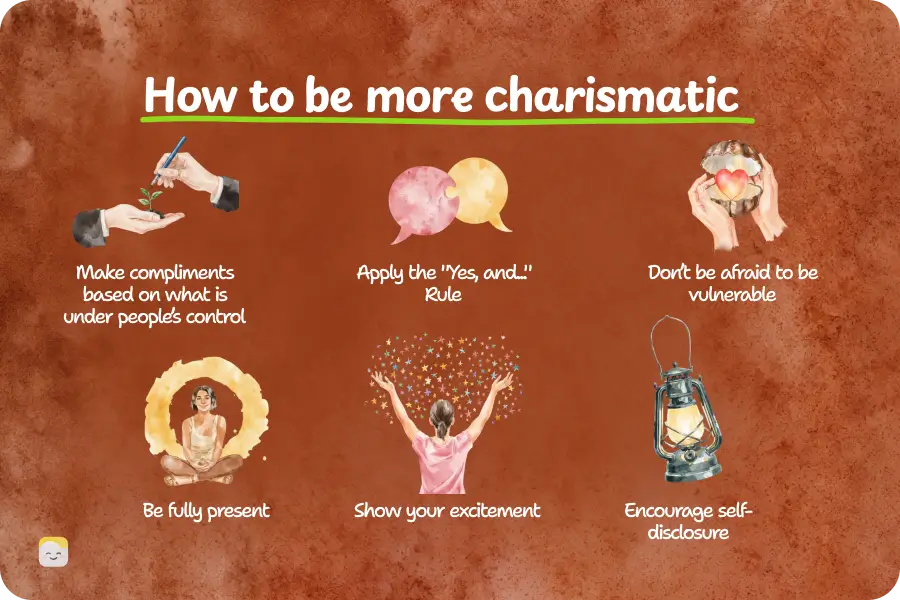
9. Make compliments based on what is under people’s control
Compliments about appearance might cheer people up, but charismatic people typically focus on something more specific. Don’t comment on traits people were born with. Try to notice the things they’ve chosen or worked hard to achieve, like their creativity, sense of humor, kindness, style, effort, or a job well done.
You can say something like:
10. Be fully present
Active listening helps you build stronger relationships because it shows people that they have your full attention. To show your presence, pay attention to:
- body language
- facial expressions
- tone of voice
- other nonverbal cues
According to the study, faster-than-usual response times, especially under 250 ms, are associated with greater perceived social connection. [1] Magyari L, Bastiaansen MC, de Ruiter JP, Levinson SC. “Early anticipation lies behind the speed of response in conversation.” J Cogn Neurosci. 2014 This conversational rhythm signals engagement and can make people see you as more charming.
11. Show your excitement
Even during small talk, don’t hesitate to say when you think that someone does something perfectly. If a friend shares good news, celebrate with them. React to someone’s Instagram Story if you enjoyed it. When a coworker does a great job on a presentation, let them know. Small moments of encouragement often mean more than you think.
12. Apply the “Yes, and…” Rule
When someone is talking, and it’s your turn to respond, don’t immediately change the subject and bring the conversation back to yourself. Instead, acknowledge what they said and build on it.
This simple technique, “Yes, and…” helps keep conversations flowing naturally. For example, if someone says, “I started learning pottery,” instead of replying, “I could never do that,” or “That reminds me of…”, you could say, “That’s awesome! What made you decide to try pottery?” or “Yes, and what’s been the most challenging part so far?”
13. Don’t be afraid to be vulnerable
Nobody is perfect. And people appreciate when you show your imperfections, so they can show theirs as well.
If you’re worried before giving a presentation, acknowledge it, and you’ll probably get the support. Or, if you don’t know the answer to a question, simply admit it instead of pretending you do. People tend to trust those who are honest, self-aware, and comfortable enough to be themselves.
Grady Shumway, LCSW, explains the difference between natural vulnerability and oversharing. “The biggest difference is intent and how processed the material is. When vulnerability is healthy, you’re sharing something you’ve already worked through enough that you aren’t handing it to the other person to carry. Oversharing usually comes from anxiety or a pull for reassurance, and it tends to show up too early in a relationship. A quick gut check I give clients: ask yourself, am I sharing this to connect, or because I need to be soothed right now? Also, does the depth of what I’m about to say match the depth of this relationship? If a coworker you’ve known for two weeks is hearing your trauma history, that’s a mismatch, and it typically pushes people away rather than drawing them in.”
14. Encourage self-disclosure
Charismatic people tend to engage in meaningful interactions. They ask thoughtful questions, share insights, and help others learn more about themselves. Instead of keeping the conversation at a surface level, they create a space where people feel comfortable opening up. When someone feels truly heard and understood, they are much more likely to remember both the conversation and the person they had it with.
Body language and appearance
Studies prove that nonverbal behavior can increase perceived charisma. [2] Caroline F. Keating, Fiona Adjei Boateng, Hannah Loiacono, William Sherwood, Kelsie Atwater, Jaelah Hutchison. “Charismatic Nonverbal Displays by Leaders Signal Receptivity and Formidability, and Tap Approach and Avoidance Motivational Systems.” Frontiers in Psychology. 2020 Here are some tips on how to practice open body language and feel more confident.
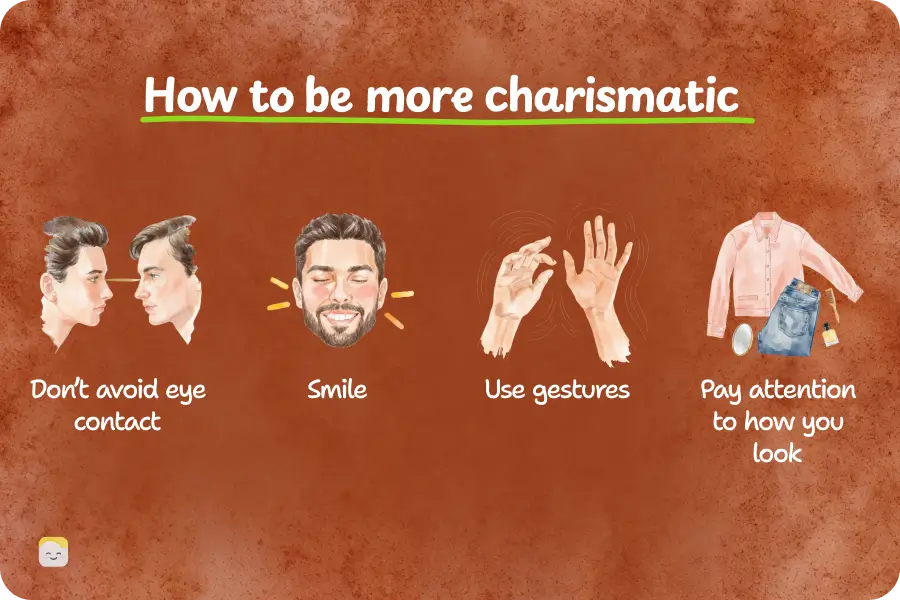
15. Don’t avoid eye contact
Maintaining eye contact is associated with more favorable judgments, such as higher self-esteem or better social evaluations. [3] Droney JM, Brooks CI. “Attributions of self-esteem as a function of duration of eye contact.” J Soc Psychol. 1993 As such, if you maintain it for 60–70% of the conversation, people may start perceiving you as more charismatic.
16. Smile
17. Use gestures
In a popular analysis of TED Talks by Vanessa Van Edwards, the most-viewed talks averaged about 465 hand gestures over 18 minutes, compared with about 272 in less-viewed talks.
Don’t hesitate to take up a comfortable amount of space and use natural hand gestures to emphasize your points. You can also use nods and tilts to support a person when they’re talking about something.
18. Pay attention to how you look
Dozens of Reddit users agree that first impressions matter, and studies indicate that it does as well. We use first impressions to determine who we should approach and who we should avoid. [4] Gilron R, Gutchess AH. “Remembering first impressions: effects of intentionality and diagnosticity on subsequent memory.” Cogn Affect Behav Neurosci. 2012 As such, your appearance can influence how people perceive you before you’ve even said a word.
You don’t need expensive clothes or a perfect sense of style. Wearing clean, well-fitting clothes, maintaining good hygiene, and dressing in a way that reflects your personality can help you feel more confident.
Expectations
Charismatic people are easy-going because they don’t expect others to solve their problems or become responsible for their happiness. They’re self-focused yet always ready to give their energy to others.
19. Don’t expect every person to become your best friend
Some connections are meant to be brief, and that’s perfectly okay. Not every conversation has to turn into a close friendship or a long-term relationship.
Charismatic people enjoy meeting others without putting pressure on the outcome. They appreciate each interaction for what it is, knowing some people will click with them while others won’t, and they don’t take it personally.
20. Accept that everyone can make mistakes
No one is perfect, and charismatic people accept it. They don’t immediately blame others for doing something wrong and concentrate on how to fix the situation and support others.
This doesn’t mean ignoring mistakes or avoiding accountability. It means responding with patience and empathy rather than criticism.
Grady Shumway, LCSW, comments on how a person can become more charismatic. “Honestly, most of the work here is internal. Self-consciousness and social anxiety are the two biggest blockers I see, because you can’t be genuinely present with someone while you’re busy monitoring your own performance. Things like mindfulness, reframing awkward moments instead of replaying them, and getting reps in low-stakes conversations tend to stick better than memorizing techniques. Consistency matters too. Charm that’s performed falls apart the first time someone catches the gap between the act and the person. And get outside feedback if you can. Asking a trusted friend how you actually come across is uncomfortable, but we’re all pretty bad judges of our own social signals.”
The three pillars of any charismatic person
You can be a good storyteller or feel perfectly confident in social situations, but people still won’t perceive you as charismatic. Here are the three pillars any charismatic person has, according to Olivia Fox Cabane, a French and American author and public speaker.
Presence
Presence means giving someone your full attention instead of thinking about your next reply or getting distracted. Charismatic people make others feel heard and valued.
For example, when a friend is telling you about their day, put your phone away, maintain eye contact, and ask a follow-up question instead of changing the subject.
Power
Charismatic people can be leaders. They know how to guide and hold space while at the same time making others feel valuable and important.
For instance, during a team meeting, a charismatic leader may confidently present a plan but still ask, “What do you think?” and genuinely consider everyone’s ideas. They project confidence without making others feel small.
Warmth
Natural charm and charisma are hard to imagine without the ability to actively listen to others and be warm and caring. Charismatic people show empathy and look for ways to make the people around them feel comfortable.
For example, if someone shares a personal struggle, a warm person doesn’t rush to give advice or change the subject. They listen, acknowledge the person’s feelings, and let them know they’re not alone.
5 practices to become one of the most charismatic people
Charisma can be trained and developed. You don’t need to attend dozens of networking events to practice warmth and presence. Here’s what can really help.
1. Try energy matching
When entering the room, first try to read the energy of the people around you. Then, match their tone, pace, and intensity of conversation. It doesn’t mean that you need to always follow what others do. However, most people may feel more comfortable when you first match their existing energy and then gradually shift the tone or the topic of the discussion.
2. Use relaxed body language
People can read lack of confidence not only from your words but also from your gestures, posture, and movements. To appear charismatic, it’s better to adopt an open and grounded posture. Relax your shoulders, don’t cross limbs, and take as much space as you need.
Fidgeting or constantly touching your face, neck, or hair can signal nervousness or discomfort, even if you don’t realize you’re doing it.
3. Frame conversations around shared experiences
Most people like talking about their passions, hobbies, and life in general. So, instead of changing the topic to something unrelated, build on what the other person has already shared and look for common ground.
For example, if someone tells you they recently started hiking, ask what they enjoy most about it or mention a similar experience you’ve had. Conversations flow more naturally when both people contribute to the same topic rather than competing to introduce a new one.
4. Practice strategic vulnerability
Next time you feel worried or exhausted, don’t try to hide your feelings. Acknowledge them and say something like, “I’m a little nervous about this presentation, but I’m excited to share my ideas,” or “It’s been a long day, so I might be a bit slower than usual.”
Being honest about how you feel makes you more relatable and authentic. The key is to share your emotions without expecting others to fix them. This kind of vulnerability helps people feel more comfortable opening up to you as well.
5. Make specific, earned compliments
Set yourself a goal of giving five compliments a day. Don’t focus on appearance or something a person has no control over. Instead, notice their effort, skills, attitude, creativity, or the way they treat other people. Notice how you feel and how others’ approach to you changes.
Frequently asked questions
What makes a charismatic man?
A charismatic man isn’t necessarily the funniest, loudest, or most outgoing person in the room. He makes people feel comfortable, listens without judgment, and speaks with confidence. He stays true to his values and leaves people feeling better after spending time with him.
What is the dark side of charisma?
Charisma can become harmful when it’s used to manipulate, influence, or control others for personal gain. Highly charismatic people may sometimes be perceived as more trustworthy or competent than they actually are, making it easier to gain others’ confidence.
That’s why it’s important to pair charisma with honesty, empathy, and integrity rather than using it to persuade or exploit people.
Is it possible to increase charisma?
Yes, you can become more charismatic and confident. While some people seem naturally outgoing, charisma isn’t something you’re born with; it’s a skill you can develop over time.
Small changes, like listening more carefully, improving your body language, showing interest in others, and speaking with confidence, can make a big difference. The more you practice these habits in everyday conversations, the more natural and effortless they will become.
Sources
- Magyari L, Bastiaansen MC, de Ruiter JP, Levinson SC. “Early anticipation lies behind the speed of response in conversation.” J Cogn Neurosci. 2014
- Caroline F. Keating, Fiona Adjei Boateng, Hannah Loiacono, William Sherwood, Kelsie Atwater, Jaelah Hutchison. “Charismatic Nonverbal Displays by Leaders Signal Receptivity and Formidability, and Tap Approach and Avoidance Motivational Systems.” Frontiers in Psychology. 2020
- Droney JM, Brooks CI. “Attributions of self-esteem as a function of duration of eye contact.” J Soc Psychol. 1993
- Gilron R, Gutchess AH. “Remembering first impressions: effects of intentionality and diagnosticity on subsequent memory.” Cogn Affect Behav Neurosci. 2012
Disclaimer
This article is for general informative and self-discovery purposes only. It should not replace expert guidance from professionals.
Any action you take in response to the information in this article, whether directly or indirectly, is solely your responsibility and is done at your own risk. Breeze content team and its mental health experts disclaim any liability, loss, or risk, personal, professional, or otherwise, which may result from the use and/or application of any content.
Always consult your doctor or other certified health practitioner with any medical questions or concerns
Breeze articles exclusively cite trusted sources, such as academic research institutions and medical associations, including research and studies from PubMed, ResearchGate, or similar databases. Examine our subject-matter editors and editorial process to see how we verify facts and maintain the accuracy, reliability, and trustworthiness of our material.
Was this article helpful?