

Podcast name
Not physically attracted to your partner? Podcast
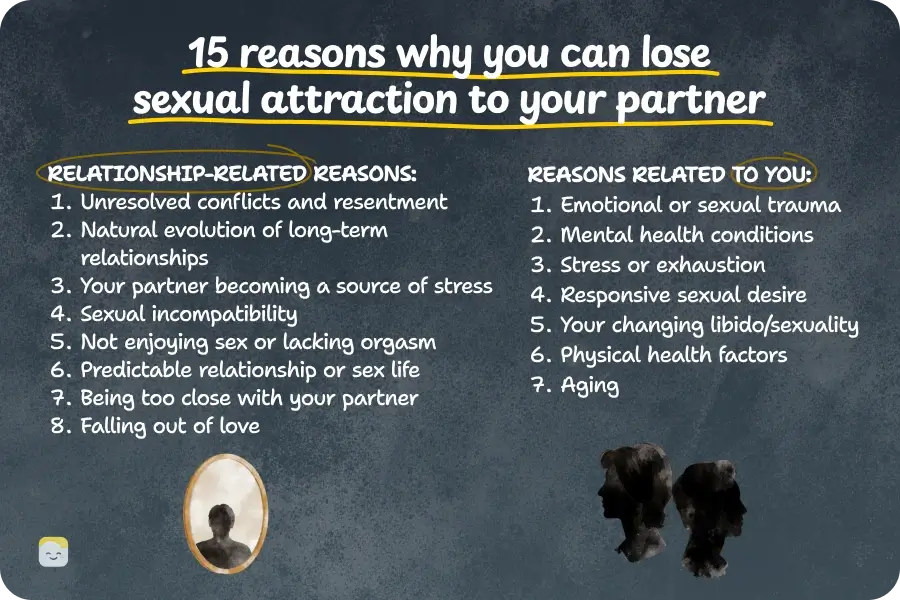
Short answer: 15 reasons that can explain why you’re not attracted to your partner
- Unresolved conflicts and resentment
- Stress or exhaustion
- Emotional or sexual trauma
- The natural evolution of long-term relationships
- Responsive sexual desire
- Your partner becoming a source of stress
- Sexual incompatibility
- Not enjoying sex or lacking orgasm
- A predictable relationship or sex life
- Being too close with your partner
- A change in your sexuality or libido
- Falling out of love
- Mental health conditions
- Physical health factors, like medications or hormones
- Aging
Changes in sexual attraction are a normal part of long-term relationships. Don’t feel guilty or responsible for no sexual chemistry in a relationship—it’s not your “duty” to maintain it.

Why Am I Not Sexually Attracted to My Partner? 15 Possible Reasons
1. Unresolved Conflicts and Resentment in Relationships
Research shows that poor communication and, as a result, resentment lead to losing interest in sexual intimacy [1] Associations of Sexual Desire with Demographic and Relationship Variables. T. Aavik, K. Täht, U. Vainik, R. Mõttus. Scientific Reports. January 2026. . But why does it impact attraction?
- Because resentment blocks empathy. You almost don’t want to understand or meet your partner’s needs because of how hurt you feel.
- Because resentment destroys security. Closeness is only possible when you can be vulnerable, knowing that you will not be used against you. Perhaps your experience proved you otherwise.
It’s hard to feel desire for someone you’re angry at. Your unmet needs and hurt can follow you into the bedroom.
What can feed resentment even more is when intimacy starts to feel like one more thing you’re giving without getting anything back.
2. You Experienced Emotional or Sexual Trauma
- You experienced emotional/physical trauma earlier in life.
- Your partner could (un)intentionally trigger trauma-like responses.
The bodily sensations during sexual arousal (rapid heartbeat, changes in breathing, muscle tension) are biologically very similar to the body’s response to fear or danger [2] PTSD and Sexual Dysfunction in Men and Women. R. Yehuda, A. Lehrner, T.Y. Rosenbaum. The Journal of Sexual Medicine. May 2015. .
Even if you haven’t experienced sexual abuse explicitly, trauma from the past can make physical attraction feel unsafe, even when you love and trust your partner.

3. You’re Too Stressed or Exhausted
Stress has become so normalized that we overlook that it can impact every single part of our functioning, including sex.
High stress levels tell your body that you’re basically surviving in the moment:
Shortly put: your body can deprioritize sex if you’re underslept, undernourished, in fight-or-flight mode, or overworked.
4. It’s a Natural Evolution of Relationships
Infatuation, passion, and constant sexual attraction are very common in the early stages of relationships. The uncertainty and novelty feed your physical attraction to each other.
But the longer you are in a relationship, the less uncertainty and novelty there is. The initial spark fades, which can make your sex life feel dull in comparison to how it used to be.
But this is a normal part of relationship evolution that’s called habituation.
Once trust and security in a relationship are established, evolutionary priorities shift from reproductive urgency to resource management. Maintaining the extreme hormonal state of early infatuation requires massive metabolic energy. So, weakening of sexual attraction in long-term relationships is literally the way to preserve your mental and physical energy.
5. You Have Responsive Sexual Desire
There are two types of sexual desire [4] Mind-body-spirit model for the medical management of female sexual well-being. T. Lorenz and N. Finley. Current Sexual Health Reports. December 2021. :
Responsive sexual desire can feel like you have trouble feeling attracted to your partner just because spontaneous sexual arousal is more normalized. But if you don’t experience this lightning-like, animalistic desire, it doesn’t mean that you’re not attracted to your partner anymore altogether.
People with responsive sexual arousal are “slow-cooking.” They need context, emotional intimacy, touch, and flirting, which are valid conditions for enjoyable sex. In short, you crave a build-up of input to trigger your sexual arousal.
Do you often not feel like sex, only to find yourself enjoying physical intimacy once it actually begins?
6. Your Partner Has Become a Source of Stress
Your partner can (un)intentionally create a hostile environment where you don’t feel safe to be vulnerable and sexy. For example:
- They can pressure you into sex.
- They criticize you for everything.
- They make you feel unattractive or not good enough.
- They don’t communicate with you.
- They don’t take your desires into consideration.
Your body and mind might unconsciously avoid sex, just to be away from the source of stress. In the meantime, your sex drive can be generally okay, so you fantasize about sex, masturbate, or feel attracted to other people.
7. You’re Sexually Incompatible
Sometimes you and your partner simply want different things in bed. You may have different wishes for frequency, duration, location, type, toys, etc.
Sexual incompatibility and different libidos can be tiring, especially if you never adjust sex or suppress your needs for the sake of the other.
As a rule, sexually incompatible couples can break up, but many don’t if they have an emotional connection and a healthy relationship. The sex gap doesn’t mean that you’re not compatible at all. It’s always possible to negotiate. Sexual gaps can be filled with candid conversations and/or sex therapy.
8. You Don’t Enjoy Sex or Lack Orgasm in Partnered Sex
Does sex feel like another chore you need to cross off your to-do list? No wonder you don’t want it. It’s like if you wanted extra laundry a few times a week!
Many people, especially women, have sex that focuses more on their partner’s pleasure than their own. As a result, only 65% of women in partnered sex usually have orgasms compared to 95% of men [6] Differences in Orgasm Frequency Among Gay, Lesbian, Bisexual, and Heterosexual Men and Women in a U.S. National Sample. D.A. Frederick, H.K. St John, J.R Garcia, E.A. Lloyd. Archives of Sexual Behavior. January 2018. .
Although orgasm might not be the goal in partnered sex, you still need to enjoy the process so that your mind associates sex with something rewarding to want it more.
9. The Relationships/Sex Became Predictable
Sex is a game. At least, our brain perceives it so.
Intimacy requires playfulness and novelty. As in real play, partners lose track of time, forget about everyday tasks, and immerse themselves in the process of exploration to reach the flow state. During sex, partners go beyond seriousness: experiment, laugh, and overcome fear of mistakes or imperfections.
So, if most of your intimate moments look the same every time, it can start to feel more like a habit than this exciting, playful experience. The same time, the same place, and the same routine simply don’t bring excitement anymore.
Expert Insight
Intimacy is cultivated by a number of factors unique to each couple.
However, some common components are the ability to embrace lightheartedness, play, and a culture of laughter to shake off the random bouts of awkwardness that could ensue during sexual experiences.
Furthermore, novelty ignites thrill and curiosity which are healthy when long-term relationships.

Katherine Scott
Mental health professional
10. You’re Too Close with Your Partner
Emotional intimacy and closeness usually support sexual attraction. But the right amount of closeness can be either a cure or a poison.
Enmeshment/codependency in a relationship creates underlying issues that negatively impact sex life:
- Familiarity becomes predictability. When partners know every small detail of each other’s day, reactions, and routines by getting constant updates, there may be less uncertainty and anticipation by the end of the day when you reconnect.
- The partner becomes “family-like.” Intense caretaking closeness can make the relationship feel incompatible with the erotic subtext of romantic relationships.
- Autonomy disappears. If partners feel guilty about their own needs or separate plans, they may lose the sense of being individuals who actively choose the relationship.
- Harmony preservation at the cost of desire. Enmeshed couples may suppress disagreement to preserve “peace,” but this comes at the cost of (sexual) tension and emotional aliveness that feeds desire.
Hence, a certain amount of emotional distance between partners is required for a healthy sex life.
11. Your Sexuality or Libido Is Changing
Sexuality and libido exist on a spectrum. If you lose interest in your partner, this can be due to your sexuality moving around this spectrum, such as:
- You may realize you’re more attracted to a different gender.
- You may come to realize that you’re on the asexual/demi-sexual spectrum.
- Your libido naturally decreases (if health issues are excluded).
12. You’re Falling Out of Love
Of course, fading sexual attraction can be a sign of fading feelings overall, not only a sexual problem.
Many people who lose sexual interest or their partners fear that this is exactly the reason. But not everyone who experiences a decrease in attraction falls out of love. Falling out of love is also accompanied by other signs, such as:
- Being less curious about the life of your significant other.
- Not feeling excited to see them.
- General avoidance of the person.
- Heightened irritability/anger.
- Complete indifference, even in fights.
The truth is, this can be hard to admit, even to yourself. But deep down, you may already know the answer to whether this reason explains your lack of attraction.
13. Libido Fluctuates due to Mental Health Conditions
These mental health conditions can lower your sex drive, even when your feelings for your partner haven’t changed:
- Depression can take away pleasure and energy from most activities, including sex.
- Anxiety disorders keep your mind busy with worry and your body tense, which can lead to trouble relaxing and staying present during intimacy.
- PTSD can make touch or closeness trigger feelings of danger.
- Bipolar disorder can cause desire to rise sharply during manic or hypomanic episodes and drop during depressive ones.
- Eating disorders can lower desire through distress about your own physical appearance and through low energy and hormonal changes due to restricted food intake as well.
- Neurodivergent conditions, like ADHD or autism, can make you more sensory sensitive and prone to sensory overwhelm and mind-wandering.
If you experience these or other mental health symptoms, seek guidance from a sex therapist or your GP.
14. Physical Health Factors Impact Libido
Your body and the medications you take can directly affect your libido. Common physical factors include:
- Antidepressants, especially SSRIs.
- Hormonal changes postpartum, during menopause, from thyroid problems, or aging.
- Chronic illnesses, like diabetes or heart disease.
- Alcohol, smoking, and substance use.
- Recovery after surgery.
- Pain during sex (dyspareunia).
- Hormonal birth control.
If you notice a change in libido after a new medication or a change in contraception, talk to your doctor to address issues before deciding something is wrong with your relationship.
15. Libido Decreases due to Aging
Sexual desire and libido naturally change with age, which can make you feel like you’re losing attraction to your partner. Decline of physical attraction happens differently in men and women:
- In men, after the age of 30-40, testosterone levels drop 1-1.6% per year, which can lead to less interest in sex altogether [7] Risk Factors Affecting Decreased Libido Among Middle-Aged to Elderly Men; Nocturnal Voiding is an Independent Risk Factor of Decreased Libido. K. Shigehara, Y. Kato, M. Iijima, S. Kawaguchi, T. Nohara, K. Izumi, Y. Kadono, M. Namiki, A. Mizokami. Sexual Medicine. September 2021. .
- In women, sexual attraction drops around the age of 40-55, around 1-2 years after the final menstrual period [8] Change in Sexual Functioning Over the Menopause Transition: Results from the Study of Women’s Health Across the Nation (SWAN). N.E. Avis, A. Colvin, A.S. Karlamangla, S. Crawford, R. Hess, L.E. Waetjen, M. Brooks, P.G. Tepper, G.A. Greendale. Menopause. April 2018. .
“Despite the myth that intimacy fades with age, many older couples maintain active, fulfilling sex lives—what sets those couples apart psychologically from the ones who panic when their desire naturally slows down?” Katherine Scott, a lead Licensed Marriage and Family Therapist, answers,
“Open dialogue and emotional safety set these couples up for success.
Women in particular experience major hormonal shifts once they experience menopause, so they may feel vulnerable talking about the physical changes that accompany this.
The safer the emotional climate in within the relationship, the more successful couples are at navigating vulnerable conversations.”
Signs You’re Not Sexually Attracted to Your Partner
Do you wonder, “Am I even attracted to my partner?” Deep down, you may already know the answer. To distinguish lack of sexual connection from other relationship issues, look for these patterns:
Is It Normal to Not Be Attracted to Your Partner?
Yes, it’s normal to lose sexual attraction to your significant other occasionally, especially in long-term partnerships. Desire can come in waves, rising and falling with stress, health, and what’s happening in the relationship.
We tend to confuse romantic and sexual love. And although they are related, they aren’t the same.
You can be romantically and emotionally attached to your significant other by wanting to protect, care for, spend time with, build a life with, and admire them. But it doesn’t necessarily involve a sexual component.
Low desire, or even no sexual attraction, isn’t necessarily a problem for the relationship as long as:
- You connect emotionally through other things you do.
- Both of you are content with how much, or how little, sex you have.
- You can have honest sex conversations without judgment.
Not wanting your partner sexually can become a concern when it causes ongoing distress for you or your partner or when it’s a big change from how you usually feel.
What If I’m Not Attracted to My Partner but I Am to Other People?
It’s common to get turned on by people other than your partner. Don’t feel guilty for it or as if you’re cheating.
This is an automatic habit of our brains: noticing physical attractiveness that happens in just 200 milliseconds [9] Natural Tendency towards Beauty in Humans: Evidence from Binocular Rivalry. C. Mo, T. Xia, K. Qin, L. Mo. PLoS One. March 2016. . Besides “just noticing” attractiveness, you might also fantasize about other people, feel interested, and even have a crush on them, and it still may be normal. Why? Because you’re not acting on it.
Part of what makes human monogamous long-term partnerships so special is that we always have the opportunity to go elsewhere. Grass is always greener on the other side. But we choose to stay with our loved ones. And because we make this choice every single day, it makes the relationship so valuable.
Normal Dip in Sexual Desire vs. Deeper Problem
Of course, sexual attraction can also disappear due to underlying issues in relationships. Here’s how to distinguish them:
If most of your answers fall into the second column, it’s worth talking to a couples therapist or sex therapist. They can help you understand what’s behind the change before you make any big decisions about your relationship.
Can You Love Your Partner but Not Be Sexually Attracted to Them?
Yes, you might not be sexually attracted to your partner, but still love and care for them deeply.
Studies prove that you can still be in an enjoyable relationship, even when the sexual component declines:
For some couples, passionate love simply slowly turns into a calmer, caregiving kind of love. Whether that works for you is something only you and your partner can decide. A lower-desire relationship is healthy if:
- Both of you feel cared for and respected.
- You can talk about sex and affection openly, without pressure or guilt.
- You both feel heard, and you practice active listening when the topic comes up.
So, don’t hurry to feel guilty for thinking “I’m not attracted to my boyfriend, but I love him.” It may not even be a problem for either of you.
How to Regain Sexual Attraction in a Relationship
If you want to know how to regain sexual attraction in a relationship and how to be more sexually attracted to your partner, keep in mind that it’s work for two.
Can attraction come back? Yes, especially if both of you are willing to work on your relationship, both together and separately.
Sources
- Associations of Sexual Desire with Demographic and Relationship Variables. T. Aavik, K. Täht, U. Vainik, R. Mõttus. Scientific Reports. January 2026.
- PTSD and Sexual Dysfunction in Men and Women. R. Yehuda, A. Lehrner, T.Y. Rosenbaum. The Journal of Sexual Medicine. May 2015.
- The Evolution of Desire. D. Buss. Encyclopedia of Evolutionary Psychological Science. 2016.
- Mind-body-spirit model for the medical management of female sexual well-being. T. Lorenz and N. Finley. Current Sexual Health Reports. December 2021.
- Predictors of Sexual Satisfaction in Women: A Systematic Review. D. Rausch and M. Rettenberger. Sexual Medicine Reviews. July 2021.
- Differences in Orgasm Frequency Among Gay, Lesbian, Bisexual, and Heterosexual Men and Women in a U.S. National Sample. D.A. Frederick, H.K. St John, J.R Garcia, E.A. Lloyd. Archives of Sexual Behavior. January 2018.
- Risk Factors Affecting Decreased Libido Among Middle-Aged to Elderly Men; Nocturnal Voiding is an Independent Risk Factor of Decreased Libido. K. Shigehara, Y. Kato, M. Iijima, S. Kawaguchi, T. Nohara, K. Izumi, Y. Kadono, M. Namiki, A. Mizokami. Sexual Medicine. September 2021.
- Change in Sexual Functioning Over the Menopause Transition: Results from the Study of Women’s Health Across the Nation (SWAN). N.E. Avis, A. Colvin, A.S. Karlamangla, S. Crawford, R. Hess, L.E. Waetjen, M. Brooks, P.G. Tepper, G.A. Greendale. Menopause. April 2018.
- Natural Tendency towards Beauty in Humans: Evidence from Binocular Rivalry. C. Mo, T. Xia, K. Qin, L. Mo. PLoS One. March 2016.
- Relationship and sexual satisfaction: A developmental perspective on bidirectionality. C. Quinn-Nilas. Journal of Social and Personal Relationships. September 2019.
Disclaimer
This article is for general informative and self-discovery purposes only. It should not replace expert guidance from professionals.
Any action you take in response to the information in this article, whether directly or indirectly, is solely your responsibility and is done at your own risk. Breeze content team and its mental health experts disclaim any liability, loss, or risk, personal, professional, or otherwise, which may result from the use and/or application of any content.
Always consult your doctor or other certified health practitioner with any medical questions or concerns
Breeze articles exclusively cite trusted sources, such as academic research institutions and medical associations, including research and studies from PubMed, ResearchGate, or similar databases. Examine our subject-matter editors and editorial process to see how we verify facts and maintain the accuracy, reliability, and trustworthiness of our material.
Was this article helpful?