

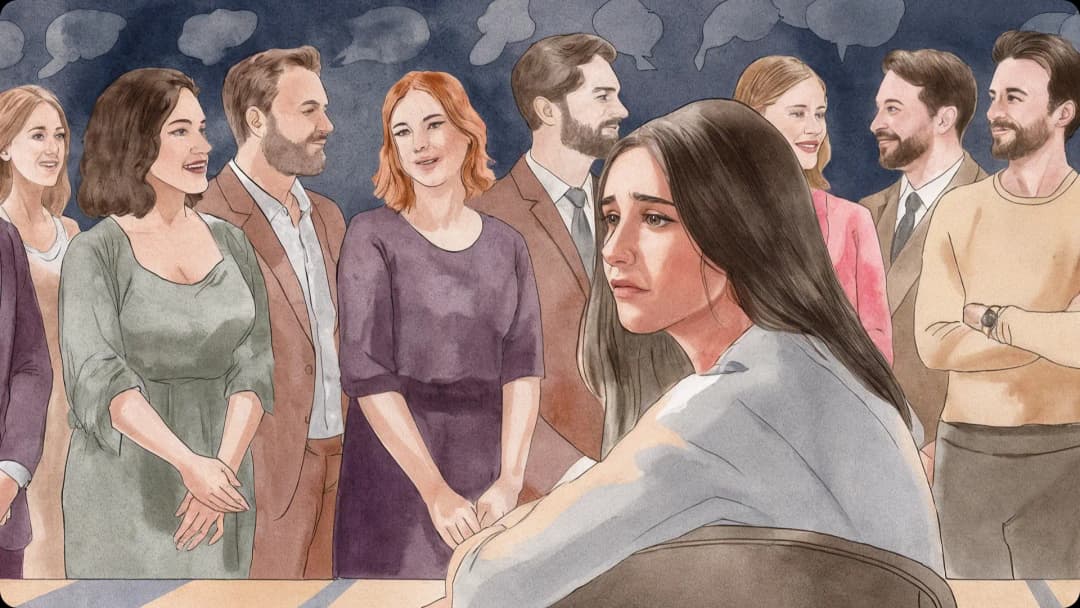
Many people may experience loneliness at different points in their lives. While occasionally it is completely normal, persistently feeling isolated can influence your mental health and overall quality of life.
In 2023, the World Health Organization declared that loneliness is a threat to global health, while the U.S. Surgeon General Vivek Murthy called it an “epidemic.” In this article, we’ll explore ways to reduce feelings of loneliness and share tips for connecting with others to build strong bonds.

What loneliness actually is
Loneliness is a painful feeling of emptiness that stems from a perceived gap between social connections you want and have. This is why people may feel lonely at different points. While some may need to see their friends and family every day to feel connected, others might be completely fine if they talk to their long-distance friend once a week.
Feelings of loneliness vs. being alone: why solitude and loneliness aren’t the same
Being alone isn’t equal to feeling lonely. Probably, most of us don’t spend all of our time with other people. We can wake up, work, or even travel alone without feeling lonely. As loneliness stems from our perception, it’s highly subjective.
The 3 types of loneliness
Can you feel lonely while other people are around? Apparently, yes. Researchers have identified the three types of loneliness, and they aren’t only about solitude.
| Type | What it feels like | Example |
| Emotional loneliness | You’re missing a deep, meaningful connection with someone you can trust. | “I have people around me, but I don’t have anyone I can truly talk to.” |
| Social loneliness | You don’t feel like you have a community of people you really belong to. | “I know people, but I don’t have anyone I’d actually call a friend.” |
| Existential loneliness | You feel deeply disconnected from other people, life, or your sense of meaning and purpose. | “Even when someone understands me, I still feel like I’m completely alone in this world.” |

Why do I feel so lonely? Common causes explained
There are plenty of reasons why you might feel disconnected from other people and life in general. Let’s explore the main ones.
Situational loneliness
Relationship and life changes can trigger feelings of loneliness. When you experience a significant life transition, you may need more support or notice that you stop talking to some people from the past, which can feel overwhelming.
Among the most possible changes are:
In this case, loneliness is typically temporary and may go away when you adjust to new circumstances. However, sometimes you may need to find new friends to feel better.
Chronic loneliness: Why am I so lonely all the time?
Chronic loneliness typically doesn’t go away as you join other social groups, like a running club or a new workplace. You may have plenty of opportunities to meet people and still feel disconnected. You may have many people to go to the bar with, but no one to share your worries.
In our individualistic society, where “low-effort relationships” are increasingly common, this can lead to feelings of isolation. If so, focus on quality instead of quantity. You may need to build genuine friendships with a few people rather than have dozens of friendly acquaintances.
Feeling lonely even when you’re surrounded by people
Existential loneliness can feel like you’re alone even in a group full of people. You may be talking, laughing, and spending time with others, yet still feel like no one truly sees or understands you.
If you experience this often, it may be connected to mental health challenges such as unresolved childhood experiences, low self-esteem, social anxiety, and depression. You may also feel socially isolated if you’re trying to fit in, pretending to be someone else, and hiding your real needs.

How to cope with loneliness: Practical, step-by-step tips
To combat loneliness, one way to target this is to work on your mindset and build social connections. Follow these steps.
Acknowledge and name the feeling instead of pushing it away
You might pretend like everything is fine while feeling empty, anxious, or depressed, or experiencing mood fluctuations. Instead, it’s better to acknowledge, “Yes, I feel lonely and want to change it,” and then start working on it.
Pay attention to negative self-talk, too. If you think, “No one wants to be around me,” “I have no one,” or “Everyone already has their own people,” pause and question whether these thoughts are facts or assumptions. Try replacing them with something more realistic, such as “I feel disconnected right now, but that doesn’t mean nobody cares about me.”
Reach out in low-pressure ways
If you really experience social isolation, it may be helpful to initiate contact. Here are some tips on how to do it in low-pressure ways (no, you won’t look clingy):
Just note a few things. First, don’t take it personally if someone doesn’t reply. People may be busy, exhausted, or have some challenges to deal with. No reply doesn’t make you a bad person.
Second, don’t wait for a perfect moment. The longer you wait, the easier it is to overthink what to say or to convince yourself not to reach out. A simple “Want to hang out sometime?” can be enough.
Build a small routine that creates natural social contact
You can meet a cool person in a coffee shop near your house, in a zumba class, at a coworking space, etc. The essence is to start attending places where you can meet new people and naturally talk to them.
You can try a new hobby without the pressure to “make friends” right away. Also, choose activities you enjoy, so you have something to talk about and a reason to keep coming back. The important part is consistency. Seeing the same people regularly makes it much easier to become familiar with each other.
What to do when reaching out doesn’t work
It might be necessary to change a strategy. If your colleagues don’t seem pretty talkative, you can try looking for people online. There are some apps where you can find someone to have breakfast with, go to a local event, or go somewhere.
You can also start chatting with people in comments. For instance, in the Breeze app, there are mental health-related posts where you can discuss different topics, share your experiences, and connect with people who may be going through something similar.
How to build new connections when you don’t know where to start
Small, consistent actions might help you overcome loneliness more effectively than trying to get into a few social circles at once. Here’s how to reach out to people most effectively.
Where to meet people as an adult
Think about where you can find like-minded people who share similar feelings and values about the things that are important to you. To reduce feelings of loneliness, you can choose something meaningful, like volunteering, or something simple, like joining a fitness class.
Save some ideas:
How to get past the awkward first meetup
You probably know this feeling: you meet someone for the first time, know almost nothing about each other, and suddenly have no idea what to say. The good news is that the first meeting doesn’t have to be perfect. You can make it easier with these simple tricks:
- Ask simple questions. For example, “How did you hear about this class?” or “Have you been here before?”
- Talk about things you have in common. If you’re at a pottery class, discuss the class. If you’re at a concert, ask what they think of the music.
- Say something about yourself. Don’t turn the conversation into an interview. If you ask where they work, you can also briefly mention what you do.
- Don’t panic if there’s silence. You don’t need to fill every second with conversation.
- If it’s easier for you, keep the first meeting short. Picking an activity that doesn’t require a lot of time can reduce the pressure to maintain the conversation.
- Plan your next step in advance. If you get along well, say, “It was a pleasure talking. Would you like to get coffee sometime?”
- Remember that the other person might be nervous too. This can help put your nerves at ease.
The first conversation shouldn’t necessarily be perfect. Instead, its aim is for you to discover whether you get along with the person and are interested in spending more time together.
How to build long-term connections
Most people may feel awkward while trying to build new friendships. Don’t make it forced, but stay involved to give the connection a chance to grow naturally.
Getting comfortable in your own company
Maybe you have many friends and trusting family members but still feel lonely if you need to spend some time on your own. In this case, you might need to learn to be in your own company. Here’s how to become your own best friend.
Small ways to enjoy solitude instead of dreading it
You might simply feel bored on your own. Work and routine errands can fill most of your day, so when you finally have some free time, being alone may feel uncomfortable rather than relaxing.
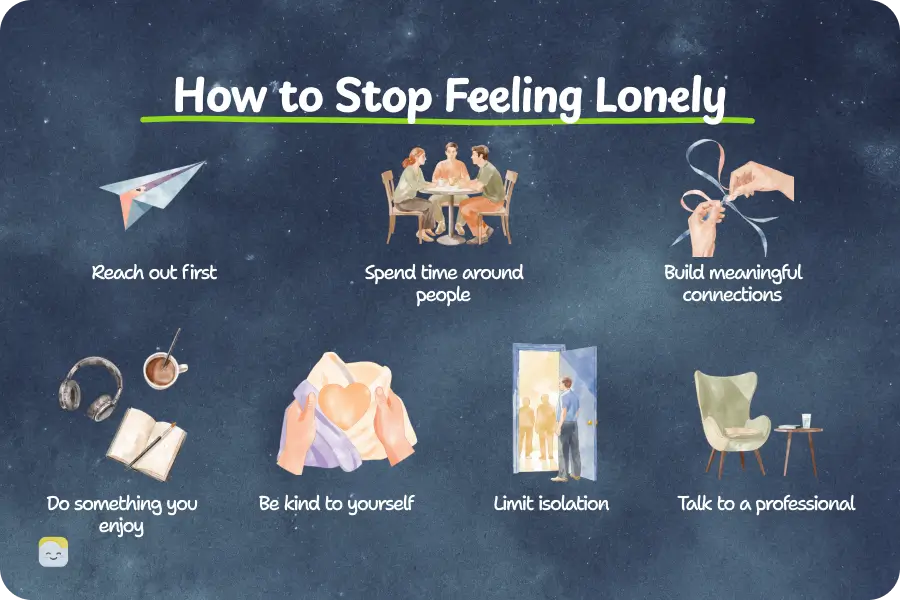
Try to change how you spend your free time and learn to romanticize life. You can engage in hobbies that lift your mood. If you’ve always dreamt about playing the guitar, maybe it’s worth starting to learn.
Other simple activities that can lift your mood may involve listening to music, drawing for your pleasure, going for a walk, trying a new recipe, reading a book in a cozy place, etc. The goal is to do things you enjoy to make time alone feel like a pleasure.
Building self-esteem to feel less dependent on others’ approval
Studies prove that low self-esteem is associated with stronger feelings of loneliness, especially in adolescence and in young people. [2] Vanhalst J, Luyckx K, Scholte RH, Engels RC, Goossens L. “Low self-esteem as a risk factor for loneliness in adolescence: perceived – but not actual – social acceptance as an underlying mechanism.” J Abnorm Child Psychol. 2013 Due to poor self-image, people may find interacting in social situations more challenging. You might worry about being judged, compare yourself with others, or assume that people don’t really want you around.
To build more stable self-esteem, focus on small, manageable goals and reach them step by step. You may need to stop measuring your worth by other people’s reactions and start noticing your progress. Even small achievements can remind you that you’re worthy without constant validation.
“How to stop being alone and feeling unwanted if it seems like nothing helps? I don’t know what to begin with.” Hannah Schlueter, MA, LAC, answers, “Unpleasant emotions can commonly lead to thoughts of defeat and wanting to quit. Taking a step back and focusing on your own interests, hobbies, and passions can be helpful temporarily, as it builds your level of understanding of yourself and can make connections with others more accessible.”
Self-care habits that ease loneliness
Self-compassion can increase feelings of self-worth, help you overcome negative self-talk, add more meaning to your life, and manage feelings of loneliness.
Sleep, movement, and sunlight
Your feeling of loneliness may be a result of constant stress, the research proves. [3] Grocott B, Morstead T, Sin NL, DeLongis A, LeMoult J. “Reciprocal longitudinal associations of loneliness and perceived stress: A random intercept cross-lagged panel model.” Emotion. 2026 In turn, taking care of your physical health can lower cortisol levels, improve mood, and reduce the emotional intensity of loneliness.
Journaling and processing emotions instead of numbing them
Some people may feel lonely because they have too many emotions they don’t know how to express or process. Instead of dealing with what they feel inside, they might constantly seek company to avoid meeting their true selves.
Journaling can become a healthy way to release emotions and better understand what is happening inside you. Spend 5 minutes in the morning and 5 minutes in the evening noticing how you feel, what triggers your emotions, and what you want to change and why. Don’t try to find the right words; just let your feelings go.
Loneliness and social media: Friend or foe?
Social media can be a double-edged sword that either makes you feel lonelier or helps you get connected to others.
When social media helps
Online communities, niche forums, and group chats can help people with similar interests find each other and share their experiences. This can be especially useful if you have difficulty meeting like-minded people in your everyday life.
You can join a Facebook group, comment on thematic Reddit threads, or even create a blog, post something about yourself, and attract people interested in the same things.
When it makes loneliness worse
Constant comparison while watching Reels, checking other people’s photos, or seeing their seemingly perfect lives can make you feel like everyone is happier and more connected than you are. This can make your life seem boring or empty, even when that picture isn’t realistic.
Expert Insight
How you use social media can have a massive impact on your mental health. Using social media to connect with friends, find other like-minded individuals, or learn more about desired hobbies or interests is a great way to use social media to fuel connections. Boundaries around who you follow, how your interactions on social media make you feel, and when to pause the use of social media are a great start.

Hannah Schlueter
Mental health professional
Loneliness in different life stages and identities
At different stages of life, loneliness can manifest differently and stem from different factors. A person in their 20s may feel lonely because they’re trying to find their place in life, while someone later in life may miss the relationships and routines they once had.
Loneliness in your 20s and 30s vs. later in life
Being in your 20s and 30s can be surprisingly lonely. You may be surrounded by people at work, university, or social events, but you may still feel like you haven’t found “your people” and lack peer support. Friendships can also change as people move to new cities, start relationships, have children, or focus more on their careers.
Loneliness as a stay-at-home or single parent
Single parents may feel especially lonely, as they need to take care of their children and handle their own lives at the same time. As such, it can be more challenging to meet with friends, build social connections, or find time for self-care. You may spend hours with your child, but still miss having an adult conversation.
It’s also important to remember that loving your child and feeling lonely can exist at the same time. Needing adult connections doesn’t make you a bad parent.
Loneliness after retirement or becoming an empty nester
In older people, loneliness can be linked to the loss of loved ones, changes in health or mobility, retirement, or fewer opportunities for regular social interaction. When grown-up children leave home and go to college or move to another city, the house may suddenly feel much quieter.
This change can also leave you with more free time than usual, which may feel uncomfortable at first.
How loneliness affects your mental health and body
Persistent loneliness may negatively affect both the mental and physical health of a person. If you feel lonely for a long time, it can gradually affect how you think, sleep, behave, and respond to stress. You may notice that you become more irritable, tired, anxious, or emotionally drained.
As a result, it might lead to:
- Depression
- Low self-esteem
- Anxiety
- Sleep problems
- Emotional exhaustion
- Difficulty concentrating
- Loss of motivation
- Social withdrawal
When loneliness needs more support
Sometimes loneliness may highlight deeper feelings and mental health challenges. You might need professional help if you experience persistent loneliness:
How therapy can help
Talk therapy and clinical support can help you identify patterns that contribute to loneliness. A mental health professional will support you without judgment and help you understand what may be keeping you stuck in the cycle of isolation.
Together, you can work through self-esteem, social anxiety, fear of rejection, and difficulty trusting others. Sometimes, having someone who listens and helps you understand your feelings is an important step toward feeling less alone.
Frequently asked questions
Why do I feel so lonely even when I'm with people?
If you feel lonely around others, it may signal a lack of deep connections or someone to talk to about your worries. You can have plenty of social interactions and still feel emotionally disconnected if you don’t feel understood.
How to deal with loneliness as a woman?
There’s no gender-specific way to deal with loneliness. Start by identifying what you’re missing: emotional closeness, friendship, practical support, or simply more time around people. Then take small steps to meet that need.
How do I stop feeling alone and unwanted?
Start by separating the feeling from the fact. Feeling unwanted doesn’t necessarily mean that nobody wants you around. Talk to someone you trust, spend time with people who you feel comfortable with, and avoid isolating yourself when you’re already feeling low.
Is it normal to feel lonely all the time?
Feeling lonely occasionally is a normal part of life. However, constant loneliness shouldn’t be something you simply accept. If this persists despite your efforts to connect with others, consider seeking help from a mental health professional.
What's the fastest way to feel less lonely today?
Reach out to one person. Send a simple message, call a friend or family member, ask someone to meet for coffee, or join a group activity. If nobody is available, go to a café, class, park, or community event.
Sources
- van Tilburg TG. “Social, Emotional, and Existential Loneliness: A Test of the Multidimensional Concept.” Gerontologist. 2021
- Vanhalst J, Luyckx K, Scholte RH, Engels RC, Goossens L. “Low self-esteem as a risk factor for loneliness in adolescence: perceived – but not actual – social acceptance as an underlying mechanism.” J Abnorm Child Psychol. 2013
- Grocott B, Morstead T, Sin NL, DeLongis A, LeMoult J. “Reciprocal longitudinal associations of loneliness and perceived stress: A random intercept cross-lagged panel model.” Emotion. 2026
Disclaimer
This article is for general informative and self-discovery purposes only. It should not replace expert guidance from professionals.
Any action you take in response to the information in this article, whether directly or indirectly, is solely your responsibility and is done at your own risk. Breeze content team and its mental health experts disclaim any liability, loss, or risk, personal, professional, or otherwise, which may result from the use and/or application of any content.
Always consult your doctor or other certified health practitioner with any medical questions or concerns
Breeze articles exclusively cite trusted sources, such as academic research institutions and medical associations, including research and studies from PubMed, ResearchGate, or similar databases. Examine our subject-matter editors and editorial process to see how we verify facts and maintain the accuracy, reliability, and trustworthiness of our material.
Was this article helpful?