



The main reasons why people talk to themselves a lot, both silently and out loud, are:
- Active inner dialogue.
- Externalizing thoughts as a coping mechanism.
- Stress and emotional dysregulation.
- Habit.
- Loneliness.
- Protective strategy against lack of control.
- Certain mental health disorders.
Let’s look at these reasons for constant self-talk in detail and find out whether it is okay to talk to yourself and when it becomes concerning.

Why Do I Have Conversations With Myself? 7 Possible Reasons
In many cases, talking to yourself is how your mind makes sense of experiences. But the reasons for self-talk can vary, depending on how those inner conversations sound and what impact they have on you.
1. It’s a Normal Inner Dialogue
If you wonder, “Why do I talk to myself so much in my head?”, the most likely explanation for most people is that you’re experiencing inner speech.
Inner dialogue actually serves important cognitive functions:
- Working memory: Saying things out loud helps us remember them better through active involvement and dual action (speaking the words and hearing yourself at the same time).
- Rehearsal: Helps reduce uncertainty and build confidence.
- Self-motivation: Positive statements, such as “You’ve got this,” have been found to boost confidence and performance [1] The efficacy of psychological skills training for enhancing performance in sport: a review of reviews. S. Lange-Smith, J. Cabot, P. Coffee, K. Gunnell, D. Tod. International Journal of Sport and Exercise Psychology. January 2024. . That’s why professional athletes use self-talk for motivation.
- Self-regulation: Self-talk is used to calm anxiety because of psychological distancing (“Why am I freaking out?“) during emotionally tense moments.
- Problem-solving: Saying a problem aloud forces the brain to slow down and also suppress external noise.
- Task accompaniment: Self-talk helps to stay on the task, remember instructions/sequences, and prevent rushed mistakes and impulses.
- Self-awareness: Ongoing inner dialogue contributes to a coherent sense of self.
- Observation: By stating something you saw, you “fixate” it in your memory. In high-stakes environments, like driving in heavy rain, narrating what you see sharpens reaction time and focus.
2. You Externalize Your Thoughts
For some people, a thought becomes easier to work with once they can hear it.
Imagine trying to assemble furniture. You silently look at the instructions, and you’re… confused. But imagine you’re reading the instructions and saying, “Okay, this piece goes here first, then I turn it over…” Sounds easier, right? You just observed externalization.
If you talk to yourself as a way to externalize your thoughts, this might be how you cope with your emotions. Generally, externalization in the form of neutral/positive self-talk is considered a healthy coping mechanism.
By pronouncing something silently or aloud, you separate negative thoughts from your inner dialogue. They’re no longer part of you, but just something you said. This reduces intimidation and increases your control over the situation, like in the example with the furniture.
3. You’re Under Stress
Ever notice that you talk to yourself more when you have too much going on?
Stress places additional demands on attention and working memory. When your mind is already occupied with emotions, worries, and exhaustion, keeping another train of thought in your mind can feel beyond your control.
To facilitate this process and keep up with the mental fatigue, your brain recruits “extra” instruments, like your voice. Saying words out loud relieves the working memory, which has difficulty processing information that is only “inside the head.”

4. You Do It Out of Habit
The answer to “Why do I talk to myself so much when I’m alone?” can be as simple as you’ve gotten used to it. The habit of saying certain words out loud is in line with cracking your knuckles or sitting in the same place every time.
This habit can take root in early childhood. Around ages 4 to 6, children speak out loud with no shame. By talking to themselves, they direct and regulate themselves. With time, that aloud self-talk gradually transitions into a silent inner monologue [2] Inner Speech: Development, Cognitive Functions, Phenomenology, and Neurobiology. B. Alderson-Day and C. Fernyhough. Psychological Bulletin. May 2015. .
If your self-talk never fully goes silent, that is completely okay! It is especially common to mumble or speak out loud during moments of intense focus, cooking, driving, repetitive work, or emotionally charged moments.
5. You Feel Lonely
Is talking to yourself a sign of loneliness? Sometimes, it can be.
Research suggests that people who feel lonely do, in fact, talk to themselves more often than those with an active social life [3] Relation of self-talk frequency to loneliness, need to belong, and health in German adults. C. Reichl, J. F. Schneider, F. M. Spinath. Personality and Individual Differences. January 2013. .
When we’re with other people, we satisfy our primary needs to share experience and feel seen. When you spend a lot of time alone or have only shallow social connections, some of that self-talk may turn inward.
6. It’s a Protective Strategy
Talking to yourself can be both a helpful and not-so-healthy coping strategy.
Even if your inner or outer monologue is not so healthy, e.g., it’s harsh or negative, it subconsciously tries to protect you. Negative self-talk works as a preemptive strike: “If I punish myself before anyone else, I stay in control.”
Unfortunately, self-criticism, as a type of self-talk, only creates an illusion of control. Instead, it becomes another source of distress.
Calling yourself stupid after every mistake doesn’t prevent future mistakes; it may only increase shame and anxiety about making them in the future.
Of course, positive self-talk might also be a protective strategy. Rehearsing an intimidating conversation before having it, repeating instructions when you’re anxious, or acting out a situation to understand how you feel. Those are neutral, harmless ways of coping that don’t require fixing.
“Self- control is a mechanism that is reinforced by internal AND external input.
We can talk ourselves into and out of most everything, and without the input of others or outside dialogues, our inner dialogue can become jaded and lack the moral needed for self-control in times of high stress.
We maintain the motivation for self-control internally, however reinforcement from outside resources aids in the foundation for the motivation.”
7. Certain Mental Health Conditions Can Lead to Self-Talk
Talking to yourself out loud has a negative reputation. It’s associated with mental instability and “weirdness.” But in reality, even vocal self-talk, by itself, doesn’t point to any mental health disorders.
That said, some mental health conditions can, however, change the frequency and intensity of a person’s thoughts, hence, self-talk.
Can talking to yourself be a sign of depression? Yes, in some cases of depression, a person’s inner dialogue can be extremely distorted and negative. To cope with such cognitive load, the brain may urge people with depression to vocalize their thoughts out loud as a way to regulate emotions.
Is It Normal to Talk to Yourself?
Yes, it is normal to talk to yourself. Whether you have whole-staged conversations inside your head or when you say separate words aloud accidentally, it is a normal way to organize information and cope with feelings.
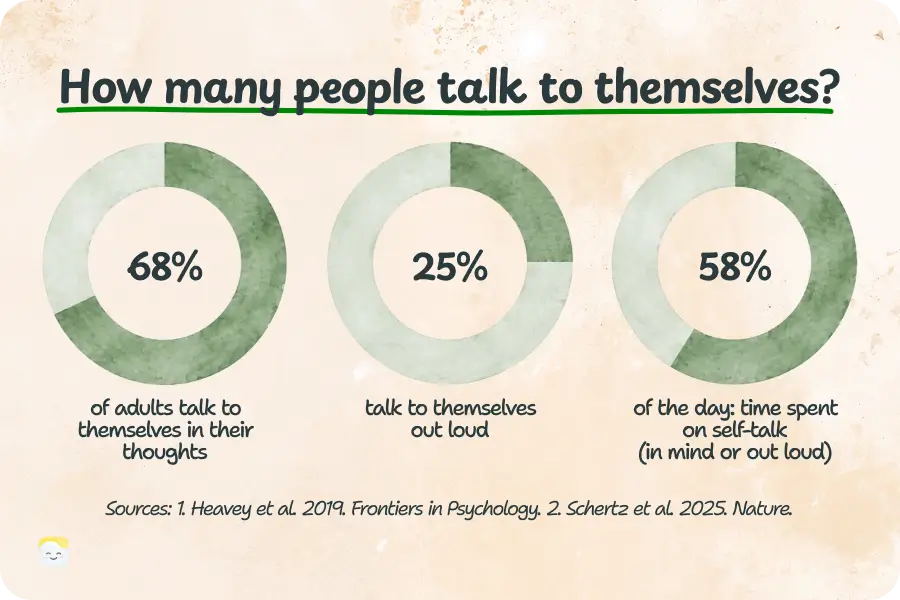
In fact, 68% engage in self-talk daily [5] Measuring the Frequency of Inner-Experience Characteristics by Self-Report: The Nevada Inner Experience Questionnaire. C. L. Heavey, S. A. Moynihan, V. P. Brouwers, L. Lapping-Carr, A. E. Krumm, J. M. Kelsey, D. K. Turner, R. T. Hurlburt. Frontiers in Psychology. January 2016. . Here are the most common examples of neutral/healthy self-talk:
- Gesturing/acting up the situation you think about.
- Slipping out a few words out loud during intense focus.
- Cracking up at your own jokes out loud.
- Playing out difficult situations that might happen in the future.
- Getting angry/swearing out loud.
- Pretending to be interviewed and answering questions about your life.
Okay, It’s Normal, But Is It Healthy to Talk to Yourself?
The general consensus is yes, self-talk is a healthy and adaptive coping mechanism. Verbal planning is a tool that can aid in executive functioning for those who struggle with it.
However, the usefulness of conversations with yourself depends on what you say, how you say it, and the context. When self-talk is rather neutral or encouraging, it can have the following benefits [6] Effects of a 4-week combined breathing control and self-talk intervention on neural activity and coping skills in athletes: a randomized control trial. K. Tharawadeepimuk, E. Onnom, A. Nanbancha. BMC Psychology. June 2026. :
Positive Self-Talk vs. Negative Self-Talk vs. Clinical Hallucinations
We already understood that self-talk is almost always healthy. But how does it look in cases when it’s not “normal”? Here’s a simple way to understand the differences:
| Positive/neutral self-talk | Negative self-talk | Clinical hallucinations |
| You recognize the words as your own thoughts. | You recognize the thoughts as your own, even when you wish they would stop. | Voices may feel as though they are coming from somewhere external. |
| You have control over it: you can stop, redirect, or change the stream of consciousness. | Thoughts may be repetitive and difficult to redirect, but it’s possible. | You have little control over when the voices appear or what they say. |
| Usually involves planning, problem-solving, encouragement, rehearsal, narrating tasks, etc. | Often involves criticism, catastrophizing, guilt, shame, or repeatedly revisiting mistakes. | Voices may comment on you, say unusual things, give commands, and even threaten you. |
| Has a neutral or positive effect on your mood and functioning. | Can increase anxiety, lower your mood, and impact self-worth, particularly when it becomes persistent. | Causes severe distress or significantly interferes with everyday life. |
The question, “Is it bad to talk to yourself?” can usually be answered with a simple “no.” However, if you notice signs of harsh self-talk or auditory hallucinations, such self-talk can have a negative impact on your quality of life and health.
“No, we all have dialogue with ourselves to a certain extent. Our internal narrator rarely rests!
For times of emotional distress or dysregulation, it can be helpful to verbalize feelings and thoughts to aid in remaining grounded through a tough time. Verbal planning can help us remember tasks we set out to do.
However, if the ‘talk’ is largely negative, demeaning, or very distracting then it may be helpful to seek support in finding other methods of regulating emotions or difficult thoughts.”
Should You Stop Talking to Yourself?
No, it’s not required for you to stop talking to yourself unless you experience the harmful inner speech, such as:
- You speak to yourself negatively chronically.
- You’re unable to stop ruminating on painful thoughts.
- Self-talk leads you to have low self-esteem, anxiety, helplessness, and other mental health challenges.
- The inner speech feels external, like it’s separate from your usual thoughts and identity.
- The inner conversations suddenly change, becoming much more frequent or intense.
- You cannot distinguish inner dialogue from reality.
- Feel that your quality of life declines because of inner dialogue.
- Your self-talk gives you commands to hurt yourself or somebody else.
Don’t experience these symptoms? Then, in order to know whether you should stop talking to yourself, ask yourself this: Does talking to myself actually bother me, or am I worried that other people will think it’s strange?
If it’s mainly embarrassment, remember that there is nothing wrong with talking to yourself out loud. This is a harmless mental habit with tons of positive aspects. Consider whether you actually want to give up something that can be so resourceful for your nervous system.
It’s okay to still decide to stop or reduce self-talk. There are many situations in which you’d want to minimize talking to yourself, like when you’re in a library or in school classes. The main thing is to do it ecologically and with self-compassion.
Frequently asked questions
How Many People Talk to Themselves?
68% of adults talk to themselves in their thoughts, according to the research. A quarter of all people talk to themselves out loud, as in not occasional slip-ups, but having full-on conversations with themselves [5] Measuring the Frequency of Inner-Experience Characteristics by Self-Report: The Nevada Inner Experience Questionnaire. C. L. Heavey, S. A. Moynihan, V. P. Brouwers, L. Lapping-Carr, A. E. Krumm, J. M. Kelsey, D. K. Turner, R. T. Hurlburt. Frontiers in Psychology. January 2016. . Self-talk is extremely common, proving itself as a normal part of human consciousness.
Why Do Older People Talk to Themselves?
Older adults talk to themselves for the same reasons that young people do. However, as they age, they may rely more on self-talk as a tool to compensate for declining memory. Another reason why older adults can talk to themselves is social isolation. Research has shown that people who feel lonely talk to themselves more often [3] Relation of self-talk frequency to loneliness, need to belong, and health in German adults. C. Reichl, J. F. Schneider, F. M. Spinath. Personality and Individual Differences. January 2013. .
Also, you may notice more older adults talking to themselves than young people because the former usually care less about what others think. Hence, they don’t hide their private speech in public.
Are People Who Talk to Themselves “Crazy”?
No. Talking to yourself doesn’t, by itself, indicate a mental health disorder. Although conversations with yourself out loud are frowned upon, they’re usually an indicator of emotional regulation and that a person is coping with something. It can become more concerning when it causes significant distress, disrupts everyday functioning, or involves voices experienced as separate from yourself.
Sources
- The efficacy of psychological skills training for enhancing performance in sport: a review of reviews. S. Lange-Smith, J. Cabot, P. Coffee, K. Gunnell, D. Tod. International Journal of Sport and Exercise Psychology. January 2024.
- Inner Speech: Development, Cognitive Functions, Phenomenology, and Neurobiology. B. Alderson-Day and C. Fernyhough. Psychological Bulletin. May 2015.
- Relation of self-talk frequency to loneliness, need to belong, and health in German adults. C. Reichl, J. F. Schneider, F. M. Spinath. Personality and Individual Differences. January 2013.
- Prevalence and classification of hallucinations in multiple sensory modalities in schizophrenia spectrum disorders. A. Lim, H. W. Hoek, M. L. Deen, J. D. Blom. Schizophrenia Research. October 2016.
- Measuring the Frequency of Inner-Experience Characteristics by Self-Report: The Nevada Inner Experience Questionnaire. C. L. Heavey, S. A. Moynihan, V. P. Brouwers, L. Lapping-Carr, A. E. Krumm, J. M. Kelsey, D. K. Turner, R. T. Hurlburt. Frontiers in Psychology. January 2016.
- Effects of a 4-week combined breathing control and self-talk intervention on neural activity and coping skills in athletes: a randomized control trial. K. Tharawadeepimuk, E. Onnom, A. Nanbancha. BMC Psychology. June 2026.
Disclaimer
This article is for general informative and self-discovery purposes only. It should not replace expert guidance from professionals.
Any action you take in response to the information in this article, whether directly or indirectly, is solely your responsibility and is done at your own risk. Breeze content team and its mental health experts disclaim any liability, loss, or risk, personal, professional, or otherwise, which may result from the use and/or application of any content.
Always consult your doctor or other certified health practitioner with any medical questions or concerns
Breeze articles exclusively cite trusted sources, such as academic research institutions and medical associations, including research and studies from PubMed, ResearchGate, or similar databases. Examine our subject-matter editors and editorial process to see how we verify facts and maintain the accuracy, reliability, and trustworthiness of our material.
Was this article helpful?