



A parent doesn’t have to be physically absent to make a child feel alone. Lack of support and minimal involvement can quietly shape a child’s behavior, confidence, and emotional well-being.
In this article, you’ll learn the common signs of uninvolved parenting, its long-term effects on children, and real-life examples.
Wondering whether you might unintentionally repeat the same patterns as your parents? Take a childhood trauma test to understand how your own experiences may still influence your emotional stability and parenting style.

4 Signs & Examples of Uninvolved Parenting
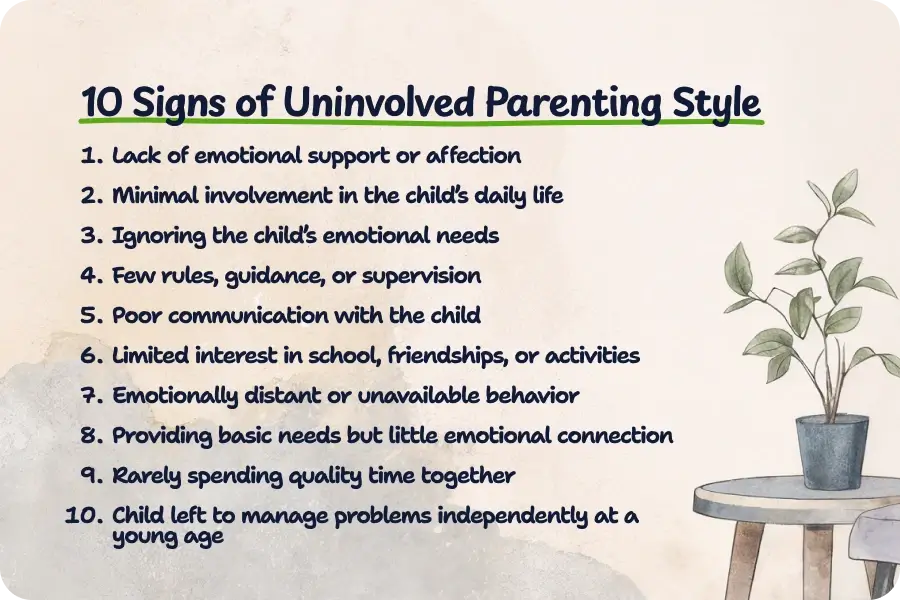
Here are some common signs and examples of uninvolved parenting:
1. They show little interest in their child’s feelings and avoid meaningful conversations
Communication in an uninvolved family is usually limited to basic instructions or necessities rather than emotional connection. Uninvolved parents spend little quality time together with a child and rarely ask them about friendships, emotions, hobbies, or personal struggles.
When a child seeks comfort or attention, they may appear uninterested, distracted, or cold. For example, if a child comes home upset after a bad day at school, the parent ignores the situation or changes the subject.
2. They don’t pay much attention to school or activities
Uninvolved parents may show little involvement in their child’s education or interests. They may skip school meetings, forget important events, or never ask about grades or homework. When a child shares an achievement, the parent may barely react or show no interest.
Expert Insight
While uninvolved parenting has significant impacts on a child’s social, emotional, and developmental needs, legal and judicial systems may not define the situation as neglect unless basic needs are not being met (food, water, shelter, etc.). That being said, uninvolved parenting often neglects important relational and attachment-based needs.

Hannah Schlueter
Mental health professional
3. They expect children to become independent too early
Children of uninvolved parents can be left to figure things out on their own without support or boundaries. They may stay out late regularly without any rules, check-ins, or concern from the parents.
Moreover, kids raised with a neglectful parenting style may be forced to handle responsibilities beyond their age because parental support is missing. For example, a young child can be expected to care for siblings, prepare meals, or manage emotional struggles alone.
4. They prioritize their own problems over parenting
Personal stress, relationships, work, financial struggles, or substance abuse may consistently come before the child’s needs. The uninvolved parent can be so focused on personal issues that they regularly neglect family responsibilities.
7 Effects of Neglectful Parents on a Child’s Development & Mental Health
Growing up in a home where a parent neglects a child’s emotional needs can affect nearly every aspect of their social life and psychological development.
1. Low Self-Esteem
Children who receive little validation or encouragement may grow up believing their thoughts, emotions, or achievements don’t matter. This can lead to poor self-confidence, persistent self-doubt, and feelings of worthlessness.
2. Difficulty Forming Healthy Relationships
Because emotional connection is limited at home, children of uninvolved parents may struggle with intimacy, trust, social skills, and emotional vulnerability in friendships and romantic relationships later in life.
As adults, they may become emotionally unavailable partners and suppress their feelings, or pull away when relationships become too close.
3. Poor Emotional Regulation
Without parental guidance and emotional support, children of uninvolved parents may lack emotional intelligence and have trouble understanding, expressing, or managing their emotions in healthy ways.
4. Academic and Behavioral Problems
Lack of supervision and involvement may affect academic performance, motivation, discipline, and social behavior. Some children become withdrawn from social life, while others may act out to seek attention or cope with emotional pain.
Try the personality type test to recognize how your behavior patterns and decision-making can influence your child.

5. Fear of Rejection
Children raised by emotionally unavailable parents may develop deep fears of being abandoned, ignored, rejected, or unloved in future relationships. As adults, they may struggle with insecurity, people-pleasing, emotional dependence, or difficulty setting healthy boundaries, attracting narcissistic partners.
Some may also repeatedly find themselves in one-sided relationships or the “friend zone” because they fear expressing their true feelings or worry that emotional vulnerability will lead to rejection.
6. Early Independence and Emotional Detachment
Many children of neglectful parents learn to rely only on themselves at a very young age. While this can create hyper-independence, it may also lead to adult child syndrome.
Expert Insight
Parents can model healthy examples of independence while still being present and emotionally attuned to their child. Parents can also foster healthy levels of independence in their children by letting them try new things and build age-appropriate responsibilities, while also talking to their child about their day and the emotional experiences they have.
Hannah Schlueter
Mental health professional
7. Long-Term Effects on Mental Health
The effects of uninvolved parenting can continue into adulthood, influencing self-worth, attachment styles, stress responses, and overall emotional well-being, research shows [3] McWhirter AC, McIntyre LL, Kosty DB, Stormshak E. Parenting Styles, Family Characteristics, and Teacher-Reported Behavioral Outcomes in Kindergarten. February 2023 . In some cases, unresolved childhood neglect may contribute to trauma-related symptoms like chronic stress, sadness, anxiety disorders, and depression.
What Is Neglectful (Or Uninvolved) Parenting Style?
Uninvolved or neglectful parenting is a parenting style in which parents provide little emotional support, guidance, or attention in a child’s life.
Uninvolved parents may meet a child’s basic needs, such as food and shelter, but are often detached from their child’s emotional, social, and developmental needs. Communication, affection, supervision, and encouragement are usually limited or absent entirely, which can leave children feeling ignored, unsupported, or emotionally disconnected, research shows [1] Ariana Awiszus, Melissa Koenig, Julie Vaisarova. Parenting Styles and Their Effect on Child Development and Outcome. August 2022. .
Uninvolved vs. Other Parenting Styles
Compared to authoritarian parents who enforce rules, uninvolved parents are often detached and cold. Those with a permissive parenting style may be lenient but still emotionally responsive, while neglectful parents tend to provide neither clear boundaries nor emotional connection.
Unlike an authoritative parenting style, which combines warmth and guidance and is considered the most effective, neglectful parenting involves little emotional support or supervision [2] Lavrič M, Naterer A. The power of authoritative parenting: A cross-national study of effects of exposure to different parenting styles on life satisfaction. September 2020 .
6 Strategies to Improve Your Parenting Skills
Parents can improve through self-awareness, parenting education, seeking help from a mental health professional, and consistent effort to become more emotionally available. Let’s find out how involved parents show emotional presence.
1. Spend Quality Time Together
Set aside regular time to talk, play, or participate in activities your child enjoys to help them feel supported. Quality time does not always have to involve expensive trips or elaborate activities. What matters most is being emotionally present and engaged.
2. Practice Active Listening
Encourage open and honest conversations without judgment. Let your child feel comfortable sharing thoughts, fears, and emotions. Give them your unconditional love and full attention when they speak. Validate their feelings instead of dismissing or criticizing them.
For example, if a child is upset about a friendship issue, a dismissive response such as saying “Don’t cry” or “It’s not a big deal” might shut them down. In contrast, a supportive response could be: “That sounds really painful. I’m glad you told me, let’s talk about what happened.” or “I can see that you’re really upset about this. Do you want to talk more about it?”
3. Show More Emotional Warmth
Simple acts like praise, encouragement, affection, and reassurance help children feel valued and build healthy self-esteem.
4. Create Healthy Rules and Boundaries
Discipline helps children understand expectations and develop responsibility. When parents provide clear limits while remaining supportive and respectful, children are more likely to feel protected rather than controlled. They benefit most when parents explain rules calmly, listen to their child’s perspective, and apply consequences fairly and consistently.
You may start by creating consistent routines for homework, chores, and responsibilities. Set regular bedtime and screen time limits. Help children understand why certain boundaries exist and be consistent with rules instead of constantly changing them or not setting them at all.
5. Become More Emotionally Aware
Becoming emotionally aware does not mean being a perfect parent. It means learning to pause, reflect, and respond more intentionally instead of reacting automatically.
The way you were spoken to, supported, disciplined, or emotionally cared for as a child can strongly influence how you respond to your own children today.
For example, some parents may become emotionally distant during stress because that is how emotions were handled in their own childhood. Others may react with anger, criticism, avoidance, or silence, unaware of how deeply these responses can affect a child’s emotional security.
Journaling can also help you better understand your parenting style. Tools like the Breeze journaling encourage self-reflection through guided prompts, mood tracking, and emotional awareness exercises. Writing regularly about parenting stress, emotional triggers, relationship dynamics, or childhood experiences can help you recognize behavioral patterns and develop healthier emotional responses.
6. Work on Parental Education & Healing Your Own Childhood Wounds
As many parenting patterns come from personal childhood experiences, reflecting on your upbringing can help you avoid repeating harmful behaviors. Working with a clinical psychologist or licensed therapist can provide deeper insight into unresolved childhood experiences, emotional triggers, and attachment patterns.
Moreover, some parenting patterns can be shaped by a simple lack of knowledge about child development and emotional needs. In this case, parenting coaches and courses can also offer practical tools, communication strategies, and guidance for building stronger relationships and more supportive parenting habits.
Frequently asked questions
1. What is uninvolved parenting?
Uninvolved parenting, also called neglectful parenting, is a parenting style where parents show supervisory neglect and provide little emotional warmth, involvement, or communication.
2. What are the signs of uninvolved parenting?
Common signs include minimal communication, little interest in their own children’s activities, poor supervision, and limited affection or encouragement.
3. How does neglectful parenting affect children?
Children raised with uninvolved parenting may learn to become highly independent at an early age because they cannot rely on consistent support from their parents. However, this parenting style is also linked to emotional, behavioral, and academic challenges, including low self-esteem, difficulty forming healthy relationships, poor emotional regulation, anxiety, and trust issues. In more severe cases, uninvolved parenting can lead to mental health struggles in a child.
4. Can uninvolved parents change?
Yes. Parents can improve through self-awareness, parenting education, counseling, and consistent effort to become more emotionally present and supportive.
Sources
- Ariana Awiszus, Melissa Koenig, Julie Vaisarova. Parenting Styles and Their Effect on Child Development and Outcome. August 2022.
- Lavrič M, Naterer A. The power of authoritative parenting: A cross-national study of effects of exposure to different parenting styles on life satisfaction. September 2020
- McWhirter AC, McIntyre LL, Kosty DB, Stormshak E. Parenting Styles, Family Characteristics, and Teacher-Reported Behavioral Outcomes in Kindergarten. February 2023
Disclaimer
This article is for general informative and self-discovery purposes only. It should not replace expert guidance from professionals.
Any action you take in response to the information in this article, whether directly or indirectly, is solely your responsibility and is done at your own risk. Breeze content team and its mental health experts disclaim any liability, loss, or risk, personal, professional, or otherwise, which may result from the use and/or application of any content.
Always consult your doctor or other certified health practitioner with any medical questions or concerns
Breeze articles exclusively cite trusted sources, such as academic research institutions and medical associations, including research and studies from PubMed, ResearchGate, or similar databases. Examine our subject-matter editors and editorial process to see how we verify facts and maintain the accuracy, reliability, and trustworthiness of our material.
Was this article helpful?