



Podcast name
Modern Parenting
You’re doing the school and soccer practice runs, packing lunches, remembering birthdays, trying to limit screen time, and still—there’s this quiet thought in the background: Am I doing enough?
This article looks at why so many parents feel that modern parenting is out of control and what actually helps reduce mental load and improve your well-being.

4 Reasons You Don’t Feel Like a Good Parent
This sense of failing as a parent is rarely about personal failure. It often speaks more about the environment in which parenting now exists, which is more demanding than ever before.
1. Intensive parenting
One of the biggest changes in modern parenting is the rise of intensive parenting—the belief that parents should be highly involved in nearly every aspect of their children’s lives. Childhood has shifted from something children simply experience into something parents actively manage, monitor, and optimize. In many ways, parenting today can feel more like project management or a quest for perfect attachment rather than intentional caregiving.
At the same time, this increased involvement can come at a cost. When parenting becomes a constant responsibility rather than just a relationship, many parents feel exhausted, guilty, or worried that they are not doing enough.
Ironically, research suggests that although parents today may spend more time with their children and be more involved than ever before, many report enjoying parenting less because of the stress and expectations attached to it [1] Irina Shapovalenko. Modern parenthood: new research approaches. January 2022 .
2. Gentle parenting
Gentle parenting has become one of the most influential parenting approaches in recent years. This framework encourages parents to respond with empathy, validate emotions, and guide behavior through connection rather than punishment. While many families find these principles helpful, the approach can also create unexpected pressure.
Many parents feel they should remain calm, patient, and emotionally available at all times. When they lose their temper, feel overwhelmed, or simply need a break, they may interpret these normal human reactions as signs that there’s something wrong with them.
The reality is that gentle parenting does not require perfection. Children need caregivers who are generally responsive, willing to repair mistakes, and able to model healthy ways of handling emotions. In fact, showing children how to apologize, reconnect after conflict, and cope with difficult feelings can be just as valuable as staying calm in the first place.
Ready to assess your emotional intelligence? Take our Emotional Intelligence Test and discover how you can improve your emotional awareness and build stronger, more compassionate connections!

3. The rise of productivity culture
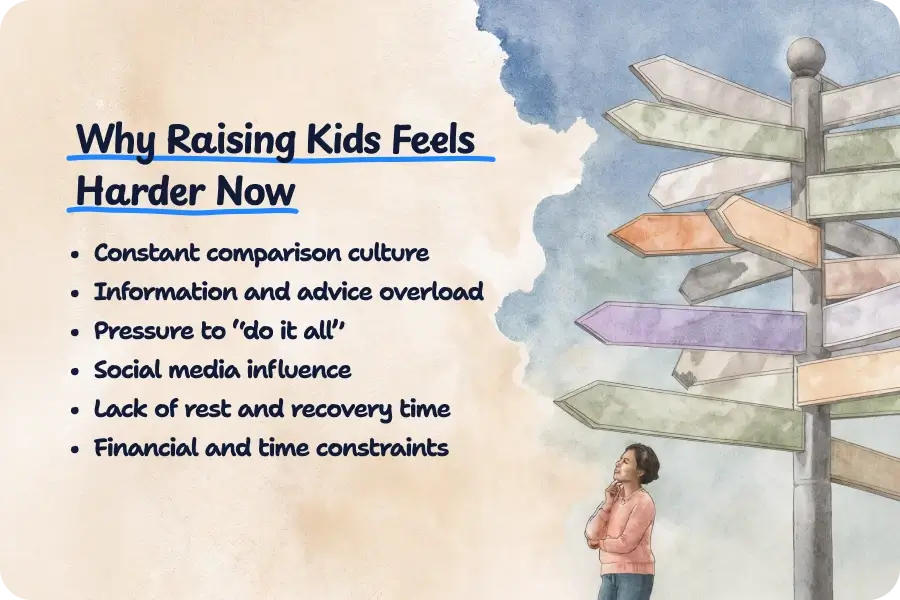
Today’s parents are surrounded by messages about self-improvement and constant growth. These ideas, originally aimed at careers and personal success, have gradually entered parenting. As a result, many parents feel responsible not only for caring for their children but also for optimizing their development, education, talents, and future opportunities.
At the same time, educational competition starts earlier than ever. Concerns about school readiness, extracurricular activities, language learning, and academic achievement often begin long before children enter formal education.
4. Constant comparison
There is always another child reading earlier, speaking better, eating cleaner, or achieving more. The comparison begins automatically but often intensifies as children move through their developmental stages.
Modern parenting environments amplify this tendency because parenting is no longer observed primarily through family, neighbors, schools, and local communities. It is observed through a global, algorithm-driven feed. They compare themselves to thousands of parents online.
The problem is that comparison is rarely fair. You may compare:
- your everyday reality to someone else’s highlight reel,
- your child’s weakest areas to another child’s strongest areas,
- your private struggles to another family’s public image.
You may process these examples as if they belong to the same comparison group, even though they come from entirely different cultures, opportunities, resources, and life situations.
Expert Insight
The term ‘good parent’ is inherently subjective. In reality, children have varying needs, but some of the broad strokes of healthy caregiving include consistent attunement, warmth, meeting basic developmental and more complex emotional needs, and striving to offer a sense of safety throughout one’s development.

Nicole Arzt
Mental health professional
The Emotional Cost of Trying to Be the Perfect Parent
According to research by the Pew Research Center, parenting stress has reached unprecedented levels, and here’s why [3] Rachel Minkin and Juliana Menasce Horowitz. Parenting in America Today. January 2023 :
1. Guilt
Guilt becomes a default emotional state. Even when children are safe, healthy, and cared for, parents can feel like they’re not preparing kids properly for the future. The problem is that modern parenting has no clear finish line, so guilt has no natural endpoint either.
Looking for more self-discovery tests? In the Breeze app, you may find quizzes on your values, childhood trauma, attachment style, temperament, parenting style, and much more.

2. Chronic self-surveillance
Modern parents are expected to be simultaneously emotionally present, educationally strategic, nutritionally informed, digitally aware, and professionally successful. As a result, they constantly feel the pressure of permanent evaluation. Instead of acting intuitively, parents may second-guess themselves, mentally replaying interactions and comparing them to external standards.
3. Inability to relax
Relaxation becomes difficult because “doing nothing” feels like falling behind. Even downtime can trigger anxiety: Should I be doing something educational? Am I missing a critical window? Am I engaging well enough with my child? According to research, this creates a parental burnout where rest is physically possible but psychologically incomplete [4] Bogdán PM, Varga K, Tóth L, Gróf K, Pakai A. Parental Burnout: A Progressive Condition Potentially Compromising Family Well-Being-A Narrative Review. July 2025 .
3 Effects on Child Development
When parents feel pressure to “get everything right,” it also shapes how childhood is structured, experienced, and remembered.
1. Reduced independence
As parents become more focused on safety, outcomes, and optimization, they might give children fewer chances to explore the world on their own. Everyday autonomy, like walking alone, resolving small conflicts, and managing boredom, is replaced by supervision or parental input. As a result, this can limit the development of confidence in independent decision-making, creativity, and negotiation.
2. Anxiety and perfectionism
Children tend to be naturally very sensitive to their parents’ emotions. When parents are constantly anxious or worried, children often pick up on those feelings. Even without being told, they may start to see the world as stressful or as something they need to be careful about.
Moreover, when adults guide children toward their best performance and behavior, children may begin to believe that their value is tied to performance. This, in turn, can lead to perfectionistic thinking and fear of failure when mistakes are treated as problems to be avoided rather than natural parts of learning.
3. Overstructured childhoods
Many children today move through highly organized schedules filled with school and extracurricular activities. While structure can provide stability, it can reduce space for spontaneity, boredom, and self-initiated exploration, which are important for emotional and cognitive development.
6 Tips to Improve Parenting Today: Mental Health Strategies for Your Well-Being
Below are 6 evidence-informed practices that help parents reduce stress, improve confidence, and better deal with the difficulties of raising children.
1. Build Self-Awareness
Instead of self-criticism, practice self-awareness:
- Notice emotional triggers. Pay attention to situations that consistently make you feel guilty, frustrated, embarrassed, or exhausted.
- Pause and reflect. Ask, “Am I reacting to my child or to my stress?”
- Identify patterns. You may find that impatience increases when you are tired, overwhelmed, or worried about other responsibilities.
- Separate feelings from facts. Feeling like a bad parent does not mean you are one. Emotions provide information, but they are not always accurate reflections of reality.
- Practice self-compassion. Parenting is a long-term relationship, not a performance that must be flawless every day.
- Most importantly, normalize imperfection. Every parent loses patience, makes mistakes, or wishes they had handled a situation differently. What matters is not being perfect but being willing to learn, repair, and grow.
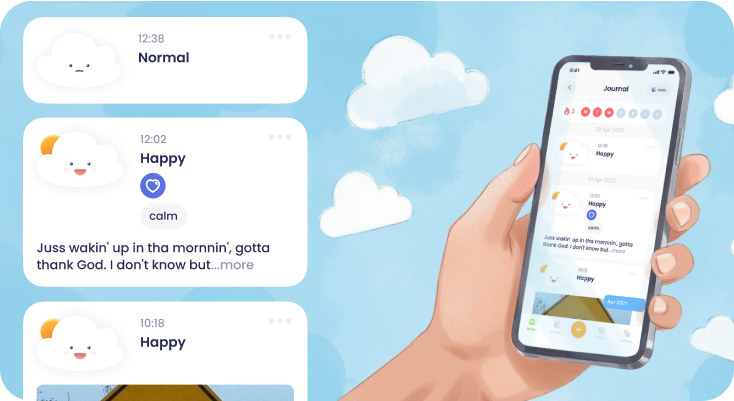
The Breeze app is ideal for monitoring your feelings and moods. It can help you better navigate the things and activities that make you feel bad by using statistics to identify patterns.
2. Set Boundaries That Protect Your Energy
Most parents may feel pressure to do everything, especially those balancing career and home life. Working mothers may try to do everything: succeed at their job, be fully present at home, volunteer at school, attend every activity, organize family events, and create memorable experiences for their children.
Eventually, this pressure can lead to exhaustion and resentment. When you constantly give without protecting your well-being, you may have less patience, attention, and emotional capacity for the moments that matter most.
Healthy boundaries include:
1. Limiting Overcommitment
It can be tempting to sign children up for multiple sports, clubs, lessons, and social activities. However, an overloaded schedule can leave both parents and children feeling stressed.
2. Say No Without Guilt
You may agree to requests because you fear disappointing others or appearing uninvolved. Yet saying yes to everything often means sacrificing time, rest, and peace of mind.
Here’s what you may try:
- Declining to host a birthday party when your schedule is already full.
- Telling a school committee that you cannot take on additional responsibilities this year.
- Saying no to another playdate when your family needs a quiet evening.
- Choosing not to attend every optional event or activity.
Expert Insight
The key is to commit to taking time yourself, even if the guilt is present. Guilt alone does not mean you are inherently doing something wrong. You may benefit from reminding yourself that children benefit from watching their caregivers appropriately tend to their own needs. This modeling can serve them well into their adult years.
Nicole Arzt
Mental health professional
3. Balance Independence Without Becoming a Helicopter Parent
Some parents become helicopter parents, constantly supervising every detail of their child’s life. Others swing too far in the opposite direction, giving too much freedom too early.
A balanced approach is free-range parenting, which teaches kids responsibility step by step. It is a style that encourages children to develop age-appropriate independence and confidence by allowing them more freedom to explore, make decisions, and learn from everyday experiences with less constant parental supervision.
4. Focus on Problem Solving, Not Perfection
Modern parenting may feel like solving endless problems: school stress, behavior issues, or conflicts with other children or friends. The problem-solving mindset reduces anxiety and helps parents feel more in control, even during difficult phases. Instead of asking “Am I doing this perfectly?” try:
- “What is the next small step to improve this situation?”
- “What does my child need right now emotionally?”
- “What can we adjust rather than fix completely?”
5. Choose Emotional Presence Over Material Perfection
Some families have more money, others have less time due to work demands. Working parents may feel pressure to “do it all.” But what matters most is how children feel within their everyday environment.
Even small rituals, such as sitting together for dinner, can be meaningful. A meal does not have to be homemade, organic, or perfectly balanced to create a connection. If a tired parent sits down with their child, talks, listens, and shares part of the evening together, that moment can contribute more to a child’s sense of belonging than a perfectly prepared meal eaten in a stressful atmosphere.
6. Support Your Child’s Growth Without Comparison
Questions such as “Should my child be reading already?” or “Will my child be successful enough to get into a good higher education institution?” can create constant pressure.
Instead of comparing your child to other kids, focus on helping them become the best version of themselves. Praise effort, persistence, and improvement instead of comparing grades. Ask, “What did you learn?” rather than “Were you the best?” and help children set personal goals instead of measuring themselves against classmates.
Frequently asked questions
1. Why do so many parents feel like they are failing today?
Constant access to social media, expert advice, academic expectations, and comparisons with families around the world can create unrealistic standards. As a result, even capable and caring parents may feel they are not doing enough.
2. Is parenting harder today than it was in the past?
Every generation faces different parenting challenges. However, modern parents often deal with unique pressures such as digital distractions, information overload, social media comparisons, demanding work schedules, and concerns about children’s future success. These factors can make parenting feel stressful and emotionally demanding.
3. How can I stop comparing my child to other children?
Focus on your child’s individual growth rather than comparing milestones, grades, or achievements. Instead of asking whether your child is ahead or behind others, ask whether they are learning, growing, and receiving the support they need.
4. What matters most for a child's well-being?
Children thrive when they feel safe, loved, supported, and understood. Everyday experiences such as conversations, shared meals, affection, encouragement, and emotional security often have a greater impact than expensive activities or perfect parenting practices.
5. How do I know if I am a good parent?
A good parent consistently tries to meet their child’s needs, provides care and guidance, and remains committed to learning and improving. If you regularly worry about your child’s well-being, support their growth, and strive to do your best, those are signs that you care deeply and are already doing many things right.
Sources
- Irina Shapovalenko. Modern parenthood: new research approaches. January 2022
- Jennifer Piscitello, Kelly Daly. The Modern Parenting Dilemma: Closing the Gap Between Science and Practice. February 2026
- Rachel Minkin and Juliana Menasce Horowitz. Parenting in America Today. January 2023
- Bogdán PM, Varga K, Tóth L, Gróf K, Pakai A. Parental Burnout: A Progressive Condition Potentially Compromising Family Well-Being-A Narrative Review. July 2025
Disclaimer
This article is for general informative and self-discovery purposes only. It should not replace expert guidance from professionals.
Any action you take in response to the information in this article, whether directly or indirectly, is solely your responsibility and is done at your own risk. Breeze content team and its mental health experts disclaim any liability, loss, or risk, personal, professional, or otherwise, which may result from the use and/or application of any content.
Always consult your doctor or other certified health practitioner with any medical questions or concerns
Breeze articles exclusively cite trusted sources, such as academic research institutions and medical associations, including research and studies from PubMed, ResearchGate, or similar databases. Examine our subject-matter editors and editorial process to see how we verify facts and maintain the accuracy, reliability, and trustworthiness of our material.
Was this article helpful?