



Does it bother you when your partner talks to someone else or when a friend spends time with someone new? Does someone else’s success make you question your own worth?
If you’ve ever asked yourself, “Why am I so jealous?” this article will help you understand your personal feelings, why jealousy happens, and find practical ways to stop feeling jealous.
Are your habits hurting the people you care about? Take the Toxic Traits Test to uncover jealousy and envy triggers and take the first step toward healthy relationships.

6 Common Reasons You’re Feeling Jealous
Excessive jealousy can appear in romantic relationships, friendships, family dynamics, and even at work. Sometimes it arrives quietly as a feeling of insecurity; other times it shows up as anxiety, anger, or fear of being replaced.
1. Past Experiences
If you’ve been cheated on, bullied, excluded, betrayed, or experienced relationships with emotionally unavailable people, you may expect disappointment. Even harmless situations can trigger jealousy because the brain interprets them as threats.
The following situations may feel like evidence that you’re about to lose your place, even when there is no real danger:
- Your partner talks to someone attractive.
- A friend spends time with other people.
- A coworker receives praise.
2. Low Self-Esteem
One of the biggest drivers of jealousy is self-doubt, research shows [1] Ayesha Farooq, Shazia Irfan. Relationship between Self-Esteem, Jealousy and Anger in Emerging Adults. December 2020 . When your self-worth depends on external validation, jealousy becomes more frequent.
If you believe you aren’t attractive enough, smart enough, or successful enough, it’s easier to assume someone else could replace you or outperform you. As a result, thoughts like “They’re better than me” or “Why would anyone choose me?” can make you feel jealous.
3. Your Attachment Style
Another common reason for jealousy is your attachment style, shaped by early life experiences and relationships with caregivers [2] Tom R. Kupfer, Morgan J. Sidari, Brendan P. Zietsch, Patrick Jern, Joshua M. Tybur, Laura W. Wesseldijk. Why are some people more jealous than others? Genetic and environmental factors. January 2022 . It can influence how safe, secure, or anxious you feel with romantic partners, friends, and family members.
People with an anxious attachment style are more likely to experience jealousy because they often fear abandonment. They may overanalyze text messages or worry when a partner spends time with others.
Those with an avoidant attachment style may not express jealousy openly, but they can still experience it internally. Instead of seeking reassurance, they may distance themselves emotionally or withdraw to protect themselves from potential hurt.

4. Constant Comparison
Do you feel like everyone else is happier, richer, more attractive, or in a better relationship than you? Social media has made comparison almost unavoidable and can make you feel worse about yourself, according to research on social comparisons [3] Samra A, Warburton WA, Collins AM. Social comparisons: A potential mechanism linking problematic social media use with depression. June 2022 . We see edited highlights of other people’s relationships, careers, vacations, and achievements as we compare them to our everyday reality.
Expert Insight
Frequently comparing yourself to others can be a harmful pattern to fall into because of how it results in assumptions about yourself and other people. It fails to take into account the struggles of other people (that we may not know are happening), creating a false narrative that everyone is doing “better” than you. Redirecting your focus to increasing your own happiness, success, and relationships highlights the amount of control you have over your life and what you want more of.

Hannah Schlueter
Mental health professional
5. Unmet Emotional Needs
Sometimes jealousy isn’t really about another person. When you feel neglected, unappreciated, or disconnected, even small situations can trigger jealousy because they highlight what you’re missing.
It may signal unmet needs, such as:
- Feeling ignored. Your partner spends more time on their phone than talking to you, and you become jealous when they seem excited to text someone else.
- Wanting more affection. Seeing another couple being affectionate makes you wish your own relationship had more warmth and closeness.
- Needing reassurance. Your friend or partner doesn’t compliment or check in with you as often as before, leaving you wondering if they still care.
- Craving appreciation. A coworker receives praise for their work while your efforts go unnoticed, making you feel overlooked.
- Feeling emotionally disconnected. Your best friend starts spending more time with other people, and instead of simply missing them, you feel jealous because you no longer feel as close.
6. A Need for Control
Do you feel anxious when you don’t know what your partner is doing? Or do you struggle when things don’t go as planned? For some jealous people, this feeling is closely tied to a need for control. When uncertainty feels uncomfortable, controlling behavior can seem like a way to reduce anxiety.
This doesn’t mean you’re intentionally controlling. This behavior can be driven by deeper fears, such as fear of abandonment or past experiences of betrayal. You may ask frequent questions or feel uneasy when you don’t know what’s happening, not because you want to be controlling but because your anxiety interprets lack of control as a threat to your safety.
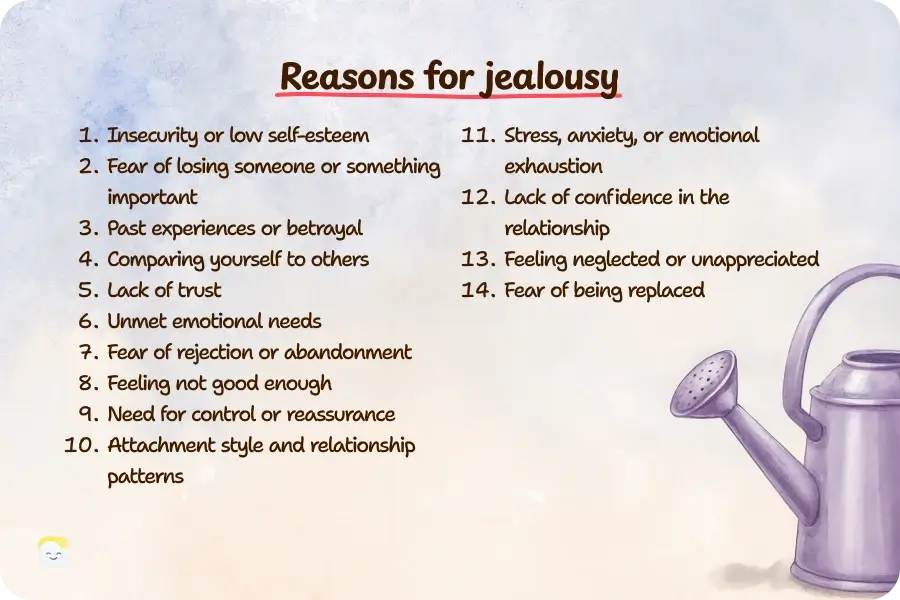
What Is Jealousy?
Jealousy is the emotional response to the perceived threat of losing something valuable, such as a relationship, opportunity, status, or sense of security. It often combines several emotions at once, including fear, anxiety, sadness, anger, and insecurity.
Contrary to popular belief, jealousy is not always a sign of weakness or possessiveness. It is a natural emotion that evolved to help humans protect important relationships and resources. The problem arises when jealousy becomes constant, irrational, or destructive.
Expert Insight
Trust and jealousy are feelings that can co-exist, so the jealousy may be coming up for other reasons. Take a look at any patterns of your feelings of jealousy, such as who’s around when you notice it, what’s going on in the environment, etc. to better understand what’s prompting the feeling and respond more effectively.
Hannah Schlueter
Mental health professional
4 Practical Tips to Manage Jealousy in a Healthy Way
With self-awareness, healthy communication, and supportive relationships—or, in some cases, therapy—you can develop more secure relationship patterns and reduce jealousy.
1. Listen to What Your Jealousy Is Saying
Pretending you’re not jealous usually makes the emotion stronger. Instead, admit it honestly: “I’m feeling jealous right now.” Naming the emotion helps reduce its intensity.
Jealousy can act as valuable emotional information. It may reveal:
- Your insecurities. For example, you may worry you’re not attractive, successful, or interesting enough compared to someone else.
- Your fears. You might fear being rejected, replaced, or not being enough for the people you care about.
- Your deepest values. Feeling jealous of someone’s close relationship may reveal that you deeply value love, connection, and emotional intimacy. Jealousy over a coworker’s promotion might show that career growth and recognition are important to you.
- Areas where you want to grow. If you’re envious of someone’s confidence, fitness, or accomplishments, it may highlight personal goals you’d like to pursue rather than simply what someone else has.
- Needs that deserve attention. You may need more affection from your partner, appreciation at work, quality time with loved ones, or reassurance in your relationships.
Instead of asking, “Why am I jealous?” it can help to ask, “What need isn’t being met?” Insightful tests on your personality type, childhood trauma, imposter syndrome, and many more in the Breeze app can help you shift your focus from self-judgment to self-understanding to address the root cause rather than just the emotion itself.

2. Separate Facts From Fear
Often, jealousy is driven more by imagination than reality. The next time jealousy arises, pause and ask yourself:
3. Build Confidence That Jealousy Can’t Shake
The stronger your sense of self, the less threatened you’ll feel by other people’s success, relationships, or achievements. When you know your own worth, you’re less likely to compare yourself or seek constant validation from others.
Invest in yourself by:
4. Surround Yourself with Supportive People
If you’re constantly surrounded by people who criticize, brag, neglect you, or compete with you, it’s easy to start doubting your own worth and feeling jealous of others. If a friend regularly compares salaries, appearances, relationships, or achievements, those conversations can fuel insecurity.
Spending time with confident, kind, and emotionally secure people can motivate you to grow without turning everything into a competition. Their success becomes a source of inspiration instead of jealousy.
Final Thoughts
Jealousy is not a character flaw—it’s a human emotion. What matters is not whether you experience it, but how you respond to it. Instead of judging yourself for feeling jealous, approach the emotion with curiosity. Ask what fear, insecurity, or unmet need lies beneath it.
When you strengthen your self-confidence, communicate honestly, and challenge unhelpful thought patterns, jealousy can become less overwhelming and more informative. Rather than controlling your life, it can become an opportunity for personal growth, stronger relationships, and greater emotional resilience.
Frequently asked questions
1. Is it normal to feel jealous?
Yes. Jealousy is a normal human emotion that almost everyone experiences at some point. It becomes a problem only when it is frequent, intense, or leads to damaging behavior in relationships.
2. Why do I get jealous so easily?
You may be more prone to jealousy because of low self-esteem, an anxious attachment style, past betrayals, unmet emotional needs, or a habit of comparing yourself to others. Identifying the underlying cause can help you address jealousy more effectively.
3. Can jealousy be a sign of love?
Not necessarily. While feeling protective of someone you love is natural, jealousy itself is the perceived threat of losing someone, which can sometimes stem from fear or insecurity. Healthy love is built on trust, respect, and open communication rather than constant jealousy.
4. How can I stop being a jealous person?
Start by recognizing your triggers, challenging negative thoughts, improving your self-confidence, communicating honestly with loved ones, and limiting comparisons with others. If jealousy feels overwhelming or persistent, speaking with a mental health professional may also help.
5. Does social media make jealousy worse?
For many people, yes. Social media often showcases carefully curated highlights of other people’s lives, relationships, and achievements. Constant exposure to these idealized images can fuel comparison, insecurity, and envious feelings.
Sources
- Ayesha Farooq, Shazia Irfan. Relationship between Self-Esteem, Jealousy and Anger in Emerging Adults. December 2020
- Tom R. Kupfer, Morgan J. Sidari, Brendan P. Zietsch, Patrick Jern, Joshua M. Tybur, Laura W. Wesseldijk. Why are some people more jealous than others? Genetic and environmental factors. January 2022
- Samra A, Warburton WA, Collins AM. Social comparisons: A potential mechanism linking problematic social media use with depression. June 2022
Disclaimer
This article is for general informative and self-discovery purposes only. It should not replace expert guidance from professionals.
Any action you take in response to the information in this article, whether directly or indirectly, is solely your responsibility and is done at your own risk. Breeze content team and its mental health experts disclaim any liability, loss, or risk, personal, professional, or otherwise, which may result from the use and/or application of any content.
Always consult your doctor or other certified health practitioner with any medical questions or concerns
Breeze articles exclusively cite trusted sources, such as academic research institutions and medical associations, including research and studies from PubMed, ResearchGate, or similar databases. Examine our subject-matter editors and editorial process to see how we verify facts and maintain the accuracy, reliability, and trustworthiness of our material.
Was this article helpful?