


Narcissistic behavior and low self-worth can sometimes look surprisingly similar. Both can involve defensiveness, jealousy, an excessive need for reassurance, and difficulty handling criticism. However, the motivations behind these behaviors and how they affect a relationship are often very different.
Thinking, “How do I know if my husband is insecure or a narcissist?” Take the test to find out whether you are in an abusive relationship.

Insecure Husband vs. Narcissistic Husband
This comparison table is designed to help you recognize narcissistic abuse and better understand what you’re experiencing.
| Insecure Husband | Husband With Narcissistic Traits |
| Seeks reassurance and validation | Expects excessive admiration and special treatment |
| May become defensive, but can apologize | Rarely takes responsibility or apologizes sincerely |
| Shows empathy and cares about your feelings | Lacks empathy and minimizes your feelings |
| Jealous because of anxiety and fear of losing you | Jealous because of a need for control or entitlement |
| Willing to reflect and work on the relationship | Blames others and resists change |
| Usually improves with support and therapy | Change requires genuine insight and long-term commitment |
What Does a Husband with a Fragile Self-Esteem Look Like?
Insecurity is rooted in self-doubt and fear. An insecure partner often worries about not being good enough, being rejected, or losing the relationship.
Although insecurity can create challenges in a relationship, an insecure person usually has the capacity for empathy. They often feel remorse when they hurt someone and are willing to work on their behavior.
Signs of insecurity may include:
1. He Seeks Reassurance That He’s Loved or Valued
He may regularly ask if you’re still happy in the marriage, worry that you’re losing interest, or seek reassurance after minor disagreements by asking, “Are we okay?” or “Do you still love me?” His questions usually come from fear of rejection rather than a desire to control you.
An attempt to gain reassurance can sometimes be linked to an anxious attachment style. Learning about attachment styles or taking an attachment style assessment together may provide helpful insight into your relationship dynamics. Understanding these patterns can make it easier to communicate, build trust, and develop healthier ways of meeting each other’s emotional needs.

2. He Becomes Jealous or Anxious When Threatened
He may become anxious when he perceives a threat, because insecurity makes him fear being replaced or abandoned. For example, if you mention spending time with a male coworker or reconnecting with an old friend, he may become jealous or ask lots of questions. After talking through his concerns, however, he’s usually able to recognize that his fears were exaggerated.
3. He Wants Approval From Others
Your husband frequently worries about what family members, friends, or coworkers think of him. He may become discouraged if he doesn’t receive praise for his work or feel disappointed when his efforts go unnoticed.
The reason is that someone who is insecure often looks to others for validation because they struggle to feel confident on their own. Compliments and recognition temporarily boost their self-esteem.
4. He Feels Vulnerable About Their Appearance, Career, or Abilities
An insecure husband may compare himself to others and doubt his own worth. These insecurities often center around his appearance, financial success, career achievements, or ability to provide for the family.
He may frequently criticize his own appearance, worry that he’s not successful enough, or compare his career to friends who seem to be doing better. He may seek reassurance that you still find him attractive or admire him.
5. He Apologizes After Emotional Reactions and Genuinely Tries to Improve
Although an insecure person may overreact emotionally, they often recognize when they’ve hurt someone. They are generally capable of offering sincere apologies and making an effort to change their behavior.
After becoming defensive during an argument, your husband may later say, “I’m sorry for how I reacted. I know I let my insecurities get the best of me,” and actively work on communicating more calmly in the future.
6. He Becomes Defensive but Eventually Reflects on It
Constructive feedback may sting because it reinforces feelings of inadequacy. That’s why an insecure husband may take criticism personally. However, after having time to process their emotions, an insecure husband is often willing to consider your perspective and will make an effort to change.
What Does a Husband with Narcissistic Traits Look Like?
Unlike insecure people, narcissists tend to focus on protecting an inflated self-image rather than expressing vulnerability. Warning signs in a narcissistic relationship include:
1. He has an inflated sense of their own importance and superiority
Your husband may inherently believe he’s more intelligent, capable, or deserving than others. He may criticize your parenting skills or dismiss your ideas during conversations because he believes his opinion is the only one that matters. Or, if you receive recognition at work, he may quickly shift the conversation back to his own achievements or downplay your success.
2. He has a lack of empathy
While they may understand that you’re upset, narcissists struggle to respond with genuine empathy unless it directly affects them [1] Howard V. Recognising Narcissistic Abuse and the Implications for Mental Health Nursing Practice. Issues Ment Health Nurs. August 2019 .
For example, after you’ve had a difficult day, your husband quickly changes the subject to talk about his own problems. If you tell him something that he said hurt your feelings, he may respond with, “You’re impossible to please,” or “You’re too sensitive,” instead of trying to understand the true nature of your feelings.
3. He manipulates situations for personal gain
Rather than communicating openly, a narcissist may use manipulation to influence your decisions or maintain power in the relationship. This can include gaslighting, future faking, guilt-tripping, playing the victim, love bombing, or twisting facts [2] Evita March, Cameron S. Kay, Bojana Dinić, Danielle Leigh Wagstaff. “It’s All in Your Head”: Personality Traits and Gaslighting Tactics in Intimate Relationships. June 2023 .
4. He rarely accepts responsibility for mistakes
Admitting fault can threaten the self-image of someone who shows narcissistic behavior. Instead of apologizing sincerely, they can make excuses, deny what happened, or blame someone else.
For example, if a narcissistic husband loses his temper during an argument, he later says, “I wouldn’t have yelled if you hadn’t pushed my buttons,” placing responsibility for his behavior on you rather than acknowledging his own actions.
5. He expects constant praise while offering little appreciation in return
Many people enjoy compliments, but a narcissist may expect you to thank him repeatedly, for example, for doing a household chore, yet rarely acknowledges everything you do for the family. If he doesn’t receive enough praise, he may become irritated or accuse you of not appreciating him.
6. He uses guilt, intimidation, or silent treatment to influence others
Instead of resolving disagreements through healthy communication, they may use emotional tactics to get their way. This can leave you feeling anxious, guilty, or responsible for keeping the peace.
For example, after an argument, your partner refuses to speak to you for several days until you apologize, even if he started the conflict. Alternatively, he may say things like, “After everything I’ve done for you,” to make you think there’s something wrong with you and feel guilty for expressing your own needs or setting boundaries.
Is It Always One or the Other? Mental Health Professional Explains
Expert Insight
This interplay is common. That’s because narcissistic behaviors are protective strategies against shame. When the shame gets activated, it’s sometimes easier to see the person’s insecurity more clearly.

Nicole Arzt
Mental health professional
“What Should I Do If I’m Married to a Narcissist?” 5 Tips To Protect Your Emotional Health in a Narcissistic Relationship
Narcissism exists on a spectrum. Many people display narcissistic behavior occasionally, especially under stress. Narcissistic Personality Disorder, however, involves a persistent pattern of grandiosity, a strong need for admiration, and a lack of empathy that significantly affects relationships.
1. Reflect On Your Own Feelings
If your husband’s behavior makes you feel invisible or anxious in daily life, focus less on diagnosing him and more on self-care and understanding the impact on you:
- Do I feel emotionally safe expressing my opinions?
- Can we disagree without punishment or guilt-tripping?
- Do I constantly question my own reality after arguments?
- Am I feeling drained from walking on eggshells?
- Do I sense that he genuinely cares about my feelings, or only about winning?
- Does he take responsibility for his actions and sincerely apologize?
- Does his behavior actually change after apologizing?
2. Pay Attention to How He Responds to Conflict
At first glance, insecurity and narcissism can evoke similar behaviors. A jealous husband, for example, might constantly question where you’ve been or who you’ve spoken to. The key question is why.
Here’s how to distinguish between insecurity and narcissism:
| An Insecure Partner | A Narcissistic Partner |
| Feel hurt by criticism | Deny obvious facts |
| Become defensive initially | Shift the blame onto you |
| Calm down and discuss the issue later | Dismiss your feelings and twist conversations to make himself the victim |
| Accept responsibility | Refuse accountability |
| Make an effort to change | Repeat the same harmful behaviors without meaningful change |
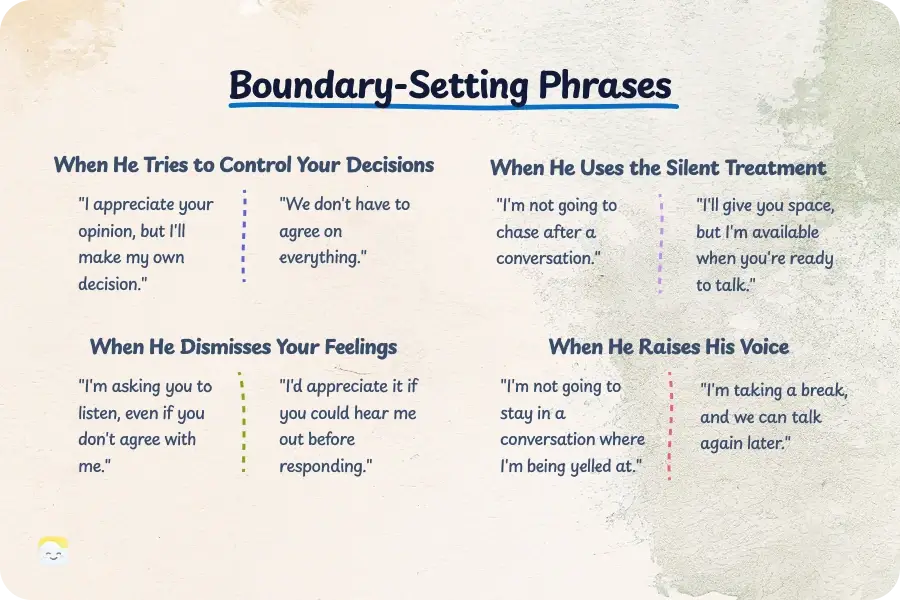
3. Set Firm Boundaries to Prevent Emotional Manipulation
Boundary setting can help you communicate what you will and won’t accept. When your husband crosses your boundaries, you may say:
- “I’ve already explained my boundary, and I’m not going to argue about it.”
- “If this continues, I’m going to end the conversation.”
- “I’m not comfortable with that, and my answer isn’t changing.
Or, if he blames you, it may be helpful to react calmly:
- “Let’s focus on solving the problem instead of assigning blame.”
- “I take responsibility for my actions, and I expect you to do the same.”
For example, if you say, “I’ll end the conversation if I’m being yelled at,” it’s important to follow through by leaving the room, ending the phone call, or taking a break.
4. Keep a journal of recurring patterns
Writing down specific situations, conversations, and behaviors can help you identify recurring patterns that may be difficult to recognize in the moment. Record what happened, how you responded, and how the interaction made you feel. The Breeze app provides insightful journaling prompts for deeper self-reflection and releasing worries.

5. Build a strong support system
Narcissistic marriages often lead to emotional isolation due to shame or withdrawal tendencies [3] Moral-Jiménez MV, Mena-Baumann A. Emotional Dependence and Narcissism in Couple Relationships: Echo and Narcissus Syndrome. December 2024 . If you’re experiencing manipulation, threats, emotional abuse, or financial abuse, reach out to your support network, such as trusted friends or family members, and seek professional support from a licensed therapist or domestic abuse resource to understand your options, prioritize your safety, and make informed decisions about your next steps.
Expert Insight
Nobody can tell you whether or not you should stay in a relationship. You are entitled to your own autonomy. At the same time, if you consistently feel unsafe, devalued, or belittled in your relationship, those are clear signs that you aren’t being respected well. Over time, this can seriously impact your self-esteem and overall health.
Nicole Arzt
Mental health professional
Final Thoughts
Insecurity and narcissism can sometimes appear similar on the surface, but they tend to differ in important ways.
Rather than focusing solely on what label fits your husband, pay attention to how his behavior affects you. Healthy relationships are built on mutual respect, empathy, accountability, and emotional safety. If those qualities are consistently absent, it’s worth exploring what that means for your well-being.
Frequently asked questions
1. Can someone be both insecure and narcissistic?
Yes. Insecurity and narcissistic traits are not mutually exclusive. In fact, some people with narcissistic characteristics may have deep underlying insecurities that they hide behind confidence, arrogance, or a need for admiration. The difference is how those insecurities are expressed. An insecure person is often open to growth and accountability, while someone with persistent narcissistic traits tends to protect their self-image by blaming others or refusing responsibility.
2. What is the biggest difference between insecurity and narcissism?
The biggest difference is empathy and accountability. An insecure person may react emotionally but can usually recognize when they’ve hurt someone, apologize sincerely, and work to change. Someone with strong narcissistic traits is more likely to dismiss your feelings, shift blame, or manipulate the situation to avoid taking responsibility.
3. Can an insecure husband become emotionally abusive?
Yes. Insecurity alone does not excuse controlling or abusive behavior. Some insecure individuals may become possessive, jealous, or controlling if they don’t address their fears in healthy ways. Regardless of the cause, emotional abuse is never acceptable and should be taken seriously.
4. Do narcissists know they are narcissists?
Not always. Many people with narcissistic traits have limited insight into their behavior. They may believe their reactions are justified or view themselves as victims rather than recognizing how their actions affect others. That said, self-awareness varies from person to person, and some people are deeply insightful.
5. How can I tell if my husband is gaslighting me?
Gaslighting involves repeatedly making you question your own memory, perceptions, or reality. Common signs include denying things that clearly happened, insisting you’re “too sensitive,” rewriting past events, or making you doubt your judgment. If you frequently leave conversations feeling confused or wondering whether your experiences are real, gaslighting may be occurring.
Sources
- Howard V. Recognising Narcissistic Abuse and the Implications for Mental Health Nursing Practice. Issues Ment Health Nurs. August 2019
- Evita March, Cameron S. Kay, Bojana Dinić, Danielle Leigh Wagstaff. “It’s All in Your Head”: Personality Traits and Gaslighting Tactics in Intimate Relationships. June 2023
- Moral-Jiménez MV, Mena-Baumann A. Emotional Dependence and Narcissism in Couple Relationships: Echo and Narcissus Syndrome. December 2024
Disclaimer
This article is for general informative and self-discovery purposes only. It should not replace expert guidance from professionals.
Any action you take in response to the information in this article, whether directly or indirectly, is solely your responsibility and is done at your own risk. Breeze content team and its mental health experts disclaim any liability, loss, or risk, personal, professional, or otherwise, which may result from the use and/or application of any content.
Always consult your doctor or other certified health practitioner with any medical questions or concerns
Breeze articles exclusively cite trusted sources, such as academic research institutions and medical associations, including research and studies from PubMed, ResearchGate, or similar databases. Examine our subject-matter editors and editorial process to see how we verify facts and maintain the accuracy, reliability, and trustworthiness of our material.
Was this article helpful?