



Talking to an envious person can make you feel inferior and hurt your self-esteem. Whether it’s a coworker who downplays your achievements, a friend who constantly competes with you, or a family member who criticizes your success, envy can lead to broken relationships if it’s not handled wisely.
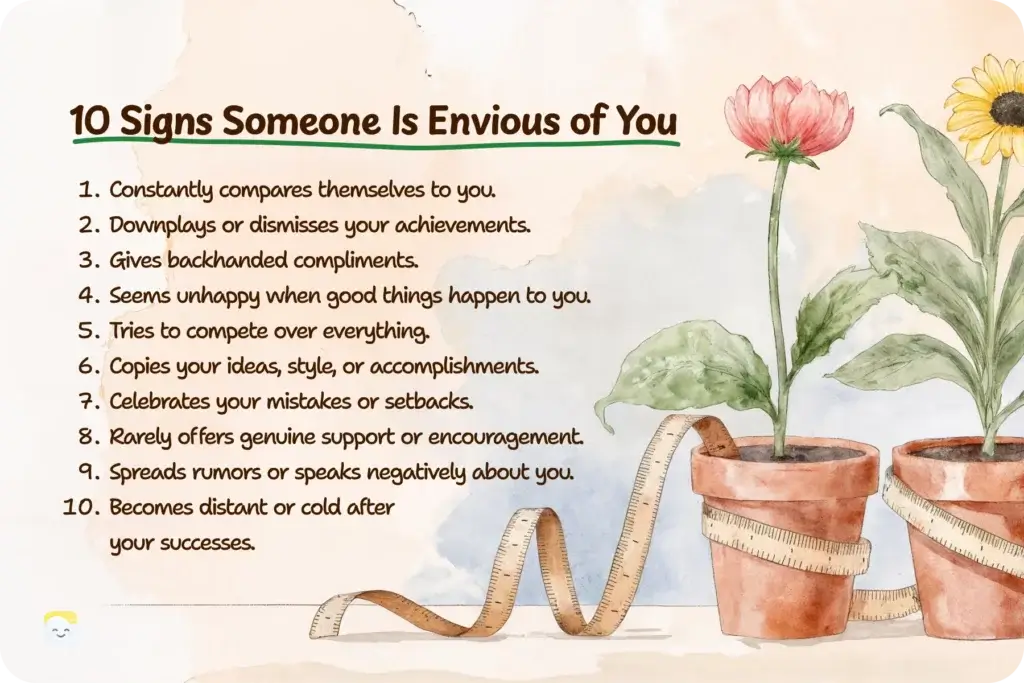
1. They Ignore or Minimize Your Success
Envious people may ignore announcements about your achievements, change the subject, respond with one-word messages, and show little enthusiasm. Their silence can speak louder than words.
Moreover, instead of celebrating and acknowledging your efforts, they reduce them to chance or circumstance. They might say:
- “It’s just good fortune.”
- “You were in the right place at the right time.”
- “Anyone would have succeeded with that opportunity.”
- “It’s not that big of a deal.”
Take the Toxic Traits Test to better understand your behavioral patterns and develop greater awareness of your own complex emotions.

2. They Constantly Compare Themselves to You
Envious people often measure their lives against yours. These conversations become competitions rather than genuine exchanges.
Instead of appreciating their own achievements and progress, they focus on:
- Your salary
- Your relationships
- Your possessions
- Your opportunities
- Your appearance
In this case, an envy attack may sound like:
- “You’re successful for someone your age.”
- “I wish I could afford that.”
- “I’d be successful too if I had what you have.”
- “You don’t have to work as hard because of your looks.”
3. They Offer Backhanded Compliments
A compliment that doesn’t quite feel like one is a classic example of hidden envy. A person who is envious of someone’s success or appearance may say, “You’re brave to wear that,” or “I wish I had as much free time as you.” These statements contain praise wrapped in criticism or comparison.
Understanding how you respond to envy can reveal a lot about your emotional awareness. Take the Emotional Intelligence Test and gain deeper insight into your emotional patterns.
4. They Seem Relieved When Things Go Wrong for You
Typically, envious people find comfort in your setback. They may not openly cheer, but they seem unusually interested and become more supportive only after you’ve experienced failure. This reaction often stems from their insecurity and feeling less threatened.
At the same time, relationships with them can change after your wins. A promotion, engagement, business success, or personal transformation can unintentionally create emotional distance if someone struggles with envy.
5. They Copy You Excessively
They may begin adopting your style, hobbies, language, career choices, or your social media content. At first, you may think they genuinely admire you. But the difference lies in frequency and intent.
Healthy inspiration respects individuality while envy often seeks to erase differences. Admiration says, “I appreciate what they have, and I’d like to learn from them.” Envy says, “I wish I had what they have, and it’s painful that I don’t.” Admiration tends to inspire curiosity and motivation, whereas envy often creates frustration or self-criticism.
6. They Criticize You More Than They Encourage You
No matter what you accomplish, they find something negative to mention while insisting, “I’m only trying to help you.” Although they present their comments as concern or honest advice, their criticism often leaves you feeling discouraged instead of empowered.
7. They Gossip About Your Success
When someone feels threatened by your achievements, they may try to protect their self-esteem by questioning yours. They might spread rumors like “They had connections” or “There’s probably more to the story.” This allows them to explain your success without confronting their own feelings.
Expert Insight
Your best protection is usually a steady, proven track record, not a defensive reaction. When your work and character stay consistent over time, most rumors fade on their own. At work, don’t confront the gossiper in the heat of the moment. Calmly set the record straight with the people who actually matter, like your manager or the co-workers involved, and keep notes if it crosses into harassment or defamation. With friends, go to the person you trust most and say your piece once. Don’t turn it into a campaign against the other person, because pushing too hard tends to make you look more bothered than the rumor deserves. You can’t control what people say, only how you carry yourself, and the ones who know you will trust their own read on you over secondhand talk. If it keeps up and starts doing real damage, drawing a firm boundary or going to HR isn’t an overreaction. Your peace and your reputation are worth protecting.

Grady Shumway
Mental health professional
5 Subtle Signs You May Be Experiencing Envy
Experiencing envy doesn’t make you a bad person. What matters is how you respond to it. Recognizing these feelings without judgment is the first step toward personal growth and healthier relationships.
1. You Feel Irritated by Someone Else’s Success
When someone achieves a goal, you feel annoyed, disappointed, or resentful. You may also think that’s unfair, wondering “Why does that never happen to me?” and catch yourself looking for reasons why they didn’t truly deserve their success.
Take insightful tests in the Breeze app to spot a narcissist, find out your attachment style, recognize the signs of emotional abuse, and much more.

2. You’re Comparing Your Life to Others in Social Media
You frequently check other people’s profiles, comparing their vacations, careers, relationships, homes, or appearance to your own. Instead of feeling inspired, you finish scrolling feeling inadequate or dissatisfied with your life.
Constantly comparing yourself to others can make you feel worse about yourself and lead to a cycle of envy, low self-esteem, and depression, according to research on social comparisons [1] Samra A, Warburton WA, Collins AM. Social comparisons: A potential mechanism linking problematic social media use with depression. June 2022 .
3. You Struggle to Feel Genuinely Happy for Others
You congratulate people on their accomplishments, but you feel disappointed or uncomfortable inside. Their success may feel like a reminder of what you haven’t yet achieved.
4. You May Secretly Hope Someone Fails
One of the strongest signs of envy is feeling relieved or even satisfied when someone experiences a setback. Their failure may temporarily make you feel better about your own situation because it narrows the gap between you.
5. It’s Difficult for You to Celebrate Your Own Progress
When you’re consumed by comparison, your own achievements rarely feel good enough. No matter what you accomplish, someone else always seems to be doing better, making it difficult to appreciate how far you’ve come.
Take an imposter syndrome test to find out whether excessive perfectionism is a reason behind your strong emotions.
What Is Envy?
Envy is the feeling that someone else possesses something we wish we had, such as a career, relationship, appearance, wealth, talent, confidence, or lifestyle. Unlike admiration, which inspires us, envy often creates discomfort because it highlights the gap between where we are and where we want to be [2] Yochi Cohen-Charash, Elliott Larson. What Is the Nature of Envy? August 2016 .
Because admitting to envy is uncomfortable, people rarely express it openly. Instead, it appears through behaviors and attitudes.
Malicious Envy vs. Benign Envy
Benign envy can motivate you to improve yourself, learn new skills, or pursue meaningful goals. Malicious envy, however, is characterized by resentment and a desire to see the other person lose their advantage. The key difference lies in whether envy inspires growth or fuels hostility [3] Lange J, Paulhus DL, Crusius J. Elucidating the Dark Side of Envy: Distinctive Links of Benign and Malicious Envy With Dark Personalities. December 2017 .
Benign envy says, “If they can achieve that, maybe I can too.” It motivates learning, improvement, and ambition. At the same time, malicious envy says, “If I can’t have it, they shouldn’t either.” Instead of encouraging growth, it creates resentment and damages relationships.
4 Tips to Respond to an Envious Person in Healthy Ways
You cannot control another person’s emotions, but you can choose how much influence they have over your life. If you believe someone is acting from envy:
1. Stay Calm and Don’t Take the Bait
Envious people may make subtle remarks designed to provoke a reaction. Resist the urge to argue, defend yourself, or prove your worth. A calm response often ends the conversation without escalating it:
- “I’m grateful things worked out.”
- “I appreciate your perspective.”
- “I’m happy with how it turned out.”
2. Avoid Oversharing Personal Successes
You don’t have to hide your achievements, but you also don’t have to share every milestone with someone who repeatedly reacts with resentment. If you notice a pattern of criticism or competition, be selective about what you share. Save your exciting news for people who genuinely celebrate your happiness.
3. Don’t Feel the Need to Explain Yourself
Envious people may question your decisions or suggest you don’t deserve your success. However, not every opinion deserves a response.
4. Set boundaries if criticism becomes constant
For example:
- Change the subject when conversations become competitive.
- Decline to discuss sensitive topics such as money or relationships.
- Limit the amount of time you spend with toxic people.
If someone’s envy leads to persistent criticism, manipulation, gossip, or attempts to undermine your confidence or success, it may be wise to limit your interactions. Healthy relationships are built on mutual respect and support, not constant competition.
How to Turn Envy into Motivation
Envy can reveal what you truly value or aspire to achieve. Instead of dwelling on what someone else has, use those feelings to identify your own goals and take meaningful steps toward them.
1. Identify What You’re Really Envious Of
Being specific helps you move beyond vague frustration and identify what you genuinely want.
2. Separate the Person from the Achievement
Instead of thinking, “I wish I were them,” try thinking, “I want to achieve something similar.” You’re not trying to become another person—you want a quality, opportunity, or accomplishment that they happen to have. This shift makes your goal feel more attainable.
3. Learn Instead of Compare
Replace comparison with curiosity. Every successful person has something you can learn from. Ask yourself:
- What skills or habits helped them succeed?
- What can I learn from their approach?
- What can I start working on today?
4. Turn Envy into a Personal Goal
The feeling of envy can become a concrete objective, for example:
- Instead of “I wish I earned as much as they do,” create a plan to improve your skills or negotiate a raise.
- Instead of “I wish I looked like them,” focus on developing healthier habits that make you feel strong and confident.
- Instead of “I wish I had their confidence,” challenge yourself to step outside your comfort zone a little each week.
Expert Insight
You can start by naming what you really want underneath the envy, because, for example, “charisma” is rarely the real thing you’re after. Usually, it’s the connection, the ease, or the feeling of being valued that draws us in. That matters because charm is more learnable than it looks. A lot of what seems like natural charm is really just a set of skills you can practice: being truly curious about other people, making warm eye contact, remembering small details, and helping people feel heard instead of trying to impress them. Instead of trying to become that person, pick one or two of those habits and try them out in low-pressure moments. Over time, you’ll likely find your own kind of presence. Finally, watch out for the comparison trap here. Charisma often shows up in the exact social moments people feel most nervous about, so you end up comparing your behind-the-scenes to someone else’s highlight reel.
Grady Shumway
Mental health professional
Frequently asked questions
1. Is envy a normal emotion?
Yes. Envy is a natural human emotion that everyone experiences from time to time. It becomes unhealthy only when it leads to resentment, constant comparison, or behaviors that harm yourself or others.
2. What is the difference between envy and jealousy?
Although the terms are often used interchangeably, they describe different emotions. Envy is wanting something another person has, such as their success, appearance, or opportunities. Jealousy usually involves the fear of losing something you already have, such as a relationship or someone’s attention.
3. Can envy damage relationships?
Yes. Left unchecked, envy can lead to criticism, competition, gossip, passive-aggressive behavior, and emotional distance. Recognizing these patterns early can help preserve healthy relationships and encourage honest communication.
4. How can I tell if someone is envious of me?
Consistent behaviors such as minimizing your achievements, making backhanded compliments, constantly comparing themselves to you, or seeming uncomfortable with your success can be signs of envy.
5. How can I stop comparing myself to others?
Focus on your own goals, celebrate your progress, practice gratitude, and remember that people often share only the highlights of their lives, especially on social media. Limiting comparison can improve both your confidence and overall well-being.
Sources
- Samra A, Warburton WA, Collins AM. Social comparisons: A potential mechanism linking problematic social media use with depression. June 2022
- Yochi Cohen-Charash, Elliott Larson. What Is the Nature of Envy? August 2016
- Lange J, Paulhus DL, Crusius J. Elucidating the Dark Side of Envy: Distinctive Links of Benign and Malicious Envy With Dark Personalities. December 2017
Disclaimer
This article is for general informative and self-discovery purposes only. It should not replace expert guidance from professionals.
Any action you take in response to the information in this article, whether directly or indirectly, is solely your responsibility and is done at your own risk. Breeze content team and its mental health experts disclaim any liability, loss, or risk, personal, professional, or otherwise, which may result from the use and/or application of any content.
Always consult your doctor or other certified health practitioner with any medical questions or concerns
Breeze articles exclusively cite trusted sources, such as academic research institutions and medical associations, including research and studies from PubMed, ResearchGate, or similar databases. Examine our subject-matter editors and editorial process to see how we verify facts and maintain the accuracy, reliability, and trustworthiness of our material.
Was this article helpful?