



Podcast name
Why don't I want to work anymore? Podcast
Do you wake up in the morning and think, “I can’t do this anymore?” Do you also spend your Sundays dreading going to sleep just not to face the harsh reality of going to work the next day?
If you feel like you don’t want to work for the rest of your life, this article is for you. Here, you will find 7 things to do when you don’t want to work anymore and how to know when to quit.
What to do when you don’t want to work anymore? 7 steps
Most people cannot afford to quit their jobs, even if they’re severely burned out, because all of us have bills to pay. But it doesn’t mean you have to simply accept your inevitable fate and suffer in silence.
If you don’t want to work anymore but still need the money, here’s an overview of things you can do without quitting your current job:
- Prioritize self-care.
- Do the bare minimum at your current job.
- Separate your worth from your work performance.
- Get a hobby besides work.
- Take regular breaks at the job.
- Do the daily 3-3-3 exercise.
- Try therapy.
Here’s how you can apply these tips in your day-to-day life without spending even more mental energy than you spent on your work.

1. Prioritize self-care, no excuses
Unlike common belief, self-care isn’t a luxury. It’s a need. And in your case, when you don’t have the motivation or strength to work, it’s therapeutically advisable.
You might think that you don’t have time or energy for self-care. It seems like you spend most of your energy going to work you hate. What you have to understand is: You cannot give something away when you don’t have two nickels to rub together. The same thing with self-care: You cannot put in energy if it doesn’t exist.
According to Maslow’s pyramid of needs, physiological, social, safety, and esteem needs come before self-actualization, which happens at work. Self-care is when you satisfy those needs, for example:
You don’t have to stress over satisfying every single need. Do your best, but also remember that any self-care, big or small, is self-care. Whether you simply complimented yourself today or cut off a toxic person, you did a great job.
2. Do the bare minimum at work
There is nothing wrong with doing the bare minimum at your job when you’re having a difficult life period. Doing the bare minimum just to stay afloat is acceptable and even necessary if it’s a temporary energy-saving strategy.
You simply have to do what you’re paid for; here’s how:
- Set clear boundaries about your working hours: Set automatic replies and don’t go into calls past paid time established in your contract or with your manager.
- Say no to extra tasks: Do only the tasks you were hired for.
- Don’t offer your time/resources unless you’re asked for it: If your colleagues haven’t explicitly asked you for help, don’t get ahead of yourself to take on their workload.
- Don’t attend “informal” work meetings: Unless you are close friends with some of your colleagues, most company parties are still corporate events that are aimed at team-building or networking, which are your indirect work responsibilities.
You shouldn’t go above and beyond to just ruin your health. It might sound counterintuitive, but if you actually try less hard, you might do better eventually.
3. Separate your worth from your work
There are two reasons why your work makes you miserable:
- You feel trapped: It’s like you don’t have control over your life because you’re forced to work.
- You associate your worth with your work: You define yourself either through productivity, position, or the money you make.
Separate your identity and your emotions from your work as much as possible. That’s way easier said than done, but the sooner you start practicing detaching your “work self” from your true self, the sooner you’ll feel better about yourself.
You can start here:
- Stop thinking about work problems outside office/business hours.
- Remove work apps from your personal devices.
- Invest emotionally in a hobby or a side project that you genuinely enjoy doing.
- Spend more quality time with family members, friends, kids, or your romantic partner without thinking about your work.
Do your job. Do it well. But don’t exploit yourself for somebody else’s gain.

4. Have a hobby besides work
In order to separate your identity from your work, you must have an identity besides a job. A meaningful, enjoyable hobby is the best way to do so. To maximize positive effects from hobbies, use these tips:
- Consistency over intensity: Research on behavioral activation shows that 90 minutes per week is the golden mean for hobbies [2] Behavioral activation interventions for well-being: A meta-analysis. T. G Mazzucchelli, R. T Kane, C. S. Rees. Journal of Positive Psychology. May 2010. . You get benefits from consistent re-engagement with rewarding activity and also don’t burn out.
- The chosen one: Make sure that the hobby is one that you choose voluntarily. Don’t choose a hobby out of desperation, absence of options, pressure, or trends.
- The flow state: Hobbies that naturally capture your attention and get you in a flow state are the most valuable.
- Plan and protect: Plan your hobbies intentionally rather than leaving them to chance. Prioritizing something that is dear to you positively affects your self-worth.
Hobbies are a form of self-care: doing something that brings you satisfaction shows you that you deserve care. Hobbies also give a sense of mastery, confidence, and control over your life.
5. Make regular breaks at work
It’s impossible to maintain focus or be physically active for 8 hours straight without it impacting your well-being.
An effective and productive way to integrate breaks into your work is to use the Pomodoro technique:
- Set a timer for 25 minutes.
- Try to work with the minimum number of distractions possible.
- Then, take a 5-minute pause.
- After 4 intervals, take a longer 15-30 minute break.
Although the Pomodoro technique is approved for most workplaces, breaks can be regulated depending on the job. Whenever possible, try to sneak in these small breaks in a way that’s comfortable for you. Healthy breaks should refresh your mind and relieve tension.
“The structure matters less than the disengagement. If someone is burned out, their brain needs an actual break from decision-making and screens, not just a change of task.
I usually tell clients: step away from the desk, go outside if you can, do something with your hands or your body. Skip the phone if possible, because scrolling still keeps your nervous system ‘on.’
And don’t feel like you have to earn the break by being productive with it. A timer-based system like Pomodoro works for some people, but for someone who’s truly depleted, forcing another structured routine can backfire.”
6. Do the daily 3-3-3 exercise
Perhaps the thought “I don’t want to work anymore” feels so dreadful because you keep ruminating on it. Because you’re overfocused on the bad, you neglect other beautiful moments of living.
You may not have power over circumstances, but you still have power over your mindset. Stop seeing everything as self-depleting. You need to rewire your brain to be more objective and positive.
7. Try therapy
If you feel like you’re withdrawing from work, it can be out of severe mental or physical exhaustion.
In therapy, a licensed professional can help you to:
- Feel listened to and understood.
- Identify the root cause of your lost motivation to work.
- Underline your values and align your identity with your current position.
- Plan transitions, like career changes, and give advice to prepare for them mentally.
- Develop healthy coping mechanisms to process employer-related stress.
In therapy, expect that you will talk a lot about yourself, including moments of perceived “failures” like feeling stuck or stuff you’re not proud of. This is done for self-exploration and more precise goal-setting for the ideal life you pave the way towards.
“I don’t want to work anymore, but I need the money.” Should you quit your current job?
Before cold-quitting your job, stop.
We know how strong the urge to quit can be. However, once the initial relief that you don’t have to work anymore passes, you might get overwhelmed by the idea of being unemployed. What about bills now? How do you make ends meet?
A healthier way is to assess your employment situation objectively. Here’s how.
To quit or not to quit?
In order to know whether you can quit or not, you have to objectively assess your financial security: Do you have debt? Do you have savings that will be enough for at least 6 months of living? Do you have big expenditures coming up? Do you support only yourself or also provide for a family?
If you absolutely can’t stand the idea of working at the same place anymore, your strategy is to de-escalate your efforts at your current job (see section “Do the bare minimum at work”) + prepare to quit. Here’s what to do while you’re preparing for exit:
- Track your expenses for 1-2 months.
- Calculate your minimum cost of living, including housing, food, utilities, debt payments, and basic healthcare.
- Shrink your non-compulsory spending, like subscriptions, impulsive purchases, or take-out food, and choose cheaper alternatives for your expenses.
- Pay off your debt. There are many strategies of “aggressive debt payoffs” to eliminate the pressure of monthly payments.
- Work on your savings or investments. Call it “The Freedom Fund.” This fund should cover a minimum of 3 months of living. Best-case scenario: your freedom fund can cover you for 6 months.
- Document your professional accomplishments to prepare for a job transition.
How to choose a new job to prevent similar situations in the future
An alternative option if you can’t simply quit is to slowly transition to a different career. It’s never too late for a career change or even going to school all over again.
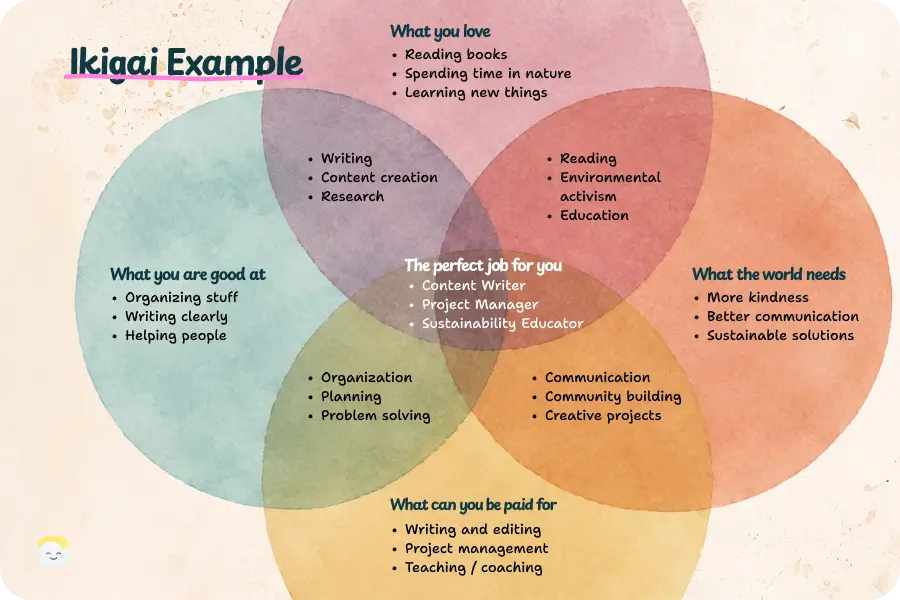
You will be more motivated to work if you actually enjoy your work tasks or the industry you’re in. But how do you know which of your interests can become a source of income? Try the Ikigai method:
Why Don’t I Want to Work Anymore? 7 Reasons
There are seven reasons most people don’t feel like working anymore:
- Burnout
- Toxic work environment.
- Lack of quality rest.
- Absence of meaning and purpose.
- Lack of recognition.
- Lack of control/victim mindset.
- Not liking their career.
You may not want to work anymore for one reason or an interplay of several of these reasons:
“People just don’t want to work anymore!” Is that so?
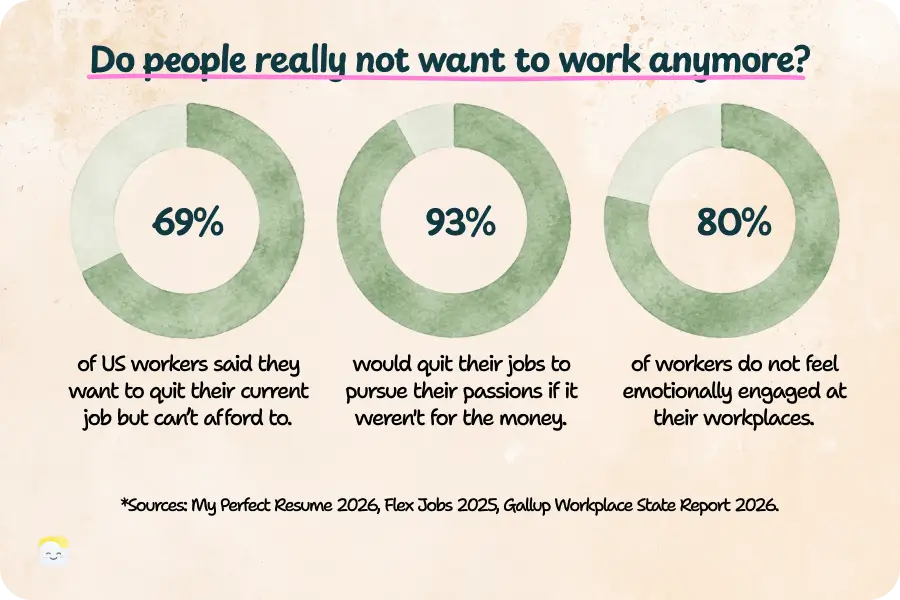
Honestly, yes. According to the latest data, most people would gladly not work if it weren’t for the money:
But it’s not that simple. People nowadays are no more lazy than at any given point in history. The reasons for lost motivation are much more complex:
- The rising cost of living: Salary growth has failed to keep pace with basic living costs. Basic living expenses accounted for 85% of the average American’s salary in 2024 [6] Housing and transportation accounted for 50 percent of household spending in 2024. U.S. Bureau of Labor Statistics. February 2026. . Working for money is no longer worth it. Reaching traditional financial goals like getting a car or a house feels impossible to achieve, so people choose to live in the moment instead.
- “Hard work will get you far” is an empty promise: Hard work leads you to more tasks and doesn’t guarantee recognition or, hence, financial gain. The traditional predictors of success, such as a university degree, extra courses, or determination, don’t promise even employment nowadays.
- Employer-employee loyalty is breached: The largest employers seek every potential way to minimize expenditures and maximize revenues. Workers are laid off or replaced with AI left and right. Employees have just started responding with equal energy.
- Illusion of simple work: It’s true that people nowadays do the least physical or mundane, manual work in all of history. However, just because most people work sitting at their computers, it doesn’t mean that their work becomes simpler. The work became more complex and demanding mentally. Modern workers are expected to give more output in less time.
Is it normal not to want to work?
Yes, most people don’t want to go to work either chronically or lose motivation occasionally. 69% of Americans would quit their jobs if they could afford to [7] Half of Workers Would Quit Within 3 Months If They Could Afford To. J. Escalera. My Perfect Resume. May 2026. .
It’s not controversial not to aspire to a job or a career. Even if you turn your most passionate hobby into work, doing something 40+ hours a week for 50 years straight will eventually deplete you. It’s perfectly fine to admit that you don’t want a job; you want a life.
Sadly, no matter how nice it would be to imagine a world where you don’t have to work, it’s not a world we live in. You might be tired of responsibilities, but imagine your life doing nothing. After resting for a year or even half a year, you’ll feel the urge to do something because the human brain isn’t good with boredom.
“A lot of it comes down to how we’re raised to think about work ethic.
Most people grew up hearing that being a hard worker is basically the same thing as being a good person, so when the motivation disappears, it can feel like a character flaw instead of what it actually is: exhaustion.
There’s also a real gap between what burnout feels like from the inside (heavy, foggy, hard to explain) and how it looks from the outside (like someone’s just being lazy or checked out). That gap makes people doubt themselves.
And then there’s the practical fear underneath it all, that saying “I’m struggling” out loud might put their job at risk. So people push it down, which usually just makes the shame worse over time.”
Frequently asked questions
How to recover from burnout while still working?
Recovery requires strict boundaries rather than a sudden resignation. Start by identifying the bare minimum you can do at work to stay afloat—the work that fulfills your core responsibilities without taking on extra, unpaid labor. After logging off, mute work notifications and calls. Don’t forget to make regular breaks throughout the day and treat them as sacred time during which you detach psychologically.
In your non-work time, make sure you get enough sleep, eat nutritiously, and move enough. Another piece of advice: devote at least 90 minutes a week to a hobby you’re really passionate about to build a life outside of work you can switch to after in-office hours.
Is work culture nowadays healthy?
It depends on a workplace, but many people report that modern work culture feels unhealthy. Modern work culture frequently prioritizes hyper-productivity and short-term corporate output over human well-being. The rise of digital communication has blurred the line between professional and personal life, leading to chronic availability expectations.
While awareness around mental health is growing, systemic issues like stagnant wages, unmanageable workloads, and lack of job security consistently contribute to rising rates of burnout.
What is the difference between laziness and burnout?
Laziness is a conscious choice to avoid effort despite having the capacity to act. Burnout, on the other hand, is a state in which procrastination appears due to empty physical and mental capacities rather than intentional choice. When you are burned out, you usually want to meet your goals, but your brain and body lack the energy required for the task. Laziness feels comfortable; burnout feels overwhelming and exhausting.
How can I romanticize my daily life when I hate my job?
To romanticize your life in this case, shift your focus away from work as the central element of your day and treat it as a background task that funds your life. Be very intentional about your routines: pay attention to small daily moments, reduce your screen time, and bring beauty, not just practicality, into your life.
For example, enjoy your morning coffee away from screens, listen to your favorite music on your commute, take a walk during lunch, and plan engaging evening activities so your day doesn’t start and end with your job.
Sources
- Benefiting from creative activity: The positive relationships between creative activity, recovery experiences, and performance-related outcomes. K. J. Eschleman, J. Madsen, G. Alarcon, A. Barelka. Journal of Occupational and Organizational Psychology. April 2014.
- Behavioral activation interventions for well-being: A meta-analysis. T. G Mazzucchelli, R. T Kane, C. S. Rees. Journal of Positive Psychology. May 2010.
- Ikigai: The Japanese Secret to a Long and Happy Life. H. García, F.Miralles. Penguin life. August 2017.
- Burn-out an “occupational phenomenon”: International Classification of Diseases. World Health Organization (WHO). May 2019.
- Perceived union support, work meaningfulness, and well-being: evidence from an emerging country context. D. Dirik, E. Metin. Frontiers in Psychology. August 2026.
- Housing and transportation accounted for 50 percent of household spending in 2024. U.S. Bureau of Labor Statistics. February 2026.
- Half of Workers Would Quit Within 3 Months If They Could Afford To. J. Escalera. My Perfect Resume. May 2026.
Disclaimer
This article is for general informative and self-discovery purposes only. It should not replace expert guidance from professionals.
Any action you take in response to the information in this article, whether directly or indirectly, is solely your responsibility and is done at your own risk. Breeze content team and its mental health experts disclaim any liability, loss, or risk, personal, professional, or otherwise, which may result from the use and/or application of any content.
Always consult your doctor or other certified health practitioner with any medical questions or concerns
Breeze articles exclusively cite trusted sources, such as academic research institutions and medical associations, including research and studies from PubMed, ResearchGate, or similar databases. Examine our subject-matter editors and editorial process to see how we verify facts and maintain the accuracy, reliability, and trustworthiness of our material.
Was this article helpful?