

Podcast name
Why am I so hard on myself?
Are you your own biggest critic? Have you ever thought about why self-criticism doesn’t feel nice and is proven to be counterproductive?
This article explores the meaning of being hard on yourself and the 5 reasons why you’re so mean to yourself. Ask yourself this: Are you ready to spend your whole life believing you’re not enough? If not, this article is the right place for you.
Why am I so hard on myself? 5 reasons from psychology
People who are mean to themselves hate losing control. They would rather choose 100% controllable self-punishment than a minimal risk of someone else criticizing them unexpectedly. This protective strategy can stem from several grounds:
- Perfectionism
- Low self-esteem
- Negative early life experiences
- Cognitive distortions
- Certain mental health conditions
Let’s break down each of these causes of negative self-talk one by one.
1. Perfectionism
Most perfectionists have an overly critical inner voice. This voice inside makes you punish yourself for every mistake and flaw, demanding perfection, even when perfection is neither possible nor necessary.
Something in your life taught you that making mistakes is dangerous. Hence, you developed perfectionism to protect yourself from these mistakes.
But guess what? Mistakes are unavoidable. Your perfectionism backfires. You start to associate unavoidable mistakes with proof that there is something wrong with you.
By demanding flawlessness, you attempt to return a sense of control. The brain is scared of the unknown. When you expect “perfect outcomes,” you deny any other possibility, creating the illusion that you predicted results.

2. Low self-esteem
Low self-esteem means believing there is something inherently wrong with you. If you believe in your intrinsic deficiency, you will also believe every negativity directed at you. Even if it’s coming from your own negative thoughts about yourself.
Every mistake, every flaw, every success of other people feels existential to you. That’s because your inner critic leads you to believe that every mistake threatens your ego.
Common triggers that make you go so hard on yourself are:
- Comparison
- Unrealistic expectations
- (Perceived) criticism
- Failures and mistakes
- Hyperfocus on the success of others
3. Childhood experiences
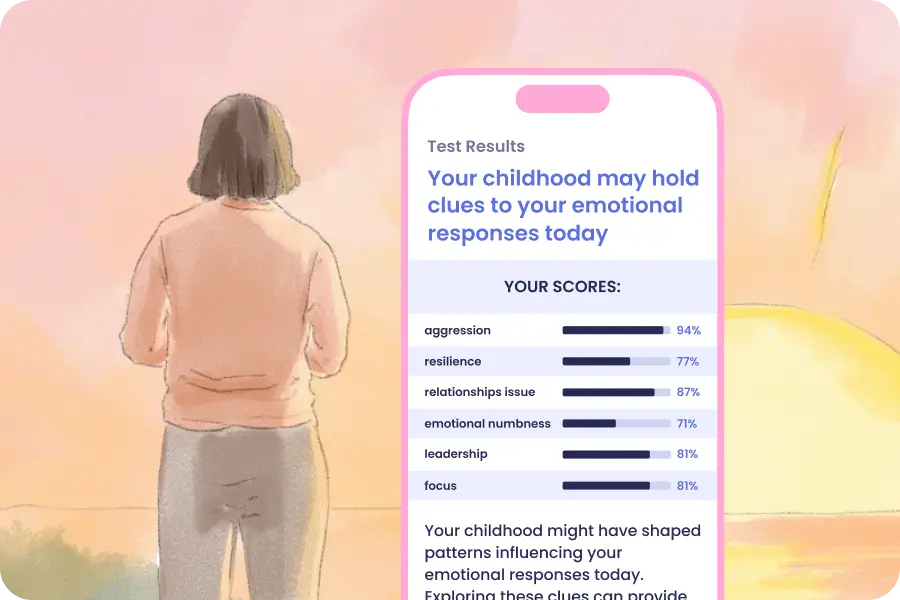
Many people who are hard on themselves weren’t born that way—they learned it in childhood. Research shows that up to 77% of people who experienced something negative in childhood develop symptoms of anxiety or depression linked to damaged self-esteem [1] The role of explicit and implicit self-esteem in the relationship between childhood trauma and adult depression and anxiety by A. W. Gathier, L. A. van Tuijl, B. Penninx, P. J. de Jong, P. C. van Oppen, C. H. Vinkers, J. E Verhoeven. Journal of Affective Disorders. June 2024. .
If you were criticized, blamed, humiliated, rejected, etc., as a child, you might’ve internalized the idea that you are the reason for all the negativity you experience.
It’s not your fault, but rather a protective mechanism: As a child, your brain couldn’t comprehend uncertainty. It was safer for you to assume you were the reason and feel in “control” rather than face the more dangerous idea that your caregiver was actually unsafe.
If you didn’t have a corrective experience (e.g., an experience of unconditional love or therapy), you’ll carry on negative thoughts about yourself in adulthood.

4. Cognitive distortions
Almost every person experiences cognitive distortions occasionally. From the psychological perspective, cognitive distortions are energy-saving shortcuts. We, people, cannot approach everything super reflectively. We wouldn’t have time for anything else if we did.
Here are some common thinking errors you didn’t know you experience that make you be too hard on yourself:
Cognitive distortions are not inherently bad. They are our mind’s way to save resources. But it’s important to notice and stop these automatic thoughts when they make us feel bad.
5. Certain mental health conditions
Being hard on yourself isn’t a mental health condition on its own, but it can be a symptom of a few conditions:
- Depression
- Anxiety
- Obsessive-Compulsive Disorder (OCD)
- Attention Deficit/Hyperactivity Disorder (ADHD)
- Post-Traumatic Stress Disorder (PTSD)
- Eating disorders
In psychiatry, negative self-talk is considered a transdiagnostic factor across these conditions. It means that being hard on yourself can be both a symptom and one of the causes of these mental health conditions [2] Understanding Self-Criticism: A Systematic Review of Qualitative Approaches by V. Zaccari, M. Fazi, F. Scarci, V. Correr, L. Trani, M. G. Filomena, V. Piccione, S. J. Cattan, M. G. Ginni, F. D’Olimpio, F. Mancini. Clinical Neuropsychiatry. December 2024. .
Is being hard on yourself a sign of depression?
Being hard on yourself is a very common sign of depression. It comes from feelings of worthlessness, exhaustion, and loss of hope.
10 out of 16 studies that explored the link between self-criticism and depression found that being negative about yourself significantly increases the chances of developing depression [3] The role of self-criticism in common mental health difficulties in students: A systematic review of prospective studies by R. McIntyre, P. Smith, K. A. Rimes. Mental Health & Prevention. June 2018. .
Why am I so hard on myself when I make a mistake?
You’re so self-critical when you make mistakes because you try to control everything. Such a desire can come from different events in your past. But the primary need you satisfy by self-deprecating is to reduce the uncomfortable shame you associate with mistakes.
Perhaps you weren’t taught in your childhood that mistakes have nothing to do with who you are as a person. Because every mistake you make comes with a ton of shame, you try to avoid them by overthinking and demanding flawlessness from yourself.
Your thinking pattern can be distorted with generalization. For example:
- You were unfairly irritable about your significant other. →
- You feel bad and start thinking that you’re a bad partner. →
- If you’re a bad partner, you might as well think you’re a bad person who’s incapable of love.
See how one wrongdoing turned into an existential crisis? No wonder you try to protect yourself from mistakes when one mistake “proves” that all the shame you carry is “right.”
It’s great when you are aware of your mistakes and can reflect on them. That’s how you become a better person. The reflection, though, shouldn’t turn into self-criticism and self-doubt.
How long are you going to punish yourself for something you can’t change?
You hurt someone.
You wasted time.
You lost money.
You trusted the wrong person.
And now what? Instead of spending so much time and energy punishing yourself mentally for wrong things you did, you can redirect that energy into learning from your mistakes and repairing damage.
You’re not the same person who made that wrong decision. You’ve grown since then. You learned. What’s more, you wouldn’t grow if not for that mistake.
Our expert, Katherine Scott, the lead Licensed Marriage and Family Therapist at Puzzle Peace Counseling, expains when guilt can drive accountability and when it becomes toxic and leads you to punish yourself:Helpful guilt arises when we do something that results in a poor outcome. Guilt alerts us to ways we need to adapt and evolve to better reach ‘self-actualization.’
Comparatively, it’s like a computer updating its software. If we never ‘updated’ our software or took accountability for our part, we would stay stagnant and never evolve to our best selves.
Maladaptive guilt lingers and infiltrates our entire perspective of ourselves and the world around us. Maladaptive guilt leads with the core belief of ‘I am bad,’ vs adaptive guilt that leads with ‘I did something bad that I can improve upon.’
What does it mean to be hard on yourself? 10 signs
Being hard on yourself basically means seeing yourself through a way-too-harsh lens. It often involves distorting or rejecting objective truth, either to blame yourself when things go wrong or to downplay your achievements.
People who are negative about themselves often exhibit these 10 common behaviors. Can you relate?
- You overthink past mistakes.
- You feel like everybody else judges you for your past, preferences, personality, etc.
- You try to meticulously plan everything to avoid things going wrong, even when it costs you resources like sleep/money.
- You chronically compare yourself to other people, who seem more “successful” on the surface.
- You feel guilty for your own failures or when things go wrong in your life in general.
- Your self-criticism doesn’t stop even if you have already fixed a mistake.
- You don’t believe your achievements are actually due to your efforts and hard work.
- You have more empathy for other people than for yourself in the same situations.
- You put your needs last in favor of work, friends, projects, etc.
- You experience negative self-talk: calling yourself names, ignoring positivity, exaggerating failures, etc.
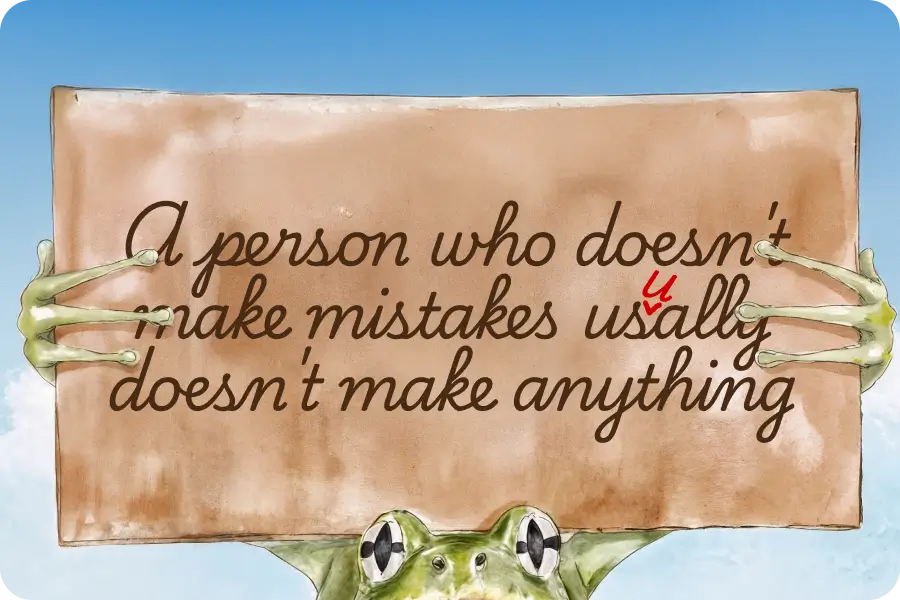
Am I too hard on myself, or am I hard-working?
Even though the difference between being ambitious and being hard on yourself is small, it exists:
“Well… Maybe I’m not too hard on myself. Maybe I’m just ambitious and disciplined.”
Maybe you are. Surprisingly, being overly critical of yourself and working hard to achieve your personal goals can be really difficult to tell apart.
How do you know, for example, when to take on a new challenge at work if you really don’t want to do it? Should you cut yourself some slack and be self-compassionate, or should you push yourself out of your comfort zone to achieve success?
You’re a worthy human being, even if you work just hard enough to support your living, you’re worthy when you take breaks; you’re worthy even if someone tries to prove otherwise.
How to stop being hard on yourself?
To stop being hard on yourself, you have to do a lot of reflection on what your self-criticism brings you and what exactly you want to change. Besides changing your mindset, you’ll also need to practice self-compassion to retrain your automatic responses and teach your mind that there is a different way.
Here are five ideas on how to do it:
1. Reflect on your negative self-talk
A good question to ask yourself is, how do you benefit from being hard on yourself?
It can sound counterintuitive that negative self-talk can be useful in some way. In reality, self-criticism does protect us (or at least we think so). Think about what your reason is for having so many negative feelings about yourself:
- Are you afraid of other people’s judgment, so you get in there first to undercut that judgment?
- Are you afraid that making a mistake or not being good at something makes you less worthy as a human?
- Is being hard on yourself a way to signal to others that you know you are lesser?
- Do you need the praise of others, making it particularly difficult when you make a mistake?
Once you identify the underlying need behind your self-criticism, you can replace it with a healthier coping strategy, such as self-compassion, gratitude, asking for support, or writing down/talking through your feelings.
2. Do the “care less list” exercise
After determining why you self-deprecate, you have to think about what positive changes you want to make in your life. The “care less list” helps you with this exactly. Here’s how to do it:
- Take a sheet of paper and divide it into two columns.
- Title the first one “Care Less About” and the second “Care More About.”
- In the first column, write down specific things that you want to stop doing or caring about, such as doing things perfectly, what strangers think of me, and success or losses of other people.
- In the second, list what you want to care more about: learning, meaningful relationships, curiosity, your health, or having fun.
The more concrete your lists are, the better. This exercise helps to stop being so hard about values and ideas that aren’t even your own. It shifts your attention from fear-driven, protective priorities to values that are genuinely important to you.
3. Challenge your inner critic
Your inner critic is that nagging voice that makes you feel bad about yourself. And just because these feelings have appeared in your mind, you don’t have to believe them. You don’t have to believe everything you think.
Here are some actionable steps on how to deal with a self-critical inner voice:
- Notice when you start punishing yourself, but don’t intentionally try to stop negative self-talk. Research shows that being aware of your self-criticism is a precondition for any other inner criticism work [4] Breaking the vicious cycles of self-criticism: a qualitative study on the best practices of overcoming one’s inner critic by B. Šoková, K. Greškovičová, J. Halamová, M. Baránková. BMC Psychology. March 2025. .
- Give your inner critic a silly name. Making something funny makes it less scary. When Señor No Deservo tells you you’re falling short, does it really matter? Next time your inner monologue starts to put you down, shut it with “This Judgy Karen and his like-always inappropriate comments.”
- Replace criticism with positive self-talk. Don’t try to convince yourself of things you don’t believe in. Instead, show some self-compassion: “I’m being unfair to myself in the moment. I tried my best,” or “My emotions are intense, but I know I’ll deal with them because I did it before.”
- Try CBT exercises. CBT exercises are meant to evaluate the objectivity of your thoughts. In these exercises, you assess what evidence supports and refutes your thoughts. It’s very effective to combat cognitive distortions if such thinking has become automated.
It might be hard to catch this negative thought pattern in the moment, especially if you’ve thought like this your entire life, but it’s possible. Some days, you’ll realize you were unfair to yourself after the moment passes. But on other days, you’ll catch and stop the inner critic right when it goes off at you. Practice makes perfect.
4. Do one nice thing for yourself a day
The truth is, if being hard on yourself worked, you probably would’ve felt great by now.
If you don’t feel great about yourself, don’t wait for self-acceptance to magically come down upon you. Actions shape self-confidence. Show yourself some self-compassion, even if you think you don’t “earn” it. Treat yourself. Rest.
One study showed that people who take care of themselves have more stable self-esteem and mental well-being. This happens because consistent self-care serves as evidence that we are worth the effort [5] Healthy Lifestyle in Adolescence: Associations with Stress, Self-Esteem and the Roles of School Violence by A. G. Moreno and M. M. M. Jurado. Healthcare (Basel). December 2023. .
5. Try therapy
Working with a mental health professional can play a pivotal role in how you see yourself and your life. A licensed therapist provides a neutral, judgment-free space to help you trace back these patterns to their roots and gain valuable insights to reframe them.
Sources:
- The role of explicit and implicit self-esteem in the relationship between childhood trauma and adult depression and anxiety by A. W. Gathier, L. A. van Tuijl, B. Penninx, P. J. de Jong, P. C. van Oppen, C. H. Vinkers, J. E Verhoeven. Journal of Affective Disorders. June 2024.
- Understanding Self-Criticism: A Systematic Review of Qualitative Approaches by V. Zaccari, M. Fazi, F. Scarci, V. Correr, L. Trani, M. G. Filomena, V. Piccione, S. J. Cattan, M. G. Ginni, F. D’Olimpio, F. Mancini. Clinical Neuropsychiatry. December 2024.
- The role of self-criticism in common mental health difficulties in students: A systematic review of prospective studies by R. McIntyre, P. Smith, K. A. Rimes. Mental Health & Prevention. June 2018.
- Breaking the vicious cycles of self-criticism: a qualitative study on the best practices of overcoming one’s inner critic by B. Šoková, K. Greškovičová, J. Halamová, M. Baránková. BMC Psychology. March 2025.
- Healthy Lifestyle in Adolescence: Associations with Stress, Self-Esteem and the Roles of School Violence by A. G. Moreno and M. M. M. Jurado. Healthcare (Basel). December 2023.
Disclaimer
This article is for general informative and self-discovery purposes only. It should not replace expert guidance from professionals.
Any action you take in response to the information in this article, whether directly or indirectly, is solely your responsibility and is done at your own risk. Breeze content team and its mental health experts disclaim any liability, loss, or risk, personal, professional, or otherwise, which may result from the use and/or application of any content.
Always consult your doctor or other certified health practitioner with any medical questions or concerns
Breeze articles exclusively cite trusted sources, such as academic research institutions and medical associations, including research and studies from PubMed, ResearchGate, or similar databases. Examine our subject-matter editors and editorial process to see how we verify facts and maintain the accuracy, reliability, and trustworthiness of our material.
Was this article helpful?