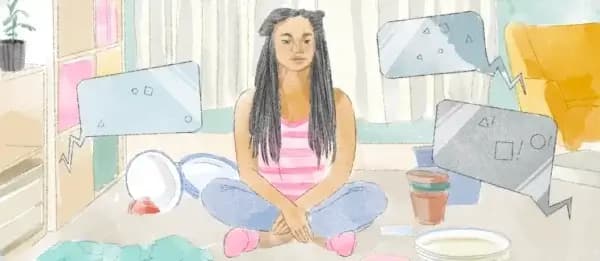


Procrastination is an act of postponing important things, even though a person clearly has time and resources to complete the task. Although procrastination is generally frowned upon (“You just have to do it“), 95% of people worldwide procrastinate [1] The Procrastination Equation: How to Stop Putting Things Off and Start Getting Stuff Done Piers Steel. Anne Blake. Performance Improvement. March 2019. .
Knowing your type on a procrastination scale can help you understand what drives your personal procrastination. Ready? Let’s see why you procrastinate.
What is my procrastination type? Test
What do my results mean? Unpacking your dominant procrastination type
Now that you have determined where you are on the procrastination scale, you can make changes in your daily life and try targeted strategies to boost your productivity.
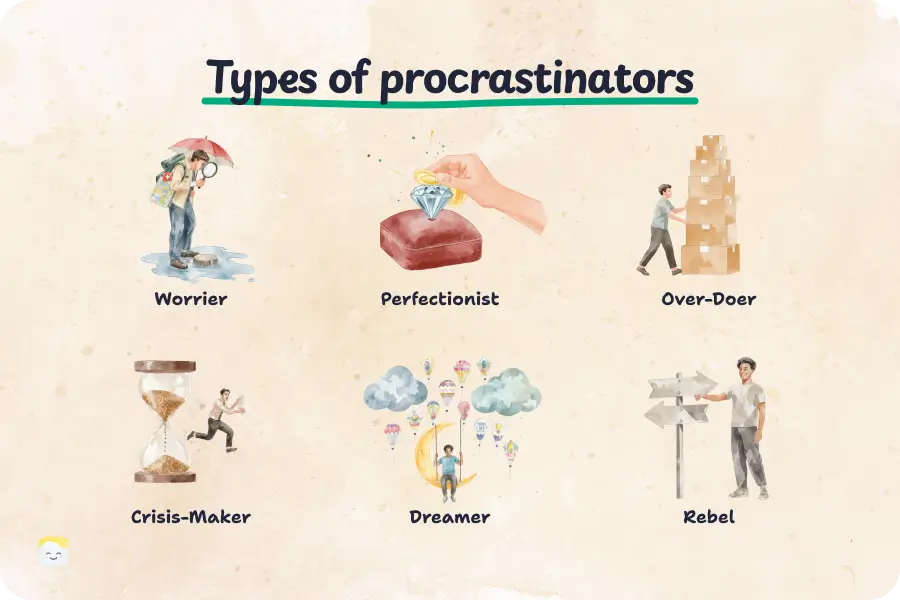
Crisis-Maker
Do you feel like you can only work under pressure? That’s because you depend on the sense of urgency created by a surge of adrenaline and dopamine, which temporarily boost focus and motivation.
This is a sign of executive dysfunction, which is a brain disruption that impairs time management, planning, and organization skills. This is found in many neurodivergent individuals, especially those with ADHD.

Tips for crisis-makers
Instead of relying on panic to get things done, you can try creating urgency in healthier ways:
- Try breaking tasks into several smaller deadlines.
- Work with an accountability partner who will regularly check your progress.
- Use timers, such as the Pomodoro technique (25 minutes of work, followed by 5-minute breaks), to create short bursts of urgency.
- Turn tasks into games and reward yourself for finishing early.
- Reduce distractions before you start so you don’t need a crisis to focus.
You may want to discover your ADHD patterns before finding targeted strategies for your procrastination type.
Worrier
As a worrier, you keep delaying tasks out of the freezing fear that something can go wrong. Your overthinking makes you live through every possible mistake and worst-case scenario, even though you haven’t even started performing tasks.
Your brain can’t tell the difference between what happens in reality and what you just imagined. Everything you think is a serious, real-life threat to your brain. You may procrastinate just because you don’t want to go through all the potential shame and fear all over again. Your brain already lived through that.
Tips for worriers procrastinators
Don’t focus on eradicating anxiety. Moderate, well-timed anxiety protects you. The goal of these tips is to manage your worries and learn that discomfort is safe:
- Voluntarily do small things you’re most likely to fail at, but that won’t impact anything major in your life.
- Try breaking tasks into ridiculously small steps, to the point where “get up from bed” is a separate first step.
- Celebrate progress and small wins. Get yourself micro-rewards like a 15-minute break or a coffee when you complete a small piece of work.
- Be compassionate to yourself. Don’t punish yourself for procrastinating. Rather, tell yourself that you’re okay with not always having the motivation.
Perfectionist
Perfectionism is a blessing and a curse for procrastinators. Yes, perfectionist procrastinators will perform a task flawlessly. But their high standards are so pressuring that they fall short of actually achieving them.
If you’re a perfectionist, procrastination is your self-protection from your patterns. Your brain keeps choosing avoidance over tasks because by avoiding them, you won’t need to face the disappointment of your high standards.

Tips for perfectionist procrastinators
For you to overcome procrastination, it’d be beneficial to change your mindset:
- Strive for progress, not perfection. Your 70% is usually enough for you to remain outstanding and hard-working. But by being 70%, 50%, and sometimes even 20%, you avoid burnout.
- Don’t talk about yourself in absolutes. Stop using words like “always,” “never,” “should,” “I’m bad at…” These labels create expectations for you, which can lead to pressure and, ultimately, procrastination.
- Try the Pomodoro technique to do the first messy draft. Set a timer for 20 minutes and do a task you need to do without trying to be “good enough.” Let go and write all of your ideas; don’t fix the details. By regularly doing this exercise, you’ll realize how much you can accomplish without worrying about minor errors.
Over-Doer
Over-doers are actually pretty motivated people. Their struggle is less about motivation and more about learning when to say “stop.” If you’re an over-doer, you probably overload yourself until there isn’t enough time or energy to finish every single little task you picked up.
You may find yourself saying “yes” to every request, and this responsibility for others makes you feel guilty and afraid.
Tips for over-doing procrastinators
- Set boundaries on your availability to help. For example, you can make Sunday your personal day. So, whenever someone invites you over or asks for help, let them know that you’re busy today without making excuses.
- Develop your time management and prioritization skills. Collect tasks you have to complete today/this week. Use the Eisenhower Matrix to divide them into the categories of urgent/not urgent and important/not important. Depending on what you have, you can see whether you objectively have time to help others.
- Stop managing the emotions of others. Others are allowed to feel disappointed, and it is not your job to control their emotions. You can respond with simple empathy, “I know this is inconvenient for you,” without taking responsibility for their feelings.
Dreamer
Dreamer procrastinators are full of ideas and exciting plans, but turning those visions into action feels much harder. You may spend more time imagining the perfect outcome than taking the first step.
This disconnect between your present self and your future self is a recognized psychological phenomenon. When the gap between your ideal future and your current reality feels too large, avoiding the task feels more comfortable than risking disappointment [5] Future self-continuity: how conceptions of the future self transform intertemporal choice. Hal Hershfield. Annals of the New York Academy of Sciences. September 2013. .
Tips for dreamer procrastinators
- Set process-based goals instead of outcome-based goals. For example, “I’ll clean for 30 minutes today” instead of “I’ll declutter every kitchen cabinet.”
- Start before you feel ready. “Ready” isn’t a state. It’s a decision. The sooner you make it, the closer you’ll get to your envisioned goals.
- Track daily progress, even if it’s only five minutes. Remember, consistency matters more than intensity.
- Connect with your future self. Visualize how you do the work and how it impacts your life instead of letting avoidance and fear of failure hijack your motivation.
Rebel
As a rebel, when you see a boring or unfair task, your first instinct would be not to do it. This could be a bureaucratic task that doesn’t make sense, a pointless job assignment when you’re already full, or being the only one responsible for household chores.
Expert Insight
Resentment is like poisoning yourself and waiting for the other person to be affected. It shifts our focus to rumination on what someone is or is not doing, however it leads to self-sabotage when our goals and tasks fall to the wayside because of this distraction. Anger and resentment absorb a lot of time and energy which can delay tasks and necessary moves to meet goals.

Katherine Scott
Mental health professional
Tips for rebel procrastinators
In order to overcome procrastination, rebels have to re-find a sense of autonomy so that it becomes easier to take action. Here’s how to do it:
- Reframe tasks as choices rather than obligations. Change your inner monologue from “I have to” to “I choose to.” For example, “I have to do my taxes” to “I choose to do my taxes so I can avoid penalties and better manage my finances.”
- Prioritize rest. Every person needs at least one hour a day of unwinding time to recharge (not counting sleep). Schedule this hour throughout the day to do things that make you feel rested, like doing your favorite hobby.
- Do it for just five minutes. Do the task you struggle with for just five minutes. Often, getting over the initial mental barrier is the hardest part, and once you start, momentum makes you feel motivated enough to finish. This is a great tip if procrastination gets in the way of doing something you absolutely have to do.
Can I trust this procrastination test?
Yes, you can trust Breeze’s procrastination test. Here’s why:
- The procrastination types in this procrastination test are based on the work of Dr. Sapadin, a psychologist and best-selling author of self-help books.
- The questions are based on the General Procrastination Scale (GPS), one of the most credible self-report measures of chronic procrastination.
- Each of our tests is carefully reviewed by a licensed mental health professional. This procrastination test isn’t an exception.
Sources
- The Procrastination Equation: How to Stop Putting Things Off and Start Getting Stuff Done Piers Steel. Anne Blake. Performance Improvement. March 2019.
- Tomorrow Never Comes: The Risks of Procrastination for Adolescent Health. David Pérez-Jorge, Ana Cristina Hernández-Henríquez, Roshan Melwani-Sadhwani, Anthony Fernando Gallo-Mendoza. European Journal of Investigation in Health, Psychology and Education (EJIHPE). July 2024.
- The States with the Worst Procrastinators. Neal Taparia. Solitaired. April 2024.
- Executive Functioning and Emotion Regulation in Children with and without ADHD. Nicole Groves, Erica Wells, Elia Soto, Carolyn Marsh, Emma Jaisle, Kathy Harvey, Michael Kofler. Research on Child and Adolescent Psychopathology. June 2023.
- Future self-continuity: how conceptions of the future self transform intertemporal choice. Hal Hershfield. Annals of the New York Academy of Sciences. September 2013.
Disclaimer
This article is for general informative and self-discovery purposes only. It should not replace expert guidance from professionals.
Any action you take in response to the information in this article, whether directly or indirectly, is solely your responsibility and is done at your own risk. Breeze content team and its mental health experts disclaim any liability, loss, or risk, personal, professional, or otherwise, which may result from the use and/or application of any content.
Always consult your doctor or other certified health practitioner with any medical questions or concerns
Breeze articles exclusively cite trusted sources, such as academic research institutions and medical associations, including research and studies from PubMed, ResearchGate, or similar databases. Examine our subject-matter editors and editorial process to see how we verify facts and maintain the accuracy, reliability, and trustworthiness of our material.
Was this article helpful?