


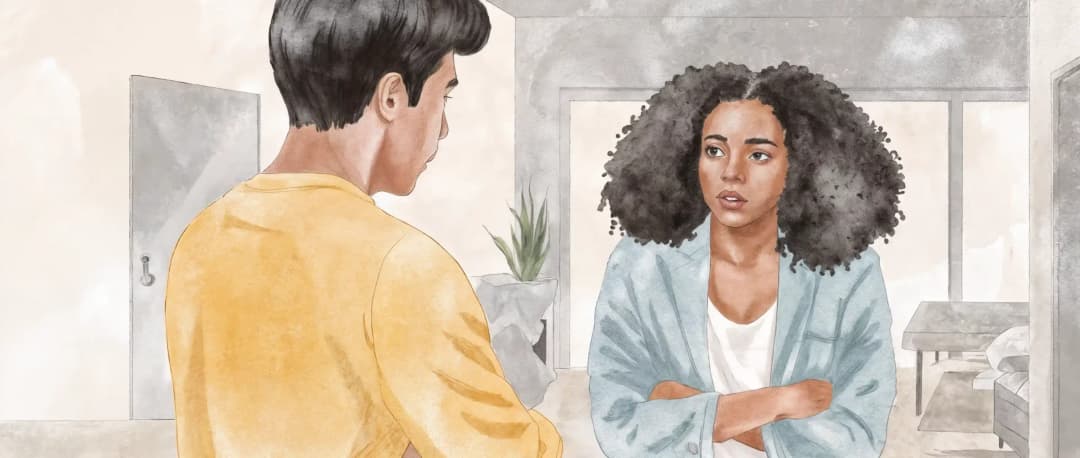
Have you ever had someone point out something you did, and you immediately get angry, make excuses, or try to prove them wrong? Let’s find out the underlying reasons why you might be feeling attacked and reacting defensively in everyday life.
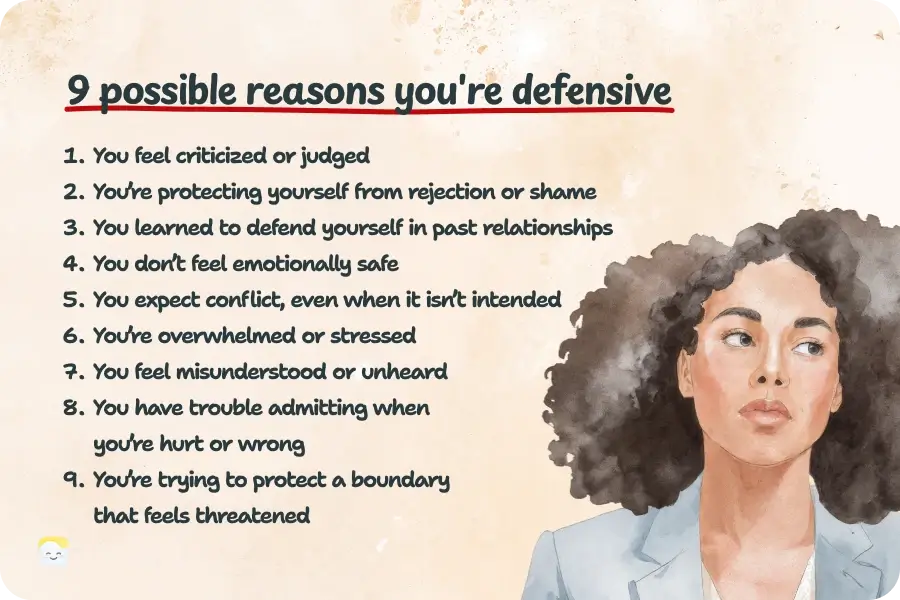
9 Root Causes for Defensive Behavior
Being a defensive person doesn’t necessarily mean you’re arrogant, difficult, or unwilling to accept criticism. Often, defensiveness is a form of self-protection. Something in the conversation makes you feel emotionally, socially, or psychologically threatened, and your mind reacts by trying to protect you.
1. You May Be Protecting Yourself From Shame
One of the biggest reasons people take things personally and become defensive is that criticism feels like “There is something wrong with me” [1] Trauma Research UK. Do You Often Take Things Personally. April 2024. .
- Imagine your partner says, “You forgot to call me like you said you would.”
- A typical response might be, “You’re right. I’m sorry. I forgot.”
- But if you associate mistakes with being a bad person, your mind may immediately try to protect you, and you respond with, “You forget things all the time.”
Now the conversation is no longer about forgetting the phone call. It’s about defending your worth.
Could your defensiveness be connected to your past trauma? Take a Childhood Trauma Test to learn more about how your story may affect the way you respond to criticism, conflict, and relationships today.

2. You May Have Learned That Mistakes Are Dangerous
Think about how you handled mistakes when you were younger:
- Were you allowed to make mistakes?
- How would the people in your life respond to you when you made mistakes?
- Could you say, “I don’t know”?
- Could you admit that you were wrong without being humiliated?
For example, your boss says, “Can we talk about this report? There are a few things I’d like you to change.” Your body reacts before you’ve even processed the sentence. You feel tense and start explaining, “I only did it that way because…”
The boss may simply be giving you instructions, but your nervous system may interpret the situation as “I’m in trouble.” In this case, you may be defending not your report but yourself against an old feeling.
3. You May Be Afraid of Being Rejected
Sometimes defensiveness is connected to the fear that criticism will lead to abandonment [3] Marici M, Clipa O, Runcan R, Pîrghie L. Is Rejection, Parental Abandonment or Neglect a Trigger for Higher Perceived Shame and Guilt in Adolescents? June 2023 .
Your defensive reaction may seem disproportionate to the original comment because you’re responding not just to the present moment but also to what the comment means to you.
Getting defensive in difficult conversations with your partner? Take a free Attachment Style Test to learn more about how you respond to emotional closeness, conflict, and relationships.

4. You May Feel Misunderstood
Another common reason for defensiveness is the feeling, “That’s not who I am.”
Imagine someone says, “You’re being selfish.” If you strongly believe that you’re a caring person, that statement can feel like an attack on your identity. You might immediately respond: “I’m not selfish! I do so much for everyone.”
Now, you’re not discussing the specific behavior anymore. You’re defending your character.
5. You May Actually Be Guilty
Sometimes we become defensive because, deep down, we know the other person has a point. This can be uncomfortable.
- Imagine someone says, “You’ve been avoiding me.”
- Your immediate response is “No, I haven’t!”
But you know you’ve been ignoring their messages. Why deny it? Because admitting it means confronting something uncomfortable.
6. You May Be Tired of Being Criticized
Not all defensiveness comes from insecurity. Sometimes people become defensive because they genuinely feel over-criticized.
Imagine someone constantly comments on everything you do:
- “Why did you do it that way?”
- “You should have done this.”
- “You always forget.”
- “You’re too sensitive.”
- “You never listen.”
Eventually, even a reasonable comment may feel exhausting. You might think, “Here we go again.” So your defenses go up before you even know what the person wants.
7. You May Be Confusing Explanation With Excuses
There’s nothing wrong with explaining yourself. The problem happens when every explanation becomes a way to avoid responsibility.
For example: “I was late because traffic was terrible.” That’s an explanation.
But “I was late because traffic was terrible, and you know how difficult mornings are, and I barely slept, and you were late last week too…” might be an attempt to avoid simply saying, “I’m sorry I was late.”
8. You May Think Being Vulnerable Means Being Weak
Defensiveness often says, “Don’t let them see that they got to you.”
- So instead of saying, “That hurt me,” you say, “Whatever.”
- Instead of saying, “I’m scared you’re disappointed in me,” you say, “I don’t care what you think.”
- Instead of “You’re right, and I feel embarrassed,” you argue for twenty minutes.
Why? Because vulnerability can feel dangerous. But it isn’t the same as weakness. Sometimes saying, “That comment made me feel insecure,” takes more courage than saying, “You don’t understand what you’re talking about.”
9. Your Body May React Before Your Mind Does
Defensiveness isn’t always a conscious decision. You may notice physical signs first:
- Your heart starts racing
- Your face feels hot
- Your muscles are tense
- You feel an urge to interrupt
- Your voice gets louder
- You suddenly want to leave
- You feel like you have to respond immediately
What Does It Mean to Be Defensive?
Defensiveness is a reaction to a perceived attack, such as criticism, blame, rejection, or judgment. Defensiveness can look like:
- Explaining yourself immediately
- Making excuses
- Getting angry
- Blaming the other person
- Interrupting
- Changing the subject
- Becoming sarcastic
- Saying “I don’t care” when you actually do
- Shutting down completely, becoming quiet, distant, or emotionally unavailable
- Turning criticism back onto the other person
- Feeling the need to prove that you’re right
- Assuming someone has bad intentions
For example, someone says, “You’ve been distant lately,” and you immediately respond, “I’m not distant. I’ve just been busy.” Or someone tells you, “That comment hurt my feelings,” and your first reaction is, “Well, you hurt my feelings too.”
Expert Insight
Defensiveness can be a trauma response, but not all the time. Everyone has various defenses they use to navigate the presence of rejection, conflict, shame, etc. Oftentimes, defenses show as a result of some experience of discomfort.

Hannah Schlueter
Mental health professional
5 Tips to Stop Being Defensive and Accept Responsibility
You don’t have to defend yourself from every piece of feedback. But you also don’t have to accept every criticism as truth. Here’s how to reduce your own defensiveness and strengthen your relationship skills:
1. Pause Before Responding
Imagine your friend says, “You seem really stressed lately.” You might hear, “You’re not handling your life well.” Even though that wasn’t what the person said, your brain may fill in the gaps based on your insecurities and past experiences.
Instead of immediately responding, “That’s not true!” try taking a deep breath and saying, “Give me a second to think about that.” That small pause can prevent a reaction from becoming an argument.
2. Separate Behavior from Identity
Another less defensive response might be, “What did I do that made you feel that way?” That question creates space between your behavior and your identity.
You can disagree with someone’s interpretation without needing to prove that you’re a perfect person. Instead of “They’re saying I’m a terrible person.” try: “They’re pointing out something I did.”
3. Ask Yourself: “What Am I Actually Defending?”
This may be the most useful question. Maybe you’re protecting:
- Your image
- Your pride
- Your sense of competence
- Your relationship
- Your independence
- Your need to be right
- Your fear of being seen as a bad person
- Your fear of rejection
- Your fear of disappointing someone
For example, someone says, “You didn’t handle that very well,” and you immediately want to argue. Try to pause and think, what are you defending?
Maybe the real thought is, “If I admit I handled it badly, they’ll think I’m incompetent.” Now you have something meaningful to work with.
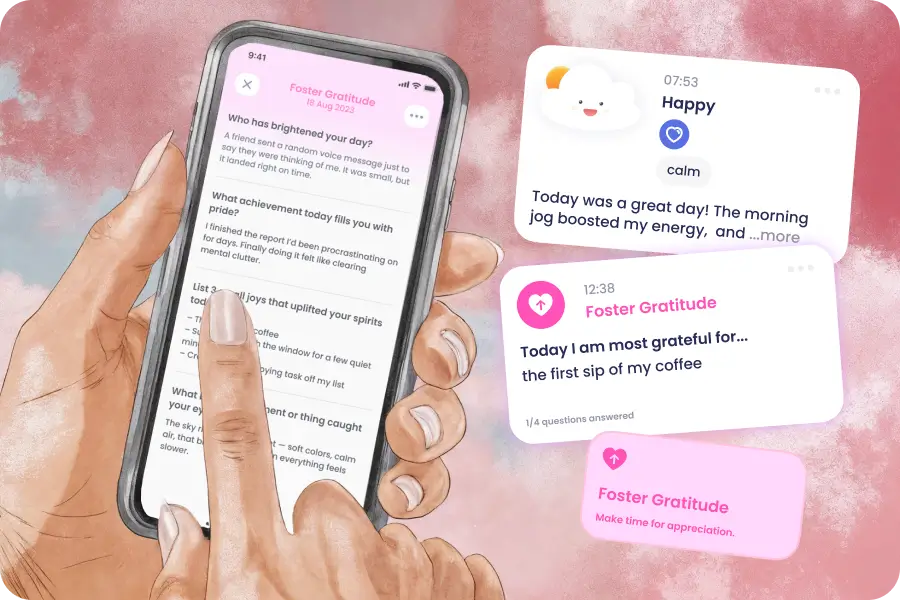
Guided journaling in the Breeze app helps you notice your reactions before they control you. With regular practice, you can start to realize what triggers your defensiveness and break free from old patterns. For example, you may journal your reflections the next time you feel yourself becoming defensive:
- Try asking, “What am I afraid this person is going to think about me?”
- Then ask, “If they’re right, what would that mean about me?”
- And finally: “Can I accept that I made a mistake without deciding that I am a mistake?”
4. Take Responsibility Where It’s Appropriate
Ask: “Is there even 5% of what they’re saying that might be true?” You don’t have to agree with everything to acknowledge something.
Then, you can say, “I can understand why that bothered you,” or “You’re right. I could have handled that differently.” Taking responsibility doesn’t mean accepting unfair blame. It shows you acknowledge your part.
5. Set Boundaries
It’s also important not to label every form of self-protection as defensiveness. Someone can criticize you unfairly, manipulate you, or constantly blame you.
You don’t have to accept that. In this case, the solution isn’t necessarily to become less defensive. It may also involve learning to set boundaries around how other people communicate with you. For example, if someone tells you, “You always ruin everything,” you don’t need to calmly accept that statement just because you’re trying to become less defensive.
You can say, “I’m willing to talk about what happened, but I’m not willing to be insulted.” That’s a boundary, not necessarily defensiveness.
Expert Insight
Constructive feedback, more often than not, is given assertively, meaning someone communicates it directly but with compassion. It is okay to protect yourself from harmful, aggressive, or otherwise negligent behaviors of others.
Hannah Schlueter
Mental health professional
How to Deal With a Defensive Person
Dealing with a defensive partner, friend, family member, or colleague can be frustrating. You may feel like you can’t bring up a problem without them getting angry, making excuses, or turning the conversation back on you.
But arguing harder usually makes defensiveness worse. The goal is to make the conversation feel safer while still being clear about what you need.
1. Stay calm
If you become angry too, the conversation can quickly turn into a fight. Instead of “Why are you getting so defensive?” try “I’m not trying to attack you. I just want to talk about what happened.”
2. Don’t blame their character
Avoid statements like “You’re so selfish” or “You never listen.”
Focus on the specific behavior instead: “When you interrupted me, I felt like you weren’t listening.” This gives them something specific to respond to instead of making them feel attacked.
3. Let them explain
Sometimes defensiveness comes from feeling misunderstood. You can ask, “Can you help me understand how you see it?”
You don’t have to agree with their explanation. Just giving them a chance to speak can lower the tension and create a deeper connection.
4. Don’t get pulled into proving who’s right
A defensive person may respond to criticism by bringing up something you did wrong.
For example:
– I was upset when you canceled our plans.
– Well, you canceled on me last week!
Instead of immediately defending yourself, try: “We can talk about that, too. Right now, I’d like to finish talking about what happened today.”
5. Be clear about what you need
Don’t make the other person guess what you want. Instead of “You don’t care about me,” try “I’d like you to listen before responding.” Clear requests are easier to understand than accusations.
6. Know when to take a break
If the conversation becomes too heated, continuing may only make things worse. You can say, “I don’t think we’re getting anywhere right now. Let’s take a break and talk about it later.”
Taking a break isn’t avoiding the problem. Sometimes, it’s what lets you come back and actually solve it.
7. Remember that you can’t make someone change
You can communicate calmly, listen, and choose your words carefully, but you can’t control how another person responds.
If someone constantly blames you, refuses to take responsibility, insults you, or turns every conversation against you, the problem may be more than simple defensiveness. You can be kind and understanding without accepting unhealthy behavior.
Frequently asked questions
1. Is being defensive a sign of insecurity?
It can be, but not always. Defensiveness sometimes comes from insecurity, fear of rejection, shame, or a need to feel in control. However, it can also happen when you’re genuinely being misunderstood, unfairly criticized, or repeatedly blamed.
2. Why do I get angry when someone points out my mistakes?
Anger can be a secondary emotion that appears when you feel embarrassed, ashamed, threatened, or powerless. For example, you might make a mistake at work, and your manager points it out. Instead of feeling the embarrassment directly, you become angry: “Why are you making such a big deal out of it?” The anger may be protecting you from the uncomfortable feeling underneath it.
3. Why do I always feel like I have to explain myself?
You may have learned that you need to justify yourself in order to be understood, accepted, or forgiven. If you grew up feeling that your intentions were constantly questioned, you may automatically start explaining whenever someone is upset with you.
4. Why do I become defensive with the people I love most?
We often feel the most emotionally vulnerable with people we care about. A comment from a stranger might not matter much, but criticism from a partner, parent, friend, or family member can feel much more significant because their opinion matters to you. Sometimes defensiveness is connected to fear of losing the relationship.
5. How do I know if I'm being defensive or if someone is actually treating me unfairly?
Ask yourself a few questions:
- Did they criticize a specific behavior or attack my character?
- Are they willing to listen to my perspective?
- Is this a one-time disagreement or a constant pattern?
- Can I disagree without being punished or insulted?
- Am I reacting to what they said or to what I think they meant?
For example, “You forgot to do what you promised” is different from “You never do anything right.” The first can be useful feedback. The second is a personal attack.
Sources
- Trauma Research UK. Do You Often Take Things Personally. April 2024.
- Cun Li, Peicai Fu, Minghuan Wang, Ye Xia, Caihong Hu, Mao Liu, Han Zhang, Xin Sheng, and Yuan Yang. The role of self-esteem and emotion regulation in the associations between childhood trauma and mental health in adulthood: a moderated mediation model. April 2023.
- Marici M, Clipa O, Runcan R, Pîrghie L. Is Rejection, Parental Abandonment or Neglect a Trigger for Higher Perceived Shame and Guilt in Adolescents? June 2023
Disclaimer
This article is for general informative and self-discovery purposes only. It should not replace expert guidance from professionals.
Any action you take in response to the information in this article, whether directly or indirectly, is solely your responsibility and is done at your own risk. Breeze content team and its mental health experts disclaim any liability, loss, or risk, personal, professional, or otherwise, which may result from the use and/or application of any content.
Always consult your doctor or other certified health practitioner with any medical questions or concerns
Breeze articles exclusively cite trusted sources, such as academic research institutions and medical associations, including research and studies from PubMed, ResearchGate, or similar databases. Examine our subject-matter editors and editorial process to see how we verify facts and maintain the accuracy, reliability, and trustworthiness of our material.
Was this article helpful?