



The top 10 reasons why you might obsess over people include:
- Limerence
- Insecure attachment styles
- Obsessive love disorder (relationship OCD)
- Low self-esteem
- Loneliness
- Idealization
- Uncertainty or lack of closure
- Hyperfixation
- Other mental health conditions
- Hate & dislike of the person you’re obsessed with
The answer to the question “Why am I obsessed with someone?” lies in a formula: strong feelings for a particular person + unmet needs that obsession could satisfy.

What can cause obsession with a person? 10 reasons
Obsessive thoughts rarely appear due to only one cause. Molding experiences in childhood could predispose you to obsessive attachment, but your current feelings and even temporary moments of vulnerability in adulthood could amplify this need.
Instead of searching for THE reason to explain your obsession, look at it as a system of causes that feed each other. These 10 causes are the most common pieces of that system.
1. Limerence
Limerence is commonly compared to crushes. But unlike crushes, limerence is more of an addiction-like state of mind. You might experience limerence if:
- Your mood depends on the behavior of your limerent object.
- You fantasize and daydream about them so much that it gets in the way of real life.
- You overthink details of their behaviors and your interactions.
Uncertainty is limerence’s driver: when you don’t know how they feel about you, you may want to do something that will give you certainty that you’ve “won over” their attention.
2. Insecure attachment styles
Most attachment style development happens in childhood. Following the example of your parents and your relationships with them, your attachment style determines how you will relate to other people: build relationships with them, see your roles there, interact, and even think about them.
If a child experiences emotional/physical abuse, neglect, inconsistency in the household, or intense fear, they may not develop the ability to trust people or trust themselves in relationships with others.
Here’s how anxious attachment can make you more obsessive:
- Thinking feels like control. Replaying conversations and imagining scenarios gives you the sense that you’re preventing something, even though you can’t control what the other person feels.
- Lack of safety makes you keep watching the other person for signs they might leave or hurt you in some other way.
- Attention/validation from someone else becomes proof that you’re okay. You can only be happy when they’re happy because, in childhood, mood swings of your parents could decide whether the day is good/bad and even safe/dangerous.
Psychologists call this pattern hyperactivation: when you’re afraid of losing someone, your mind turns its attention to the relationship all the way up, in the hope of keeping them close.

3. Obsessive love disorder (relationship OCD)
Obsessive love disorder is a term from pop psychology used to describe intense possessiveness, jealous behavior, and a constant need for reassurance from the person they love. But it is not the official diagnosis in the Diagnostic and Statistical Manual of Mental Disorders (DSM-5).
What is recognized in the DSM, though, is obsessive-compulsive disorder (OCD).
Relationship OCD (ROCD) is a pop culture subtype that focuses on bonds with other people, especially on romantic relationships [1] Relationship obsessive compulsive disorder (ROCD): A conceptual framework. G. Doron, D. S. Derby, O. Szepsenwol. Journal of Obsessive-Compulsive and Related Disorders. April 2014. . People with ROCD can have intrusive thoughts like “Do I really love them?” or “Do they secretly hate me?” even when there are no causes for such doubts.
People with ROCD can turn to compulsive behaviors to feel perceived control over their obsessive thoughts, like comparing their partner to others or asking friends for reassurance again and again.
Have you ever had an intrusive thought that someone you know can secretly hate you, even though you consciously understand that it’s not rational?
4. Low self-esteem
Psychologist Mark Leary describes self-esteem as an internal “sociometer” that shows how accepted you are by society. Low self-esteem, in Leary’s theory, is a signal to the brain that you might be rejected, which the brain perceives like a real threat to survival [2] Me, us, and them: Testing sociometer theory in a socially diverse real-life context. A. K. Reitz, F. A. Motti-Stefanidi, J. B. Asendorpf. Journal of Personality and Social Psychology. 2016. .
On the other hand, when a person does give you validation, you may not fully believe it because of your opinion of yourself, so you keep seeking reassurance.
Without inner support systems, like a basic sense that you’re okay on your own, their approval starts to feel like the only thing holding you up. This constant monitoring can turn your desire to protect yourself into an actual obsession with someone (or with their attention).
5. Loneliness
If you can’t stop fantasizing about how you receive attention from a loved one, you could be yearning for simple human warmth.
As a human species, we evolved to form social bonds for survival. So, when we don’t really have authentic connections, it’s totally normal to fantasize about how you receive love and attention. It’s like you dream about a juicy burger when you’re starved.
A person you’re obsessing over can be a complete stranger, a celebrity crush, or your friend. In any case, it’s a person who you can safely project your emotional needs onto.
6. Idealization
When you don’t know someone well, your mind fills in the blanks, which is also the brain’s natural mechanism to cope with the unknown. If you like the person you don’t know much about, your brain may choose to fill these blanks with good things to confirm your beliefs about them.
That’s why it’s easy to obsess over someone you barely know: situationships, celebrity crushes, new friends, etc. You’re not attached to the real person so much as to the future or narrative you’ve built around them in your head.
In reality, the first stages of relationships can also resemble obsessions. When psychologists studied people recently and intensely in love, they found that participants thought about their beloved for more than 85% of the hours they were awake [3] Intense, Passionate, Romantic Love: A Natural Addiction? How the Fields That Investigate Romance and Substance Abuse Can Inform Each Other. H. E. Fisher, X. Xu, A. Aron, L. L. Brown. Frontiers in Psychology. May 2016. .
Important: Idealization can be a sign of possible mental health conditions like delusional disorder or BPD. It can also push people to unhealthy behaviors like social media stalking or love-bombing.
7. Uncertainty or lack of closure
Our brains hate unfinished stories. So, if you keep getting mixed signals or have unanswered questions about someone, you can obsessively think about them until it finally makes sense for you.
Psychologists attribute human desire for closure to the Zeigarnik effect:
That search for the “answer” can bring more anxiety and stress than answers. Sometimes closure is your responsibility—something you have to give yourself.
8. Hyperfixation
Obsessive thoughts about someone can come from hyperfixation: an all-absorbing focus that takes over your thoughts the way a new hobby might. Hyperfixations create blinders in our minds that block out other sources of focus.
Hyperfixation appears due to the dysregulation of dopamine, which is why it’s very common in neurodivergent individuals or people with ADHD. Maybe thinking about this person makes you feel happy and satisfied, like you won’t be in real life.
“From a psychological standpoint, what purpose does idealizing someone serve for the person having obsessive thoughts?” Katherine Scott, lead Licensed Marriage and Family Therapist (LMFT), answers,
“Largely, idealization fuels a false sense of connection, which can be powerful for those experiencing hardship or loneliness.
Idealization is a form of escapism when we conceptualize someone without proof. It’s a place for our minds to seek refuge when life is difficult.
Furthermore, idealization attempts to mask negative qualities in people, which can occur during toxic relationships.”
Unpredictable attention can make hyperfixation even stronger. When someone is affectionate sometimes and distant other times, they activate the slot-machine effect in your brain:
You keep obsessing over someone because your brain is anticipating and hoping for the reward—attention from that person. Your brain doesn’t know when the next “win” will come, so it keeps “tossing coins”: constantly thinking about them, stalking social media, analyzing every word they say, etc.
9. Other mental health conditions
Several other mental health conditions can make you more likely to obsess over a person:
If obsessions start to interfere with your well-being or other responsibilities, it’s time to seek support. Only a mental health professional can tell whether your obsessive thoughts are linked to mental health issues like these.
10. Hate & dislike of someone
You can become obsessed with someone you dislike just as easily as with someone you love. An ex who hurt you, a coworker who wronged you… But why would you become obsessed with someone you hate? Two reasons:
- Threat monitoring: your brain keeps tracking people it sees as dangerous to your safety or self-worth. Extreme jealousy can be a consequence of threat monitoring.
- Anger and a sense of injustice: replaying what happened or imagining the perfect comeback can give a brief relief from feeling helpless. You get “addicted” to this relief and keep fantasizing about justice, continuing the loop.
Katherine Scott, LMFT, explains why it’s so easy to become obsessed with someone through hate,
“Criticizing and judging others can create a false sense of safety and superiority for people.
If someone experiences an insecure attachment pattern or has experienced relational pain in their past, defaulting to criticism serves as a maladaptive coping mechanism to attempt to protect oneself from future pain.
However, this sort of ‘obsession’ also isolates a person, which fuels the self-sabotaging nature of it.”
What does it mean to be obsessed with someone?
You can still think about a person a lot without being obsessed with them. So, how to tell if you are obsessed with someone rather than simply attracted to them? What sets obsession apart is control:
- With ordinary attraction/thinking, you think about someone and then can get on with your day.
- With obsession, the thoughts feel all-consuming and can trigger shame, overwhelm, confusion, and self-deprecation.
Passionate love vs. unhealthy obsession with a person
In short:
- Passionate love makes room for both of you to have full lives and identities.
- An unhealthy obsession shrinks your world down to one person, which can negatively impact yours and their well-being.
Both passionate love and obsessing over someone can feel intense. Both can keep you up at night. And both can make you confused about whether it’s normal. But they’re different in other ways:
Passionate love |
Unhealthy obsession |
Grows from time actually spent together. |
Grows mostly from fantasy and imagination. |
Feels exciting. |
Feels exciting, but anxious and on edge as well. |
Respects the other person’s space, even despite strong curiosity. |
Makes you look where they are and who they’re with, despite morals and common sense. |
Lets you keep your friends, interests, separate identities. |
Pushes everything else aside just to focus on this one person and please them. |
Is realistic and can grow into long-term relationships. |
Is not realistic and has a low chance of becoming something bigger. |
Happens between two people who consent to it. |
Usually isn’t reciprocal: the object of obsession might not be aware of the other person’s emotions. |
Is being obsessed with someone bad?
Strong feelings about others aren’t bad in themselves, but obsession has a bad reputation for a reason.
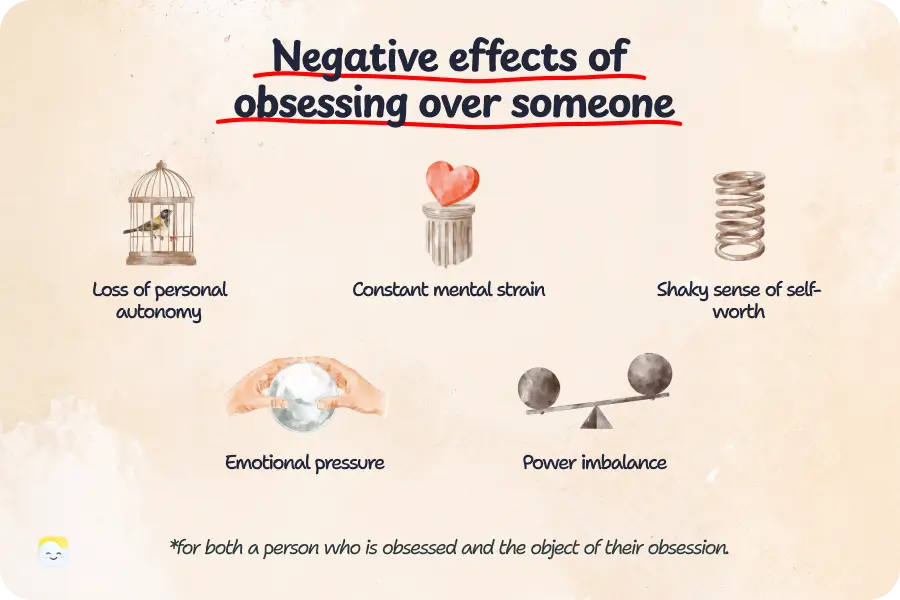
Obsession can become harmful when it costs you your well-being or crosses the other person’s boundaries. Here’s how it can affect everyone involved:
How to stop obsessing over someone? 7 tips
You can’t switch off strong feelings on command, but you can stop feeding the thoughts that keep an obsession going. If you’re wondering how to deal with obsession, start with these tips. Changes, small or big, perfect or inconsistent, do impact how you respond to your obsessive thoughts.
1. Don’t fight obsessive thoughts
Trying to push obsessive thoughts away usually makes them come back stronger. Remember: notice, don’t suppress.
When a thought about the person pops up, don’t try to work out where it came from or what it means for you yet:
- Just name it as a thought: “I’m having the thought that I need to check their profile.”
- Don’t give yourself an instruction: “Don’t do it! It’s creepy.”
Firstly, this creates distance between you and the urge, separating your identity from your obsession. Secondly, sitting with an urge and not acting on it calms it down and reduces the desire to make something “obsessive.”
A quick note in a journal or mood tracker like the Breeze app can help you see when these urges show up most, so you can catch them earlier next time.

2. Ground your expectations
Many obsessive thoughts are mental shortcuts that jump to conclusions. Yes, they are comfortable because you don’t have to doubt yourself when every thought already makes sense in your head.
So, question the deep-rooted stereotypes. Especially challenge the thoughts that feel the most vivid and emotional, because those are usually the least reliable.
A thought like “They looked at me, so they must like me” can feel convincing, but look at the evidence: a look is just a look, and it cannot prove attraction.
You cannot read anyone’s mind. So, if you want to know how someone feels for sure, there’s only one way to find out: ask them directly.
3. Cut down reminders/triggers
Every reminder of the person can restart intrusive thoughts, so remove as many as you can.
Habit research proves that certain routines and cues in your environment that you associate with the person you obsess over can automatically trigger rumination [5] Psychology of Habit. W. Wood and D. Rünger. The Annual Review of Psychology. 2016. . So, get rid of your triggers, like a time, place, photos, or social media that can trigger it automatically.
Out of sight won’t mean out of mind overnight. But it gives your brain fewer chances to fall back into old habits.
4. Try CBT exercises
Obsessive thoughts can be vague and more emotion-based. Exercises from cognitive behavioral therapy (CBT) are good for bringing thinking back to reality and concrete facts. For example:
| Rumination thoughts | CBT questions |
| “Why did they say/do that to me?” | “Am I reacting to what this person actually did or said, or to my interpretation of what it means?” |
| “I can’t live without them!” | “Have I survived rejection or loss in the past, and what strengths got me through it then?” |
| “They are perfect.” | “What are 3 realistic, everyday flaws or limitations they have?” |
Sometimes the honest answer to CBT questions is “I don’t know, and I can’t know right now.” And learning to sit with that uncertainty, without filling it with stories, is part of healing too.
5. Practice more self-care
Obsession appears or grows bigger when one person becomes your main source of meaning. The more of your life depends on them, the harder it is to let go of them.
Make room for things that are just for you, even before you feel motivated to do them. Pick one or two a day, like a walk, a class, or an hour on a project you care about.
6. Reintroduce other people in your life
Shifting your focus from one person to many people reminds you once again that meaning is not reserved for that one person only. The sense is in connection, not in someone else’s approval. Start small:
- Reach out to friends from lost relationships you’ve let slip.
- Join a group built around an activity, like a running club or a class, so that connections grow around shared interests, not personalities of each other.
- Choose low-pressure plans, like a coffee or a walk, instead of big conversations right away.
To avoid repeating the same pattern, spread your time among several people instead of making one new person your focus. Set clear boundaries for yourself, like not texting someone new every hour, and notice when you start comparing people to the one you are obsessed with.
7. Seek support
If the obsession is causing real distress or you can’t stop it on your own, it’s worth talking to a professional. Signs it’s time to reach out for support:
- You feel intense distress most days.
- You struggle to sleep or function at work/school.
- You can’t stop contacting or monitoring the person.
- You feel depressed or hopeless.
- You have thoughts of harming yourself.
Individual therapy with a professional trained in CBT or exposure and response prevention (ERP) can help you break the cycle. If the obsession is linked to trauma or another mental health condition, a qualified professional can also suggest the right treatment or a support group.
Frequently asked questions
What does obsession feel like?
Obsession can feel very restless, elevated, on-edge, frightening, and almost addiction-like. When an object of obsession does something you like or gives you attention, it can feel euphoric. On the other hand, when they don’t correspond with the image in your own head, it can feel empty and like you’re stuck. Obsession can feel like constant anticipation and hope: you’re always waiting for the next sign of how they feel about you.
Why do I get obsessed with crushes so easily?
You may get obsessed with crushes easily because the first stages of love/relationships can feel high due to a hormone rush. New attraction combines novelty with uncertainty, two things the brain finds very rewarding. The euphoric feelings can make you idealize potential partners, which can make you want to spend more time with them.
Why am I obsessed with a guy I barely know?
When you barely know someone, your imagination can fill in everything you don’t know. So, if a person appeals to you due to their appearance, character, ideas, etc., your brain can fill in what you don’t know with idealization. You’re often drawn to who you hope he is, not who he actually is. This is a stage that can last up to 2 years if you start dating.
Why am I obsessed with my friend?
You may be obsessed with your friend due to admiration, a strong emotional bond, or a fear of losing them. It isn’t always romantic. You might want to be like them or feel jealous when they spend time with others. Obsession with a friend can be unhealthy if your mood depends on their attention or when you cross their boundaries/privacy.
Sources:
- Relationship obsessive compulsive disorder (ROCD): A conceptual framework. G. Doron, D. S. Derby, O. Szepsenwol. Journal of Obsessive-Compulsive and Related Disorders. April 2014.
- Me, us, and them: Testing sociometer theory in a socially diverse real-life context. A. K. Reitz, F. A. Motti-Stefanidi, J. B. Asendorpf. Journal of Personality and Social Psychology. 2016.
- Intense, Passionate, Romantic Love: A Natural Addiction? How the Fields That Investigate Romance and Substance Abuse Can Inform Each Other. H. E. Fisher, X. Xu, A. Aron, L. L. Brown. Frontiers in Psychology. May 2016.
- The Zeigarnik Effect. R. Kontinou, D. Georgiou, P. Giamarellos M. Bitha. Open Schools Journal for Open Science. December 2025.
- Psychology of Habit. W. Wood and D. Rünger. The Annual Review of Psychology. 2016.
Disclaimer
This article is for general informative and self-discovery purposes only. It should not replace expert guidance from professionals.
Any action you take in response to the information in this article, whether directly or indirectly, is solely your responsibility and is done at your own risk. Breeze content team and its mental health experts disclaim any liability, loss, or risk, personal, professional, or otherwise, which may result from the use and/or application of any content.
Always consult your doctor or other certified health practitioner with any medical questions or concerns
Breeze articles exclusively cite trusted sources, such as academic research institutions and medical associations, including research and studies from PubMed, ResearchGate, or similar databases. Examine our subject-matter editors and editorial process to see how we verify facts and maintain the accuracy, reliability, and trustworthiness of our material.
Comments (0)
Was this article helpful?