



You get easily distracted, constantly replay conversations in your head, find it challenging to meet deadlines, and get overwhelmed about small things.
Is it anxiety or ADHD? Or, maybe, both? Explore what your psychological symptoms might be related to and find out how to handle your racing thoughts.

Do I have ADHD or anxiety? Take the free test
Attention-deficit/hyperactivity disorder (ADHD) vs. anxiety in adults at a glance
People might confuse ADHD and anxiety due to overlapping symptoms. Let’s explore how they might influence your life.
Comparing adult ADHD vs. anxiety symptoms
| Symptom or experience | ADHD | Anxiety |
| Racing thoughts | Thoughts jump quickly between ideas, topics, or tasks. | Your thoughts may repeatedly focus on worst-case scenarios |
| Procrastination | Putting things off due to trouble starting, organizing, or sustaining attention. | Delaying tasks due to fear of making mistakes or falling. |
| Forgetfulness | Frequently losing track of appointments or belongings. | Forgetfulness may occur when your attention is taken by something you worry about. |
| Avoidance | Avoiding tasks that feel boring or complicated. | Avoiding tasks that trigger fear, worry, or uncertainty. |
| Time management | You may underestimate how long tasks will take and lose track of time. | You might spend excessive time planning or preparing because you worry about what might go wrong. |
| When symptoms start | In childhood | At any point in life |
| Root causes | A neurodevelopmental condition linked to differences in how the brain functions | Involves a combination of genetic, biological, psychological, and environmental factors |

Symptoms that ADHD and anxiety have in common
Studies prove that anxiety disorders are among the most prevalent comorbidities, estimated to affect 25–50% of ADHD patients. [1] Fu X, Wu W, Wu Y, Liu X, Liang W, Wu R, Li Y. “Adult ADHD and comorbid anxiety and depressive disorders: a review of etiology and treatment.” Front Psychiatry. 2025 Even more, 31.3% of children and adolescents with ADHD had a comorbid anxiety disorder. [2] Tsang TW, Kohn MR, Efron D, Clarke SD, Clark CR, Lamb C, Williams LM. “Anxiety in young people with ADHD: clinical and self-report outcomes.” J Atten Disord. 2015
This is because ADHD and anxiety can affect some of the same areas of daily functioning, making their symptoms difficult to distinguish. In particular, they might contribute to:
Symptoms unique to ADHD
Some experiences are particularly characteristic of ADHD. These can include:
- Difficulty focusing regardless of emotional state (not only when stressed).
- Impulsive actions without thinking about consequences.
- Frequently losing or misplacing everyday items.
- “Time blindness” and difficulty estimating how long tasks take.
- Hyperactivity and a constant need to move.
- Hyperfocus on activities that are especially interesting or desirable to the individual.
Symptoms unique to anxiety
People with generalized anxiety disorder and other anxiety disorders may experience specific challenges different from those of ADHD. Those with heightened anxiety who don’t have an official diagnosis might face similar symptoms as well.
- Persistent, excessive worry that is difficult to control.
- Fear of potential problems.
- Constantly seeking reassurance.
- Avoiding situations that trigger fear or anxiety.
- Physical symptoms such as muscle tension, sweating, or a racing heart.
- A constant feeling of anticipation that something bad might happen.
What is ADHD?
Attention-deficit/hyperactivity disorder is a mental health condition that includes inattention, hyperactivity, and impulsivity. It’s a neurodevelopmental disorder that affects brain functioning through the way your brain regulates dopamine, attention, motivation, and executive functioning.
Research shows that 72.8% of adults in the ADHD group had at least one co-occurring medical condition. [3] Pehlivanidis A, Papanikolaou K, Mantas V, Kalantzi E, Korobili K, Xenaki LA, Vassiliou G, Papageorgiou C. “Lifetime co-occurring psychiatric disorders in newly diagnosed adults with attention deficit hyperactivity disorder (ADHD) or/and autism spectrum disorder (ASD).” BMC Psychiatry. 2020
Types of ADHD
What is an anxiety disorder?
Anxiety disorders are mental health conditions characterized by an intense fear or constant worry that is difficult to control and interferes with everyday life.
Types of anxiety disorders
There are several types of anxiety disorders, and each has its own characteristic pattern of fears. The main types include:
- Generalized anxiety disorder (GAD) involves excessive and persistent worry about everyday situations.
- Panic disorder involves recurring, unexpected panic attacks and a fear of another attack.
- Social anxiety disorder involves fear of being judged in social situations or anxiety regarding social interactions.
- Specific phobias are about an intense fear of a specific object or situation (like flying, heights, animals, etc.)
- Separation anxiety disorder involves excessive fear associated with separation from an attachment figure.
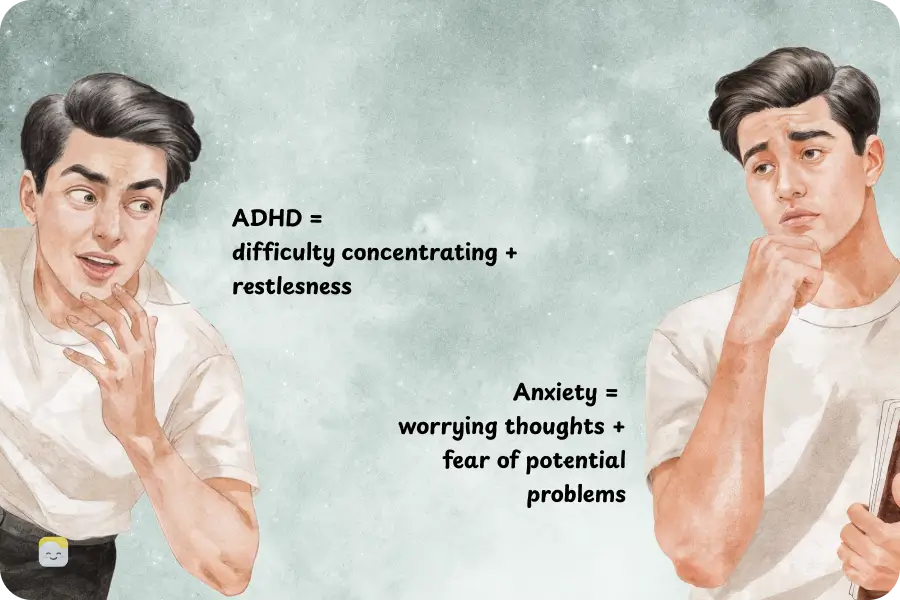
Anxiety vs. ADHD symptoms — Why they look so similar
Let’s go into more detail about symptoms that might look similar but are triggered by different causes or manifest in different ways.
Difficulty concentrating: ADHD vs. anxiety
- In ADHD, difficulty concentrating is related to low interest, poor working memory, or difficulty regulating attention.
- People with anxiety may have trouble concentrating because persistent worries occupy their attention.
Restlessness: ADHD vs. anxiety
- For people with ADHD, restlessness may come from a need for stimulation or difficulty sitting still.
- In anxiety, restlessness is often caused by nervousness because you’re feeling as if something might go wrong.
Sleep problems in both conditions
- In ADHD, sleep problems may be associated with difficulty relaxing, intrusive thoughts, and challenges with transitions.
- In anxiety disorders, sleep problems can happen due to persistent worry or repeated rumination about stressful situations.
Emotional reactivity
- Among people with ADHD, emotions can jump in intensity quickly. Frustration, excitement, rejection, or disappointment can trigger a strong reaction that may fade relatively quickly.
- In anxiety, emotional distress is more often connected to fear, uncertainty, or perceived threats.
Is anxiety a symptom of ADHD?
Anxiety is not a symptom of ADHD, but people with ADHD may experience it more often than the general population. [4] Van Ameringen M, Mancini C, Simpson W, Patterson B. “Adult attention deficit hyperactivity disorder in an anxiety disorders population.” CNS Neurosci Ther. 2011
Primary anxiety vs. secondary anxiety
Primary anxiety occurs as a separate disorder (like generalized anxiety disorder, social anxiety disorder, etc.). In this case, excessive worry or fear can appear even when ADHD-related difficulties are not present. The anxiety itself is usually the main source of distress.
Secondary anxiety may be ADHD-driven. People with secondary anxiety experience excessive emotional distress because they frequently miss deadlines, forget responsibilities, lose things, or find it difficult to organize themselves. All this can lead to self-doubt and fear of mistakes.
Does ADHD cause anxiety?
How untreated ADHD fuels anxiety over time
When ADHD symptoms consistently interfere with your daily life, you may begin to anticipate problems before they arise. For example, you may worry about forgetting an important task, being late, missing a deadline, or disappointing someone.
This can create a vicious cycle:
Emotional dysregulation as a hidden driver
Emotional dysregulation in ADHD can also cause additional stress. People with attention-deficit/hyperactivity disorder may experience frustration, rejection, or stress very intensely.
When these reactions are difficult to manage, it can lead to problems in romantic and friendly relationships, at work, or in the family, which, in turn, causes even more stress.
Can you have both ADHD and anxiety?
Yes, you can live with both ADHD and anxiety at the same time. As some symptoms overlap, it might be challenging to diagnose both disorders. Nevertheless, with professional evaluation, you can get a proper diagnosis.
Signs you might be dealing with both
You may experience both ADHD and anxiety if:
- You find it difficult to stay focused even when calm, but your concentration worsens when worried or stressed.
- You procrastinate and worry about it. Difficulty starting work may be related to ADHD, while fear of failure or missing deadlines can fuel your anxiety.
- Your attention jumps between ideas, while anxiety continually returns to the same fears or “what if” scenarios, which makes it difficult to handle daily tasks.
- You feel emotionally overwhelmed and worried at the same time. ADHD can make your emotions feel more intense, while anxiety can make you fear what might happen next.
Why is one often misdiagnosed as the other?
Sometimes anxiety might get misdiagnosed as attention-deficit/hyperactivity disorder (ADHD) and vice versa because they can cause specific self-regulation problems.
For example, someone with anxiety may appear distracted because they are preoccupied with worrying, while someone with ADHD may appear anxious because they are overwhelmed by unfinished tasks and daily responsibilities.
If only one condition is recognized, the underlying symptoms of the other may remain unaddressed.
Hannah Schlueter, MA, LAC, explains how mental health professionals typically differentiate ADHD and anxiety (or spot that these disorders are comorbid). “Mental health professionals utilize quantitative data such as evidence-based assessments and evaluative tools to assess symptoms of ADHD, anxiety, and the overlap of the two. We also use qualitative data such as personal anecdotes and information from the client themselves to better understand their symptoms and differentiate between the two diagnoses or identify comorbidity.”
ADHD vs. anxiety in women
ADHD in women can manifest differently compared to men.
Why is ADHD underdiagnosed in women?
Women with ADHD might lean toward quieter, inattentive symptoms. Because of this, it may be easier to attribute these behaviors to anxiety, stress, or emotional difficulties.
A woman may appear organized, responsible, or successful, yet still experience difficulty with concentration and forgetfulness. Anxiety may also be a more prominent problem, which is why ADHD can go unnoticed.
Masking: How women hide ADHD symptoms as “just anxiety”
Women may turn to different masking strategies to look like they cope with their inattentiveness. “It’s not a big deal. What’s wrong with me?” they might think while creating dozens of to-do lists, double-checking everything they do, setting multiple reminders, or spending extra time preparing for even simple tasks.
These strategies can help them seem organized from the outside, while on the inside, they may come at a high emotional cost. Constantly compensating for forgetfulness or poor time management can create a cycle of worry and self-criticism. As a result, ADHD symptoms may be mistaken for or overshadowed by anxiety.
Hormonal cycles and their effect on ADHD/anxiety symptoms
Hormonal fluctuations can exacerbate anxiety symptoms and make ADHD more difficult to diagnose. Changes in estrogen and progesterone throughout the menstrual cycle may affect attention, mood, energy, and emotional regulation.
Tracking your emotions alongside the menstrual cycle can help identify whether they follow a recurring hormonal pattern. This will give a healthcare professional a clearer picture of your symptoms.
How to tell if you have ADHD or anxiety
It might be challenging to understand what’s going on with you without a consultation with a healthcare provider. However, there are some things that might help you better understand your experiences.
The context test
- It might be ADHD if the symptoms are present from childhood, while anxiety can arise at any age.
- You might have ADHD if attention and organization problems persist even when you’re not stressed. Anxiety-related difficulties become more noticeable during periods of uncertainty.
- It might be anxiety if worry is at the center of your difficulties. Constant anticipation of negative outcomes is more characteristic of anxiety than ADHD.
When to see a doctor or mental health professional
You may need to see a doctor if the mental and physical symptoms you’re experiencing interfere with daily life and make it challenging to handle your obligations. A professional will access family history, learn more about your current state, check the symptoms, and prescribe the right treatment.
ADHD and anxiety treatment: What’s the difference?
Both ADHD and anxiety disorders can be treated, but the approach depends on the condition, the severity of symptoms, and how they affect your life.
ADHD medication and treatment options
ADHD can be treated with:
- Stimulant and non-stimulant medications
- Talk therapy
- Behavioral strategies and skills training
- Organizational and time-management techniques
- Structured routines and external reminders
Anxiety treatment options
Effective treatment for anxiety disorders might include:
- SSRIs (selective serotonin reuptake inhibitors)
- SNRIs (serotonin-norepinephrine reuptake inhibitors)
- Cognitive behavioral therapy (CBT)
- Other forms of psychotherapy
- Exposure therapy for specific anxiety disorders
- Relaxation and breathing techniques
- Mindfulness practices
Hannah Schlueter, MA, LAC, comments on whether ADHD medication can cause or worsen anxiety. “Some people may report an increase in anxiety because of a stimulant; however, some report a decrease in anxiety because of the improvement in executive functioning. I would recommend speaking with your prescriber to best understand what will work best for you long-term.”
Treating ADHD and anxiety together
When ADHD and anxiety disorder coexist, treatment may require addressing both conditions. The best approach depends on which symptoms are most prominent and how these conditions affect each other.
A doctor may recommend medication, psychotherapy, behavioral strategies, or a combination of these, with treatment adjusted over time based on your response.
Frequently asked questions
Can ADHD be mistaken for anxiety?
Yes, ADHD can be mistaken for anxiety disorders because they share many symptoms, including restlessness, racing thoughts, difficulty concentrating, and feeling overwhelmed, which might prevent people from living fulfilling lives.
Does anxiety make ADHD worse?
Yes, anxiety can worsen ADHD symptoms because it influences the way you regulate your emotions, manage time effectively, focus, organize tasks, and control impulses.
Constant worry can also use up mental energy and make it harder to manage ADHD challenges.
What's the difference between ADHD and being anxious?
ADHD is a neurodevelopmental disorder that affects how your brain works and makes it difficult to regulate attention, motivation, and executive functions.
Anxiety is a temporary emotional state that typically occurs in response to stress, uncertainty, or a perceived threat. Anxiety disorders, however, involve excessive fear or worry that is difficult to control and interferes with everyday life.
Can ADHD medication help with anxiety?
ADHD medications do not directly treat anxiety disorders. However, if anxiety is partly caused by uncontrolled ADHD symptoms, such as problems with time management, procrastination, emotional dysregulation, etc., ADHD treatment may help you manage these symptoms, thereby reducing anxiety.
Sources
- Fu X, Wu W, Wu Y, Liu X, Liang W, Wu R, Li Y. “Adult ADHD and comorbid anxiety and depressive disorders: a review of etiology and treatment.” Front Psychiatry. 2025
- Tsang TW, Kohn MR, Efron D, Clarke SD, Clark CR, Lamb C, Williams LM. “Anxiety in young people with ADHD: clinical and self-report outcomes.” J Atten Disord. 2015
- Pehlivanidis A, Papanikolaou K, Mantas V, Kalantzi E, Korobili K, Xenaki LA, Vassiliou G, Papageorgiou C. “Lifetime co-occurring psychiatric disorders in newly diagnosed adults with attention deficit hyperactivity disorder (ADHD) or/and autism spectrum disorder (ASD).” BMC Psychiatry. 2020
- Van Ameringen M, Mancini C, Simpson W, Patterson B. “Adult attention deficit hyperactivity disorder in an anxiety disorders population.” CNS Neurosci Ther. 2011
Disclaimer
This article is for general informative and self-discovery purposes only. It should not replace expert guidance from professionals.
Any action you take in response to the information in this article, whether directly or indirectly, is solely your responsibility and is done at your own risk. Breeze content team and its mental health experts disclaim any liability, loss, or risk, personal, professional, or otherwise, which may result from the use and/or application of any content.
Always consult your doctor or other certified health practitioner with any medical questions or concerns
Breeze articles exclusively cite trusted sources, such as academic research institutions and medical associations, including research and studies from PubMed, ResearchGate, or similar databases. Examine our subject-matter editors and editorial process to see how we verify facts and maintain the accuracy, reliability, and trustworthiness of our material.
Was this article helpful?