



Long-distance couples may love each other deeply and still struggle with loneliness, missed calls, misunderstandings, different schedules, or the feeling that they are living separate lives. Here are practical ways to make a long-distance relationship work and stay connected while still allowing each person to live a healthy, independent life.
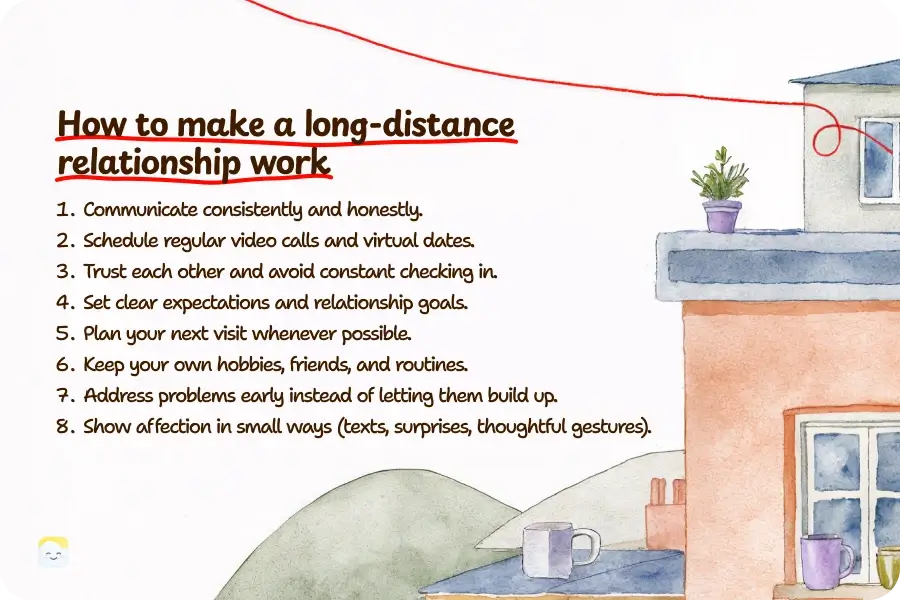
1. Define Your Expectations
One of the biggest sources of anxiety in a long-distance relationship is uncertainty. You should have open communication about your current status and what you expect from the relationship:
- Are you exclusive?
- How often do you expect to communicate?
- How do you handle social situations involving other people?
- How often do you expect to visit each other?
- How much personal space does each person need?
- What does commitment look like to each of you?
- What do you both want the relationship to become eventually?
For example, one partner might believe that texting throughout the day is normal, while the other considers a short evening call enough. Neither person is necessarily wrong. The problem is that they have different expectations. The end goal isn’t to set strict rules but to make sure you both want the same kind of relationship.
Want to understand how you connect in relationships? Take a test to learn more about your attachment patterns and how they may affect the way you handle geographic separation, communication, and emotional closeness.

2. Prioritize Consistent Communication Over Constant Communication
Dating long-distance can create the temptation to communicate all day just to compensate for not being physically together. That can become exhausting.
A healthier goal is consistent and meaningful communication, rather than being constantly available [2] Hogan JN, Crenshaw AO, Baucom KJW, Baucom BRW. Time Spent Together in Intimate Relationships: Implications for Relationship Functioning. September 2021 .
You might have a short morning message, exchange updates during the day, and have a longer conversation in the evening. Another couple may prefer fewer conversations but longer video calls.
Make some conversations intentional
Instead of only asking, “How was your day?” try questions that encourage a deeper conversation and personalized support:
Struggling with insecurity or defensive behaviors? Take the “Am I Toxic?” Test to gain deeper insights into your patterns and discover how to build healthier relationships.

3. Create Shared Experiences To Feel Connected
Another hard part of long-distance relationships is missing ordinary experiences. You aren’t there when your partner gets coffee, cooks dinner, watches a funny video, goes for a walk, or has a difficult day.
You can recreate some of that sense of togetherness. Try doing things simultaneously:
- Watch the same movie or series
- Listen to the same playlist or podcast
- Have a video-call dinner
- Cook the same recipe
- Play an online game
- Read the same book
- Take evening walks while talking on the phone
- Make plans for a future trip
- Send each other photos throughout the day
- Have virtual date nights
4. Don’t Let Every Conversation Become a Relationship Meeting
If every phone call is about the relationship, like asking “Why didn’t you reply?” or “When are we going to see each other?” communication can start feeling like an obligation.
5. Build Trust Instead of Trying to Monitor Each Other
When you cannot physically see what your partner is doing, your imagination may fill in the gaps. You might wonder, “Who are they with?” or “Why did they go out without telling me?”
At the same time, trust doesn’t mean ignoring genuine warning signs. If someone repeatedly lies, hides important information, breaks agreed boundaries, or dismisses your concerns, the solution isn’t simply to “trust harder.” Trust combines freedom with responsibility.
Expert Insight
It’s important to talk about feelings of jealousy in a long-distance relationship. While it’s not uncommon to feel this way, it’s crucial to accurately share how you are feeling and take note of how your partner chooses to respond. Feelings of jealousy should not be dealt with by controlling your partner, but instead can create a collaborative conversation on how to best move forward.

Hannah Schlueter
Mental health professional
6. Learn How to Handle Conflict
Arguments are difficult in any relationship, but physical absence makes them harder because you can’t sit together, talk things through, hold hands, hug, or comfort each other afterward. That makes communication during conflict especially important.
Instead of: “You obviously don’t care about me.” try: “I felt unimportant when you canceled our call without explaining what happened.” The first statement attacks your partner’s character. The second explains the actual problem.
If emotions are too intense, taking a short break is okay. Just make sure the break isn’t used as punishment or silent treatment, and collectively determine a time to return to the conversation.
7. Make Visits Special but Don’t Expect Them to Be Perfect
You may imagine that every minute together needs to be romantic, exciting, and unforgettable. Then reality arrives: someone is tired, plans go wrong, you disagree about where to eat, or you simply spend an afternoon doing nothing.
Do you really understand your partner’s emotions or just what they say? Are you building a fulfilling relationship or just maintaining one out of habit? Take a relationship quiz to gain insights about your emotional connection and future.
The Breeze app offers a variety of tests that will give you insights into your personality, childhood, career, and relationship patterns.

8. Talk About Your Long-Term Plan
A long-distance relationship can be sustainable for some couples, but indefinitely living apart can become emotionally difficult. At some point, you should discuss whether there is a realistic path toward living closer together.
You don’t necessarily need a precise date immediately. But you should know whether you are moving toward something.
The future doesn’t need to be completely planned. But having no future conversation at all can leave one partner feeling as though they’re waiting without any direction.
9. Maintain Your Own Life
A common mistake in long-distance relationships is making the relationship the center of everything. Having your own life also gives you things to talk about. You continue growing as a person, rather than spending time waiting for the next call.
10. Be Intentional About Romance
Romance doesn’t disappear just because you are far apart. It simply requires more creativity.
11. Give Each Other Reassurance
In a long-distance relationship, small reminders of commitment can provide emotional stability. Don’t assume your partner automatically knows how you feel.
A simple message such as “I miss you,” “I’m proud of you,” or “I’m really grateful we’re doing this together” can have a powerful effect.
Expert Insight
Knowing when a long-distance relationship is not sustainable depends on how it makes you feel and what it adds to your life. If the relationship creates more stress, insecurity, or anxiety than it does safety, security, and connection, it may be time to reconsider.
Hannah Schlueter
Mental health professional
12. Don’t Keep Score of Your Contribution
Long-distance relationships can easily turn into a competition:
- “I called last time.”
- “I traveled to you twice.”
- “I always text first.”
- “I made more effort.”
Of course, relationships should have mutual effort, but they aren’t always perfectly 50/50 every day. Instead of keeping a mental spreadsheet of every contribution, look at the broader pattern:
- Is each person generally trying?
- Does each person make sacrifices?
- Does each person care about the other’s needs?
- Does each person take responsibility when they make mistakes?
13. Have Difficult Conversations Before They Become Major Problems
If something repeatedly bothers you, bring it up early. You don’t have to turn every annoyance into a serious confrontation. But you should be able to say, “There’s something small that’s been bothering me, and I’d rather talk about it now than let it build up.”
14. Have Something to Look Forward To
One of the best ways to make distance emotionally manageable is to have future moments you’re excited about.
Final Word
Distance can be difficult, but it can also teach couples valuable skills: how to communicate clearly, how to trust, how to appreciate time together, and how to support each other’s personal growth.
You don’t have to communicate constantly or make grand romantic gestures. What matters is showing up for each other, keeping your promises, and making your partner feel that they are still an important part of your life.
The goal is to build a relationship strong enough that the distance is temporary or, if it must remain part of your lives, manageable without losing the connection that brought you together in the first place.
Frequently asked questions
1. How often should couples in a long-distance relationship talk?
There is no perfect amount of communication. Some couples enjoy talking every day, while others prefer a few longer conversations each week. What matters most is finding a routine that works for both of you and doesn’t feel forced or exhausting.
2. How can you keep a long-distance relationship exciting?
Try creating shared experiences instead of only talking about your day. Have virtual dates, watch a movie together, play games, cook the same meal, send surprise gifts, or plan your next visit. Small, thoughtful gestures can help keep the relationship feeling fresh.
3. How do you build trust in a long-distance relationship?
Be open about your plans, communicate when something changes, and respect each other’s boundaries. Avoid constantly checking up on your partner or controlling their day; monitoring can create more insecurity rather than trust.
4. How do you handle arguments in a long-distance relationship?
If possible, discuss serious disagreements over a call or video chat rather than through a long series of texts. Listen to each other’s perspectives, explain how you feel without blaming, and take a break if emotions become too intense. The goal should be to solve the problem, not to win the argument.
5. Can a long-distance relationship really work?
Yes. Long-distance relationships can work when both partners are committed, communicate openly, trust each other, and make time for the relationship. It also helps to have a realistic plan for how the distance will eventually be managed.
6. When should a long-distance relationship end?
There is no single answer. It may be time to reconsider the relationship if trust has repeatedly been broken, effort has become one-sided, communication is consistently unhealthy, or there is no realistic path toward a future that works for both partners.
Sources
- Johnson MD, Lavner JA, Mund M, Zemp M, Stanley SM, Neyer FJ, Impett EA, Rhoades GK, Bodenmann G, Weidmann R, Bühler JL, Burriss RP, Wünsche J, Grob A. Within-Couple Associations Between Communication and Relationship Satisfaction Over Time. April 2022
- Hogan JN, Crenshaw AO, Baucom KJW, Baucom BRW. Time Spent Together in Intimate Relationships: Implications for Relationship Functioning. September 2021
- Dixie Meyer, Renata Sledge. The Relationship Between Conflict Topics and Romantic Relationship Dynamics. March 2021
Disclaimer
This article is for general informative and self-discovery purposes only. It should not replace expert guidance from professionals.
Any action you take in response to the information in this article, whether directly or indirectly, is solely your responsibility and is done at your own risk. Breeze content team and its mental health experts disclaim any liability, loss, or risk, personal, professional, or otherwise, which may result from the use and/or application of any content.
Always consult your doctor or other certified health practitioner with any medical questions or concerns
Breeze articles exclusively cite trusted sources, such as academic research institutions and medical associations, including research and studies from PubMed, ResearchGate, or similar databases. Examine our subject-matter editors and editorial process to see how we verify facts and maintain the accuracy, reliability, and trustworthiness of our material.
Was this article helpful?