


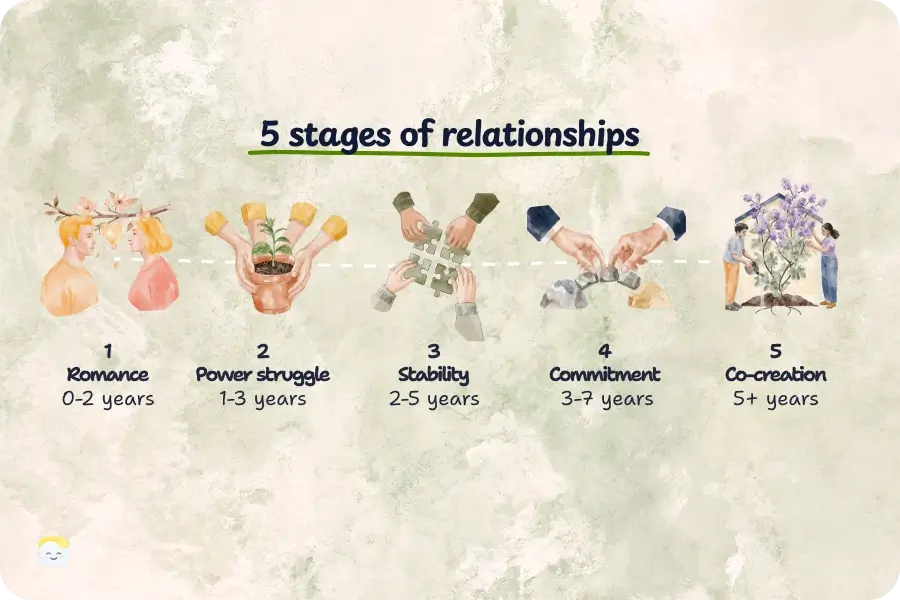
While every relationship follows its own path, most couples experience five different stages, proposed by a psychologist, Dr. Susan Campbell [1] Susan M. Campbell. The Couple’s Journey: Intimacy As a Path to Wholeness. .
The ranges below represent generalized observational averages, not clinical benchmarks. While relationships progress through shared stages, your specific attachment style influences how you manage stress and conflict within each stage.
Do you have secure attachment? Take a test to find out more about your attachment style and get insight into your behavior patterns in relationships.

Stage 1: Romance or Honeymoon Phase (0–2 Years)
The Romance stage is where most relationships begin. The relationship feels exciting, effortless, and full of possibility. Couples often experience intense attraction and want to spend as much time together as possible.
During this relationship stage, it’s common to focus on your partner’s best qualities while overlooking their flaws. This “honeymoon phase” is driven by powerful brain chemicals that create feelings of happiness, passion, and emotional connection.
What You’ll Experience In a Honeymoon Phase
- Strong physical attraction
- Constant communication
- Excitement about the future
- Frequent affection
- Idealizing your partner
Romance Stage Challenges
Because this early relationship stage feels so positive, couples may avoid having hard conversations like financial stress, family expectations, or long-term goals.
Stage 2: Power Struggle Stage (1–3 Years)
The Power Struggle phase is often the most difficult part of a relationship. As the excitement of the honeymoon phase fades, rose-colored glasses begin to come off. Differences in personality, nervous system, communication styles, habits, and expectations become more noticeable.
Many couples may have more frequent disagreements, wondering, “Am I with the wrong person?” or “Do we want the same things?” when in fact this is a completely normal stage of relationship development [2] Dixie Meyer, Renata Sledge. The Relationship Between Conflict Topics and Romantic Relationship Dynamics. March 2021 . This is where couples begin to learn how to navigate conflicts as a team.
Common Experiences
Research on romantic relationships shows that many couples experience recurring disagreements around similar themes, even though the specific details vary from relationship to relationship [3] Lavner JA, Karney BR, Bradbury TN. Relationship problems over the early years of marriage: stability or change? August 2014 .
1. Money
Money conflicts are rarely just about numbers. In fact, they often reflect deeper values, such as security, freedom, responsibility, or lifestyle preferences.
Common disagreements include:
- How much to spend vs how much to save
- Different attitudes toward budgeting
- Whether finances should be shared or separate
- Who contributes more financially
- What purchases require discussion or agreement
2. Sex
Partners may have different levels of desire, different sexual preferences, or different ways of experiencing intimacy. Conflicts may involve:
- Mismatched levels of sexual desire
- Different expectations around intimacy
- Feeling rejected or misunderstood
- Difficulty discussing sexual needs openly
3. Household Responsibilities
Many conflicts arise from different ideas about what “fair” means. The issue is often not the task itself but whether both partners feel appreciated and supported. They may disagree about:
- Who handles specific chores
- How responsibilities are divided
- Whether the mental load is shared equally
- Who takes care of planning, organizing, and remembering daily tasks
4. Family
Relationships often involve navigating two families, each with its own traditions, expectations, and communication styles. Common topics include boundaries, in-laws, and parenting differences:
- How much time to spend with extended family
- Setting boundaries with parents or relatives
- Different parenting approaches
- Holiday traditions and obligations
5. Time
Finding the right balance between couple time and personal time can be challenging. Conflicts may involve:
- Work demands affecting quality time
- Different needs for socializing or alone time
- Feeling neglected or overwhelmed
- Prioritizing responsibilities over connection
6. Control: Decision-Making and Personal Power
Conflicts may appear around:
- Who makes important decisions
- Whose preferences take priority
- How compromises are reached
- Whether both partners have an equal voice
Why the Power Struggle Stage Matters
Research shows that unresolved conflict during the power struggle phase can predict future relationship problems [3] Lavner JA, Karney BR, Bradbury TN. Relationship problems over the early years of marriage: stability or change? August 2014 . At this stage, relationships end more frequently because many couples mistakenly believe they made the wrong choice in their partner. However, conflict itself isn’t the issue—it’s how couples handle it.
Conflict is normal in a relationship. However, if conflict consistently involves boundary violations and behaviors like gaslighting, it could be a sign of narcissistic abuse.

*Note: This screening tool is for self-reflection only. Online assessments cannot diagnose Narcissistic Personality Disorder (NPD) or replace a clinical evaluation by a licensed mental health professional.*
Stage 3: Stability Stage (2–5 Years)
Once couples learn how to resolve conflict effectively, the relationship moves to the next stage with a deeper kind of intimacy and emotional safety.
Trust grows, communication improves, and daily life becomes more predictable. Instead of questioning the relationship, partners begin working together toward shared goals.
Signs You’ve Reached Stability
- Greater emotional intimacy
- Better ability to handle conflicts
- Increased trust
- Comfortable routines
- Stronger teamwork
Challenges to Watch For
Comfort can sometimes lead to complacency. Busy schedules, careers, or parenting responsibilities may reduce quality time together.
Stage 4: Commitment Stage (3–7 Years)
At this stage, love becomes less about intense feelings and more about conscious choice and deepening connection. Partners have accepted each other’s strengths and weaknesses, built trust through shared experiences, and developed confidence in the relationship. Commitment means choosing each other every day, even during stressful seasons of life.
Characteristics
- Deep trust
- Shared goals and core values
- Strong emotional support
- Honest communication
- Long-term planning
Common Challenges
Major life events such as career changes, raising children, financial pressures, or caring for family members can create stress. Successful couples face these challenges together rather than allowing them to create distance.
Stage 5: Bliss/Co-Creation (5+ Years)
The Bliss/Co-Creation stage represents a mature, deeply connected relationship built on years of trust, respect, and shared experiences.
Rather than trying to change one another, couples embrace each other’s imperfections and support personal growth. Love becomes steady, dependable, and resilient.
What This Stage Looks Like
- Complete trust
- Emotional safety
- Deep friendship
- Mutual respect
- Strong partnership
- Shared purpose
Expert Insight
It’s normal for relationships to change over time. The earliest stages are characterized by passion, which is driven by neurochemistry. As a relationship grows and enters the commitment stage, those intense feelings may change, resulting in a calmer but deeper attachment. However, that doesn’t mean that the passion has to disappear. It does take intentional effort to keep romance alive. You can do that by trying new things together, like fun date nights.

Emily Mendez
Mental health professional
Do All Couples Reach Stage 5?
Not always. Some couples become stuck in the Power Struggle stage because conflicts remain unresolved. Others move back and forth between stages as life changes.
Relationships aren’t linear. Marriage, children, career changes, illness, or financial hardship can temporarily create new challenges. What’s most important is the willingness to adapt and continue growing together.
Expert Insight
Relationship development is a changing process that changes in response to certain life events. Moving into an earlier stage doesn’t mean that your relationship is failing. It could be that there are stressors or changes that are causing it to regress. Events, like emotional affairs, cause breaches of trust that can cause a relationship to regress. But couples can rebuild after events like this and move forward. Sometimes relationships regress because of a loss of romance or passion. But you can deliberately reintroduce that into your relationship by recreating novelty and playfulness.
Emily Mendez
Mental health professional
Which of the Five Stages Is Your Relationship In? Quiz
Check the statements that feel most true about your relationship today. Then, count which stage has the most checkmarks. You may identify with more than one stage, and that’s completely normal.
Results
- Mostly Romance: You’re enjoying the excitement of new love and building your connection.
- Mostly Power Struggle: Your relationship is learning how to navigate differences and grow through conflict.
- Mostly Stability: You’ve developed healthier communication and stronger trust.
- Mostly Commitment: You’re building a secure partnership based on mutual respect and shared goals.
- Mostly Co-Creation: Your relationship is characterized by deep emotional safety, lasting trust, and genuine companionship.
6 Signs Your Relationship Is a Healthy Long-Term Partnership
Regardless of your stage, healthy relationships often share these qualities:
1. You Communicate Honestly and Respectfully
Healthy partners feel comfortable expressing their thoughts, needs, and feelings without fear of being dismissed or judged. They can talk about difficult topics, share concerns, and have honest conversations while still treating each other with kindness.
Signs of healthy communication include:
- Listening without immediately becoming defensive
- Expressing needs clearly
- Discussing problems instead of avoiding them
- Being willing to apologize and repair misunderstandings
2. Both Partners Feel Emotionally Safe
Emotional safety means you can be yourself in the relationship. You don’t feel the need to constantly hide your feelings, pretend to be someone else, or worry that vulnerability will be used against you.
In a healthy partnership:
- Your emotions are taken seriously
- Your opinions are respected
- You can admit mistakes without fear of rejection
- You feel accepted even during difficult moments
3. Conflicts Lead to Solutions Instead of Resentment
Healthy conflict often includes:
- Staying focused on the current issues
- Understanding that the goal of an argument is not to determine who is right, but to find a solution that respects both partners
- Avoiding personal attacks
- Taking responsibility when needed
- Finding compromises
- Reconnecting after disagreements
4. You Support Each Other’s Personal Growth
A strong relationship allows both people to continue growing as individuals. Healthy partners don’t feel threatened by each other’s goals, friendships, interests, or achievements.
Instead, they encourage each other to:
- Pursue personal goals
- Develop new skills
- Maintain independence
- Become the best version of themselves
5. Trust Continues to Deepen Over Time
A strong partnership does not require constant reassurance because both people feel secure in the relationship. Trust grows when you:
- Keep your promises
- Communicate openly
- Respect boundaries
- Show up during difficult times
- Make decisions with each other’s well-being in mind
6. You Enjoy Being Together, Even During Ordinary Moments
Long-term love is not only about exciting dates, vacations, or major milestones. Some of the strongest relationships are built through everyday moments.
A healthy couple can enjoy:
- Cooking dinner together
- Running errands
- Sharing quiet moments
- Laughing about small things
- Simply being in the same space
Practical Tips for Building Deepening Connection and Emotional Safety on Each Stage
Instead of trying to rush through the difficult moments, focus on developing habits that strengthen your connection over time.
1. The Romance Stage
Enjoy the excitement, but also invest time in getting to know each other on a deeper level:
- Be curious about each other’s values, goals, and life experiences.
- Talk openly about expectations for the relationship.
- Maintain your own hobbies and friendships.
- Don’t ignore potential red flags simply because you’re in love.
Stage 2: Power Struggle
Learn to solve problems together instead of fighting each other:
- Take a break if arguments become heated, then return when you’re both calm.
- Replace blame with curiosity by asking, “Help me understand how you’re feeling.”
- Focus on one issue at a time instead of bringing up past mistakes.
- Accept that even your biggest differences don’t automatically mean incompatibility.
- Remember that you’re on the same team.
Stage 3: Stability
At this stage, the main goal is to keep the relationship growing rather than letting it settle into a routine:
- Continue planning dates, even if you’ve been together for years.
- Celebrate small achievements together.
- Keep learning about your partner as they grow and change.
- Prioritize quality time over screen time.
Try the Daily Appreciation Habit. Every evening, tell your partner one specific thing you appreciated about them that day. Be specific. Instead of saying, “Thanks for everything,” explain what they did and how it made you feel. Specific appreciation feels more personal and meaningful, making it more likely to strengthen your emotional connection.
For example:
- “I really appreciated that you made me coffee this morning—it started my day on a positive note.”
- “Thank you for listening when I needed to vent after work. It made me feel supported.”
- “I noticed how patient you were with the kids today. I really admire that about you.”
- “I appreciate that you remembered to pick up groceries without me asking.”
- “I loved how you made me laugh tonight. You always know how to brighten my day.”
- “Thank you for checking in on me today. It made me feel cared for.”
Stage 4: Commitment
Continue choosing each other intentionally:
- Make important decisions together.
- Support each other’s personal goals and ambitions.
- Talk about future dreams regularly.
- Protect your relationship from outside stress.
Create a shared vision. Spend an hour discussing where you’d like to be in one, five, and ten years. Talk about finances, travel, family, careers, and personal growth. Shared goals create a stronger sense of partnership.
Create traditions that strengthen your bond. For example:
- Have a Friday night date, whether it’s dinner out or a movie at home.
- Start each morning with a 10-minute coffee together before the day begins.
- Take a monthly adventure, such as visiting a new town, hiking trail, or restaurant.
- Celebrate your relationship anniversary by revisiting your first date or favorite place.
- Go for a Sunday evening walk to talk about the week ahead.
- Create a yearly photo book filled with your favorite memories.
- Cook a special meal together every week, trying a new recipe each time.
- End each day with a goodnight ritual, such as sharing the best part of your day or saying one thing you’re grateful for.
Stage 5: Co-Creation
Stay curious about your partner’s changing dreams and interests and continue trying new experiences together. Sharing a purpose beyond yourselves often strengthens long-term relationships. Talk about the impact you want to have as a couple. For example:
- Mentor younger couples
- Offer guidance to newly married friends and share lessons you’ve learned about communication and conflict resolution.
- Lead or host a couples’ discussion group at your church or community center.
- Be the supportive couple that others feel comfortable turning to for advice.
- Volunteer together
- Serve meals at a local food bank or homeless shelter.
- Walk dogs or care for animals at a rescue organization.
- Participate in community clean-up events or tree-planting projects.
- Volunteer at charity runs, festivals, or fundraising events.
- Pack care packages for military members, hospitals, or families in need.
- Build something meaningful for future generations
- Create a family cookbook with treasured recipes and stories.
- Record your family’s history or interview older relatives.
- Plant a garden or trees that future generations can enjoy.
- Establish an education or travel fund for your children or grandchildren.
- Write letters or record videos sharing life lessons for future family members.
- Start annual family traditions that can be passed down through the years.
Final Thoughts
Every relationship evolves. The journey from Romance to Power Struggle, Stability, Commitment, and ultimately Co-Creation is rarely perfect, but it’s often rewarding.
If you’re currently experiencing conflict, don’t assume your relationship is failing. For most people, the Power Struggle stage is simply where real growth begins. With patience, empathy, and consistent communication, challenges can become the foundation for a stronger and more fulfilling partnership.
Frequently asked questions
1. What are the five stages of a relationship?
The five stages of a relationship are Romance, Power Struggle, Stability, Commitment, and Co-Creation. Each stage reflects a different phase of emotional growth, from the excitement of new love to building lasting trust and deepening connection.
2. Which stage of a relationship is the hardest?
The Power Struggle stage is often considered the most challenging. As the Romance stage fades, differences in personalities, expectations, and communication styles become more apparent. Many relationships end during this stage because couples mistakenly believe conflict means they’re incompatible, when it’s actually a normal part of building a healthy relationship.
3. How long does each relationship stage last?
There’s no universal timeline, but many couples experience the following:
- Romance: 0–2 years
- Power Struggle: 1–3 years
- Stability: 2–5 years
- Commitment: 3–7 years
- Co-Creation: 5+ years
4. Do all couples go through the five stages?
Most long-term relationships experience these stages in some form, but not every couple progresses through them in the same order. Some may spend longer in one stage, revisit an earlier stage after a major life event, or skip certain experiences altogether.
5. Can a relationship go back to an earlier stage?
Yes. Major life changes—such as marriage, having children, financial stress, career changes, or health issues—can temporarily bring back challenges similar to those experienced in earlier stages. Healthy couples adapt and continue growing together.
Sources
- Susan M. Campbell. The Couple’s Journey: Intimacy As a Path to Wholeness.
- Dixie Meyer, Renata Sledge. The Relationship Between Conflict Topics and Romantic Relationship Dynamics. March 2021
- Lavner JA, Karney BR, Bradbury TN. Relationship problems over the early years of marriage: stability or change? August 2014
Disclaimer
This article is for general informative and self-discovery purposes only. It should not replace expert guidance from professionals.
Any action you take in response to the information in this article, whether directly or indirectly, is solely your responsibility and is done at your own risk. Breeze content team and its mental health experts disclaim any liability, loss, or risk, personal, professional, or otherwise, which may result from the use and/or application of any content.
Always consult your doctor or other certified health practitioner with any medical questions or concerns
Breeze articles exclusively cite trusted sources, such as academic research institutions and medical associations, including research and studies from PubMed, ResearchGate, or similar databases. Examine our subject-matter editors and editorial process to see how we verify facts and maintain the accuracy, reliability, and trustworthiness of our material.
Was this article helpful?