



“Bare minimum” is a term that has been around the Internet for a while. It means the non-negotiable standards about respect, mutual trust, and effort in healthy relationships that can’t be lowered.
“But the bare minimum can be different for different people,” you may say. And it definitely can. So in the article, we’ll explore the most common kinds of bare minimum behavior, look at real-life examples, and find out how these behaviors might differ from couple to couple.

What does “bare minimum” mean in a relationship?
The bare minimum is the minimal effort partners need to make to maintain a relationship. It might include the ability to handle conversations, respect boundaries, keep promises, etc. These behaviors may not seem particularly romantic or impressive, but they create the foundation for a relationship to feel mutual.
At the same time, the bare minimum is basically just a minimum investment of effort. On Reddit, people describe it as “one step above ‘nothing,” which is why bare minimum couples may finally find themselves living like roommates rather than lovers.
The person you’re with may remember important dates, respect your choices, and do their share of household duties. However, they might not go for more: making genuine compliments, planning dates you dream about, or expressing love in ways that make you feel appreciated.
Such low-effort relationships may seem like “nothing wrong” in the beginning because your partner might seem like “they’re doing just OK.” Nevertheless, over time, the lack of initiative, affection, and emotional investment can leave one or both partners feeling unappreciated and make this type of relationship seem “normal” at the same time.
Bare minimum vs. healthy relationship effort vs. grand gestures — What’s the difference?
The bare minimum can be considered as a part of a healthy relationship effort, which, however, isn’t enough to maintain a thriving relationship.
- Bare minimum = avoiding relationships from failing and doing “just enough.”
- Healthy relationship effort = consciously investing in the relationship to help it develop.
Grand gestures are something outstanding, like a romantic surprise with no particular reason, an expensive gift, or an elaborate date. They can feel exciting, but they are not a substitute for consistent effort. A partner can make grand gestures while still failing to provide the basic respect and emotional safety a healthy relationship requires.
In other words, grand gestures are optional, while healthy relationship effort is ongoing.

What are the healthy bare minimum standards? List of bare minimum signs in a relationship
The bare minimum in an equal partnership means that both partners consistently meet basic standards. These can include:
1. Respect as a non-negotiable standard
Basic respect involves avoiding insults, dismissive language, manipulation, and intimidation. In healthy love, partners make each other feel valued even when they’re having an argument.
Mutual respect can also involve:
2. Consistent communication and emotional support
Emotionally invested partners regularly communicate about important issues. As part of the bare minimum, they might not initiate meaningful conversations but might discuss things if they go wrong.
Other aspects of emotional support can include:
Dr. John Gottman, in the book The 7 Principles for Making Marriage Work, introduced the concept of “magic five hours.” It refers to 5 hours that couples can intentionally spend on connection throughout the week. The idea is that small, consistent moments of connection can help strengthen a relationship over time.
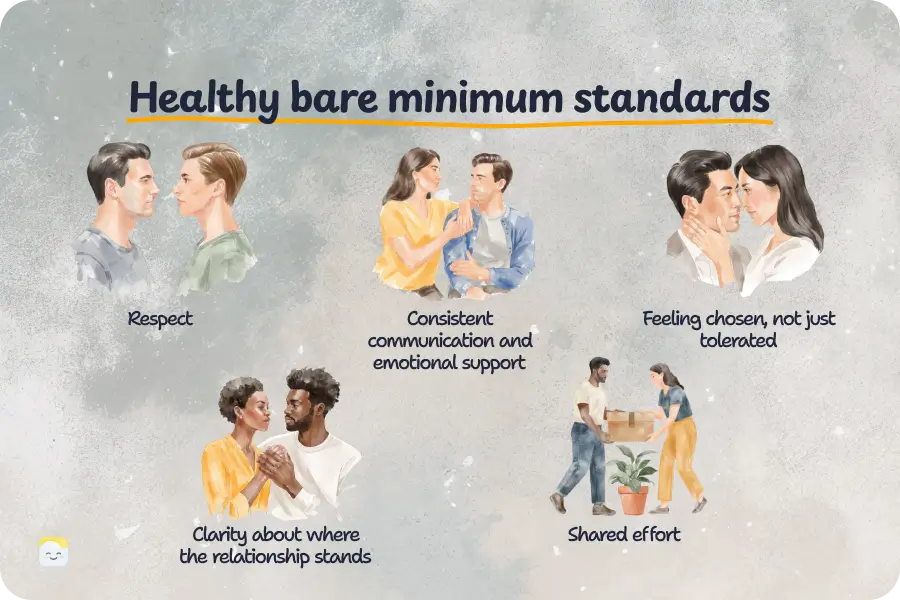
3. Feeling chosen, not just tolerated
Your current partner provides you with a feeling that you’re valuable because they truly love you, not because you’re just someone they’ve been with for years or because they’re afraid of being alone. You don’t feel anxious about them leaving tomorrow or constantly questioning whether they still want to be with you.
This can look like:
4. Clarity about where the relationship stands
A shared vision of where the relationship stands and how you want it to develop is part of inevitable emotional security. Discussing future plans, relationship expectations, and core values helps partners understand whether they want the same things and avoid unnecessary uncertainty about the relationship.
It’s also totally fine if you don’t want to put in mutual effort and want to stay in a situationship, become friends with benefits, or stay in an open relationship. However, any type of connection requires clarity and direct communication from both partners.
5. Shared effort, not a one-sided relationship
Real relationships require real effort. If both partners decide to stay committed, working on shared goals and contributing to the relationship should be their responsibility. Both people need to show initiative, make compromises, and be willing to invest time and energy.
In terms of the bare minimum, it can include:
It doesn’t mean that the effort should always be divided strictly 50/50. Still, if one partner puts in zero effort while the other one does their best to keep the relationship going, it can make the connection feel one-sided and leave the more invested partner feeling unappreciated.
Grady Shumway, LCSW, comments, “I’d add physical and emotional safety as a baseline that this list doesn’t name outright, meaning no threats, intimidation, or coercion, ever. Basic honesty about things that actually affect the other person, like finances or fidelity, belongs here too, not just honesty in day-to-day conversation. I’d also mention accountability, actually owning a mistake instead of getting defensive or turning it back on the other person. And consistency matters just as much as any single behavior, since one kind gesture doesn’t erase a pattern of neglect. Finally, respecting the other person’s autonomy, their friendships, their choices, and their right to disagree is often overlooked but it’s about as basic as it gets.”
Real examples of the bare minimum in a relationship
Let’s explore the most common examples of bare minimum so you can check your current relationship or future relationship expectations.
Bare minimum texting and communication examples
- Functional, on-time replies. Your partner may reply promptly enough and answer your direct questions, but the conversation stays mostly practical.
- They’ll tell you if plans change or they’re running late, but they never text first to check in or share their day.
- Your partner answers what you ask but rarely asks “how did it go?” or continues the conversation on their own.
Bare minimum date nights and quality time examples
Bare minimum emotional support examples
- Your partner supports you when you need to deal with the emotional weight of big challenges like changing jobs. Yet, they don’t seem to be involved in small daily struggles (and might not even care a lot about it).
- They comfort you if you ask directly but rarely notice on their own that something’s off.
- Your loved one may say the right words, like, “Sorry, it’s my fault,” but they don’t check in the next day to see how you’re doing.
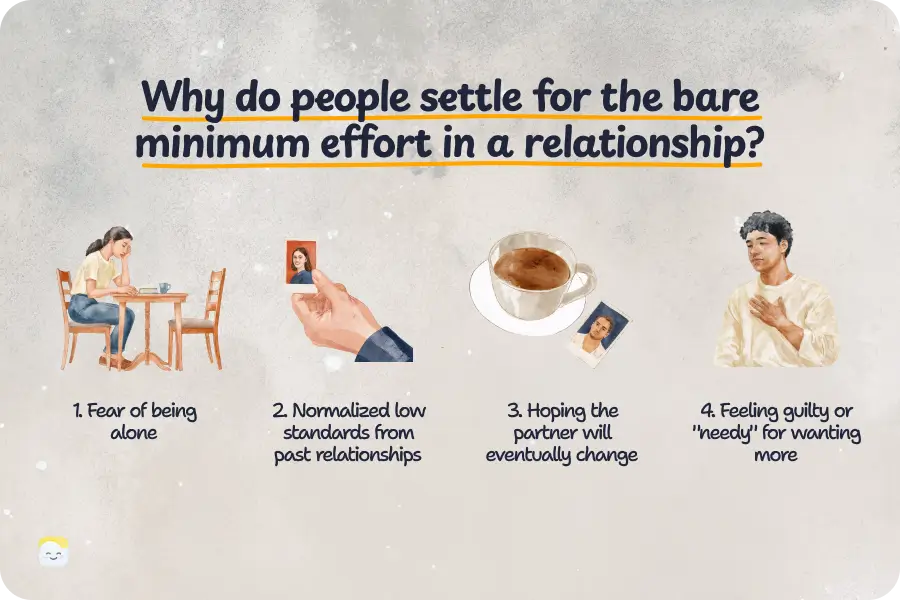
Why do people settle for the bare minimum effort in a relationship?
Having low expectations and agreeing to the bare minimum can make relationships work, but it might not make you feel special or valuable. Trust, honesty, and clear communication are essential standards. Yet, agreeing to a less-than-healthy relationship effort can influence your self-respect.
Here’s why people might settle for the bare minimum.
1. Fear of being alone
Some people feel safe and valuable only when they’re dating someone and might accept the bare minimum simply due to the fear of being alone. Low self-worth, inability to satisfy your own needs, or a belief that being single means being unwanted can make it harder to recognize when a relationship is no longer fulfilling.
As a result, you might stay with a partner who offers less effort than you need to feel happy because being alone feels frightening. You may also convince yourself that “at least they’re here” is enough.
2. Normalized low standards from past relationships
Our beliefs not only form in childhood but also keep developing and changing throughout life. As such, if you’ve dated a narcissistic or abusive partner who tried to prove that “this is how normal relationships work,” you might not realize that committed people tend to put in more effort.
Maybe you had to ask for affection, or they dismissed your expectations as “too much” or gave you attention only when it benefited them. Because of this, now you may start seeing healthy bare minimum as normal or even unusually good, and expect little from future partners.
3. Hoping the partner will eventually change
Some people might believe that their partners will eventually change and start doing more than acting like a friendly roommate. They may ask their loved ones to buy them flowers, plan romantic dates, and expect the same from a significant other, or stay 100% involved and hope to get this level of affection as well.
Nevertheless, the only person you can change is you, and the only life you can change is your own. As such, it’s important to focus on your partner’s current behavior, not on who they might become. If you have communicated your needs and nothing changes, waiting for more effort can keep you in a relationship that does not meet your needs.
4. Feeling guilty or “needy” for wanting more
Social media and the people you regularly talk to can form the way you approach relationships in general. Even more, approval from friends and family predicts greater relationship stability and commitment. [3] Taylor SH, Zhao P, Bazarova NN. “Social media and close relationships: a puzzle of connection and disconnection.” Curr Opin Psychol. 2022
What happens when you accept the bare minimum in a relationship
When people accept the bare minimum and don’t acknowledge that effort in healthy relationships is important to them, it might affect their sense of self-worth and overall love life.
1. You start to feel lonely and emotionally disconnected
Maybe you want more affection, romantic gestures, or simply a partner’s presence in your daily life (which goes beyond basic questions about how your day was). If, in turn, they make you feel emotionally neglected and not so important, it can lead to anxiety, depression, or a constant feeling of loneliness.
2. You begin carrying the relationship alone
Lack of the partner’s involvement may force you to do more. You may take responsibility for organizing dates, planning trips together, or creating special moments (without getting anything similar in return).
3. Your standards quietly get lower over time
After some time, you may start noticing that even a simple “good morning” text starts feeling special for you, or the fact that they didn’t forget about your birthday already makes you happy. It doesn’t mean these things don’t matter or aren’t worth appreciating. The problem is when basic consideration starts feeling like something exceptional.
4. The relationship stops growing
You don’t feel like anything changes, or you get closer over time. You may not feel like sharing secrets with your loved one, creating meaningful moments, or reaching relationship goals. “I have friends who can support me and make my life more exciting,” you may think. And a loving relationship turns into a habit.
5. You start comparing your relationship with others
Maybe you aren’t the only ones having problems in relationships in your social circle. So, at some point, you may start comparing your relationship to theirs. “These two have arguments all the time, so maybe my relationship isn’t that bad,” or “In this couple, the boyfriend brings flowers every week. Why doesn’t mine ever do that?”
You may use someone else’s relationship as proof that yours is either good enough or not good enough, instead of looking at how you actually feel with your loved one.
6. You lose motivation to invest in the relationship yourself
When your significant other does only the bare minimum, you may catch yourself thinking, “Why would I do more?” At this point, you might stop planning dates, initiating conversations, or making an effort to make your partner feel special. This can create a cycle where both partners gradually invest less and less, which negatively influences relationship dynamics.
How to stop settling for the bare minimum effort
If you want to build a happy and meaningful connection with someone, it’s worth assessing how you see “the bare minimum” and “princess treatment” now, as well as understanding what you’re ready to agree to and what feels unacceptable for you.
1. Identify your own healthy effort and bare minimum standards
Before deciding whether your existing or potential partner is doing enough, define what “enough” really means to you. Think about what you need to feel respected and connected to your partner, such as:
You may create a table with two columns and list things you consider the bare minimum and healthy relationship effort. Then realize what you’re ready to agree on. For example, basic respect, honesty, and keeping promises may be non-negotiable, while planning thoughtful dates or surprising each other with small gestures may fall into the category of additional effort you would like to see at least a few times a week.
2. Communicate what you need without feeling bad about it
Choose a calm evening and communicate your needs to your loved one. Use “I-statements” and state that some things are important for you without blaming them for not doing something. If they’re interested in relationship development, you can discuss both your and their needs and plan future actions.
If you don’t have a partner but are talking to someone you’re interested in, you can gradually communicate what matters to you as the relationship develops. You don’t have to list all your expectations on the first date, but you can pay attention to how they respond when you express preferences or set boundaries.
3. Watch their actions and how emotionally invested they are, not just their words
Maybe they agree to your standards but don’t do anything to meet your needs. If so, focus on what they actually do, not how well they explain their actions.
For example, they might say they understand how important it is for you to spend quality time but never offer to plan anything. They might promise to communicate more openly but continue to avoid difficult conversations. Or they might apologize after an argument but repeat the same behavior without trying to change.
4. Know when it’s time to walk away
If you keep talking about your needs but your partner doesn’t seem interested in meeting them, it might be worth asking yourself whether the relationship is still working for you.
Walking away doesn’t mean your standards are too high or that your partner is a bad person. Sometimes, two people simply want different things from a relationship. If the relationship continues to leave you feeling lonely, unappreciated, or emotionally drained, it may be time to choose what works better for you.
Grady Shumway, LCSW, provides more tips on how to stop settling for the bare minimum.
Frequently asked questions
Is wanting more than the bare minimum considered "needy"?
Not at all. Wanting affection, attention, quality time, emotional support, or a little extra care doesn’t automatically mean you’re needy. Everyone in a relationship has different needs and their own definition of what a happy couple can look like.
Communicate these needs openly and find ways to reach both personal growth and growth as a couple.
Can a bare minimum relationship become a healthy relationship again?
Yes, it can if both partners want it. In this case, having an open discussion and putting more effort is necessary. You can gradually make changes in how you communicate and become more intentional about spending time together. One person can’t carry all the responsibility for strengthening the relationship.
What's the difference between bare minimum effort and grand gestures?
Bare minimum effort means something that keeps relationships functional. It’s about daily things like checking in on how your partner feels, managing your share of household chores, or keeping promises.
Grand gestures aren’t necessary to keep relationships alive, but they’re pleasant and make your partner feel valued. These can be romantic dates, costly surprises, or something that requires effort and you do specifically for them.
How do you know if you're emotionally checked out of your own relationship?
If you no longer want to discuss problems, spend time together, or share what’s going on in your life, you may feel emotionally detached. You may have stopped caring about resolving problems or feel largely indifferent when considering the future of the relationship.
Sometimes, the thought of breaking up can even bring more relief than distress. These signs don’t necessarily mean the relationship is over, but they are worth paying attention to.
Sources
- Rosenfeld, Michael J., and Sonia Hausen. 2023. “Resilience and Stress in Romantic Relationships in the United States During the COVID-19 Pandemic.” Sociological Science 10: 472-500.
- Pepping CA, Girme YU, Cronin TJ, MacDonald G. “Diversity in singlehood experiences: Testing an attachment theory model of sub-groups of singles.” J Pers. 2025
- Taylor SH, Zhao P, Bazarova NN. “Social media and close relationships: a puzzle of connection and disconnection.” Curr Opin Psychol. 2022
Disclaimer
This article is for general informative and self-discovery purposes only. It should not replace expert guidance from professionals.
Any action you take in response to the information in this article, whether directly or indirectly, is solely your responsibility and is done at your own risk. Breeze content team and its mental health experts disclaim any liability, loss, or risk, personal, professional, or otherwise, which may result from the use and/or application of any content.
Always consult your doctor or other certified health practitioner with any medical questions or concerns
Breeze articles exclusively cite trusted sources, such as academic research institutions and medical associations, including research and studies from PubMed, ResearchGate, or similar databases. Examine our subject-matter editors and editorial process to see how we verify facts and maintain the accuracy, reliability, and trustworthiness of our material.
Was this article helpful?