


Can you imagine that 26–47% of people among different populations tend to experience self-esteem issues, particularly feeling “not good enough.” [1] Elahi A, Sohail M, Safdar M. “Prevalence of impostor syndrome in medical and non-medical students at the university of Faisalabad.” J Pak Med Assoc. 2026 The root causes of this feeling may be pretty different: from negative past experiences and childhood trauma to unrealistic expectations set by social media and modern society.

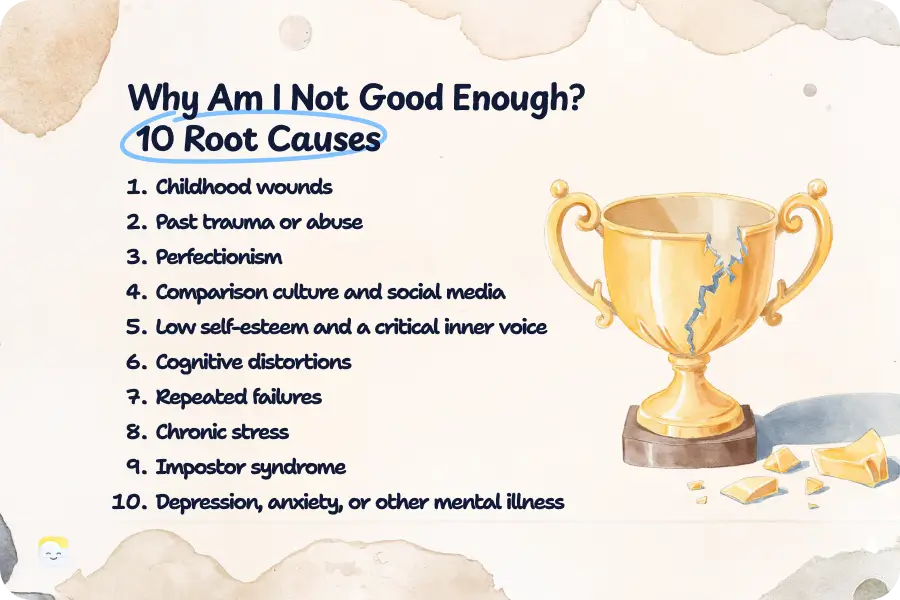
Why am I not good enough? 10 root causes
A deep conviction of not being good enough can influence the feeling of inadequacy and affect the whole life. While it can stem from childhood, self-critical beliefs may also develop much later. Let’s explore the main reasons below.
1. Childhood wounds
Growing up with emotionally neglectful, abusive, or critical parents can lead to a low sense of self-worth and cause emotional regulation problems. [2] Pereira A, Santos JP, Sardinha P, Cardoso J, Ramos C, Almeida T. “The impact of childhood abuse on adult self-esteem and emotional regulation.” Ann Med. 2021 When a kid constantly hears that they’re “not doing enough” or experiences punishment for their behavior, they may begin to believe that something is inherently wrong with them. They might internalize trauma and start feeling responsible for it, keeping this feeling in adulthood.
It can also work for golden children — those who grow up in dysfunctional families (especially with narcissistic parents) and get praised for achieving more and more. They learn to feel worthy because of their achievements while gradually disconnecting their sense of self-worth from who they are as a person.
As a result, they may develop:
In turn, children who experience unconditional love and compassion when they do make mistakes understand that they’re valuable for who they are.
2. Past trauma or abuse
Maybe you grew up in a healthy environment but experienced negative treatment years later. Some people who date with narcissistic or abusive partners might start having negative thoughts about themselves. This is how it happens:
- A person with a healthy self-concept meets someone who blames them for everything and keeps repeating that they’re not good enough in terms of appearance, personality, intelligence, or behavior.
- They’re doing their best, as they believe that their partner is trying to help them focus on self-improvement.
- A toxic partner becomes more and more critical over time.
- Over an extended period of time, constant criticism and blame can make the person question their own judgment and start believing that there really is something wrong with them.
Even after leaving the relationship, a person may notice negative thoughts as if they hear them in their ex-partner’s voice. It can affect the sense of self-compassion in the long run.

3. Perfectionism
Perfectionism can make you feel insecure about everything you do, leading to feelings of not being good enough, missed opportunities, and repeated failures. Unrealistic, extremely high standards may stem from a person’s temperament, the environment they live in, or even be heritable. [3] Maloney GK, Egan SJ, Kane RT, Rees CS. “An etiological model of perfectionism.” PLoS One. 2014
For instance, you’ve finished an academic project. While it’s well-researched and perfectly written, you may still believe that something isn’t enough. And thinking about everything you do this way can turn into the feeling that you’re not enough as a person.
Except for feelings of inadequacy, perfectionists can also experience:
4. Comparison culture and social media
Consistent use of social media, as well as exposure to carefully curated images of other people’s lives, can make it easy to feel like you’re falling short. Here’s why you may experience negative emotions even only following people you know:
- You’re subscribed to a few hundreds of people on Instagram or Facebook and every day watch their stories, like posts, scroll through reels, etc.
- All these people are trying to publish their happiest moments and share mostly positive news. Someone gets married, someone buys a house, someone travels, someone gets a promotion, and someone else starts a new business.
- You feel frustrated by the amount of success but may forget that you’re comparing yourself to hundreds of people only sharing a portion of their lives.
- At the same time, almost no one shares their challenges, moments when they feel hurt or frustrated.
- This also makes you feel that something is wrong with you because you may worry, feel tired, or lazy.
- As a result, you begin focusing on what you haven’t achieved yet rather than appreciating what you already have and do, which leads to an unhealthy comparison.
5. Low self-esteem and a critical inner voice
Low self-esteem means negative evaluation of your overall worth. Like perfectionists, people with low self-esteem may believe that they’re not doing enough. However, while perfectionism is often focused on meeting excessively high standards, low self-esteem is more deeply connected to how a person sees themselves.
Someone with low self-esteem may interpret any setback as evidence that they are inadequate. For example, getting rejected from a job or making a mistake in a relationship might become “I always ruin everything.”
6. Cognitive distortions
Some people may perceive reality using exaggerating or irrational thought patterns without even realizing it. This, in turn, might lead to the feeling that the things you’re doing aren’t good enough.
- All-or-nothing thinking. “If it isn’t a complete success, it’s a failure.” Those with black-and-white thinking perceive the world this way, which makes it difficult to appreciate progress.
- Overgeneralization is when you take one negative experience and use it as a broad conclusion even when it doesn’t make sense. For instance, if you make one mistake during a presentation, you may think, “I’m terrible at public speaking.”
- Labeling. Attaching a fixed label to yourself, your actions, or those around you can also affect your sense of self-worth. If you believe, “I’m not fit at all and will never be,” it can cause frustration without you even trying.
- Mind reading is a genuine belief that you know what other people think about. That one shop assistant probably doesn’t hate you; she just has a bad day at work (even if you think differently because she wasn’t in the mood).
- Emotional reasoning. This means believing that because you feel bad about something, it must therefore be true. For example, if you feel like you’re not doing enough, you may conclude that you really aren’t doing enough, even when your actual accomplishments suggest otherwise.
7. Repeated failures
In some cases, it may be just a period of time when you’re trying something again and again and eventually lose hope. Repeated failures can negatively influence self-esteem and, because of this, lead to inner critic development and make you overgeneralize and question, “Why am I not good enough for anyone?”
8. Chronic stress
Studies prove that chronic or sustained stress is linked to lower self‑esteem. [4] Borzikowsky C, Prignitz M, Guldner S, Flor H, Nees F; IMAC-Mind Consortium; CoviDrug Consortium. “A longitudinal daily diary study of stress, self-esteem fluctuation, and mood variability in adolescents.” Sci Rep. 2026 Due to the consistently elevated cortisol levels, chronic stress can affect mood and emotional regulation while lessening one’s tolerance for discomfort that disappointment or making a mistake may bring.
Also, when you’re under stress for a long time, even everyday responsibilities can start feeling overwhelming. You may have less energy, find it harder to concentrate, and become more likely to make mistakes. This, in turn, can then reinforce the belief that you’re not doing enough.
9. Impostor syndrome
If you spend time feeling like you don’t deserve your achievements, you may be experiencing impostor syndrome. It’s like coming to the first day at work thinking, “I don’t know anything” even if you have years of experience in the niche. Or believing that the fact that you manage to earn money, build a career, or achieve your goals is only a random success rather than the result of your achievements.
Aspect |
Self-esteem |
Self-worth |
Impostor syndrome |
Definition |
How positively or negatively you evaluate yourself |
Your sense of value as a person |
Persistent doubt about whether you deserve your achievements |
Core question |
“How capable or good am I?” |
“Am I valuable and worthy?” |
“Do I really deserve my success?” |
Usually connected to |
Abilities, performance, appearance, social confidence |
Identity and inherent value |
Achievements, competence, career, recognition |
Main risk |
Constantly seeking evidence that you’re good enough |
Feeling fundamentally unworthy |
Feeling like a fraud despite evidence of competence |
10. Depression, anxiety, or other mental illness
Certain mental health conditions can affect how people feel about themselves as well. Particularly, you may feel “not good enough” due to difficulties related to:
- Anxiety
- Depression
- Social anxiety disorder
- Obsessive-compulsive disorder (OCD)
- Post-traumatic stress disorder (PTSD)
- Complex PTSD (C-PTSD)
- Eating disorders
- Body dysmorphic disorder (BDD)
- ADHD
- Autism spectrum disorder
- Bipolar disorder
- Personality disorders
Katherine Scott, M.Ed/Ed.S, LMFT, explains the mechanism of why people may feel “not good enough” when living with mental health conditions. “Mental health conditions make it inherently more difficult to achieve optimal functioning. These roadblocks then seem to be ‘invisible,’ often impacting how they may be perceived vs. their experiences internally. This mismatch can often disrupt one’s equilibrium, and we often do not exist within an inclusive and compassionate world. It can be perceived as a threat to ‘be different,’ thus increasing one’s own isolation in their mental health struggles. Disability is often categorized as a deficit within the medical model that is so heavily weighed, where the category should be differently-abled.”
Why am I never good enough for a relationship?
Maybe you understand your self-worth in daily life but find it challenging to feel valuable in relationships or while looking for a partner. Here’s why these thoughts may arise.
Attachment styles and repeating relationship patterns
Fear of rejection and self-sabotage in dating
Due to the fear of rejection, you may protect yourself from feeling “not enough” by setting unrealistic standards, withdrawing before you become vulnerable, or testing your partners to see how much they care about you.
You may also withdraw as the relationship becomes more serious, or you may intentionally distance yourself to see if your partner will pursue you. This self-sabotaging can create the rejection you were trying to avoid and reinforce the belief that something is wrong with you.
Learning to tolerate vulnerability and communicate directly can help break this cycle.
When it’s about them, not you
How to stop feeling not good enough and experience self-doubt
To overcome the feeling of inadequacy, you may need to practice self-love and self-compassion, learn to build emotional safety in relationships with others, as well as improve your self-esteem. Save some practical tips on how to do so:
Practice self-compassion
Self-compassion may help you feel more satisfied and content with your life.
- Next time you decide to blame yourself for something, think about what a caring friend or an older brother would say to you. Instead of using phrases like, “You’re stupid; why can’t you do it correctly?” they would probably say something like, “It’s OK to make mistakes. This is how you’re learning.”
- Try mindfulness to recognize negative thoughts without automatically believing them. You might notice, “I have a thought that I’m not good enough,” instead of treating the thought as an objective fact.
- Practice gratitude daily, noticing small accomplishments or things that went well. This can help you take your mind off of your worst fears and worries and turn to positive thoughts.
Quiet the inner critic by challenging negative thoughts
Shift from external validation to internal values
Sometimes the truth may be in the fact that you rely on external validation too strongly and stop thinking about what’s important for you personally. To change it, start paying attention to your needs, wishes, and desires. For instance, you may:
- Define your values — list what truly matters to you.
- Make decisions based on what you want — practice choosing for yourself instead of constantly seeking approval. It can start from small choices like buying your favorite ice cream and then turn into something more meaningful.
- Stop comparing your progress — focus on your path and pace. Accept that success comes to us at different points of our lives.
- Learn to enjoy life without an audience — do things because they make you happy, not because they make you look successful.
- Redefine what “enough” means — decide what a fulfilling life looks like for you instead of endlessly chasing external markers of worth.
Set boundaries with critical people
Focus on who you surround yourself with. Some people may be jealous or simply toxic. So, instead of truly believing everything others say, learn to separate conscious feedback from unhealthy criticism. If you notice that someone engages in constant judgement, you can limit your communication with them and directly state that some words are unacceptable for you.
When “not good enough” might signal a mental health condition
Expert Insight
When the feeling becomes persistent and disruptive to your life. The feeling of ‘not good enough’ can become a means of self-sabotage and restricting yourself from opportunities and growth. When we don’t feel good enough, we rob ourselves of opportunities that run the risk of not working out; however, that is how we evolve. Furthermore, the feeling of ‘not good enough’ can incite increased isolation and withdrawal from community, thus creating opportunities to impact mood, motivation, and self-esteem.

Katherine Scott
Mental health professional
If you understand that feeling of inadequacy is overwhelming and significantly influences your life quality, it may be time to reach for professional help.
- Compassion-focused therapy can help you approach mistakes with more self-compassion and reduce harsh criticism.
- Cognitive behavioral therapy (CBT) may be helpful to improve self-esteem and identify and challenge negative thoughts about yourself.
- Acceptance and commitment therapy (ACT) can help you stop fighting uncomfortable thoughts and focus instead on actions that reflect your personal values.
Don’t wait for feeling “not good enough” to become unbearable. Instead, seek support once you notice that something goes wrong to overcome this feeling faster and simpler.
Frequently asked questions
What does "not good enough" really mean?
Feeling “not good enough” means believing that you fall short in some way. It’s often a perception rather than an objective reflection of who you are.
What are the common signs of feeling not good enough?
Common signs include constant self-criticism, comparing yourself to others, difficulty accepting compliments, fear of failure, and feeling that your achievements are never enough.
Is feeling not good enough a mental illness?
No. Feeling inadequate is not a mental illness by itself. However, persistent or overwhelming feelings of inadequacy can be associated with certain mental health conditions.
Why don’t I feel good enough even when people tell me I am?
External support may not change deeply rooted negative beliefs about yourself. If you have learned to judge your worth through achievement, compliments may only provide temporary relief.
Why do I feel like I don't deserve good things?
This feeling can develop from low self-worth, past criticism or rejection, difficult experiences, or a habit of focusing on your perceived flaws.
What's the difference between low self-esteem and low self-worth?
Low self-esteem typically involves negative beliefs about your abilities or performance, while low self-worth is a deeper belief that you are not valuable. In other words, self-esteem is often about “I’m not good at this,” whereas self-worth is more like “I’m not good enough as a person.”
Sources
- Elahi A, Sohail M, Safdar M. “Prevalence of impostor syndrome in medical and non-medical students at the university of Faisalabad.” J Pak Med Assoc. 2026
- Pereira A, Santos JP, Sardinha P, Cardoso J, Ramos C, Almeida T. “The impact of childhood abuse on adult self-esteem and emotional regulation.” Ann Med. 2021
- Maloney GK, Egan SJ, Kane RT, Rees CS. “An etiological model of perfectionism.” PLoS One. 2014
- Borzikowsky C, Prignitz M, Guldner S, Flor H, Nees F; IMAC-Mind Consortium; CoviDrug Consortium. “A longitudinal daily diary study of stress, self-esteem fluctuation, and mood variability in adolescents.” Sci Rep. 2026
Disclaimer
This article is for general informative and self-discovery purposes only. It should not replace expert guidance from professionals.
Any action you take in response to the information in this article, whether directly or indirectly, is solely your responsibility and is done at your own risk. Breeze content team and its mental health experts disclaim any liability, loss, or risk, personal, professional, or otherwise, which may result from the use and/or application of any content.
Always consult your doctor or other certified health practitioner with any medical questions or concerns
Breeze articles exclusively cite trusted sources, such as academic research institutions and medical associations, including research and studies from PubMed, ResearchGate, or similar databases. Examine our subject-matter editors and editorial process to see how we verify facts and maintain the accuracy, reliability, and trustworthiness of our material.
Was this article helpful?