



In this article, you’ll find out more about Eye Movement Desensitization and Reprocessing (EMDR), whether it’s safe, and what psychological and physical symptoms indicate EMDR treatment is moving too quickly or that additional clinical support is needed.
Is Eye Movement Desensitization and Reprocessing (EMDR) Safe?
EMDR is generally considered a safe, evidence-based psychotherapy when delivered by an appropriately trained mental health professional. Developed in 1989 by Dr. Francine Shapiro, it’s most commonly used to treat post-traumatic stress disorder (PTSD).
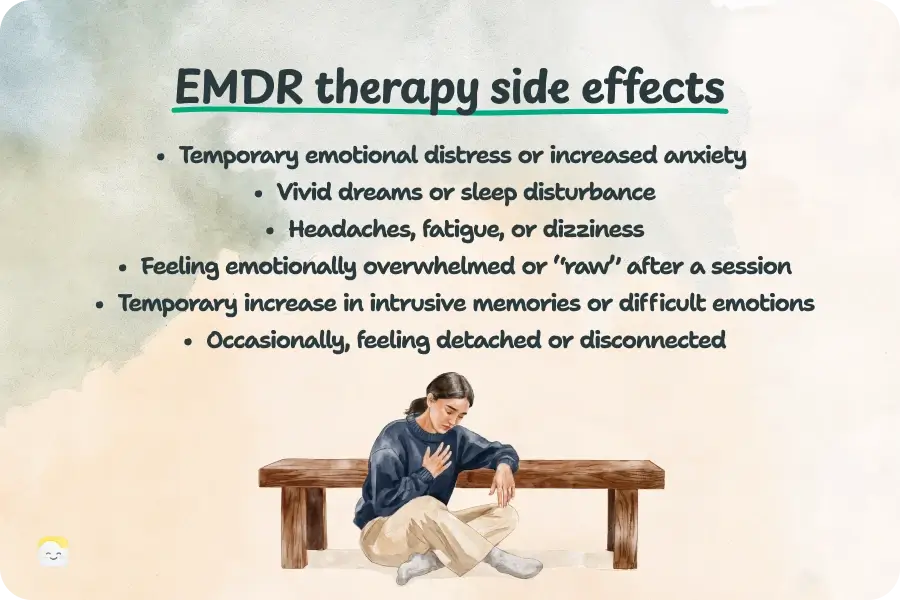
No therapy is entirely free of risks or uncomfortable reactions. EMDR therapy aims to support the processing of emotional memories while maintaining attention to the present. Potential side effects include some people experiencing fatigue, vivid dreams, or other reactions after a session.

Is EMDR Science or Pseudoscience?
Researchers continue to investigate exactly how bilateral stimulation works and which components of the therapy are responsible for its effects. Traumatic stress studies show that there is still debate about the mechanism and whether eye movements themselves are necessary [3] Jeffries FW, Davis P. What is the role of eye movements in eye movement desensitization and reprocessing (EMDR) for post-traumatic stress disorder (PTSD)? A review. May 2013 . However, EMDR should not be classified as pseudoscience simply because researchers continue to debate why it works.
Clinical trials also show that 91% of EMDR patients no longer had PTSD after treatment. Moreover, EMDR is recognized as a best practice by the Veterans Health Administration [5] Shapiro F. The role of eye movement desensitization and reprocessing (EMDR) therapy in medicine: addressing the psychological and physical symptoms stemming from adverse life experiences. Winter 2014 .
What to Expect After A Session: EMDR Therapy Side Effects
Some people feel tired or emotionally drained after an intense EMDR session. Others may notice vivid dreams, temporary emotional sensitivity, or increased awareness of thoughts and memories connected with the psychological trauma discussed in therapy. It is common for the brain to continue processing once the EMDR session is complete.
EMDR can feel difficult before it feels better
These EMDR therapy side effects can be described informally as an “emotional hangover.” They do not necessarily indicate harm, particularly when they are short-lived, and the person can return to their normal level of functioning.
However, emotional activation should remain manageable enough for the patient to regain stability. A qualified therapist should be prepared to slow down, return to preparation or grounding, change the target, or stop reprocessing traumatic memories when necessary.
Experiencing overstimulation, difficulties with focus, or emotion regulation? Take a quick ADHD test to learn more about your symptoms and whether it may be worth discussing them with a mental health professional.

What is not a normal reaction?
Emotional and physical symptoms stemming from EMDR therapy deserve additional attention if they involve:
- persistent or escalating distress that does not settle;
- severe dissociation or feeling disconnected from reality;
- panic that remains difficult to manage;
- significant deterioration in daily functioning;
- feeling unsafe between sessions;
- new or worsening thoughts of self-harm or suicide.
These reactions do not mean that EMDR is inappropriate. However, in this case, the treatment plan should be reassessed with a qualified clinician. Effective treatment should also include a closure phase, during which the therapist helps the patient return to a calmer, present-focused state before leaving the session.
Expert Insight
It all depends on the person and the particular trauma that is being focused on. Feeling ‘bad’ after an EMDR session is not ideal. A qualified and well-trained EMDR clinician will focus on a client returning to regulation prior to exiting the office, so that the person may feel emotionally drained, but not ‘poorly.’ It is encouraged for clients to be gentle with themselves and self-imposed expectations for the rest of the day, but returning to normal functioning is a prominent goal after an EMDR session.

Katherine Scott
Mental health professional
Can EMDR Sessions Re-Traumatize You? Risks and Potential Complications
Typically, problems can arise when treatment is poorly paced. For example, problems can arise when a therapist moves into intensive trauma processing before the patient has developed coping skills, stabilization is not properly established, or when significant symptoms are not properly assessed.
1. Re-traumatization
One of the biggest concerns trauma survivors have about EMDR therapy is whether revisiting a traumatic memory can make the trauma stress worse.
Trauma-focused therapy methods are not supposed to mean forcing someone to relive an experience uncontrollably. In EMDR, treating trauma occurs in brief sets and includes preparation, when the therapist assesses whether the patient is ready for reprocessing.
2. Dissociation, memory distortion, and panic attacks
Dissociation and memory distortion can occur in people who have experienced severe or repeated trauma. It can involve feeling detached from oneself, feeling unreal or disconnected from the surroundings, emotional numbing, or gaps in awareness or memory.
If significant dissociation or intense panic occurs during trauma processing, the therapist may need to pause reprocessing and return to stabilization and present-moment orientation.
3. Complex PTSD (C-PTSD)
People with complex PTSD may have experienced prolonged or repeated trauma and may have difficulties with emotional regulation, relationships, self-concept, or dissociation.
In this case, successful treatment may need to proceed more gradually, with greater attention to stabilization, resources, emotional regulation, and the patient’s ability to remain within a manageable level of arousal.
Who Should NOT Do EMDR Treatment?
There is no simple universal list of people who can never receive EMDR. Whether EMDR is appropriate depends on the person’s stability, medical circumstances, medications, risk factors, and treatment goals.
Rather than focusing solely on absolute contraindications, it is more useful to identify situations in which stabilization, specialist assessment, or additional precautions may be needed.
1. Acute psychosis, depression, or personality disorders
EMDR may not be suitable for people with psychotic episodes, severe depression, or personality disorders. A person may require stabilization and treatment of the acute condition before EMDR therapy begins.
That does not necessarily mean the person can never receive trauma-focused therapy. However, intensive trauma processing may not be the appropriate priority while the person is acutely unstable.
2. Uncontrolled dissociation
Severe dissociation should be assessed carefully before beginning trauma reprocessing. A therapist may need to spend substantially more time developing grounding and stabilization skills.
3. Active substance-use problems
Active substance use can interfere with emotional regulation, safety, attendance, and the ability to engage consistently in trauma treatment. The appropriate mental health treatment options may involve stabilization and addressing the substance-use problem alongside, or before, intensive trauma processing.
4. Limited emotional-regulation skills
If someone has no reliable way to calm themselves after becoming distressed, the preparation phase becomes particularly important. Before beginning intensive reprocessing, a therapist may teach grounding, breathing, containment, safe-place, or other stabilization strategies.
5. Medical considerations
People with epilepsy, cardiovascular disease, pregnancy, or other medical conditions should tell their therapist about their health history. EMDR itself is a psychotherapy rather than a medication or invasive medical procedure, but trauma processing can produce temporary physiological changes associated with emotional arousal.
How Safe Is EMDR Compared to Other Therapies?
EMDR is not “safer” or “more dangerous” than every other form of psychotherapy. The better question is whether it is appropriate for the person and delivered correctly.
1. EMDR vs. Cognitive Behavioral Therapy (CBT)
Both EMDR and trauma-focused cognitive behavioral approaches have evidence supporting their use for treating PTSD. The APA’s current guideline strongly recommends several trauma-focused CBT approaches, while EMDR receives a conditional recommendation. The APA also notes that there is not enough evidence to determine that EMDR is superior or inferior to other psychological treatments.
2. EMDR vs. traditional talk therapy
Traditional talk therapy can involve discussing emotions, relationships, beliefs, and life experiences in depth. EMDR uses a more structured protocol for trauma processing, and talking through the specifics of a trauma memory is not required for possible reprocessing. Neither approach is automatically safer. The most appropriate choice depends on the person’s symptoms, preferences, diagnosis, treatment goals, and the clinician’s expertise.
3. EMDR vs. exposure therapy
Exposure therapy involves repeatedly approaching trauma-related memories, situations, thoughts, or reminders that a person has been avoiding.
In prolonged exposure (PE), for example, a therapist may guide the patient through repeated, structured recounting of the traumatic memory and gradual exposure to avoided situations. The aim is to reduce avoidance and help the brain learn that the memory or situation can be experienced without the same level of perceived threat.
Is DIY or Online EMDR Safe?
You may want to speed up your healing process and try EMDR on your own, but without the right support, it can be difficult to predict treatment outcomes and safely handle strong emotions and memories that come up.
1. Can You Do EMDR on Yourself? YouTube and Apps
Self-directed eye movements are not the same thing as completing EMDR therapy. A video or app can show someone how to move their eyes from side to side or alternate sounds or taps. But the bilateral stimulation is only one component of EMDR. The therapy also involves assessment, preparation, target selection, clinical decision-making, reprocessing, body scanning, closure, and reevaluation.
Trying to access highly distressing traumatic memories without professional support can be incredibly risky, particularly for someone with severe PTSD, dissociation, anxiety symptoms, self-harm risk, or other mental health conditions.
2. Is virtual or online EMDR therapy safe?
Remote therapy can be an appropriate way to receive psychological care. Research shows that evidence-based psychological interventions for PTSD treatment can be delivered online in appropriate circumstances [4] Wang Y, Li X. Online Eye Movement Desensitization and Reprocessing for the Treatment of Post-Traumatic Stress Disorder. January 2024 .
However, online EMDR should still involve a properly trained therapist, a private and reliable environment, a plan for what happens if distress escalates, and access to appropriate emergency or local support when clinically necessary. A responsible therapist should also determine whether remote treatment is suitable for the particular patient.
What Makes EMDR Safe? Healing Journey Green Flags and Protocols
1. The 8-phase EMDR protocol
EMDR therapy is also structured rather than simply asking someone to repeatedly relive a traumatic event.
It contains an eight-phase treatment approach:
- History and treatment planning
- Preparation
- Assessment
- Desensitization
- Installation
- Body scan
- Closure
- Reevaluation
2. Understanding your “window of tolerance”
A useful clinical concept is the window of tolerance: the range of emotional and physiological arousal in which a person can remain sufficiently present, regulated, and able to process information.
If the patient becomes overwhelmed or shuts down, the appropriate response may be to pause, ground, stabilize, or change the treatment plan.
3. How to choose a qualified EMDR therapist
Look for a licensed mental health professional with appropriate EMDR training and experience treating the problem you actually want help with.
EMDRIA, the EMDR International Association, distinguishes between completing EMDR training and holding its separate EMDRIA Certified Therapist credential. Certification is voluntary and requires additional requirements beyond basic training.
A therapist who can answer these questions clearly is generally a better sign than someone who presents EMDR as a guaranteed “quick fix.”
Expert Insight
Everyone has a different qualifier for whether a particular therapy is proving effective for them. I typically tell clients that the goal of EMDR is to dull the sharp edges of a trauma memory so that it doesn’t carry so much inflammation. Furthermore, EMDR can decrease one’s reactivity to triggers, make coping tools more accessible, and increase one’s overall quality of everyday life once someone stops trying to sidestep every possible thing that could trigger them. EMDR can be like a growing pain, but the results can cultivate much more emotional freedom.
Katherine Scott
Mental health professional
Self-Care & Grounding: How to Recover After an Intense Session
You do not need to feel completely calm immediately after every session. The more important question is whether you can gradually return to your usual level of functioning. Simple aftercare can help you transition back into everyday life:
1. Immediate post-session grounding techniques
Depending on what your therapist recommends, grounding may include:
5-4-3-2-1 grounding. Identify five things you can see, four things you can physically feel, three things you can hear, two things you can smell, and one thing you can taste.
Slow breathing. Use a comfortable, unforced breathing pattern that helps you settle rather than trying to take extremely deep breaths.
Orienting. Look around the room and remind yourself where you are, what day it is, and that the traumatic event is not happening now.
Containment. If your therapist has taught you a containment exercise, use it to mentally set aside material that does not need to be processed further at that moment.
2. Creating an aftercare plan
After a particularly intense session, consider:
- allowing yourself some quiet time;
- staying hydrated and eating normally;
- avoiding unnecessary major decisions immediately afterward if you feel emotionally unsettled;
- keeping your schedule lighter when possible;
- writing down observations or questions for your next session;
- using grounding strategies recommended by your therapist.
3. When to contact your therapist
Contact your therapist if distress is stronger than expected, persists, interferes with sleep or daily functioning, or makes you question whether you can safely continue treatment. Tell your therapist specifically what happened rather than trying to decide on your own that the treatment “failed.”
Final Word
EMDR is not risk-free, but it is an established, evidence-based psychotherapy for PTSD. WHO and APA both recognize EMDR as a treatment option for PTSD, and current research suggests that it can reduce PTSD symptoms.
The most common concern is that trauma processing can temporarily increase emotional distress. This is why preparation, pacing, clinical assessment, grounding, closure, and follow-up are so important.
EMDR therapy may require particular caution when someone has severe dissociation, acute psychiatric instability, uncontrolled substance-use problems, significant medical concerns, or limited emotional-regulation capacity.
If a therapy session leaves you temporarily tired or emotionally activated, that does not automatically mean you have been harmed. But if you feel persistently overwhelmed, dissociated, unsafe, or significantly worse, tell your therapist. Those symptoms deserve attention and may mean the treatment needs to be adjusted.
Frequently asked questions
1. Can EMDR make trauma worse?
EMDR can temporarily make some people feel more distressed, particularly when difficult memories are being processed. This does not necessarily mean the trauma is being made worse. However, treatment that moves too quickly or does not provide adequate preparation and stabilization can be difficult to tolerate. A qualified therapist should adjust the pace if you become overwhelmed.
2. Is EMDR safe for people with complex PTSD?
EMDR can be used with people who have complex PTSD, but treatment may need to progress more slowly. A therapist should pay particular attention to emotional regulation, dissociation, stabilization, and the person’s ability to remain within their window of tolerance.
3. Can you do EMDR by yourself?
Self-directed EMDR is not equivalent to professional EMDR therapy. Videos, apps, and online exercises may provide rhythmic bilateral stimulation, but they do not provide the clinical assessment, preparation, monitoring, and support that are part of a complete EMDR protocol. Attempting to process severe trauma alone can be risky.
4. What should I do if EMDR makes me feel worse?
Tell your therapist exactly what you are experiencing. The therapist may slow the treatment, return to stabilization and grounding, change the target being processed, or reconsider the treatment plan. If you experience an immediate safety crisis or thoughts of harming yourself or someone else, seek urgent professional or emergency help.
5. Is EMDR better than CBT for PTSD?
Neither treatment is universally better for everyone. Both EMDR and trauma-focused cognitive behavioral therapies have evidence supporting their use for PTSD. The best trauma recovery option depends on your symptoms, preferences, clinical history, and the expertise of your therapist.
Sources
- World Health Organization. WHO releases guidance on mental health care after trauma. August 2013
- APA. Eye Movement Desensitization and Reprocessing (EMDR) Therapy. April 2025
- Jeffries FW, Davis P. What is the role of eye movements in eye movement desensitization and reprocessing (EMDR) for post-traumatic stress disorder (PTSD)? A review. May 2013
- Wang Y, Li X. Online Eye Movement Desensitization and Reprocessing for the Treatment of Post-Traumatic Stress Disorder. January 2024
- Shapiro F. The role of eye movement desensitization and reprocessing (EMDR) therapy in medicine: addressing the psychological and physical symptoms stemming from adverse life experiences. Winter 2014
Disclaimer
This article is for general informative and self-discovery purposes only. It should not replace expert guidance from professionals.
Any action you take in response to the information in this article, whether directly or indirectly, is solely your responsibility and is done at your own risk. Breeze content team and its mental health experts disclaim any liability, loss, or risk, personal, professional, or otherwise, which may result from the use and/or application of any content.
Always consult your doctor or other certified health practitioner with any medical questions or concerns
Breeze articles exclusively cite trusted sources, such as academic research institutions and medical associations, including research and studies from PubMed, ResearchGate, or similar databases. Examine our subject-matter editors and editorial process to see how we verify facts and maintain the accuracy, reliability, and trustworthiness of our material.
Was this article helpful?