



Do you ever lie in bed at 2 a.m. replaying a conversation from three days ago and wondering if you sounded weird? If you’ve ever asked yourself, “Why am I so neurotic?” let’s look at the reasons for that overthinking and how young adults can improve their mental health.
8 Reasons You Might Have Neurotic Traits
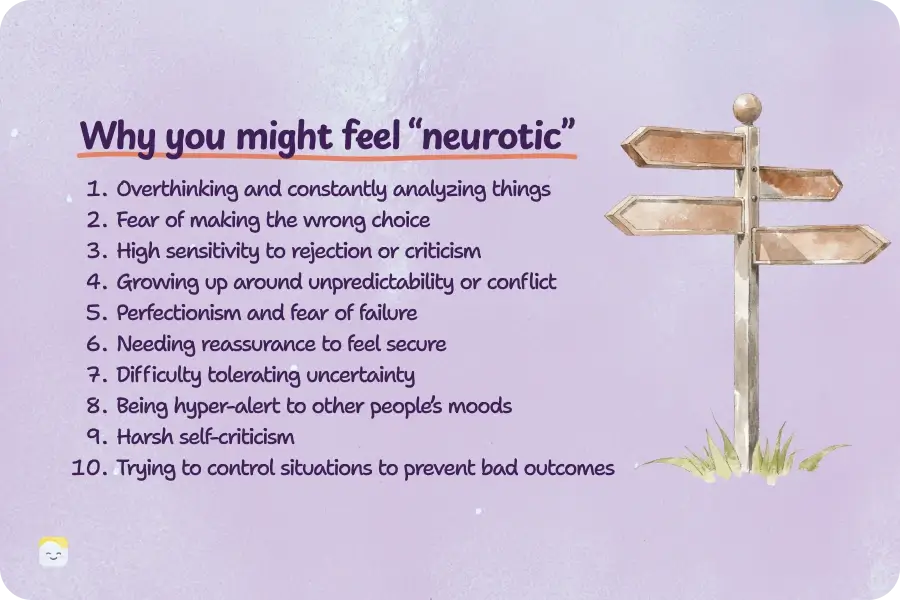
“Neurotic” isn’t really a diagnosis. It is an everyday word for negative thought patterns such as excessive worrying, obsessive thoughts, insecurity, heightened sensitivity, emotional reactivity, and difficulty tolerating uncertainty. Here are possible reasons for these intense emotions:
1. You’re Trying to Control Uncertainty
It has long been assumed that anxiety developed partly as a survival mechanism [1] Brown VM, Price R, Dombrovski AY. Anxiety as a disorder of uncertainty: implications for understanding maladaptive anxiety, anxious avoidance, and exposure therapy. March 2023 . Being alert to potential danger can be useful. The problem is that the brain also reacts to possible danger, asking, “Could something bad happen?”
The anxious mind tries to solve this problem by thinking harder. It believes, “If I analyze this enough, I’ll eventually know what to do.” Unfortunately, thinking cannot always produce certainty. As a result, you’re experiencing emotional exhaustion but not necessarily more certainty.
Having panic attacks or feeling emotionally unstable? Take a test to understand the reasons for your anxiety and improve your emotional regulation.

2. You Doubt Your Own Decisions
Another common sign of neuroticism is seeking reassurance. For example, you are deciding whether to accept a new job:
- You make a list of pros and cons.
- You imagine yourself accepting the job and regretting it.
- Then you imagine staying and regretting that.
- You ask three friends. Their answer reassures you.
- Then the doubt returns, and you change your mind.
- Eventually, you wonder whether asking your friends was itself a mistake.
This can create a cycle: Doubt → reassurance → temporary relief → new doubt.
3. You’re a Perfectionist
You may believe you should:
- always say the right thing
- make good decisions
- be productive
- be confident
- never embarrass yourself
- never waste time
- always know what you’re doing
- always have your negative emotions under control
The roots of perfectionism can sometimes be traced back to childhood. Overprotective parenting, adverse childhood experiences, or your attachment style can contribute to your sensitivity to stress and fear of making mistakes.
Take an imposter syndrome test to spot your perfectionist tendencies. In the Breeze app, you’ll find a variety of tests that will give you insights into your personality, childhood, career, and relationships.
4. You’re Hyperaware of Other People’s Reactions
Another sign of neuroticism is monitoring other people’s tone, facial expression, and body language. As a result of this hypervigilance, you always notice how quickly someone responds or whether they seem enthusiastic.
However, a person can be quiet because they’re tired, angry, distracted, or thinking about something completely unrelated. You don’t have enough information to know. But people with neurotic personality traits tend to interpret negative feelings more strongly.
Want to learn more about your personality type? Take a quick personality assessment to gain insights into your behavior patterns and negative reactions to create a more balanced life.

5. You Replay Conversations to Prevent Rejection
You meet someone new and have a pleasant conversation. Later that evening, instead of remembering the enjoyable parts, you remember one awkward sentence or a slight moment of disconnect.
You may wonder:
- “Why did I say that?”
- “Why did I laugh?”
- “Was that answer weird?”
- “Did I talk too much?”
- “Should I have asked them a question?”
- “Why did they look away?”
In this case, the underlying fear is rejection. Your brain is reviewing the interaction because it believes that understanding exactly what went wrong will help you avoid rejection next time.
6. You Believe Worry Prevents Bad Things
People with a high level of neuroticism may believe, “If I think and prepare well for every possible problem, I’ll be ready.” However, worry and preparation are not the same thing.
For example, you’re going on vacation.
7. You’re Avoiding Negative Emotions
According to science, overthinking can sometimes be a form of emotional avoidance [2] Hofmann SG, Hay AC. Rethinking avoidance: Toward a balanced approach to avoidance in treating anxiety disorders. March 2018 . Instead of actually feeling sadness, embarrassment, fear, or disappointment, you analyze it. Your mind is looking for a reason because it creates the illusion of control.
For instance, if someone rejects you, you spend days analyzing their behavior.
- “Maybe I should have waited longer to reply.”
- “Maybe I wasn’t attractive enough.”
- “Maybe I said too much.”
- “Maybe if I’d acted differently…”
8. Your Thoughts Can Become Self-Reinforcing
The more attention you give an anxious thought, the more important it can start to feel. For example, you worry that you made a mistake. You check your email five times. Nothing bad has happened, and you feel relieved. But the next time you make a mistake, your brain remembers: “Checking helped last time.” So you check again.
The behavior becomes a habit and creates a cycle: Thought → anxiety → checking → temporary relief → stronger attention → thought returns.
How to Stop Being Neurotic
If you often wonder, “Why do I think so much?” the question may be, “Why do I feel unable to trust myself unless I am completely certain?” If you trust yourself, you don’t need to predict everything. You can say something awkward and move on. Or, you can disappoint someone without assuming you’ve destroyed the relationship.
Here’s what you can do to better tolerate uncertainty and become less neurotic:
1. “3 realistic ways” exercise
To reduce your neurotic tendencies, you may need to learn that you could make a mistake and believe, “I’ll deal with it.” Think of a decision you’re currently worried about making. Write down what you fear might go wrong, and then ask yourself, “If I make the wrong choice, how could I handle it?”
Imagine you have been offered a new job. Instead of trying to be completely certain about offering it, write down what you are actually afraid of:
| What could go wrong? | “If that happens, how could I handle it?” |
| “I could accept the job and end up unhappy. I might regret quitting my current position.” | 1. Talk to my manager and try to improve the situation. 2. Give myself time to adjust before deciding that the job isn’t right for me. 3. If it doesn’t work out, I could try going back to my old job or taking a part-time job my friend told me about. |
Use Breeze journaling to identify triggers for your neurotic behaviors and create the habit of finding realistic ways you could cope. If you regularly use Breeze Wellbeing to record and briefly explain your feelings, you will become more emotionally resilient and feel entirely in charge of how you react to stress.

2. S.M.A.R.T. goals
As avoidance can be a neurotic symptom, try reframing anxious thoughts into manageable steps to create a sense of progress:
- Pick an activity you’ve been avoiding due to neurotic behavior.
- Break it down into S.M.A.R.T. goals (Specific, Measurable, Achievable, Relevant, Time-bound).
For example, if you’re worried that something bad might happen during a trip, check your route, make a simple plan, pack what you need, and focus on getting to the next step.
3. S.T.O.P. technique
This exercise teaches you that you don’t have to figure everything out to be okay or to let go of some of the worrying. The next time your brain starts creating a complicated story, try the following practice:
- Stop: Pause what you are doing.
- Take a breath: Ground your nervous system.
- Observe: Is there an actual problem I need to solve, or am I trying to make uncertainty disappear?”
- Proceed: Move forward with an action that helps, not a thought that hurts.
4. Work on your self-esteem
To become the best version of yourself and tolerate negative emotions, work on the following exercise at least 30 minutes daily:
- At the end of each day, write down one decision you made and handled well, even if the outcome wasn’t perfect. Eventually, you’ll have evidence that you can trust yourself and cope with mistakes.
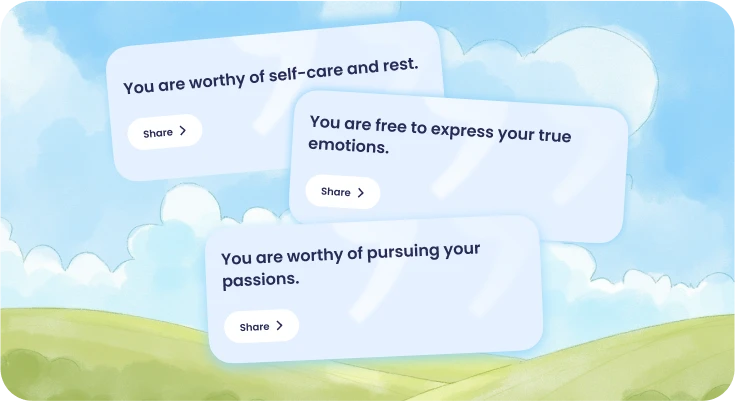
- Try positive affirmations like
- “Not every thought requires action or attention.”
- “I can trust myself, even when I’m unsure.”
- “I can make a decision and accept that it might be imperfect.”
You can try personalized daily affirmations in the Breeze app to reduce neurotic behavior and improve your overall mental health.
5. Discuss your neurotic tendencies with a mental health professional
If worrying or overthinking is affecting your daily life, making it difficult to sleep, work, study, maintain relationships, enjoy yourself, or function normally, talking to a mental health professional can be helpful. Sometimes understanding why your brain works this way is the first step toward changing the pattern.
Cognitive behavioral therapy (CBT) can help you describe mental and emotional instability, identify negative thought patterns and physical symptoms, and explore issues such as low self-esteem.
In some cases, neurotic tendencies may be linked with conditions such as personality disorders, mood disorders, generalized anxiety disorder, eating disorders, or depressive disorders.
Expert Insight
Neurotic tendencies can often coincide with anxiety disorders. They may also coexist with OCD, eating disorders, and ADHD. That said, neurotic tendencies exist on a large spectrum, and they do not inherently mean someone has a mental health condition.

Nicole Arzt
Mental health professional
Frequently asked questions
1. Is being a neurotic personality the same as having anxiety?
Not exactly. “Neurotic” is an informal word for things like overthinking, constant worry, insecurity, and being emotionally reactive. Anxiety is a broader term and can sometimes become a mental health condition. Being a person who worries a lot doesn’t mean you have an anxiety disorder.
2. How do I become less neurotic?
To reduce excessive neuroticism, work on managing emotions. Notice your physical reactions, try to stay in the present moment, and learn to interpret ordinary situations more realistically. Seek therapy to develop healthy coping strategies and improve emotional stability.
3. Can neurotic behavior ever be a good thing?
Yes. People who worry and think deeply can also be careful, observant, responsible, empathetic, and good at noticing potential problems in everyday life. They may become skilled leaders and highly attuned friends or partners.
4. Will I ever stop being a neurotic person?
Probably not completely, and that’s okay. The goal is to learn to regulate your emotional responses so they no longer control your behavior, decisions, or overall life satisfaction.
5. Why do I worry about things that haven't happened?
Because your brain is concerned about your survival and trying to prepare you for possible negative outcomes. The problem is that it doesn’t always know when to stop. Neurotic people tend to turn a little possibility into a whole imaginary scenario. For example, “What if I’m late?” can quickly become “What if they get angry and don’t want to see me again, and now I’ve ruined everything?”
Sources
- Brown VM, Price R, Dombrovski AY. Anxiety as a disorder of uncertainty: implications for understanding maladaptive anxiety, anxious avoidance, and exposure therapy. March 2023
- Hofmann SG, Hay AC. Rethinking avoidance: Toward a balanced approach to avoidance in treating anxiety disorders. March 2018
- Suma P. Chand; Daniel P. Kuckel; Martin R. Huecker. Cognitive Behavior Therapy. May 2023
Disclaimer
This article is for general informative and self-discovery purposes only. It should not replace expert guidance from professionals.
Any action you take in response to the information in this article, whether directly or indirectly, is solely your responsibility and is done at your own risk. Breeze content team and its mental health experts disclaim any liability, loss, or risk, personal, professional, or otherwise, which may result from the use and/or application of any content.
Always consult your doctor or other certified health practitioner with any medical questions or concerns
Breeze articles exclusively cite trusted sources, such as academic research institutions and medical associations, including research and studies from PubMed, ResearchGate, or similar databases. Examine our subject-matter editors and editorial process to see how we verify facts and maintain the accuracy, reliability, and trustworthiness of our material.
Was this article helpful?