

How many times have you spent $200 an hour on an expert analyzing your childhood trauma, only to walk out with the exact same knot in your stomach? You’re not alone. 25% of people who have ever tried therapy admitted they didn’t feel any considerable benefits from it [1] What is Psychotherapy? Vedrana Hodzic. American Psychiatric Association. July 2026. .
Maybe you don’t click with talk therapy or need more time to find your approach. In the meantime, you can support your well-being with these 21 complementary and alternative therapies. Find the alternative healing just for you with a free quiz.

21 Alternative Mental Health Therapies by Type
Disclaimer: The alternatives to therapy in this article are for educational purposes and should not replace necessary medical or mental health care. Besides therapy, there are also practices that can support mental well-being but are not considered mental health treatment.
Some of the practices offered below come with safety considerations and can only be practiced under professional guidance. If your mental health symptoms interfere with daily life or involve thoughts of harming yourself or others, seek professional support or emergency services.
Body-Based Therapy
Best for: Relieving nonverbal trauma symptoms, reducing stress, improving emotional regulation and self-esteem, and releasing chronic tension in the body.
1. Physical exercise
Exercise is one of the best-supported alternatives to therapy for improving mental health symptoms. It has been proven to [2] Effectiveness of physical activity interventions for improving depression, anxiety and distress: an overview of systematic reviews. B. Singh, T. Olds, R. Curtis, D. Dumuid, R. Virgara, A. Watson, K. Szeto, E. O’Connor, T. Ferguson, E. Eglitis, A. Miatke, C. Simpson, C. Maher. British Journal of Sports Medicine. February 2023. :
- Improve depressive symptoms in 43% of studies.
- Reduce anxiety symptoms in 42% of studies.
- Reduce stress in 60% of studies.
Any type of physical movement—walking, running, cycling, dancing, swimming, etc.—can be this beneficial. You just have to raise your heart rate 50% to 85% of your maximum for about 30 minutes three times a week and actually enjoy it.
2. Yoga therapy
Yoga isn’t only about movement. As in complementary and alternative therapy, yoga combines movement, breathwork, and mindfulness.
Yoga practices reconnect the mind with the physical sensations stored in the body. And since trauma symptoms often “hide” in the body, yoga helps address these subconscious mental health issues at their core, especially when you can’t put your symptoms into words.
3. Massage
When mental health problems are non-verbal, they might still show up in the feeling that your body simply won’t relax: tight shoulders, muscle tension, headaches, etc.
In such cases, massage is used as a complementary therapy alongside talk therapy. Massage works by promoting complete muscle relaxation and reducing physical pain and stress.
4. Emotional freedom techniques (Tapping)
Emotional Freedom Techniques (EFT), or tapping, commonly called tapping, works like this:
- Pick a specific feeling or problem (e.g., “work stress”) and rate its intensity from 0 to 10.
- Rephrase the problem into a phrase that acknowledges it: “Even though I have this [issue], I deeply and completely accept myself.”
- They rephrase a symptom into a phrase that acknowledges the problem.
- Use two fingertips to tap the 8 meridian points.
- Repeat tapping 5-7 times per point.
- Take a deep breath and re-rate your stress from 0 to 10. Repeat the sequence until the number drops to a level you feel comfortable with.
Although it sounds unusual, tapping has shown promising results for treating depression [3] The Effectiveness of Emotional Freedom Techniques for Depressive Symptoms: A Meta-Analysis. J. W. Seok and J. U. Kim. Journal of Clinical Medicine. October 2024. . EFT works because it replaces shame with acceptance and uses cognitive restructuring, cognitive behavioral therapy’s (CBT) approach. On a physical level, it relaxes and helps the body to feel safe with itself.

Connection-Based Therapy
Best for: Loneliness, social isolation, internalized shame, traumatic experiences, and emotional balance.
5. Animal-assisted therapy
Animal-assisted therapy means spending time with an animal, usually trained to ease anxiety and build a connection with people. The most common types of animal-assisted therapy are:
- Canine therapy
- Equine-assisted therapy
- Farm animal therapy
- (Personal) pet therapy
Animals are nonjudgmental beings. It’s much easier to build a connection with them, especially if you find it difficult to trust people.
When people interact with animals, the increased production of oxytocin and serotonin helps replace stress hormones. With a better mood and calmer overall state, it’s easier to deal with lasting mental health conditions like anxiety, depression, or post-traumatic stress disorder (PTSD).
6. Support groups
Support groups bring together people who have had similar, often traumatic, experiences.
But why does peer support work? When you meet with others, you see that you’re not alone in the problem that made you feel weird, isolated, ashamed, etc. This makes it easier to trust others and accept yourself.
The group therapy for you depends on the concern you experience. The common topics are grief, addiction recovery, loneliness, war/natural disaster survival, mental health disorders, aging, or becoming a new parent.
7. Volunteering
By helping someone, a person instantly receives a sense of purpose. This serves as proof that your existence, your skills, and your abilities matter somewhere.
So, more research shows that volunteering reduces loneliness and supports emotional well-being, provided you choose it willingly and do something meaningful to you [4] Understanding the effects of volunteering on well-being: subjective, psychological, and social well-being, gratitude, and loneliness. E. Shdaifat, A. Alotaibi, A. Alshowkan, A. AlKhunaizi, F. Abu-Sneineh. BMC Public Health. November 2025. .
Digital Therapy
Best for: Everyday stress, low mood, improving coping skills, reframing negative thinking, habit/mood tracking, emotional regulation, and improving self-esteem.
8. Mental Health Apps
Modern mental health apps have been found to reduce symptoms of anxiety, depression, stress, and eating disorders [5] Characteristic of mental health app usage: a cross-sectional survey in the general population. S. Fürtjes, E. Gebel, H. Kische, K. Beesdo-Baum. BMC Public Health. December 2024. . However, these benefits depend on your specific request. In order for a mental health app to be effective, you have to choose it based on your personal need/problem:
- Breeze: Self-Discovery Buddy—best if you’re overwhelmed with emotions and mood tracking.
- FineMind—best for addressing negative beliefs and overthinking.
- Focus Friend—best for gamified focusing and dealing with procrastination.
So far, mental health apps are the best for timely support during a mental health crisis, which is the most critical period [6] Potential and Pitfalls of Mobile Mental Health Apps in Traditional Treatment: An Umbrella Review. J. Koh, G. Y. Q. Tng, A. Hartanto. Journal of Personalized Medicine. August 2022. . Apps are available 24/7. You don’t have to wait for an appointment. And they also reinforce healthy coping skills, the base of emotional well-being.
9. Psychoeducation
Psychoeducation normalizes emotions and reactions, which teaches self-compassion and reduces stress. Sometimes, learning why something is happening makes it feel somewhat less overwhelming. With knowledge of mental health, a person is better informed and can, hence, make better decisions about their life.
Psychoeducation can be in the form of:
- (E)-books
- Podcasts
- Psychology influencers with official qualifications
- Courses and personal plans
Important: Psychoeducation might sometimes lead to intellectualization or guilt. For example, someone might understand a problem but still feel bad about it. So, it works best when paired with active practice of coping mechanisms or appropriate mental health treatment.
10. VR Exposure Therapy
Virtual Reality Exposure Therapy (VRET) is a type of exposure therapy that uses virtual reality. In VRET, a mental health professional gradually introduces you to the situations you’re anxious about through VR play therapy.
How does it work? VR creates an environment where you know you’re safe. But your brain still gets used to new scenarios you’d never tried in real life. Except now, you can practice new reactions and build new neural connections.
This is why VRET is repeatedly called one of the most effective alternative treatments for anxiety and phobias [7] Virtual reality exposure therapy for anxiety and related disorders: A meta-analysis of randomized controlled trials. E. Carl, A. T. Stein, A. Levihn-Coon, J. R. Pogue, B. Rothbaum, P. Emmelkamp, G. Asmundson, P. Carlbring, M. B. Powers. Journal of Anxiety Disorders. January 2019. . However, it can only be practiced under the guidance of a mental health professional.
Lifestyle & Mindset Change
Best for: Reaching emotional balance, improving both physical and mental health, creating stable routines, and dealing with lasting symptoms of trauma.
11. Healthy lifestyle
A healthy mind in a healthy body. This is not just a quote from a Roman poet but something that is actually proven by research. To be mentally healthy, the body should be nourished, rested, and feel that it’s in control.
12. Positive thinking
Don’t confuse positive thinking with toxic optimism. Positive thinking is about balancing optimism with objective problem-solving through:
- The acceptance of the situation as it is.
- Emotional awareness.
- Acceptance of any emotions, regardless of whether they are “good” or “bad.”
- Optimism and a focus on positive aspects rather than just negative ones.
Example of positive thinking: “Everything is going wrong.” → “This is difficult, but I’ve already dealt with difficult situations, so I will also do what’s in my power.”
13. “Do it for the plot”
The “do it for the plot” mindset is rooted in narrative psychology: seeing your life as a plot or a story to make sense of your experiences.
“Do it for the plot” is a free coping strategy. This works because you return control over your life into your own hands instead of feeling like a passive victim of circumstance.
Art and Creative Therapy
Best for: Dealing with subconscious signs of trauma, dealing with certain mental health concerns, reducing perfectionism, practicing self-compassion, and improving sense of identity.
14. Creating something (art therapy)
Art therapy is a form of established psychotherapy. Thanks to creating something and entering a “flow state,” art therapy helps to express suppressed emotions and enhance personal identity.
Why does simply creating something help with mental health? Creative tasks engage brain regions responsible for memory and emotion processing. Moreover, engaging in a “flow state” has a similar stress-relieving effect to mindfulness.
In art therapy, skill doesn’t matter. It’s about your involvement and your emotional expression.
15. Journaling or writing therapy
Things usually sound much worse in your head. Journaling is such an effective alternative therapy because it helps to take a look at your thoughts from the outside.
Externalization, the process of putting internal feelings into external words, through writing down your feelings, is found to be effective against symptoms of anxiety, depression, and even PTSD [8] Efficacy of journaling in the management of mental illness: a systematic review and meta-analysis. M. Sohal, P. Singh, B. S. Dhillon, H. S. Gill. Family Medicine and Community Health. March 2022. .
The most common types of writing therapy are:
- Gratitude journaling
- Brain dumping
- Bullet journaling
- Expressive writing
16. Theater and other collective experiences
You know how some people cry in the theater, at school concerts, or even at football games? That heightened sense of connection and emotion that makes people cry in the moment of meaningful activities together is called “collective effervescence.” And this can be extremely beneficial for mental health.
Theater isn’t unique in creating this collective effervescence effect. You can also experience it at:
- Concerts
- Religious services
- Stadiums
- School performances
- Festivals
- Protests
Lack of belonging is one of the strongest risk factors for developing various mental health conditions. Collective experiences can reduce this risk.
“Some clients use intellectualization as a defense. They can explain their patterns with impressive insight, but talking about feelings keeps them at a safe distance from actually feeling them, so little changes.
Bottom-up approaches like movement, mindfulness, and creative expression start with physical sensations and emotions rather than analysis, which can bypass that defense.
These practices complement therapy rather than repair it. Many therapists already blend both, using experiential and body-oriented models such as somatic experiencing, emotion-focused therapy, or IFS for exactly these clients.”
Spiritual Therapy
Best for: Emotional regulation, catharsis, loneliness, lack of meaning in life, depressive symptoms, and practicing self-acceptance.
17. Mindfulness and meditation
Mindfulness practices involve observing your thoughts and feelings in the present moment without judging them.
Unlike common myths, meditation practices don’t mean “not thinking.” Practicing mindfulness involves unconditionally accepting your current feelings. Not justifying them, not analyzing them, not judging either.
Other treatments rooted in mindfulness:
- Breathing techniques
- Body scan
- Mindfulness-Based Cognitive Therapy (MBCT)
- Progressive muscle relaxation
18. Connection with nature
People are biologically wired to seek nature and green environments. So much so that studies show that even 20 minutes in green spaces leads to stress reduction and a nervous system reset [9] Urban Nature Experiences Reduce Stress in the Context of Daily Life Based on Salivary Biomarkers. M. R. Hunter, B. W. Gillespie, S. Chen. Frontiers in Psychology. April 2019. .
When you can’t afford alternative mental health treatments, you can try one of these free/inexpensive outside activities:
- Gardening
- Daily 20-minute walks
- Grass sports, like badminton, frisbee, or volleyball
- Taking a lunch outdoors
- Geochacing
19. Faith
When a person believes in something larger than themselves, they also get meaning, hope, ritual, community, and identity. This is why faith is connected with a lesser risk of anxiety, depression, and suicidality [10] Impact of faith maturity on mental health and wellbeing. G. C. Adams, C. Bye, M. Alaverdashvili, S. Adams, H. G. Koenig. Religion, Brain & Behavior. November 2025. .
But faith ≠ religion. Being faithful means being connected to life and experiencing a sense of awe. You can practice spirituality in other ways if you’re not religious:
- Practicing mindfulness and meditation
- Cultivating awe
- Serving others (aka volunteering)
- Self-exploration
- Connect with nature
Experimental Therapy
Best for: extra support when treating mental health conditions, feeling emotionally stuck, and experiencing physical symptoms of trauma.
20. Hypnotherapy
Hypnotherapy is an established therapeutic practice that uses altered states of consciousness (trances) to shift your attention inward. In such states, you become more open to new experiences since your negative automatic reactions also “turn off.”
Hypnotherapy was shown to be effective in 54% of studies when it was used as a complementary therapy to treat mental health conditions [11] Meta-analytic evidence on the efficacy of hypnosis for mental and somatic health issues: a 20-year perspective. J. Rosendahl, C. T. Alldredge, A. Haddenhorst. Frontiers in Psychology. January 2024. .
Clinical hypnosis is APA-approved but can only be practiced with a licensed mental health specialist who is accredited by reputable registers, such as the GHR, NCH, or CNHC.
21. Light Therapy
Light therapy (phototherapy) is an evidence-based alternative therapy that involves sessions of sitting near a bright artificial light box.
How can sitting near a bright light improve mental health? Bright light simulates sunlight, which helps to configure circadian rhythms. Exposure to sunlight also naturally stimulates serotonin production, which improves mood.
Light therapy is used to help with insomnia, seasonal affective disorder (SAD), and severe symptoms of depression. It should be practiced only after consultation and approval by a qualified mental health specialist.
Which Alternative Therapy Is Better for Me? Quiz
With so many therapy alternatives, you might start wondering how to choose one. This quiz will help you find out which complementary healing method best meets your current mental needs.
Important: This quiz is for educational and entertainment purposes only. It doesn’t prescribe treatment. For more information about complementary and alternative medicine, refer to your GP or mental health practitioner.
Why Traditional Therapy May Not Work for Everyone
Traditional talk therapy can be life-changing, but a quarter of those who tried didn’t feel noticeable results [1] What is Psychotherapy? Vedrana Hodzic. American Psychiatric Association. July 2026. . Talk therapy may not work for the following reasons:
- It can be too expensive.
- It might be incompatible with schedules.
- Some people can struggle with verbalizing their experiences.
- A person didn’t like the modality.
- Finding a therapist who’s the right fit can take a few attempts.
- Some people can be retraumatized when recalling their painful memories.
- Unethical therapists may cross boundaries or commit malpractice.
- Being vulnerable in front of a stranger can feel intimidating.
- Mental health treatment might be inaccessible due to waiting lists or geographic barriers.
- Alternative therapies are a personal preference.
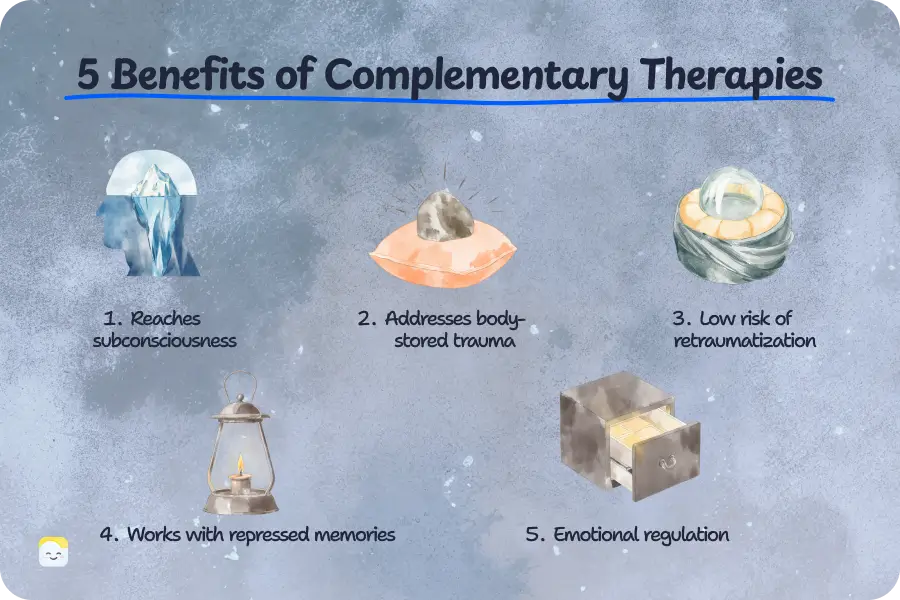
This is why there is a variety of alternative therapies that complement conventional treatment. They can reach even people who feel like they cannot be helped but who really haven’t found their mental reliance yet.
Is Non-Traditional Therapy Safe?
Yes, most non-traditional therapies are safe. Some approaches carry a higher risk of retraumatization, but they can only be used with a specialist’s approval.
There are a few safety considerations about alternative therapy, though:
How to Choose Alternative Therapies?
Here are some tips for finding a complementary and alternative therapy that will most likely work for you:
- Take our quiz to identify which category of alternative therapy may fit your needs and preferences.
- Consider your symptoms and triggers. Ask what tends to make you feel worse. Are there any environments/activities that trigger you, or anything that makes you feel more empowered and calmer?
- Define your goal/main problem. Depending on it, you might benefit from very different approaches.
- Research the practitioner or product. Review qualifications, safety standards, privacy policies, ingredients, and unrealistic treatment claims.
- Consider your health history, including medications and previous mental health conditions. Don’t quit any meds or practices without your doctor’s approval.
- Consult a mental health or healthcare professional if you’re unsure whether an approach is appropriate or safe.
- Get a prescription or professional supervision whenever the treatment requires or recommends it.
- Track how you respond. You don’t have to push through if your symptoms worsen. It’s okay to step back, re-evaluate, and, maybe, try a different method.
“Self-directed practices may be enough when concerns are mild, daily functioning is intact, and you notice improvement within a few weeks.
It’s time for professional support when symptoms last more than two weeks, get worse, or start to affect work, relationships, sleep, or self-care. It’s also time when you find yourself relying on a practice just to get through your day.
Any thoughts of suicide, self-harm, or harming others call for immediate help: call or text 988 or go to an emergency room. When in doubt, an assessment with a professional can clarify what level of care fits”
When to Look for “Traditional” Therapy
There are times when professional mental health treatment should take priority over alternative therapy. The direct indications for when it’s advisable to go for “traditional” therapy:
- You experience symptoms that limit your life and start to impact your mental and physical health.
- Your mental health affects your work, relationships, sleep, self-care, or daily functioning.
- You experience symptoms of psychosis, mania, severe depression, significant trauma, an eating disorder, or substance-use problems.
- You’re prone to self-harm or have thoughts about harming someone else.
- Alternative approaches haven’t helped, or symptoms keep returning.
- You have been previously diagnosed with mental health conditions.
You don’t necessarily need to give up your alternative therapy of choice, as long as it doesn’t do more harm than good, even if you need to be in traditional talk therapy. In fact, the professional care could only benefit from your motivation to be healthier and practice intentional self-care.
Frequently asked questions
What Are Alternatives to Therapy?
Alternatives to therapy are practices aimed at improving well-being outside conventional talk therapy. The common approaches of non-traditional therapy are mental health apps, mindfulness, lifestyle and mindset changes, music therapy, herbal remedies, etc. Although most therapy alternatives are safe, they cannot fully substitute professional help.
Who Can Benefit From Alternative Therapies?
Alternative therapies are good for people who are seeking extra ways to manage stress, mild emotional difficulties, loneliness, or overall well-being. Complementary and alternative therapies are also common among those who haven’t benefited from talk-based approaches. Where alternative therapies shine, though, is in complementing professional treatment.
What Are Some Alternatives to Therapy When You Can't Afford It?
One free way to improve your well-being is changing how you treat your body: get enough sleep, move more, and eat nutritious meals. The second free alternative to therapy is connecting with other people. Hanging out with friends is free, but if it’s unavailable to you, you can try (online) peer support, volunteering, or spending more time with animals.
People often choose to spend time in nature, journal, practice yoga, use mental health apps, practice mindfulness, or engage in the arts as free ways to support their mental well-being.
Sources
- What is Psychotherapy? Vedrana Hodzic. American Psychiatric Association. July 2026.
- Effectiveness of physical activity interventions for improving depression, anxiety and distress: an overview of systematic reviews. B. Singh, T. Olds, R. Curtis, D. Dumuid, R. Virgara, A. Watson, K. Szeto, E. O’Connor, T. Ferguson, E. Eglitis, A. Miatke, C. Simpson, C. Maher. British Journal of Sports Medicine. February 2023.
- The Effectiveness of Emotional Freedom Techniques for Depressive Symptoms: A Meta-Analysis. J. W. Seok and J. U. Kim. Journal of Clinical Medicine. October 2024.
- Understanding the effects of volunteering on well-being: subjective, psychological, and social well-being, gratitude, and loneliness. E. Shdaifat, A. Alotaibi, A. Alshowkan, A. AlKhunaizi, F. Abu-Sneineh. BMC Public Health. November 2025.
- Characteristic of mental health app usage: a cross-sectional survey in the general population. S. Fürtjes, E. Gebel, H. Kische, K. Beesdo-Baum. BMC Public Health. December 2024.
- Potential and Pitfalls of Mobile Mental Health Apps in Traditional Treatment: An Umbrella Review. J. Koh, G. Y. Q. Tng, A. Hartanto. Journal of Personalized Medicine. August 2022.
- Virtual reality exposure therapy for anxiety and related disorders: A meta-analysis of randomized controlled trials. E. Carl, A. T. Stein, A. Levihn-Coon, J. R. Pogue, B. Rothbaum, P. Emmelkamp, G. Asmundson, P. Carlbring, M. B. Powers. Journal of Anxiety Disorders. January 2019.
- Efficacy of journaling in the management of mental illness: a systematic review and meta-analysis. M. Sohal, P. Singh, B. S. Dhillon, H. S. Gill. Family Medicine and Community Health. March 2022.
- Urban Nature Experiences Reduce Stress in the Context of Daily Life Based on Salivary Biomarkers. M. R. Hunter, B. W. Gillespie, S. Chen. Frontiers in Psychology. April 2019.
- Impact of faith maturity on mental health and wellbeing. G. C. Adams, C. Bye, M. Alaverdashvili, S. Adams, H. G. Koenig. Religion, Brain & Behavior. November 2025.
- Meta-analytic evidence on the efficacy of hypnosis for mental and somatic health issues: a 20-year perspective. J. Rosendahl, C. T. Alldredge, A. Haddenhorst. Frontiers in Psychology. January 2024.
- Our Epidemic of Loneliness and Isolation. J. Holt-Lunstad. The Office of the Surgeon General. 2023.
Disclaimer
This article is for general informative and self-discovery purposes only. It should not replace expert guidance from professionals.
Any action you take in response to the information in this article, whether directly or indirectly, is solely your responsibility and is done at your own risk. Breeze content team and its mental health experts disclaim any liability, loss, or risk, personal, professional, or otherwise, which may result from the use and/or application of any content.
Always consult your doctor or other certified health practitioner with any medical questions or concerns
Breeze articles exclusively cite trusted sources, such as academic research institutions and medical associations, including research and studies from PubMed, ResearchGate, or similar databases. Examine our subject-matter editors and editorial process to see how we verify facts and maintain the accuracy, reliability, and trustworthiness of our material.
Was this article helpful?