

Feeling horrible about what you did at a young age, thinking, “How could I have behaved that way?” This article will help you address childhood guilt and regret.
If you’re wondering whether difficult childhood experiences may still be influencing your thoughts, emotions, or relationships today, take a childhood trauma test.

How to Deal with Childhood Guilt in Adulthood
Although childhood is supposed to be a carefree and happy time, children can also make serious mistakes, hurt others, break rules, lie, act impulsively, or behave in ways they later feel shame for.
Guilt and regret rarely disappear because we repeatedly tell ourselves to “stop thinking about it.” Fighting intrusive thoughts does not resolve them. A better way is to reflect on the experience without repeatedly analyzing it [1] American Psychiatric Association. Rumination: A Cycle of Negative Thinking. March 2020 .
1. Name exactly what you regret
Instead of thinking, “I’m terrible” or “I’ve ruined my life,” focus on identifying the specific behavior.
Ask:
- What exactly did I do?
- How old was I?
- What did I understand about the situation at the time?
- What did I not understand?
- Was I acting intentionally?
- What circumstances surrounded the behavior?
- What do I understand now that I didn’t understand then?
2. Separate responsibility from identity
You can take responsibility for something without letting it define your entire personality. Acknowledge it honestly: “I did something I regret. It affected someone. I wish I had acted differently. I understand more now than I did then. I can use what I’ve learned to become a kinder person today.”
Wondering whether rumination and replaying past events can be a sign of obsessive-compulsive disorder? Take an OCD test to learn whether you may be experiencing symptoms associated with OCD.

3. Ask what the regret can teach you
When regret becomes a lesson, it can help you become the best version of yourself. Perhaps the experience taught you to:
- treat people more carefully;
- think before acting;
- respect boundaries;
- apologize when necessary;
- protect vulnerable people;
- control impulses;
- recognize the consequences of your behavior.
Expert Insight
Sometimes a person will feel guilty about something from childhood and want to apologize to relieve their own guilt. That can sometimes be helpful, especially when it acknowledges the harm without expecting anything in return. But it can cross a boundary or reopen old wounds in some cases. Before contacting the person, think about how the apology might affect them. If it is not likely to benefit them and you’re mainly doing it to lessen your own guilt, it might be more helpful to talk to a mental health professional instead. A therapist can also help you decide whether contacting the person to make amends would be helpful.

Emily Mendez
Mental health professional
4. Don’t punish yourself as proof of remorse
You don’t have to turn regret into positivity immediately. Sometimes the healthiest response is simply: “Yes, I wish I hadn’t done that.” Remorse can be evidence that your values have developed.
However, sometimes people discover they use guilt as a form of self-punishment because they believe they don’t deserve to feel happy.
5. Talk about the memory
Childhood guilt may be more difficult to process when it remains a secret [2] Fine NB, Ben-Zion Z, Biran I, Hendler T. Neuroscientific account of Guilt- and Shame-Driven PTSD phenotypes. May 2023 . Sometimes saying the words out loud, such as “I did this when I was a child, and I still feel terrible about it,” can be the beginning of separating the past from the person you are today.
Talking to someone you trust can help you see the memory from a different perspective. A qualified mental health professional can also help if the memory causes distress, shame, anxiety, or intrusive thoughts.
Expert Insight
As we get older, we may naturally reflect on things from the past that we could have done differently. Sometimes old wounds resurface during periods of stress or change. If you have trouble sleeping because of thoughts about the past or you can’t seem to move on, it can be a good idea to contact a therapist.
Emily Mendez
Mental health professional
How Do I Forgive Myself for Childhood Mistakes?
You may look at your younger self as if they were a smaller version of your current adult mind. However, a child doesn’t possess the same:
- emotional regulation;
- life experience;
- impulse control;
- understanding of consequences;
- ability to recognize manipulation;
- perspective-taking abilities;
- independence;
- knowledge about relationships
that an adult has [3] Fan L, Kang T. Early childhood trauma and its long-term impact on cognitive and emotional development: a systematic review and meta-analysis. July 2025 . Here’s how you can practice self-forgiveness.
1. “Advice to the Child I Once Was” Exercise
Try imagining that a child you care about came to you and said, “When I was young, I did something awful. I’ve hated myself ever since.” Would you tell that child, “You deserve to hate yourself forever”? Probably not.
You would likely want to understand what happened, acknowledge the harm, help them learn, and remind them that they are more than their worst moment. Self-compassion asks you to extend this humanity toward yourself.
2. “Two Letters” Practice
Writing to your younger self creates distance between who you were then and who you are now. Instead of judging your childhood from an adult perspective, this exercise invites you to approach your younger self with curiosity and compassion.
1. Letter one. From your adult self to your younger self
Imagine the child you were sitting in front of you. You know everything you know now, but they do not. They are still learning to understand themselves, others, and the consequences of their choices.
Tell them what you wish they had known at the time. You might write about what you now understand about their situation, what they could not have understood then, or what you wish an adult had told them.
Try to acknowledge the things you regret without turning the letter into another punishment. You might begin with, “I know what you regret. I also know that you were still growing.”
Then continue in your own words. Tell them what you wish they had known about mistakes, responsibility, forgiveness, guilt, or being loved. If they were struggling with something you now understand differently, tell them that, too.
2. Letter Two: From Your Younger Self to Your Adult Self
Now reverse the exercise. Imagine that your younger self could see you today. They know what happened, but they can also see everything that came afterward. They can see the person you became, the things you learned, the relationships you built, and the ways you changed.
What might that child say to you? Write a second letter from their perspective.
Perhaps they would ask why you are still carrying something they did so many years ago. Or, they would tell you that they were scared, confused, or simply didn’t understand. Maybe they would ask you to stop being so hard on yourself.
Let the child’s voice be imperfect. You don’t need to force it to be positive or forgiving. If sadness, anger, confusion, or fear come up, allow those feelings to exist.
Where Does Childhood Guilt Come From?
Childhood guilt can develop from ordinary mistakes, family situations, school experiences, or the feeling of having disappointed someone.
The Effects of Childhood Guilt
Some guilt is completely normal. It teaches children that their actions have consequences and helps them recognize harm and learn how their actions affect others. It can also contribute to the development of empathy. A child who realizes that they have hurt a friend may feel guilty, apologize, and learn from the experience.
However, guilt becomes harmful when a child begins to believe that they are responsible for things they cannot control. Instead of thinking, “I made a mistake,” they may begin thinking, “I am a bad person.”
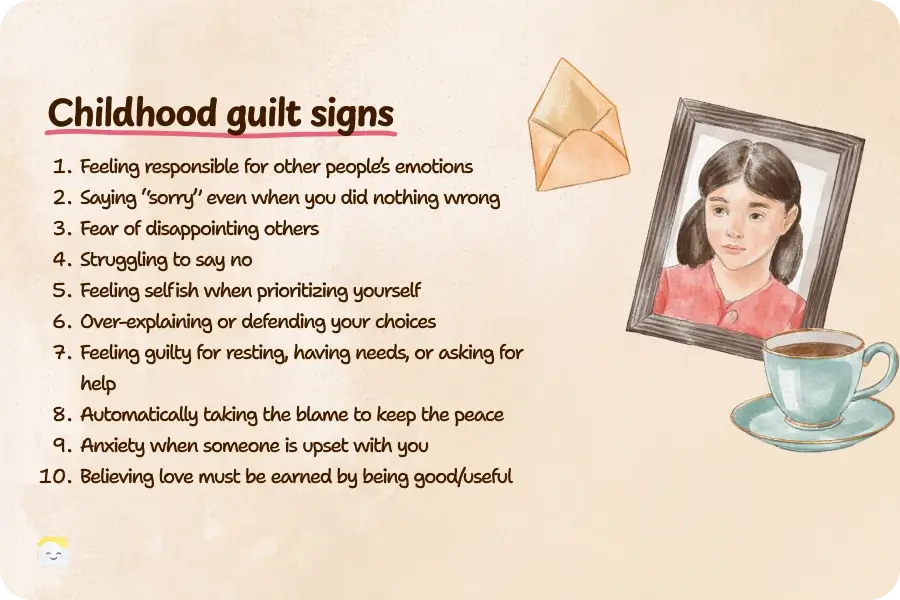
Adults who experienced excessive guilt as children may struggle with:
- Low self-esteem
- Fear of making mistakes
- Difficulty setting boundaries
- Constantly apologizing and people-pleasing
- Fear of disappointing others
- Overanalyzing and overthinking past mistakes
- Feeling responsible for other people’s emotions
When Childhood Guilt Becomes a Mental-Health Problem
Persistent guilt can sometimes occur alongside depression, anxiety, trauma-related conditions, obsessive-compulsive symptoms, or other mental health conditions. Consider seeking therapy if replaying your childhood mistakes:
- occupies a large part of your day;
- causes severe anxiety or depression;
- prevents you from enjoying your life;
- makes you believe you don’t deserve happiness;
- causes repeated compulsive checking or mental reviewing;
- leads to self-hatred or self-punishment;
- interferes with relationships;
- causes thoughts of harming yourself;
- It feels impossible to control, even though you know rationally that the event is in the past.
Frequently asked questions
1. I did something awful at a young age. How can I forgive myself for past mistakes?
Self-forgiveness means acknowledging what happened, understanding the context in which it happened, taking responsibility where appropriate, learning from it, and allowing yourself to grow beyond your worst mistake.
2. Is it normal to regret something I did as a child?
Yes. As people grow older, they may look back at childhood behavior with greater maturity, empathy, and understanding. This can create painful retrospective guilt. Remember, however, that your younger self did not have the same knowledge, emotional development, or perspective that you have today.
3. Does doing something bad as a child mean I am a bad person?
No. Firstly, children are still developing emotionally, socially, and neurologically. Their ability to anticipate consequences, regulate impulses, understand other people’s perspectives, and make mature moral judgments develops over time. Secondly, harmful action is not the same as a permanent identity. Your character is shaped by more than one moment in your life, including what you choose to do after recognizing a mistake.
4. Can I heal even if I cannot change what happened?
Yes. Healing can mean accepting that the past happened, grieving what you wish had been different, and choosing how you want to live now. You can carry the lessons of the past without carrying endless punishment.
5. When should I seek help for childhood guilt or regret?
Consider seeking professional support if guilt or shame is persistent, causes compulsive rumination, or makes you feel that you do not deserve happiness. If guilt leads to thoughts of harming yourself or feeling unable to stay safe, seek immediate help from emergency or crisis services in your area.
Sources
- American Psychiatric Association. Rumination: A Cycle of Negative Thinking. March 2020
- Fine NB, Ben-Zion Z, Biran I, Hendler T. Neuroscientific account of Guilt- and Shame-Driven PTSD phenotypes. May 2023
- Fan L, Kang T. Early childhood trauma and its long-term impact on cognitive and emotional development: a systematic review and meta-analysis. July 2025
Disclaimer
This article is for general informative and self-discovery purposes only. It should not replace expert guidance from professionals.
Any action you take in response to the information in this article, whether directly or indirectly, is solely your responsibility and is done at your own risk. Breeze content team and its mental health experts disclaim any liability, loss, or risk, personal, professional, or otherwise, which may result from the use and/or application of any content.
Always consult your doctor or other certified health practitioner with any medical questions or concerns
Breeze articles exclusively cite trusted sources, such as academic research institutions and medical associations, including research and studies from PubMed, ResearchGate, or similar databases. Examine our subject-matter editors and editorial process to see how we verify facts and maintain the accuracy, reliability, and trustworthiness of our material.
Was this article helpful?